
AI platforms are already influencing which businesses get attention, trust, and leads. The frustrating part is that most companies still treat AI visibility like a magic trick, when it behaves more like a stricter version of search. These AI tools do not pick brands randomly. They look for sources they can verify, cross-check, and confidently reuse.
This AEO optimization guide and AI SEO checklist turn your notes into one workflow you can follow. It is practical, repeatable, and designed to help you win citations and brand mentions across ChatGPT, Perplexity, Gemini, Claude, Grok, DeepSeek, Manus, and Google AI Overviews.
You will not see gimmicks here. You will see the exact moves that make your business easier to trust, easier to cite, and harder to ignore.
AI Search Behaves Like Local Search
Start with one mental shift that changes everything.
AI answers are typically built on top of:
- Traditional search results
- Maps and local data sources
- Third-party citations and mentions
- Structured pages that answer questions clearly
So your job is not to chase prompts. Your job is to win in the information layer that feeds the answers.
Use this filter before you build any AI SEO plan.
High-value targets are questions where the tool can suggest:
- A business
- A service provider
- A best option list
- A comparison with a recommendation
- A local solution
Lower-value targets are questions that only return generic education, with no need to mention a provider.
AI Search Optimization Checklist 2026
| AI SEO Growth Layer | What to Optimize |
|---|---|
| 1. Entity Foundation | • Define exactly who you are • Keep brand name consistent everywhere • Create strong About, Contact, and team pages • Maintain identical business details across platforms • Build recognizable brand identity |
| 2. Search Intent Alignment | • Create content based on what users actually ask • Map informational, comparison, and transactional intent • Match content to the customer journey instead of keywords only |
| 3. Answer First Content Structure | • Start pages with direct answers in the first 40–60 words • Expand with supporting context • Make content easy to extract and summarize |
| 4. Topic Authority Building | • Build topic clusters instead of isolated pages • Connect pillar pages and supporting content • Cover related questions comprehensively |
| 5. Content Quality Signals | • Publish original insights • Include practical examples • Remove fluff • Demonstrate expertise and experience • Refresh outdated information |
| 6. Trust & Credibility Signals | • Show credentials, testimonials, certifications, awards, media mentions, client proof, and transparent business information |
| 7. Google Business & Local Presence | • Optimize Google Business Profile if applicable • Maintain accurate hours and services • Add images, updates, FAQs, and reviews |
| 8. Review & Reputation Management | • Generate reviews consistently • Respond to all reviews • Monitor sentiment • Build reputation across trusted platforms |
| 9. Structured Data Layer | • Implement Organization schema • FAQ schema • Article schema • LocalBusiness schema • Service/Product schema where relevant |
| 10. Technical Crawlability | • Ensure HTML-rendered content • Clean URL structure • XML sitemap • Proper canonicals • Fast response time |
| 11. AI Extraction Readiness | • Use clear headings • Short paragraphs • Lists where helpful • Strong semantic relationships between sections |
| 12. Conversational Search Optimization | • Optimize for natural language queries • Include “how,” “why,” “what,” and comparison searches • Write the way users speak |
| 13. Internal Linking System | • Connect related pages naturally • Build topical pathways • Improve content discoverability |
| 14. Multi-Format Content Expansion | • Support text with visuals, videos, graphics, and examples • Repurpose content across channels |
| 15. Visual Search Optimization | • Use original images • Optimize filenames and alt text • Add diagrams and educational visuals |
| 16. Content Freshness Engine | • Update statistics, examples, screenshots, pricing, and references regularly |
| 17. Brand Mention Expansion | • Earn mentions through partnerships, guest content, PR, podcasts, directories, and collaborations |
| 18. User Experience Optimization | • Improve readability • Simplify navigation • Reduce friction • Increase time on page |
| 19. Mobile First Experience | • Optimize loading speed • Ensure excellent mobile UX • Simplify forms and interactions |
| 20. Engagement Signals | • Increase clicks, saves, scroll depth, return visits, branded searches, and interaction |
| 21. Conversion Layer | • Add clear CTAs • Reduce decision friction • Improve lead paths and trust near actions |
| 22. Measurement & Attribution | • Track rankings, AI traffic, conversions, engagement, branded searches, and customer outcomes |
| 23. AI Reputation Layer | • Monitor how your brand appears in AI platforms • Strengthen authority signals that AI systems reuse |
| 24. Distribution & Discovery | • Publish where audiences already exist • Expand beyond your website into communities and external platforms |
| 25. Continuous Optimization Loop | • Audit monthly • Improve what performs • Remove thin content • Double down on winning topics |
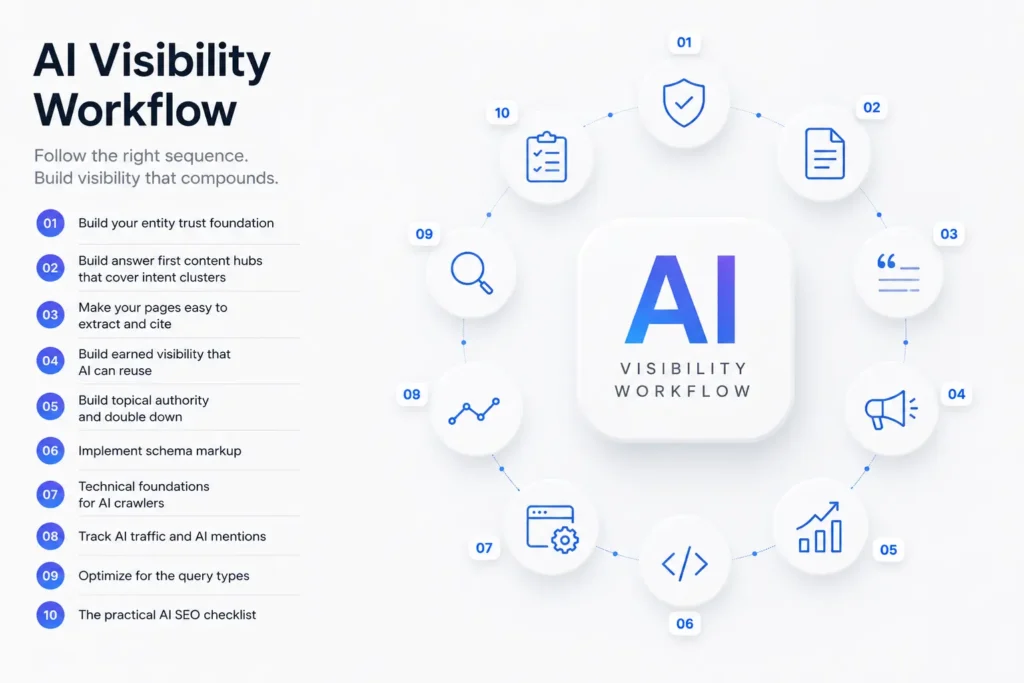
AI SEO Visibility Workflow That Compounds
Most teams lose time because they do the steps out of order. Use this sequence.
Step 1: Build your entity trust foundation
Step 2: Build answer first content hubs that cover intent clusters
Step 3: Make your pages easy to extract and cite
Step 4: Build earned visibility that AI can reuse
Step 5: Build topical authority and double down
Step 6: Implement schema markup
Step 7: Technical foundations for AI crawlers
Step 8: Track AI traffic and AI mentions
Step 9: Optimize for the query types
Step 10: The practical AI SEO checklist
That is the full system. Now we break each step into clear actions.
Step 1: Build Strong Entity Trust
Entity trust is the gatekeeper. If AI cannot confidently validate your business identity, it will hesitate to recommend you even if your content is good.
Entity trust checklist
Make sure your business looks consistent across the places AI checks most often.
- Your business name is the same everywhere
- Your core services are described using consistent language
- Your locations and service areas are consistent
- Your phone number and website match across profiles
- Your About page clearly states who you are and what you do
- Your contact information is visible and crawlable
Platform presence checklist
AI tools draw from many sources, but these are the ones that repeatedly appear as supporting evidence.
- Google Business Profile
- Bing Places
- Apple Maps and Apple Business Connect
- Major directories relevant to your market
- Industry-specific directories
- Review platforms used in your category
- Social profiles with consistent naming and service descriptions
Website context checklist
Your website needs to make your identity obvious in plain language, not buried in marketing copy.
- A clear About page with real business context
- Service pages that define what you do in specific terms
- Location or service area language that matches your profiles
- Organization schema and LocalBusiness schema that reflect your real details
The goal is simple. When an AI system cross-checks your brand across the web, it sees the same story repeated with no contradictions.
Step 2: Build Topic Cluster Pages
Single-question pages almost always turn into thin content. AI prefers pages that cover a full subject area with connected questions, because it can pull multiple answers from one source.
Think in clusters that mirror how people actually ask.
Cluster building checklist
For each service topic, build a single strong page that addresses dozens of related questions.
- Start with a core topic like emergency service in a city or the best provider in an area
- Add question variations that signal business selection intent
- Include cost questions, timing questions, and trust questions
- Cover follow-up questions on the same page so the content stands alone
High-value question patterns to prioritize
These are the question styles that most often trigger brand inclusion.
- Who is the best provider for
- Which company offers
- Top-rated service near me
- Is there a reliable service in a specific city
- What is the cost of service in a specific area
- How fast can a provider respond
Avoid building content for questions that never lead to provider recommendations.
Step 3: Write Answer-First Content for AI Extraction
This is where most content fails. It ranks, but it is not cited because the answer is buried.
The fix is a simple structure rule.
Under each question heading, place a short, direct answer first. Then expand.
Answer-first writing checklist
- Use question-style headings for the sections
- Answer in the first few lines using clear definitions
- Expand with context, steps, examples, and decision factors
- Anticipate follow-up questions and answer them nearby
- Keep headings specific so sections can stand alone
Extraction-friendly formatting checklist
AI tools pull small chunks. Your content must be chunkable.
- One clear topic per section
- Short paragraphs that do not ramble
- Lists only when they improve clarity
- Definitions written as a clean sentence
- Steps written as a simple sequence
A good section feels like something a human would quote because it is crisp and complete.
Step 4: Build Citable Credibility Signals
Owned content helps you win specific questions. Earned mentions help you win broad questions, especially in best-in-city-style prompts.
AI models often trust third-party sources more than a brand talking about itself.
Earned visibility checklist
Focus on sources that AI frequently reuses.
- Local news sites and community publications
- City blogs and neighborhood sites
- Industry local organizations
- Local partnership pages and sponsor pages
- Best of listicles and roundups
- Podcasts and interviews with your name and context
- Expert quotes in relevant articles
When you get mentioned, make sure the mention includes clear context about what you do and where you operate. That context is what makes the mention reusable.
Link-building rule that aligns with AI
Quality and relevance beat volume.
- Pursue industry-relevant placements where a mention makes sense
- Do not ignore nofollow mentions from authoritative publications
- Prioritize branded mentions even when there is no link
- Avoid unrelated sites that break topical trust
Step 5: Build Strong Topical Authority
Across many sites, the pattern is consistent. Strong topical authority and visible trust signals are the sites that keep getting cited.
This is why clusters beat isolated posts.
Topical authority checklist
- Build one pillar topic and publish supporting articles around it
- Connect the cluster with internal links that make sense to humans
- Remove irrelevant content that confuses your topical focus
- Update key pages regularly so facts do not go stale
When your site becomes the definitive resource, AI has a safer reason to cite you.
Step 6: Use Meaningful Schema Markup
Schema is not a ranking trick. It is a language layer that helps systems understand who you are and what the page represents.
Practical schema checklist
Use only what matches the page.
- Organization schema
- LocalBusiness schema
- Article schema for blog posts
- FAQ schema for genuine question sections
- Review the schema only when you display real reviews properly
- Breadcrumb schema for navigation clarity
Then validate it with a schema validator and fix errors. A broken schema is worse than no schema.
Step 7: Ensure AI-Friendly Technical Foundations
AI visibility often fails for boring reasons. The content exists but is hard to crawl, load, or render.
Crawl and indexing checklist
- Robots file does not block major crawlers
- Pages return a clean 200 status
- Pages are indexable and not hidden behind scripts
- XML sitemap is accurate and updated
- Important pages are reachable within a few clicks from the homepage
Rendering checklist
Many AI crawlers struggle with heavy client-side rendering.
- Text content should appear in the page source
- Headings and paragraphs should be in HTML
- Critical content should load server-side
Performance checklist
Speed does not replace relevance, but it can limit crawl depth.
- Fast server response time
- Mobile experience is smooth
- No broken links and no messy redirect chains
Step 8: Track AI Traffic and Mentions
Do not obsess over AI rankings. Track inclusion and outcomes.
Your best KPIs are leads and conversions that originate from AI or are assisted by AI-driven brand exposure.
GA4 tracking checklist for AI referrals
Use this to see which AI tools are already sending traffic.
- Open GA4 Reports
- Go to Acquisition, then Traffic Acquisition
- Add a comparison for Referral and affiliates traffic
- Filter the Session source or medium using a regex match
- Include sources like ChatGPT, OpenAI, Perplexity, Gemini, Bard, and other AI referrers
- Apply the same comparison to Pages and screens to find which pages get AI clicks
This is where the strategy becomes obvious. The pages receiving AI traffic show you what AI tools already like. Expand those topics and strengthen those sections.
Visibility tracking checklist for AI mentions
Track how often you appear in answers, not just clicks.
- Pick a set of high-value prompts that your customers would ask
- Run variations of the same prompt across platforms
- Record whether you are mentioned and how you are framed
- Repeat monthly because answers change frequently
Keep it simple. You are measuring the share of answers and brand presence trends.
Step 9: Optimize for High-Intent Query Types
Not all AI queries are equal in terms of business visibility. Some queries never require fresh retrieval, so there are fewer citations.
Focus on prompts that force tools to compare options and recommend brands.
High-value prompt patterns
- Who are the best providers for a specific use case
- What are the best alternatives to a known brand
- Compare Brand A vs Brand B vs Brand C
- Which option is best for a specific requirement set
These patterns naturally surface businesses, tools, and providers.
Step 10: Monthly AI SEO Checklist
Use this as your monthly execution loop.
- Review AI referral traffic in GA4 and identify winning pages
- Add missing question headings and answer first blocks to those pages
- Update facts and clarify definitions on your most cited content
- Improve entity consistency across listings and social profiles
- Earn one new credible mention from a relevant third-party source
- Publish multiple supporting articles that strengthen a topic cluster
- Validate schema on key pages and fix errors
- Re-test a small set of priority prompts and record mention trends
This keeps momentum without chasing vanity tactics.
Common AI SEO Mistakes to Avoid
These issues keep popping up.
- Writing for keywords instead of intent-based questions
- Hiding the answer under long intros
- Publishing thin pages that do not stand alone
- Using inconsistent business details across the web
- Over-tagging schema that does not match the content
- Letting statistics and facts become outdated
- Building links and mentions from irrelevant sources
- Publishing random topics that dilute topical authority
AI systems reward clarity and consistency. They punish confusion.
Build the Source Layer, Answers Follow
The brands winning across AI platforms are not doing secret hacks. They are building a clean information footprint, publishing content that is easy to cite, and earning real-world trust signals that machines can verify.
If you want one takeaway, it is this.
Win the sources that feed the answers, and you will keep showing up even as platforms change.