
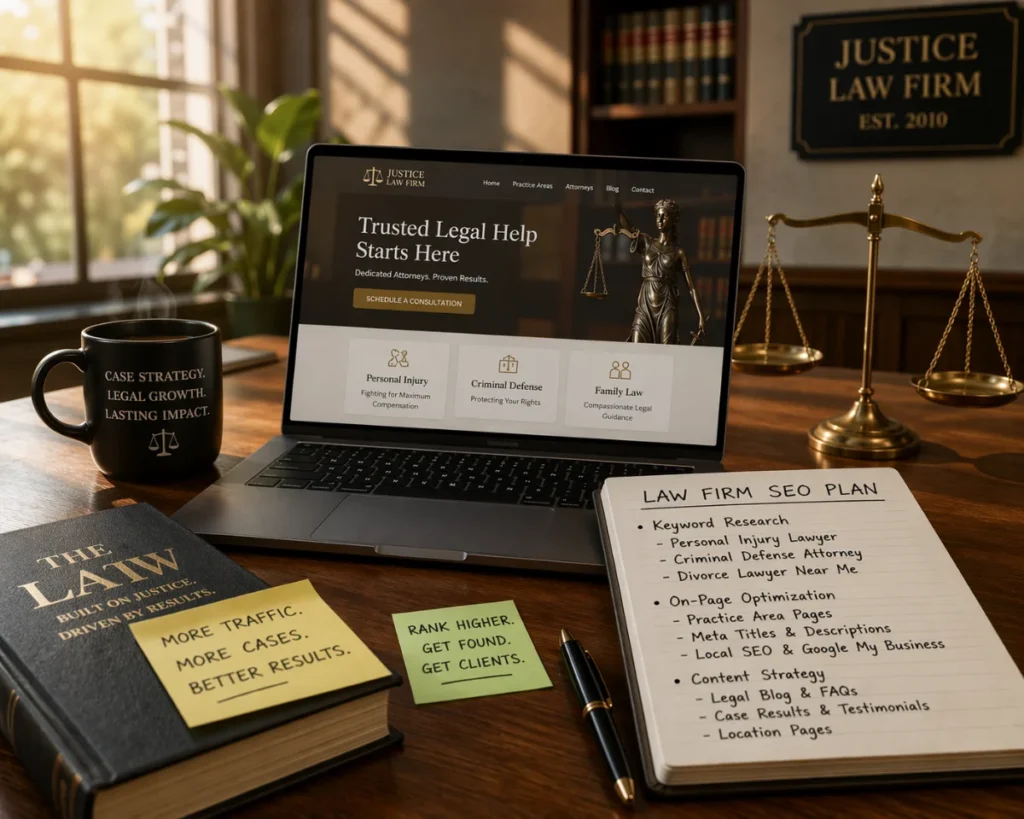
Legal search behavior in 2026 is urgent, high-stakes, and trust-driven.
When someone searches:
• “Personal injury lawyer near me”
• “Best divorce attorney in [city]”
• “Criminal defense lawyer urgent”
• “Immigration attorney consultation”
They are not browsing casually. They are facing stress, legal risk, or life-changing decisions.
That urgency makes local SEO for law firms different from most industries.
Ranking is not enough. Visibility must translate into immediate trust.
This guide breaks down the full ecosystem required for law firms to dominate:
• Google Maps
• Organic local search
• AI Overviews
• ChatGPT and Perplexity responses
• Review platforms
• Legal directories
• Brand searches
This is not a checklist. It is a growth system.
Why Law Firm SEO Is One of the Hardest Local Markets
Law is one of Google’s most scrutinized categories.
Legal falls under high-risk search evaluation standards. That means:
• Higher trust thresholds
• Stricter content scrutiny
• Greater review impact
• Stronger emphasis on credibility
• Increased AI filtering
In competitive cities, every top result likely has:
• Hundreds of reviews
• Strong legal directory presence
• Aggressive content depth
• Consistent press mentions
• Clear specialization
Winning requires precision, not volume.
The Core Ranking Layers for Law Firms in 2026
To dominate in the local map pack, law firms must follow these eight key optimization steps:
- Google Business Profile authority
- High-intent practice area architecture
- Location-based service dominance
- AI search optimization
- Legal authority & backlinks
- Brand demand strategy
- Conversion optimization
- PPC strategy
Each layer reinforces the others.
Step 1: Google Business Profile Optimization
For most law firms, Google Maps drives the fastest consultations.
When someone searches “car accident lawyer near me,” the Map Pack captures the majority of clicks.
Primary Category
Use the most accurate category:
• Personal Injury Attorney
• Criminal Justice Attorney
• Family Law Attorney
• Immigration Attorney
• Bankruptcy Attorney
Avoid generic categories like Lawyer unless specialization truly spans everything.
Precision improves relevance.
Secondary Categories
Only add if truly practiced:
• Trial Attorney
• Law Firm
• Legal Services
• Estate Planning Attorney
Do not over-categorize. Irrelevant categories dilute clarity.
Service Section Optimization
Each practice area must be added individually:
• Car accident lawyer
• Truck accident lawyer
• DUI defense
• Divorce representation
• Child custody attorney
• Green card attorney
• Bankruptcy Chapter 7
• Business litigation
Each entry should include:
• Clear explanation
• Case type
• Service area mention
• Consultation availability
Empty service fields weaken profile depth.
Review Strategy for Law Firms
Legal reviews influence both ranking and conversion more heavily than most industries.
Focus on:
• Steady monthly review growth
• Detailed case type mentions
• Professionalism and communication feedback
• Outcome clarity without promises
Encourage clients to post-case resolution or after a successful consultation.
Respond to every review professionally without discussing confidential details.
Recent reviews outweigh older bulk volume.
Photos and Media
Upload:
• Office interior
• Team photos
• Attorney headshots
• Community events
• Professional environment
Avoid stock courtroom imagery.
Authenticity builds trust.
Step 2: Practice Area Page Architecture
Generic “Law Firm Services” pages do not rank in 2026.
Each practice area requires a dedicated page.
For example:
• Personal injury lawyer
• Car accident attorney
• Slip and fall lawyer
• Criminal defense attorney
• DUI lawyer
• Divorce attorney
• Child custody lawyer
• Immigration lawyer
Each page must include:
• Case type explanation
• Legal process overview
• Client eligibility factors
• Timeline expectations
• FAQ section
• Local court references
• Strong consultation call-to-action
Google must understand specialization clearly.
Step 3: Location-Based Legal Authority
If serving multiple cities:
Create structured location pages:
/personal-injury-lawyer-city
/divorce-attorney-city
Each location page should include:
• Local court system references
• County and district information
• Nearby neighborhoods
• Driving directions
• Embedded Google Map
• Unique localized content
Never duplicate content across cities.
Doorway pages are heavily penalized in legal search.
Step 4: AI Search Optimization for Attorneys
AI systems increasingly answer legal queries.
Example queries:
• How much does a personal injury lawyer cost in Chicago?
• What should I do after a DUI arrest?
• How long does divorce take in Texas?
To appear in AI answers:
- Use question-based headings
- Provide 40–60-word concise answers.
- Use structured FAQ schema
- Cite statutes or regulations when relevant
- Maintain factual clarity
AI rewards clarity and trust signals.
Step 5: Legal Authority and Backlink Strategy
Legal SEO requires high-quality citations.
Prioritize:
• Legal directories
• Bar association listings
• Chamber of Commerce
• Community sponsorships
• Local news mentions
• Industry publications
• Law school alumni features
Avoid low-quality mass directories.
A few strong legal mentions outperform dozens of generic links.
Step 6: Brand Demand Strategy
If your firm only appears in generic searches, growth is fragile.
Increase brand demand through:
• Educational YouTube content
• LinkedIn thought leadership
• Community seminars
• Media interviews
• Guest articles
• Public speaking engagements
When people search:
• Firm name
• Attorney name
• Firm name + reviews
Google interprets brand demand as authority.
Brand searches stabilize rankings during updates.
Step 7: Conversion Optimization for Law Firms
Legal searches are emotionally charged.
Above the fold:
• Free consultation badge
• Phone number visible
• Live chat option
• Practice area clarity
• Trust badges
On mobile:
• Sticky call button
• Immediate contact access
After form submission:
• Clear next-step explanation
• Case review timeline
• Reassurance messaging
Engagement metrics influence rankings.
Step 8: Paid Ads as Strategic Acceleration
Use Google Ads for:
• High-cost practice areas
• Competitive cities
• Immediate consultation capture
Paid visibility increases:
• Brand searches
• Recognition
• Retargeting opportunities
However, SEO builds long-term equity.
Technical SEO for Law Firm Websites
Legal sites must be technically precise.
Checklist:
• Mobile-first speed under 3 seconds
• Secure HTTPS
• Clean URL structure
• Proper canonical tags
• XML sitemap
• No duplicate practice pages
• Structured data implemented
Include:
• LegalService schema
• LocalBusiness schema
• Organization schema
• FAQ schema
• Review schema
• Breadcrumb schema
• GeoCoordinates schema
AI systems rely on structured context.
Practice Area Technical Separation
Avoid overlapping keywords between:
• Personal injury and car accident pages
• Divorce and child custody pages
• DUI and criminal defense pages
Clear separation improves ranking clarity.
Multi-Location Law Firm Technical Setup
Each office must have:
• Unique LocalBusiness schema
• Unique NAP data
• Unique GBP listing
• Unique location page
Do not merge locations into a single entity unless they are truly operating from a single office.
How to Recover Lost Keyword Rankings
If traffic drops:
Do not publish random blog posts.
Instead:
• Audit top practice pages
• Update legal references
• Expand FAQs
• Improve internal linking
• Increase review velocity
• Strengthen directory presence
Recovery pattern:
Brand searches increase
Impressions stabilize
Map visibility returns
Organic growth follows
Usually within 60–120 days.
Measurement & Reporting
Local SEO for law firms is not complete without proper tracking.
Rankings alone do not pay the bills. Consultations do.
To understand whether your local seo strategy is working, measure the right signals.
Tracking Local Rankings
Monitor:
• Google Map Pack positions
• Organic rankings by city
• Practice area keyword movement
• Competitor comparison grids
• Geo-based ranking variations
Use local grid-tracking tools to see visibility across neighborhoods, not just citywide averages.
Google Business Profile Insights
Review monthly:
• Calls from GBP
• Direction requests
• Website clicks
• Profile views
• Search queries triggering visibility
Look for patterns:
Are calls rising with review growth?
Are impressions stable, but clicks are dropping?
Are new services gaining visibility?
GBP data reveals intent-driven behavior before organic shifts appear.
Website Analytics for Local Traffic
Inside analytics platforms, monitor:
• Organic traffic by city
• Practice area page performance
• Conversion rate by location
• Bounce rates on high-intent pages
• Mobile vs desktop behavior
Segment traffic by geography to identify which markets need reinforcement.
Converting Local Visits to Consultations
The most important metric:
Consultation volume.
Track:
• Call conversions
• Form submissions
• Live chat interactions
• Consultation booking rates
• Cost per lead (if ads run alongside SEO)
Local SEO success is measured in signed cases, not keyword positions.
Strong reporting allows law firms to scale what works and correct what doesn’t before visibility drops.
The Reality of Local SEO for Law Firms in 2026
Winning law firms do not rank because they inserted keywords.
They rank because:
• They dominate Google Maps
• They maintain review velocity
• They publish structured practice pages
• They build legal authority
• They generate brand demand
• They appear in AI answers
• They maintain technical stability
• They build community trust
Local SEO for law firms in 2026 is a full ecosystem strategy.
Firms that behave as authoritative legal brands dominate.
Firms that chase isolated tactics disappear.