
Tree service customers rarely begin their search because everything is going well.
A large branch may be hanging above a roof. A storm may have dropped a tree across a driveway. A property owner may have noticed cracks near the base of a mature tree. Roots may be lifting concrete. A dead tree may be standing too close to a home, utility line, parking area, or neighboring property.
The customer does not want to explore twenty websites.
They want to know:
- Is the tree dangerous?
- Can someone respond quickly?
- Does the company serve my location?
- Is the crew insured and properly trained?
- Can the job be completed without damaging my home?
- Does the company have the equipment required?
- Should the tree be removed, treated, pruned, or monitored?
- How much could the work cost?
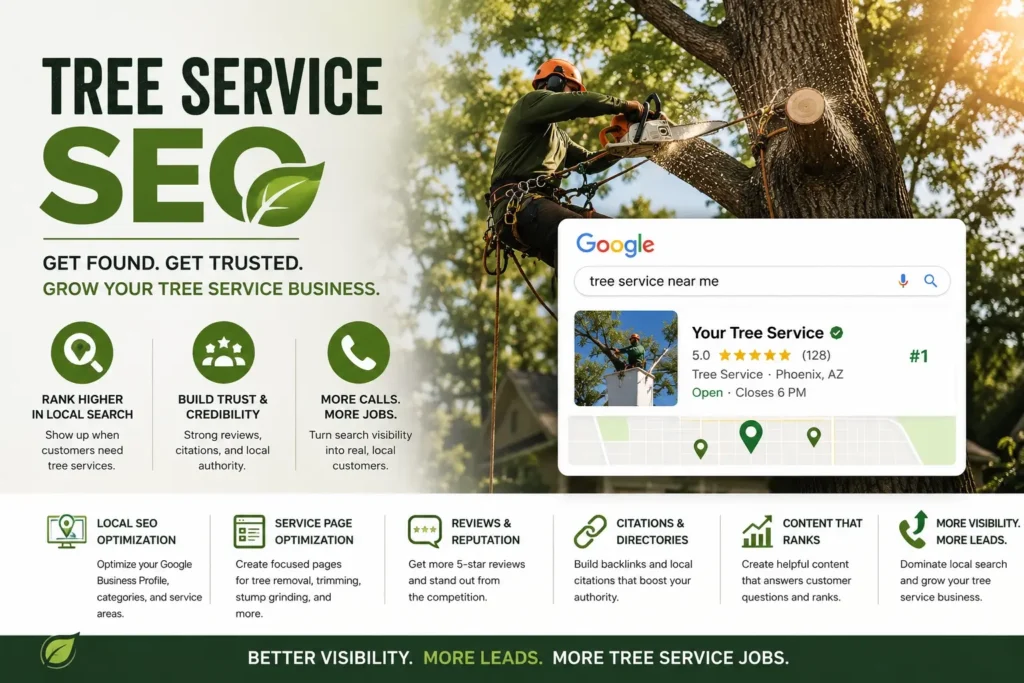
Local SEO helps your tree service company become visible during these high-intent moments.
Local SEO for tree service companies is the process of improving a business’s visibility across Google Search, Google Maps, local listings, review platforms, and AI-powered search experiences for customers in its real service area.
The goal is not simply to increase website traffic.
The goal is to generate more:
- Emergency calls
- Tree removal estimates
- Pruning and trimming jobs
- Stump grinding requests
- Arborist consultations
- Storm cleanup projects
- Commercial contracts
- Land clearing opportunities
- Qualified leads from profitable service areas
A complete local SEO strategy for tree service connects your Google Business Profile, website, service pages, reviews, credentials, local authority, technical SEO, AI visibility, and conversion process.
When those elements work together, your company becomes easier to discover and safer to hire.
The Tree Service Local SEO Growth System
A strong tree service SEO strategy has seven connected layers:
- Local demand and service mapping
- Google Business Profile visibility
- Service and location page relevance
- Reviews, credentials, and risk reduction
- Local authority and community recognition
- Technical SEO and AI search accessibility
- Conversion tracking and revenue measurement
A weakness in one layer affects the others.
A Google Business Profile may generate views but few calls when the company has weak reviews. A well-designed website may struggle if the business is not visible in Google Maps. Strong rankings may produce poor leads if the site does not explain service boundaries, emergency response, insurance, or equipment capabilities.
The companies that win consistently treat local SEO as a complete lead-generation system.
1. Understand How Tree Service Customers Search
Tree service searches have different levels of urgency, risk, and commercial value.
The SEO strategy must reflect those differences.
Emergency Tree Service Searches
Emergency searches happen when a customer believes a tree is creating an immediate safety or property risk.
Common searches include:
- Emergency tree removal near me
- Fallen tree removal
- Storm damage tree service
- Tree on house removal
- Tree blocking driveway
- Emergency branch removal
- Tree service open now
- Same-day tree removal
These customers prioritize:
- Immediate phone access
- Response availability
- Service location
- Recent reviews
- Insurance information
- Equipment capability
- Evidence of storm or emergency experience
They are unlikely to read a lengthy company history before calling.
The landing page must reduce uncertainty quickly.
Tree Removal Searches
Tree removal customers may be dealing with:
- Dead trees
- Leaning trees
- Root damage
- Diseased trees
- Trees near structures
- Construction conflicts
- Storm damage
- Property improvement projects
Typical searches include:
- Tree removal company near me
- Tree removal cost in [city]
- Large tree removal service
- Dead tree removal
- Crane tree removal
- Hazardous tree removal
- Tree cutting service
These customers need information about:
- Removal process
- Safety precautions
- Equipment
- Cleanup
- Stump options
- Permits
- Pricing factors
- Insurance
- Property protection
Tree Trimming and Pruning Searches
Pruning searches are often less urgent but can produce repeat business.
Examples include:
- Tree trimming near me
- Tree pruning service
- Crown reduction service
- Deadwood removal
- Tree canopy thinning
- Palm tree trimming
- Seasonal tree pruning
Customers may be searching for:
- Safety
- Clearance
- Tree health
- Appearance
- Storm preparation
- Roof protection
- Road or driveway access
A pruning page should distinguish professional tree care from indiscriminate cutting or topping.
Arborist and Tree Health Searches
People searching for an arborist may not know whether the tree needs treatment, pruning, support, monitoring, or removal.
Common searches include:
- Certified arborist near me
- Tree health assessment
- Tree disease diagnosis
- Tree risk assessment
- Why is my tree dying?
- Tree fungus treatment
- Tree preservation service
- Root damage assessment
These customers are usually seeking expertise before deciding on a service.
The International Society of Arboriculture explains that trained arborists understand how to maintain trees for public safety and tree health. The ISA Certified Arborist credential is a voluntary professional certification based on arboricultural knowledge and experience.
If the company employs an ISA Certified Arborist, say so clearly and accurately.
The credential belongs to the individual who earned it. Do not imply that every employee is certified when that is not true.
Stump Grinding Searches
Stump customers may be motivated by:
- Trip hazards
- Landscaping plans
- Insect concerns
- New construction
- Mowing difficulty
- Regrowth
- Property appearance
Searches include:
- Stump grinding near me
- Stump removal company
- Large stump grinding
- Tree stump removal cost
- Root removal service
Tree removal and stump grinding should usually have separate pages because the process, equipment, pricing, and customer intent differ.
Utility and Power Line Searches
Tree work near energized lines carries serious risks.
OSHA identifies overhead power lines, falling branches, falls, and equipment failures among the potentially fatal hazards in tree care. OSHA also warns that contact with electricity is a leading cause of death among tree care workers.
Customers may search for:
- Tree branches near power lines
- Utility line tree trimming
- Power line clearance arborist
- Tree touching electrical wires
- Emergency tree near power line
Do not create a utility clearance page unless the company genuinely has the qualifications, safety procedures, and legal authorization required for the work.
The page should explain when a customer must contact the utility company rather than attempting to arrange private tree work.
Commercial and Municipal Searches
Commercial buyers may include:
- Property managers
- HOA boards
- Apartment communities
- Municipal departments
- Schools
- Retail centers
- Office parks
- Industrial facilities
- Golf courses
- Construction companies
Common searches include:
- Commercial tree service
- HOA tree trimming company
- Apartment tree removal
- Municipal tree contractor
- Lot clearing service
- Tree maintenance contract
- Commercial storm cleanup
These buyers care about:
- Insurance
- Safety procedures
- Crew capacity
- Equipment
- Documentation
- Scheduling
- Traffic control
- Multi-property service
- Emergency response
- Contract management
Commercial tree care should have its own content and conversion process when it represents a meaningful business line.
2. Understand How Google Ranks Local Tree Service Companies
Google states that local results are mainly determined by relevance, distance, and prominence.
Relevance
Relevance reflects how closely the business matches the customer’s search.
Tree service relevance can be strengthened through:
- The correct Google Business Profile category
- Accurate services
- Dedicated service pages
- Clear service descriptions
- Tree-related reviews
- Arborist and equipment information
- Local content
- Strong internal linking
- Complete business information
A company described only as a general landscaping business may be less relevant to a hazardous tree removal search than a clearly defined tree service company.
Distance
Distance considers the relationship between the searcher and the business location.
This presents a real challenge for tree service companies because many operate as service area businesses.
Adding cities to a Google Business Profile does not make the company equally competitive across every city.
Service areas communicate where the business operates. They do not remove the distance factor.
The strategy should focus on building strong relevance and prominence in the areas the company can realistically serve.
Prominence
Prominence reflects how established and recognized the company appears.
Google may consider reviews, links, articles, directories, and the company’s position in traditional search results when assessing local prominence.
For a tree service company, prominence can grow through:
- Genuine customer reviews
- Local news mentions
- Professional credentials
- Community work
- Relevant backlinks
- Chamber membership
- Industry directories
- Strong organic rankings
- Consistent business information
- Branded searches
- Local partnerships
This is why changing a few fields in Google Business Profile is not a complete local SEO strategy.
3. Audit the Tree Service Market Before Optimizing
The first step should be understanding where the company can win profitably.
Map the Real Service Area
Document:
- Cities currently served
- Cities producing the best jobs
- Emergency response limits
- Average drive time
- Crew availability
- Equipment transportation limits
- High-value neighborhoods
- Commercial service zones
- Areas the company does not want to serve
Do not create location pages for places the company cannot reach efficiently.
Map Services by Business Value
For each service, estimate:
- Average job value
- Profit margin
- Closing rate
- Lead quality
- Seasonality
- Crew requirements
- Equipment requirements
- Insurance risk
- Geographic limitations
- Repeat-business potential
A tree service company may find that emergency removal generates fast calls, while pruning contracts and commercial maintenance create more predictable revenue.
The SEO plan should account for both.
Analyze Local Competitors
Evaluate competitors across four surfaces.
Google Maps
Review:
- Primary and secondary categories
- Review volume
- Review recency
- Review themes
- Services
- Photos
- Business type
- Physical location
- Service areas
- Profile completeness
Organic Search
Review:
- Service pages
- Location pages
- Arborist content
- Emergency content
- Trust information
- Internal linking
- Project galleries
- Backlinks
- Site speed
- Calls to action
Local Authority
Review:
- Local news coverage
- Chamber profiles
- ISA directory visibility
- Community partnerships
- Supplier relationships
- Municipal work
- Commercial clients
- Industry memberships
AI Search
Test questions in ChatGPT, Gemini, Perplexity, and Google’s AI search experiences.
Examples:
- Who are the best tree removal companies in [city]?
- Which tree services have certified arborists in [city]?
- Who handles emergency fallen trees near [location]?
- Which local companies provide tree risk assessments?
- How do I choose a safe tree removal company?
Record:
- Businesses mentioned
- Sources cited
- Review platforms used
- Directories referenced
- How competitors are described
- Missing or inaccurate information
This reveals the wider information network influencing recommendations.
4. Optimize the Google Business Profile Correctly
For many tree service companies, Google Business Profile is the most valuable local visibility asset.
A customer may see the listing, review photos, check availability, and call without visiting the website.
The profile must answer:
- Does the company provide the service I need?
- Does it serve my location?
- Does it appear legitimate?
- Can it perform the work safely?
- Can I contact someone quickly?
Set Up the Correct Business Type
Most tree service companies travel to customer properties and do not receive customers at their operating address.
Google instructs service-area businesses to hide their addresses when customers are not served at the location. A public address should only be displayed when the location genuinely meets Google’s requirements for a customer-facing business.
Do not use:
- Virtual offices
- Mailboxes
- Unstaffed coworking spaces
- Equipment storage yards with no customer access
- Temporary storm-response addresses
- Employee homes presented as branch offices
A policy violation can lead to suspension at the exact time the company needs visibility most.
Use the Real Business Name
The profile should use the company’s actual name as it appears on:
- Vehicles
- Website
- Licenses
- Insurance documents
- Signage
- Invoices
- Customer materials
Use:
Oak Valley Tree Service
Do not use:
Oak Valley Tree Service | Best Emergency Tree Removal Dallas
Adding services and cities to the name creates unnecessary policy risk.
Choose the Most Accurate Category
The primary category should describe the company’s main business.
For most dedicated tree care companies, the closest available primary category is generally Tree service.
Secondary categories should only be used when they accurately represent meaningful business activities.
Possible examples may include:
- Arborist and tree surgeon
- Stump removal service
- Landscaping service
- Firewood supplier
- Crane service
Category availability and wording may vary.
Do not add unrelated categories simply to appear for more searches.
Define Real Service Areas
Google currently allows service area businesses to add up to 20 service areas. It recommends keeping the total service boundary within approximately two hours of driving time from the business base and selecting specific cities, postal codes, or supported geographic areas.
Use service areas to reflect operational reality.
Do not add distant cities the company cannot serve reliably.
List Every Major Service
Complete the services section with the work the company genuinely performs.
Examples include:
- Tree removal
- Emergency tree removal
- Tree trimming
- Tree pruning
- Stump grinding
- Stump removal
- Storm damage cleanup
- Tree risk assessment
- Tree health evaluation
- Cabling and bracing
- Crane-assisted tree removal
- Land clearing
- Lot clearing
- Commercial tree service
- Palm tree trimming
- Brush removal
Each service description should explain:
- The problem addressed
- The type of customer served
- The general process
- Whether emergency service is available
- Where the service is offered
Avoid repeating the city name unnaturally.
Write a Clear Business Description
A useful description should define the company precisely.
Example:
Oak Valley Tree Service provides tree removal, pruning, stump grinding, storm cleanup, and tree risk assessment services throughout the Dallas area. Our insured crews handle residential and commercial projects, including hazardous trees, crane-assisted removals, and emergency storm response.
This provides more useful information than generic claims about quality and customer satisfaction.
Keep Hours Accurate
Update:
- Regular hours
- Weekend availability
- Holiday hours
- Seasonal hours
- Emergency availability
- Storm response changes
Do not list 24-hour service unless someone can genuinely respond at all times.
Publish Authentic Project Photos and Videos
Tree service work is visual.
Useful images include:
- Tree removals
- Crane work
- Rigging systems
- Stump grinding
- Pruning
- Storm cleanup
- Commercial projects
- Branded trucks
- Chippers and lifts
- Safety equipment
- Crew members
- Before and after results
- Jobsite protection
- Cleanup
Avoid exposing:
- Customer addresses
- License plates
- Personal documents
- Children
- Neighboring property details
- Insurance information
Do not rely entirely on stock images or AI-generated crews.
Real work builds stronger trust.
Publish Timely Business Updates
Useful Google Business Profile post topics include:
- Storm preparation
- Emergency availability
- Seasonal pruning
- Recent projects
- Equipment additions
- Arborist education
- Safety information
- Commercial availability
- Service area updates
- Community projects
Posts can help customers see that the company is active, but they do not replace strong service pages, reviews, or authority.
Use UTM Tracking
Add UTM parameters to the website link so Google Business Profile traffic can be identified in GA4.
Example:
?utm_source=google&utm_medium=organic&utm_campaign=gbp
Use a consistent naming structure.
5. Build a Review Strategy That Reduces Customer Risk
Tree removal is a high-risk purchase.
Customers are not only evaluating whether the company can cut a tree.
They are evaluating whether the crew can protect:
- The home
- Vehicles
- Fences
- Neighboring property
- Landscaping
- Utility lines
- People nearby
Reviews help answer those concerns.
Focus on Consistent Review Growth
There is no universal review number that guarantees map rankings.
The correct benchmark depends on:
- Market size
- Competitor strength
- Business age
- Service type
- Review quality
- Search location
- Reputation
Compare the business with legitimate local competitors.
Then build a steady review process.
Create a Simple Request Workflow
A practical process may include:
- Complete the work
- Confirm customer satisfaction
- Send the review link
- Send one polite reminder
- Respond after the review appears
The request should be easy to complete on a phone.
Follow Google’s Review Policies
Google prohibits businesses from:
- Paying for reviews
- Offering discounts or gifts for reviews
- Selectively asking only happy customers
- Discouraging negative reviews
- Pressuring customers
- Requiring a five-star rating
- Asking for specific wording
Reviews must represent genuine customer experiences.
Ask for Honest Feedback
A compliant request may say:
Thank you for choosing our team for your tree service project. Would you be willing to share an honest review about your experience? Your feedback helps local property owners make informed decisions.
Do not provide a list of keywords for the customer to include.
Respond to Reviews Naturally
A good response should:
- Thank the customer
- Reference the project naturally
- Remain concise
- Avoid private details
- Show professionalism
- Provide a next step when needed
Example:
Thank you, Mark. We appreciate you trusting our crew with the damaged oak near your home. We are glad the removal and cleanup were completed safely before the next storm arrived.
Handle Negative Reviews Professionally
Do not argue publicly.
Use a simple response structure:
- Acknowledge the concern
- State that the company takes it seriously
- Avoid disclosing private information
- Invite direct communication
- Explain how the issue can be reviewed
Future customers will often judge the response more closely than the complaint.
6. Build a Website Around Tree Service Intent
A tree service website should not force every customer to go through a single generic services page.
Different tree problems require different expertise, equipment, timelines, and decisions.
Core Pages for a Tree Service Website
A comprehensive website may include:
- Homepage
- Tree removal
- Emergency tree removal
- Tree trimming
- Tree pruning
- Stump grinding
- Storm damage tree service
- Arborist services
- Tree risk assessment
- Tree health care
- Cabling and bracing
- Crane-assisted removal
- Land clearing
- Commercial tree service
- Utility line clearance, when qualified
- Service area pages
- Projects or gallery
- About
- Credentials and insurance
- Reviews
- Contact
- Privacy policy
The exact structure should match the real business.
Do not create pages for services the company does not provide.
Separate Services With Different Intent
Tree removal, pruning, stump grinding, and arborist assessment solve different problems.
Each deserves a dedicated page when:
- Search intent differs
- Equipment differs
- The process differs
- Pricing factors differ
- The customer’s concerns differ
- The company wants leads for the service
Do not split every tiny variation into a separate thin page.
Create the strongest page for each meaningful intent.
7. Use a High-Converting Tree Service Page Format
Above the Fold
Every high-intent service page should immediately show:
- Service
- Primary location
- Phone number
- Click-to-call button
- Estimate CTA
- Emergency availability
- Relevant trust proof
Example H1:
Emergency Tree Removal in Dallas, TX
Supporting copy:
Get help with fallen, split, storm-damaged, or hazardous trees threatening your property. Contact our insured local crew to request an emergency assessment.
Direct Answer
The opening paragraph should clearly explain the service.
Example:
Emergency tree removal addresses trees or large branches that create an immediate risk to people, structures, roads, or utilities. The crew first evaluates the hazard, controls the work area, and determines the safest method for removal based on the tree’s condition, location, and surrounding property.
Warning Signs
Describe when the customer may need help:
- Sudden leaning
- Split trunks
- Broken hanging limbs
- Uprooted roots
- Cracks near branch unions
- Dead canopy
- Storm impact
- Trees resting on structures
- Exposed roots
- Soil movement
- Branches near electrical lines
Avoid telling readers to approach, climb, cut, or inspect a dangerous tree themselves.
Service Process
Explain the real workflow:
- Initial call
- Safety and urgency screening
- Site assessment
- Work-zone setup
- Equipment selection
- Controlled removal or pruning
- Debris processing
- Stump options
- Cleanup
- Final inspection
Pricing Factors
Tree service costs can vary significantly.
Explain factors such as:
- Tree height
- Trunk diameter
- Species
- Condition
- Location
- Accessibility
- Nearby structures
- Utility hazards
- Equipment requirements
- Crew size
- Emergency timing
- Debris volume
- Stump grinding
- Permit requirements
Publish local price ranges only when the company has reliable data and can keep it up to date.
Trust and Safety Section
Show verifiable information such as:
- General liability insurance
- Workers’ compensation coverage where applicable
- ISA credentials
- Local licenses where required
- Safety training
- Equipment capabilities
- Years of relevant experience
- Commercial insurance limits
- Professional memberships
- Real project photographs
OSHA identifies falls, struck-by incidents, lacerations, falling branches, and contact with energized lines as major hazards in tree care operations. Demonstrating real safety procedures is therefore more than a marketing exercise.
Frequently Asked Questions
Examples include:
- Can a leaning tree be saved?
- How quickly can an emergency tree be removed?
- Does tree removal include stump grinding?
- Can a tree be removed without damaging the lawn?
- Who handles branches touching power lines?
- Do I need a permit to remove a tree?
- What happens to the wood and debris?
Conversion Section
End with:
- Clear CTA
- Phone number
- Short form
- Service area reminder
- Expected response process
8. Build Specialized Trust Pages Competitors Ignore
Tree service SEO becomes more effective when the site addresses the specific risks customers worry about.
Insurance and Safety Page
Explain:
- General liability coverage
- Workers’ compensation where applicable
- Property protection procedures
- Crew safety processes
- Equipment inspection
- Traffic and work-zone management
- Emergency procedures
- Certificate of insurance availability
Do not publish expired insurance documents.
Do not make coverage claims the policy does not support.
ISA Certified Arborist Page
If the company has an ISA Certified Arborist, create a page explaining:
- The individual’s name
- Credential type
- Credential number when appropriate
- Areas of expertise
- Services involving arboricultural knowledge
- Difference between an arborist consultation and routine cutting
- How customers can verify the credential
ISA states that its Certified Arborist program measures knowledge in areas such as tree biology, diagnosis, maintenance practices, and safety.
Do not use the ISA logo or credential language in a way that violates the organization’s brand guidelines.
Tree Risk Assessment Page
A useful tree risk assessment page should explain:
- What triggers an assessment
- What the inspection may consider
- Tree condition
- Structural defects
- Root conditions
- Targets such as homes, roads, and people
- Likelihood of failure
- Potential consequences
- Risk mitigation options
- Monitoring recommendations
If someone on the team holds the ISA Tree Risk Assessment Qualification, describe it accurately.
Do not imply that every visual estimate is a formal risk assessment.
Utility Line Safety Page
A utility-related page should explain:
- Why energized lines create exceptional risk
- When the utility company should be contacted
- Whether the company performs line-clearance work
- Which qualifications the crew has
- What customers should never attempt
- How emergencies are handled
OSHA guidance notes that qualified work near overhead electrical conductors may be subject to specific training and separation requirements.
Equipment and Capabilities Page
Customers often want to know whether the company can handle a large or complicated job.
Show:
- Cranes
- Aerial lifts
- Bucket trucks
- Chippers
- Stump grinders
- Mini loaders
- Rigging equipment
- Traffic-control equipment
- Ground protection
- Debris hauling capacity
Explain what each capability allows the company to do.
Do not present rented or subcontracted equipment as permanently owned unless that is clear.
Commercial Tree Service Page
Address:
- Multi-property service
- Scheduled maintenance
- Emergency response
- Risk documentation
- Insurance requirements
- HOA communication
- Property manager coordination
- Traffic management
- Work-hour restrictions
- Recurring contracts
- Detailed invoicing
Commercial buyers need a different CTA from residential customers.
Offer:
- Site assessment
- Portfolio review
- Maintenance proposal
- Vendor onboarding
- Emergency contact setup
9. Build Location Pages Without Creating Doorway Content
Location pages can help a tree service company communicate relevance to individual cities.
They should not be mass-generated copies.
Google’s spam policies prohibit scaled production of low-value or unoriginal pages created primarily to manipulate rankings.
Create a Location Page When
- The company genuinely serves the city
- There is meaningful demand
- The business has capacity
- The page can provide local value
- Projects have been completed there
- The location supports the growth strategy
Include Real Local Information
A useful location page may include:
- Services offered
- Response availability
- Local project examples
- Local photos
- Neighborhoods served
- Genuine local testimonials
- Common regional tree species
- Weather-related concerns
- Local tree risks
- Permit information when verified
- Commercial service availability
- Links to service pages
- Clear contact options
Avoid
- Replacing only the city name
- Inventing local projects
- Creating fake offices
- Using fake local phone numbers
- Copying testimonials between pages
- Publishing pages for distant markets
- Adding lists of ZIP codes with no useful context
- Generating hundreds of AI-written city pages
A smaller group of strong location pages will usually provide more value than a large collection of weak pages.
10. Optimize Tree Service Content for Search and AI Answers
Google’s current guidance says foundational SEO practices remain relevant for generative AI search. Pages must still be indexed and eligible for traditional search, and businesses can improve local visibility by maintaining accurate Google Business Profile information. Google also states that special AI files or unsupported markup are not required.
Use Answer-First Sections
Place a clear answer directly below important headings.
Example:
How Much Does Tree Removal Cost?
Tree removal cost depends on the tree’s height, diameter, species, condition, accessibility, nearby structures, utility hazards, crew requirements, equipment, debris volume, and whether stump grinding is included. A site assessment is usually required before a tree service company can provide an accurate quote.
Then expand each factor.
Write Standalone Passages
Weak:
This is what makes it so dangerous.
Stronger:
A split trunk can create an unpredictable risk of failure because weakened sections may separate under wind, rain, snow, or the weight of the canopy.
The stronger paragraph remains useful when extracted.
Increase Fact Density
Useful citation-ready content may include:
- Local tree species
- Storm damage patterns
- Original project data
- Equipment explanations
- Tree condition examples
- Inspection checklists
- Maintenance calendars
- Permit guidance
- Risk assessment processes
- Cost data
- Arborist observations
- Material and equipment comparisons
Do not invent statistics or claim that one treatment works for every species.
Show First-Hand Expertise
Add:
- Real project photographs
- Crew commentary
- Arborist insights
- Named authors
- Case examples
- Safety limitations
- Local experience
- Seasonal advice
- Clear update dates
Google’s systems are designed to prioritize helpful, reliable, people-first content rather than pages created mainly to manipulate rankings.
Answer Follow-Up Questions
AI search users often continue the conversation.
A strong tree removal page should anticipate:
- Can the tree be saved?
- Is the tree dangerous?
- Is emergency removal required?
- What equipment is needed?
- Is stump grinding included?
- Does the city require a permit?
- What happens to the wood?
- Will the lawn be damaged?
- Does insurance cover the work?
Do not provide legal or insurance guarantees.
Explain when the customer should contact an insurer, a utility, a municipality, or a qualified professional.
11. Build Tree Service Topic Clusters
Random blog publishing rarely generates sustainable leads.
Build content around the services and decisions that produce revenue.
Tree Removal Cluster
Main page: Tree Removal Services
Supporting topics:
- Signs a Tree May Need Removal
- Can a Leaning Tree Be Saved?
- What Affects Tree Removal Cost?
- How Large Trees Are Removed Safely
- Tree Removal Versus Pruning
- What Happens After Tree Removal?
Emergency Tree Service Cluster
Main page: Emergency Tree Removal
Supporting topics:
- What to Do When a Tree Falls on a House
- How to Identify a Dangerous Hanging Branch
- When a Leaning Tree Becomes an Emergency
- Storm Damage Tree Safety Checklist
- Who to Call When a Tree Touches Power Lines
- Emergency Tree Tarping and Property Protection
Tree Pruning Cluster
Main page: Tree Pruning Services
Supporting topics:
- When Is the Best Time to Prune Trees?
- Tree Trimming Versus Pruning
- Why Tree Topping Can Cause Problems
- Signs a Tree Has Deadwood
- How Pruning Supports Tree Structure
- How Often Should Mature Trees Be Pruned?
Arborist and Tree Health Cluster
Main page: Arborist Services
Supporting topics:
- What Does a Certified Arborist Do?
- Signs of Tree Disease
- What Is a Tree Risk Assessment?
- Can a Diseased Tree Be Saved?
- Tree Cabling and Bracing Explained
- When Should Tree Roots Be Inspected?
Stump Grinding Cluster
Main page: Stump Grinding Services
Supporting topics:
- Stump Grinding Versus Stump Removal
- How Deep Does Stump Grinding Go?
- Can a Tree Grow Back From a Stump?
- What Happens to the Roots?
- How Much Does Stump Grinding Cost?
- Can You Plant After Stump Grinding?
Commercial Tree Service Cluster
Main page: Commercial Tree Services
Supporting topics:
- Tree Maintenance for HOAs
- Apartment Community Tree Risk Management
- Commercial Storm Response Planning
- Tree Inspections for Property Managers
- Parking Lot Tree Maintenance
- Municipal Tree Service Contractor Checklist
Build one cluster thoroughly before starting another.
12. Strengthen Entity Trust and Business Authority
Search engines and AI systems need to understand who the company is, what it does, and whether independent sources confirm that identity.
Keep Core Information Consistent
Maintain accurate:
- Business name
- Website
- Phone number
- Address or hidden-address status
- Service areas
- Services
- Hours
- Leadership
- Credentials
- Social profiles
Focus on material inconsistencies.
A minor difference between “Road” and “Rd.” is usually less important than an outdated phone number, conflicting business name, or incorrect location.
Build Strong About and Team Pages
The About page should include:
- Company history
- Owner or leadership information
- Team experience
- Service area
- Insurance
- Credentials
- Safety commitment
- Equipment capabilities
- Community involvement
- Real photographs
A team page may include:
- Names
- Roles
- Experience
- Certifications
- Areas of specialization
- Professional biographies
Verify Credentials
Link to appropriate verification sources where possible.
Relevant authority sources may include:
- ISA credential directory
- State licensing database
- Municipal contractor registration
- Professional association
- Insurance verification process
- Manufacturer or equipment training
Do not display expired or unverifiable credentials.
13. Build Local Citations, Links, and Community Recognition
Local citations help confirm that the business operates within a market.
Priority Listings
Potentially relevant platforms include:
- Google Business Profile
- Bing Places
- Apple Business Connect
- Yelp
- Better Business Bureau
- Local Chamber of Commerce
- ISA directory
- Tree Care Industry Association
- State contractor directories
- Local licensing databases
- Home service platforms
- Commercial vendor directories
Do not submit the company to hundreds of low-quality directories.
Build Relevant Partnerships
Tree service companies can build relationships with:
- Roofing companies
- Landscapers
- Property managers
- HOAs
- Real estate agents
- Insurance agents
- Restoration companies
- Municipal departments
- Schools
- Golf courses
- Construction companies
- Utility contractors
- Local nurseries
These relationships can produce:
- Referrals
- Local links
- Co-created resources
- Community mentions
- Commercial contracts
- Emergency partnerships
Earn Local Media Coverage
Useful media angles include:
- Storm safety
- Dangerous tree warning signs
- Seasonal pruning
- Drought stress
- Invasive pests
- Tree preservation
- Utility safety
- Community cleanup
- Emergency response
- Arbor Day education
Provide accurate expert commentary.
Do not turn every community contribution into a promotional pitch.
Create Linkable Resources
Useful assets include:
- Local tree species guide
- Storm preparation checklist
- Tree risk worksheet
- Seasonal pruning calendar
- Tree removal cost report
- Emergency property safety guide
- HOA tree maintenance checklist
- Commercial inspection template
- Local pest and disease report
- Tree lifespan guide
Original resources can earn links, media mentions, and AI citations.
14. Strengthen Technical SEO
Strong content cannot perform consistently if search engines cannot crawl, index, render, or understand the website.
Technical SEO Checklist
- Priority pages return a 200 status code
- Robots.txt allows important content
- XML sitemap is accurate
- Canonicals point to preferred pages
- Redirect chains are removed
- Broken links are repaired
- Important pages are internally linked
- Mobile forms work
- Click-to-call buttons work
- HTTPS is active
- Project images are compressed
- Important content appears in HTML
- Duplicate pages are consolidated
- Tracking is working
- Spam and malware are monitored
Improve Mobile Performance
Emergency tree service customers often search from a phone while standing near the damaged property.
Prioritize:
- Fast page loading
- Stable call buttons
- Clear phone numbers
- Short forms
- Compressed galleries
- Minimal popups
- Readable text
- Easy navigation
Google recommends achieving good Core Web Vitals for search success and user experience. Current benchmarks include an LCP within 2.5 seconds, an INP below 200 milliseconds, and a CLS below 0.1. Google also makes clear that perfect scores alone do not guarantee rankings.
Use Structured Data Accurately
Structured data can help search engines understand the entities and content on a page, but it does not guarantee a ranking or rich result.
Relevant types may include:
- Organization
- LocalBusiness
- WebSite
- WebPage
- BreadcrumbList
- Article
- VideoObject
- Person
- Service where accurately implemented through Schema.org
Review Schema Warning
Do not expect organic review stars by marking up testimonials about the company on its own website.
Google does not provide self-serving review rich results for LocalBusiness and Organization pages controlled by the reviewed company.
FAQ Schema Warning
Helpful FAQ content can improve the page for customers.
However, Google removed general FAQ rich-result documentation in 2026 after previously limiting FAQ visibility. Do not add FAQ markup to every tree service page expecting special search displays.
Use structured data because it accurately describes the page.
Do not use it as a shortcut.
15. Convert Tree Service Traffic Into Calls and Estimates
Traffic has little value if customers cannot take the next step easily.
Above-the-Fold Conversion Checklist
Every priority page should show:
- Service
- Location
- Phone number
- Click-to-call button
- Estimate CTA
- Emergency availability
- Trust proof
Build an Emergency Conversion Path
Emergency pages should include:
- Immediate phone access
- What qualifies as an emergency
- Service boundary
- Response expectations
- Safety warnings
- Utility instructions
- What information to provide
- What happens after calling
Do not promise arrival times the company cannot consistently meet.
Show Risk-Reducing Proof Early
Useful trust elements include:
- Insurance
- Workers’ compensation
- ISA credentials
- Licensing
- Safety training
- Equipment
- Reviews
- Project photographs
- Years of experience
- Commercial capabilities
Keep Forms Short
An initial estimate form may request:
- Name
- Phone
- Property address
- Service needed
- Short description
- Photo upload, when secure and useful
Do not require unnecessary information before the company has earned trust.
Use Photo Upload Carefully
Photos can help the office understand the situation, but the website should state:
- A photo is not a complete safety assessment
- Customers should not approach dangerous trees
- Customers should not touch branches near utility lines
- Emergency conditions require direct phone contact
Build a Useful Thank-You Page
After submission, confirm:
- The request was received
- Expected response timing
- What happens next
- Emergency phone instructions
- Safety reminders
- How to prepare for the visit
- Additional proof or resources
The customer may continue comparing companies after submitting the form.
16. Measure Tree Service SEO by Revenue
Rankings matter only when they contribute to business results.
Primary KPIs
Track:
- Qualified phone calls
- Estimate requests
- Emergency inquiries
- Booked appointments
- Closed jobs
- Revenue by service
- Revenue by location
- Average job value
- Lead-to-job conversion rate
- Cost per qualified lead
Supporting Metrics
Track:
- Google Business Profile calls
- Website clicks
- Search terms
- Direction requests
- Organic clicks
- Service page conversions
- Review growth
- Map visibility
- Branded searches
- Local backlinks
- AI referrals
- AI citations
Track Leads by Service
Separate:
- Emergency removal
- Standard removal
- Pruning
- Stump grinding
- Arborist services
- Commercial work
- Land clearing
- Storm cleanup
This shows which rankings and pages attract profitable demand.
Track Calls Carefully
Use call tracking with proper dynamic number insertion.
Keep the core business number consistent on major listings.
Do not create conflicting phone information across the web.
Track AI Search Visibility
Monitor referral traffic from:
- ChatGPT
- Perplexity
- Gemini
- Microsoft Copilot
Also test high-value prompts manually.
Record:
- Brand mentioned
- Website cited
- Competitors included
- Sources referenced
- Sentiment
- Accuracy
- Date tested
AI visibility may also increase branded searches without generating a direct referral.
Common Tree Service Local SEO Mistakes
Using One Generic Services Page
Tree removal, pruning, stump grinding, and arborist work target different customer needs.
Keyword Stuffing the Business Name
This creates unnecessary Google Business Profile policy risk.
Using an Ineligible Address
Virtual offices, mailboxes, and unstaffed locations should not be presented as customer-facing branches.
Adding Every Nearby City as a Service Area
Service areas do not guarantee rankings throughout every selected city.
Creating Duplicate Location Pages
Replacing only the city name creates weak content and a poor user experience.
Claiming Arborist Credentials the Company Does Not Have
Use certification language only when the credential is current and verifiable.
Ignoring Utility Safety
Tree work near power lines requires specialized procedures and may require utility involvement.
Buying or Manipulating Reviews
Fake, incentivized, gated, or scripted reviews violate Google’s policies.
Publishing Generic Tree Care Articles
Content should support real services, customer decisions, local conditions, and professional expertise.
Using Stock or AI-Generated Project Images
Customers want evidence of real crews, equipment, and completed work.
Hiding Insurance and Safety Information
Customers hiring a tree service are evaluating risk, not only price.
Measuring Traffic Without Lead Quality
More visits do not automatically mean more profitable jobs.
Local SEO Checklist for Tree Service Companies
Google Business Profile
- Verified and policy compliant
- Correct business type
- Real business name
- Accurate primary category
- Real service areas
- Complete services
- Current hours
- Authentic photos
- Useful updates
- Working website link
- UTM tracking installed
Website
- Clear homepage
- Dedicated service pages
- Emergency page
- Arborist page
- Tree risk assessment page
- Commercial page
- Useful location pages
- About page
- Credentials and insurance
- Project galleries
- Click-to-call buttons
- Short forms
- Clear pricing factors
- Strong internal linking
Reviews
- Consistent request process
- No incentives
- No review gating
- No required wording
- Personalized responses
- Negative review protocol
- Review patterns monitored
Authority
- Core listings accurate
- ISA credentials verified
- Industry profiles complete
- Local partnerships
- Community mentions
- Local media
- Original resources
- Relevant backlinks
Technical SEO
- Crawlable pages
- Accurate sitemap
- Correct canonicals
- No broken links
- Strong mobile performance
- Secure website
- Accurate structured data
- Working forms
- Call tracking
- GA4 and Search Console
Content and AI Search
- Answer-first sections
- Real customer questions
- Service topic clusters
- Local expertise
- Original project evidence
- Updated content
- Clear business entity
- AI referral tracking
- Commercial prompt testing
How LocalMighty Helps Tree Service Companies Generate More Leads
Growing a tree service company requires more than ranking for a few tree removal keywords. LocalMighty helps tree care businesses improve Google Maps visibility, optimize Google Business Profiles, build high-converting service and location pages, strengthen arborist and safety authority, and create useful content for property owners researching tree removal, pruning, stump grinding, storm cleanup, and tree risk concerns.
Our strategies combine local SEO, AI search optimization, technical SEO, reputation management, entity optimization, and conversion optimization to help tree service companies generate more qualified calls, increase estimate requests, strengthen customer trust, and achieve sustainable growth across Google Search, Google Maps, and modern AI search platforms.
Final Thoughts
Local SEO for tree service companies is not a collection of disconnected marketing tactics.
It is the process of making the company the clearest, safest, and most trustworthy local option for property owners who need professional tree care.
That requires:
- A legitimate and optimized Google Business Profile
- Service pages matching real tree care problems
- Useful location content
- Genuine reviews
- Verifiable credentials
- Strong safety and insurance information
- Local authority
- Technical accessibility
- Helpful content for traditional and AI search
- A website that converts searches into calls and estimates
- Measurement connected to booked jobs and revenue
The tree service companies that build this system reduce their dependence on purchased leads, strengthen their local reputation, capture both emergency and planned demand, and create a position that becomes increasingly difficult for competitors to replace.
That is what tree service local SEO should accomplish.
Not more traffic for the sake of traffic.
More qualified opportunities from property owners, managers, and organizations ready to hire a professional tree service.
Frequently Asked Questions About Local SEO for Tree Service Companies
Local SEO for tree service is the process of improving a tree care company’s visibility for geographically relevant searches across Google Search, Google Maps, business listings, reviews, and AI search platforms. The goal is to generate qualified calls, estimate requests, emergency inquiries, and booked tree service jobs.
There is no guaranteed timeline. Results depend on competition, location, website quality, Google Business Profile history, reviews, authority, technical issues, and the company’s starting visibility. Foundational improvements may produce early movement, while competitive markets require ongoing work.
A company can qualify as a service area business when it travels to customers. If customers are not served at the operating address, Google requires the address to be hidden from the public profile.
Hiding an address does not prevent a legitimate service area business from having a profile. However, service areas do not override Google’s distance factor or guarantee equal rankings across every city.
Google currently permits up to 20 service areas and recommends keeping the total boundary within approximately two hours of driving time from the business base.
The most appropriate primary category for many dedicated tree care businesses is Tree service. Secondary categories should only be added when they accurately describe meaningful services offered by the company.
Create pages only for genuine service markets where the company can provide useful local information. Avoid mass-producing duplicate city pages with no local value.
Google states that review count and review score can contribute to local prominence. Reviews also affect whether customers trust the company enough to call.
An ISA Certified Arborist can provide recognized professional knowledge in areas such as tree biology, diagnosis, maintenance, and safety. Whether the company needs that credential depends on its services, market, and customer needs.
Yes. Accurate business information, strong traditional SEO, useful answer-first content, genuine reviews, third-party authority, and clear credentials can improve a company’s eligibility to appear in AI search experiences.
Local SEO and paid advertising serve different purposes. Paid campaigns can generate immediate exposure, while local SEO builds long-term organic visibility and brand authority. Many tree service companies use both, then compare lead quality and acquisition cost.