
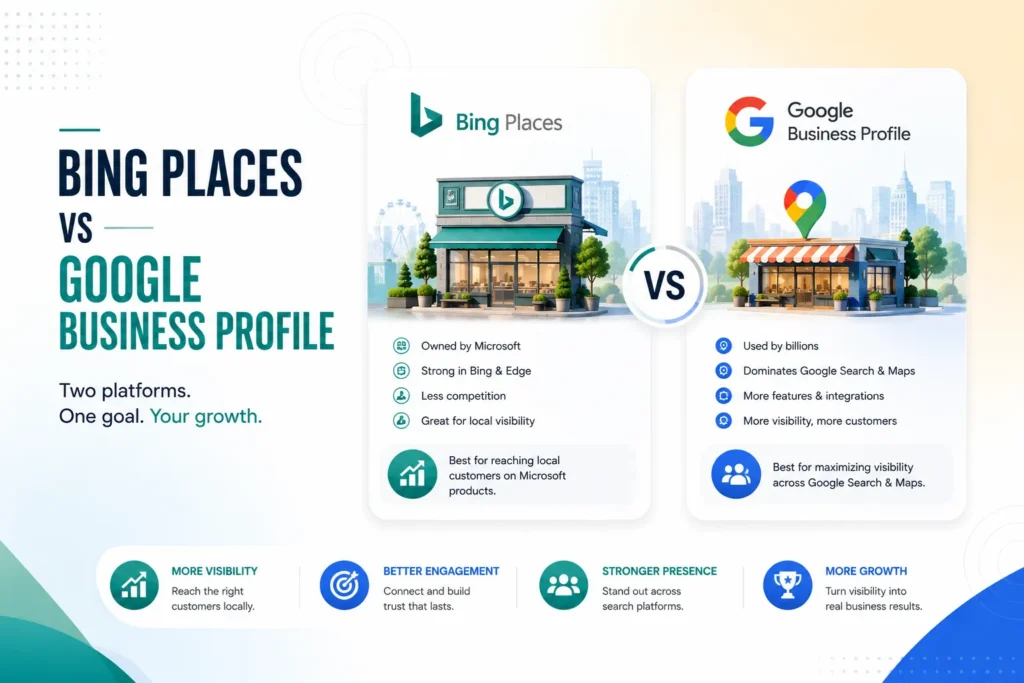
The Short Answer: Bing Places vs Google Business Profile
In 2026, most local businesses should prioritize Google Business Profile. If a business serves customers who also use Bing, claim and maintain Bing Places as a strong secondary listing. Google controls about 91% of global search, while Bing has around 4.5% overall. The gap is smaller on desktop, where Bing’s market share rises to nearly 9% (see the full breakdown below).
The solution is not to choose only one platform; prioritize Google, then use Bing strategically. Consumer-facing businesses, such as restaurants, dentists, salons, or home services, should direct most local SEO efforts toward Google. By contrast, a business-to-business company, a professional services firm, an enterprise organization, or one that caters to an older audience that relies more on desktop computers should take Bing more seriously.
This comparison follows that principle: audience first, opportunity second, and effort last.
What Google Business Profile and Bing Places Actually Do
Both platforms address the same fundamental problem: they give a search engine structured information about a real business and a controlled position in local search. The difference is the ecosystem where that presence lives.
Google Business Profile: Google’s Local SEO Engine
Google Business Profile forms the basis of local SEO on Google. It determines what customers see in Google Search and Google Maps, including the business’s location, opening hours, phone number, website, photos, reviews, and action links. After verification, a business gains direct control over how that information is displayed, and claiming and verifying a Google Business Profile is typically the first item on any local SEO checklist.
For customers who search for “near me”, “open now”, or “best [service] near me”, Google Business Profile is not optional; it is the fundamental element of relevance, distance, and prominence, the three factors which determine most local rankings.
Bing Places for Business: Microsoft’s Local Listing Platform
Bing Places for Business is Microsoft’s corresponding service. It provides the business information displayed in Bing’s local search and Maps results, and Microsoft encourages businesses to claim or update the details that appear in Bing Maps. Setting up and verifying a Bing Places entry is separate and essentially mechanical; the following article covers the ongoing attention the platform should receive after that’s done.
That footprint extends beyond Bing.com; Microsoft Copilot can draw on Bing’s search index to base its answers on up-to-date web information, which is why an accurate Bing Places listing has become part of the broader AI-visibility discussion (more on that below).
Bing Places vs Google Business Profile: Where It Actually Matters for Rankings
The biggest mistake when comparing Google Business Profile with Bing Places is treating them as equal competitors; they aren’t equal in audience size, and they’re complementary assets with very different reach.
Bing Places Market Share and Real Traffic Potential
The first thing you need to do to decide how much time Bing Places market share data deserves is to review the latest figures available, since they provide a useful reality check.
| Search engine | Global share, all platforms | Desktop share |
|---|---|---|
| ~91.3% | ~86.1% | |
| Bing | ~4.5% | ~8.8% |
On mobile devices, the gap is even greater: Google has about 95.8% of the global mobile search market and Bing about 0.6%.
Therefore, if anybody asks, “What proportion of local search traffic is from Bing?” there is no single accurate percentage, since it varies by country, device mix, and industry. But search share is not the same as lead share: if Bing brings you 5% of the traffic but 8% of your qualified leads, it is outperforming its market share for your business. Before setting Bing’s budget, check your analytics and rank platforms by the leads they generate.
Ranking Algorithm Differences
Neither company makes an exact formula available for how it weighs local listing signals. Google’s method is already shown above: relevance, distance, and prominence. Bing operates its own ecosystem, with its own data sources and review environment, and hasn’t published anything as detailed. So ranking logic differs by platform: Google relies on relevance, distance, and prominence, while Bing uses its own signals, and you should optimize accordingly.
Copying your Google strategy word for word into Bing isn’t a strategy; it’s duplication. Focus on Google, where most demand lives; on Bing, focus on accuracy and the specific audience segments where it has disproportionate reach.
Reviews, Photos, and Engagement Signals
You can use both platforms to display reviews and photos, but their importance extends well beyond being a “ranking signal”; they affect whether a searcher selects you after finding you. Google’s review system is closely integrated with Maps and local search, enabling businesses to collect and reply to reviews and manage photos and videos directly on the profile.
The hours, ratings, and photos available in Bing’s Places experience also appear in Bing’s local search results. Treat both as trust and conversion assets first, and consider ranking factors only afterward: positive reviews convert a click into a customer after the user has already been discovered.
Verification Speed and Listing Control
Don’t choose a platform based on which is easier to verify, since verification friction is a one-off operational expense while visibility is a continuous business asset. If you haven’t already claimed either listing, claim both today. When you’re deciding where to allocate recurring optimization time, prioritize Google.
The integration of an AI Assistant: a comparison between Copilot, Google AI Overviews, and Gemini
This is where the conversation around Bing Places Copilot gets interesting. Because Microsoft Copilot can query Bing’s search index and base its answers on up-to-date web data, an accurate Bing Places listing is strategically important within Microsoft’s AI ecosystem. However, Microsoft has not released a formula that links listing quality to Copilot visibility, so the mechanism should not be overstated.
Google is doing the same from the other side: it now uses AI Overviews with its Gemini 3 model, added a Gemini-powered “Ask Maps” conversational feature to Google Maps in 2026, and integrated Google Business Profile directly into the Gemini app.
Google Business Profile enables visibility within Google’s growing AI ecosystem, while Bing Places provides visibility within Microsoft’s. However, neither company gives sufficient information to support the claim that listing data is a precisely weighted AI ranking factor. Still, ignoring either platform effectively excludes you from an ecosystem investing in AI-driven local discovery. The broader effort to promote AI visibility is a separate initiative once both listing systems are set up.
Where Google Business Profile Wins
Google leads in reach, local search demand, Maps usage, and the breadth of its local consumer ecosystem. The market-share figures mentioned make the choice clear for most businesses. A customer can discover, assess, and act on a business entirely within Google’s ecosystem: through search, Maps, reviews, photos, directions, and booking links, all linked to a single verified profile.
For a mobile-oriented local business, that combination is hard to beat. If I have only one hour to improve a restaurant’s local visibility in a neighborhood, I won’t spend thirty minutes on Bing; I’ll spend it on Google.
Where Bing Places Wins
Bing comes out on top when the audience matters more than total volume. Its greatest strength is access to a different kind of search behavior: since its share on desktops is about twice its overall share (as the table above shows), it suits businesses whose customers spend their day using Windows PCs, desktop browsers, or searching in workplace settings. Bing also offers a fairly cheap way to gain a foothold in a second major search environment. Since the platform is free, once a listing is taken over and accurate, the cost of keeping it up to date is small compared with the value of the additional qualified leads it can generate. That is the straightforward response to whether you should use Bing Places: yes, but generally as a secondary investment, not as your main local SEO tool.
Which Platform Should You Choose? A Decision Framework Based on Business Type
The appropriate division between local SEO on Bing and Google depends on who actually makes the purchase. The percentages given below are estimated allocations for strategy purposes and are not official benchmarks published by the platforms. Adjust them based on your traffic, the number of calls you receive, the number of direction requests, and your lead data, so the platform with the stronger business impact gets more attention.
| Business type | Priority | Recommended effort |
|---|---|---|
| Restaurant/café | 85% Google / 15% Bing | |
| Dentist/doctor | 85% / 15% | |
| Salon/spa | 85% / 15% | |
| Home services | 80% / 20% | |
| Retail storefront | 80% / 20% | |
| Legal/professional services | 75% / 25% | |
| B2B / enterprise services | Google + Bing | 65% / 35% |
| Desktop-heavy professional audience | Google + Bing | 65% / 35% |
| Multi-location brand | Google first, Bing scaled | 75% / 25% |
If You’re a Consumer-Facing, Mobile-First Local Business
Go with Google since that is the simplest decision in the entire comparison. Businesses such as restaurants, salons, gyms, dentists, auto repair shops, and similar ones rely on customers searching on their phones and making quick decisions. Google’s leading position on mobile devices (as the figures above show) is decisive. Although you should still make a claim on Bing, don’t let the work involved in doing so take time away from carrying out Google reviews, improving your profile, or the other activities that actually boost your visibility.
If Your Customers Skew Older, Desktop-Based, or Enterprise/B2B
That’s where the usual suggestion that “Google is bigger, so just ignore Bing” falls flat. When your customers work at desks all day, use Windows devices, or are in corporate settings, Bing merits more than a brief mention, since its market share is significantly higher on desktop systems. This doesn’t mean that Bing should be your main platform, only that the cost of ignoring it increases. For a business-to-business company in which a single qualified inquiry is worth thousands of dollars, a small secondary channel is enough to warrant serious consideration.
If You’re an Agency or Multi-Location Brand
You don’t need to split effort between Google and Bing 50/50, since their audiences aren’t equal. For most agencies and businesses with multiple locations, start by allocating about 75% of your local listing effort to Google and 25% to Bing, then adjust based on performance. Standardize the data across all platforms (name, address, phone number, hours of operation, and key business details should be the same everywhere), but let your reporting and effort distribution reflect the opportunities each platform offers.
Do you need both Bing Places and Google Business Profile?
Certainly, take the opportunity to claim both, without making the decision any more complicated. Make Google Business Profile your main focus, with Bing Places as the backup. By claiming both listings, you can control your information in both major search environments, and you eliminate the possibility of a competitor, a data aggregator, or an out-of-date crawl controlling either listing.
The real danger is failing to manage one or both profiles. The information then becomes outdated, duplicate entries appear, and details change without anyone monitoring them. Businesses that make this mistake aren’t typically committing a sophisticated SEO error; they are simply not managing an asset.
Common Myths About Bing Places vs Google Business Profile
Myth one: Bing Places isn’t important for local SEO.
That is incorrect because Bing matters less to most businesses than Google, but that is different from saying it does not matter at all. A global search market share of about 4.5% still represents a substantial number of users, and Bing’s share on desktop computers is much higher. The right conclusion, therefore, is that it has lower priority, not zero priority.
Myth 2: Simply syncing from your Google Business Profile is enough.
It doesn’t have to be. Although an imported listing reduces manual work, you can’t assume it is complete or accurate, so treat it as a starting point and check the actual Bing listing yourself.
Myth 3: The effort required to obtain Bing traffic is not worth it.
Usually false. For a low-value consumer business with almost no Bing traffic, minimal attention is fine. For a B2B company where one lead is worth thousands, even a small channel can be commercially meaningful. Judge Bing by qualified outcomes, not raw search share.
Myth 4: It’s necessary to use paid advertisements to appear in Copilot.
Not at all. Copilot can draw on Bing’s search index for grounding even if you haven’t purchased ads. Nevertheless, an optimized listing doesn’t guarantee it will be mentioned. Microsoft has not released a formula for organic Copilot placement.
Myth 5: If you’re already ranked number one on Google, you can ignore Bing.
That’s still untrue. You can’t control Bing’s ecosystem through Google rankings. If there are customer segments that you could realistically attract, the fact that you rank first on Google is no reason to pass that channel to a competitor. Local SEO is about qualified visibility, not winning on a single search engine.
Bottom Line: Bing Places vs Google Business Profile for Local SEO
Most local businesses prefer Google Business Profile because Google owns the vast majority of global and mobile search traffic (as the figures above show). Bing Places doesn’t take its place, but it’s too inexpensive and potentially valuable to ignore.
Practically, make Google Business Profile your main investment and keep Bing Places as a backup, boosting it when your customers use desktop computers, are older, are enterprise clients, or otherwise fit within Microsoft’s ecosystem. Instead of focusing on market-share percentages, monitor the real leads and conversions.
Of the businesses I have looked at, the best return comes not from debating whether Google or Bing is “better,” but from directing efforts to where customers actually search.
Most businesses take the same approach: they treat it as important work that requires constant attention to optimize their Google Business Profile, and they see Bing Places as an asset that only needs to be kept claimed, accurate, and up to date. Google gets the bigger investment, while Bing earns a seat at the table. This will be the appropriate strategy for most businesses in 2026.
FAQs: Bing Places vs Google Business Profile
Not directly. Bing Places is a Microsoft product and not one of Google’s ranking factors. Although it may help keep business information consistent, Google’s rankings are determined by the relevance, distance, and prominence factors mentioned above.
Certainly, you should. Most eligible local businesses have no reason to choose one and leave the other. Use your Google Business Profile as your main asset and your Bing Places account as your secondary presence within Microsoft’s ecosystem.
Bing Places can pull information from other sources to avoid entering the same data repeatedly, but don’t treat the two as permanently mirrored. You should check the Bing entry yourself following any import. The aim is to ensure the information is accurate on both sides, not merely to complete the synchronization.
No single percentage applies to all cases; for current global and desktop figures, refer to the market-share table above. The percentage of leads that you actually get (not just traffic) may be higher or lower depending on the market in which you operate, so check your own analytics before deciding on a budget.
Yes, you can keep it active without running a paid campaign. This keeps the risk-to-reward simple since the platform costs nothing, so the only real issue is how much management time it requires.
It is possible, but it by no means guarantees a result. Since Copilot can pull web information from Bing’s search index to support its answers, an accurate Bing listing matters. However, Microsoft has not made public the exact weighting it uses for a listing’s contribution to any one Copilot answer.
There is no clear overall winner, since verification requirements differ from one business to another and from one account to another, and also depend on the location of both parties. Don’t choose a platform based on convenience; instead, make the claim, verify it, and keep it up to date.
Certainly, but tailor your efforts to your audience: mobile-oriented local businesses should still spend most of their ongoing optimization time on Google. On the other hand, desktop-focused businesses, B2B businesses, or those with an older audience should spend more time optimizing their Bing Places listing. The error isn’t failing to invest in Bing; it’s assuming that every business should receive the same allocation.