
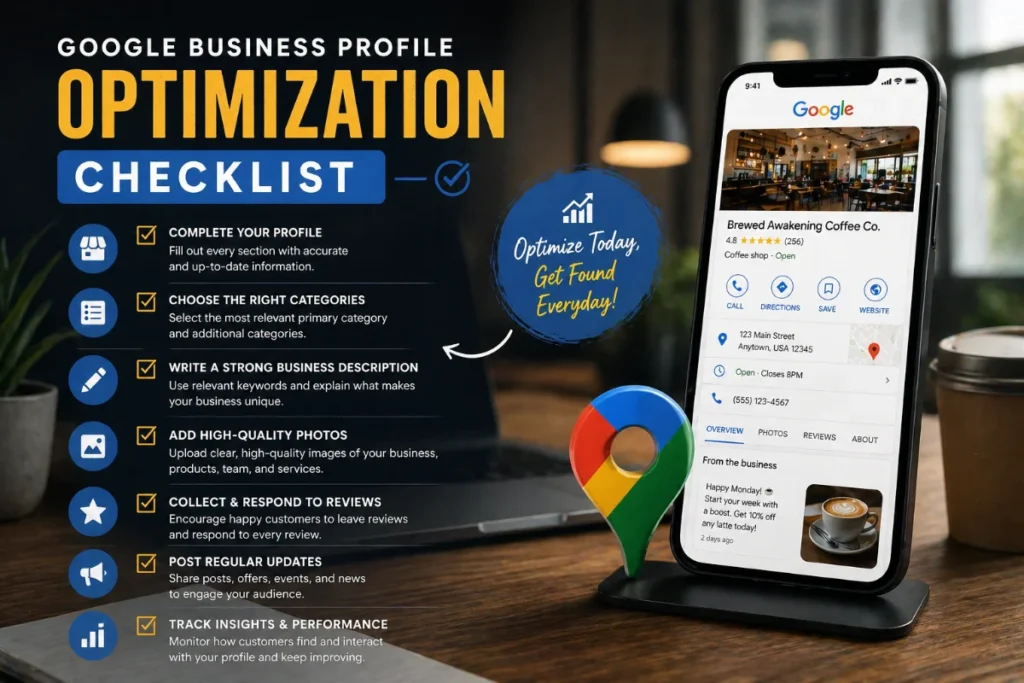
The Only Local Visibility Framework That Still Works
Google Business Profile is no longer just a listing.
In 2026, it will be the primary discovery layer for local businesses across Google Maps, AI answers, and zero-click searches.
If your profile is weak, outdated, or inconsistent, your website SEO cannot save you.
This checklist reflects how LocalMighty optimizes GBP for real local growth, not vanity rankings.
Phase 1: Foundation Setup (Non-Negotiable)
Before growth, your Google Business Profile must be structurally correct. Most businesses fail here.
Business Identity Validation
• Business name matches real-world branding only
• No keywords, cities, or services added to the name
• Name is identical across website, signage, invoices, and directories
Address and Service Area Setup
• Physical address verified and accurate
• Service areas set realistically, not aggressively
• No virtual offices or mailbox addresses
• Service radius reflects actual operations
Category Precision
• Primary category matches core revenue service
• Secondary categories added only if services are actively offered
• No category stuffing
• Categories reviewed against top map competitors
Phase 2: Trust Signals That Actually Influence Rankings
Google now prioritizes recency, authenticity, and consistency, not raw volume.
Review Velocity Strategy
• Target steady monthly review growth
• Focus on the last 90 days, not lifetime totals
• Encourage customers to mention services naturally
• Never script reviews
• Never buy or incentivize reviews
Review Response System
• Respond to every review
• Responses are helpful, not templated
• Service context added naturally
• No keyword stuffing in replies
Reputation Distribution
• Google Reviews actively managed
• Industry review platforms maintained
• Reviews showcased on the website
• Negative feedback addressed publicly and professionally
Phase 3: GBP Content Optimization (Where Most Businesses Lose)
Your profile must clearly communicate your services to Google and AI-driven platforms.
Business Description
• Written in natural language
• Clearly states what the business does and where
• No emojis, no promotional fluff
• Services mentioned once, not repeated
• Updated at least once per year
Services Section Optimization
• Every service is fully added
• Descriptions written for humans, not bots
• No empty or generic services
• Services align with website service pages
• Regular audits to remove outdated offerings
This is where Google Business Profile best practices matter most, because services are now heavily used in AI justifications and Maps relevance.
Phase 4: Visual Proof That Converts and Ranks
Photos are no longer cosmetic. They are ranking and trust signals.
Photo Strategy
• Real job photos only
• Weekly or bi-weekly uploads
• Mix of interior, exterior, team, and work photos
• No stock images
• File names and metadata kept natural
Video Content
• Short real-world clips
• Office walkthroughs or job process videos
• Team introductions
• Uploaded directly to GBP, not embedded links
Businesses with consistent visual updates outperform inactive profiles even with fewer reviews.
Phase 5: Posts, Updates, and Engagement Signals
GBP activity shows Google your business is alive.
Posting Framework
• One to two posts per week
• Mix of updates, FAQs, proof, and seasonal info
• Clear CTA on every post
• Natural language only
• No repetitive posting patterns
Q&A Optimization
• Pre-seed common customer questions
• Answer using service and location context
• Monitor and respond to public questions
• Avoid keyword-stuffed answers
Phase 6: Justification Triggers (The Hidden Ranking Lever)
Google Maps now highlights why a business ranks. You must engineer these signals.
Website Justifications
• Service keywords clearly present on relevant pages
• GBP services aligned with page content
Review Justifications
• Customers naturally mention services
• Responses reinforce relevance
Post and “Provides” Justifications
• Services consistently referenced across GBP
• No spam or forced phrasing
These justifications directly influence map pack visibility.
Phase 7: Local Authority Reinforcement
GBP does not rank in isolation. It relies on external trust.
Citation Consistency
• Core directories secured first
• NAP is perfectly consistent everywhere
• Old or duplicate listings cleaned up
• Industry-specific platforms prioritized
Local Link Signals
• Chamber of Commerce listings
• Local sponsorship pages
• Community partnerships
• Supplier and vendor mentions
Mentions matter as much as links in 2026.
Phase 8: GBP + Website Alignment
Your website must support, not contradict, your profile.
On-Site Alignment
• Service pages match GBP services
• Location pages reinforce proximity
• Embedded Google Map on key pages
• Clear NAP visible site-wide
Conversion Support
• Call buttons are prominent on mobile
• Thank-you pages optimized
• Tracking enabled for calls and directions
Phase 9: AI Search Readiness (2026 Requirement)
GBP now feeds AI answers, not just Maps.
AI Visibility Checklist
• Business entity is clearly defined everywhere
• Same service language used across platforms
• Brand mentioned beyond its own website
• GBP is frequently updated
• Reviews and posts written in conversational language
AI systems favor businesses that look real, active, and consistently referenced.
Phase 10: Ongoing Maintenance (What Keeps Rankings Sticky)
Most businesses lose rankings by stopping.
Monthly Tasks
• New reviews acquired
• Photos uploaded
• Posts published
• Q&A monitored
Quarterly Tasks
• Category review
• Competitor comparison
• Service audit
• Citation accuracy check
Annual Tasks
• Description refresh
• Photo cleanup
• Strategy recalibration
Final Reality Check for Local Businesses
Google Business Profile optimization in 2026 is not a one-time task.
It is:
• Brand building
• Reputation management
• Local authority development
• AI discovery optimization
Businesses that treat GBP as a living asset dominate Maps, AI answers, and local leads.
Those who “set it and forget it” disappear.