
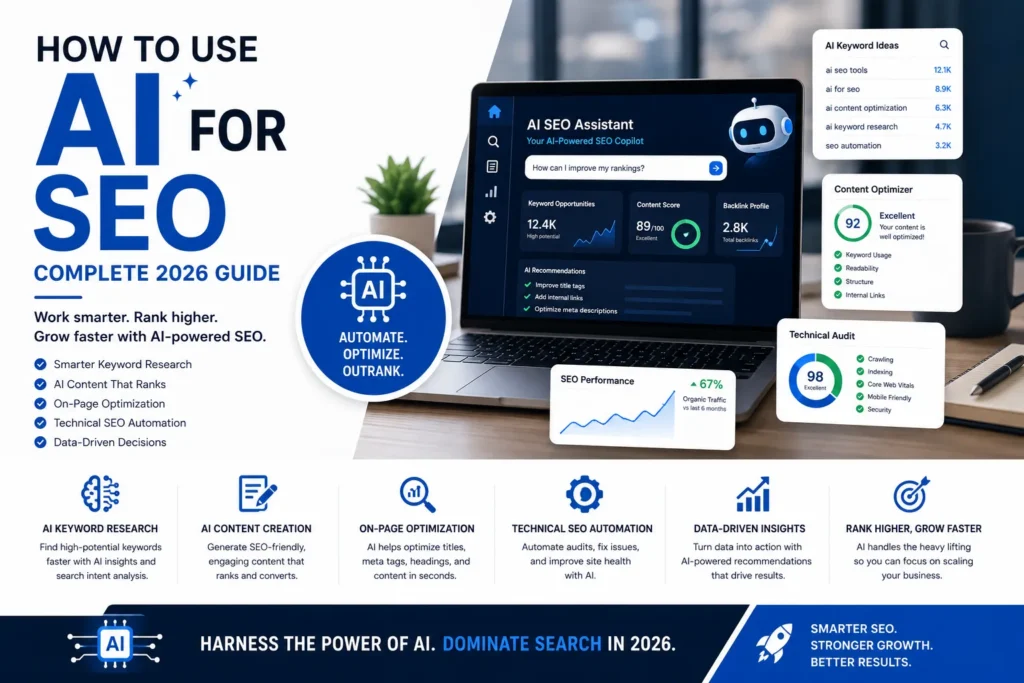
AI has gone from a novelty in SEO to a fixture in the daily routine. Most practitioners now reach for it during keyword research, content planning, technical checks, and dozens of small jobs that used to swallow whole afternoons. Meanwhile, AI has rewired search itself. People pull answers straight from AI Overviews, ChatGPT, Gemini, and Perplexity before they click anything, so SEO is no longer only about ranking a page. It is about being the source the answer is built from.
That shift is both an opening and a hazard. Used well, AI makes you faster, sharper, and more consistent at every stage. Used carelessly, it buries the web in generic filler that helps no one and can quietly drag your own site down. This guide walks through how to use AI for SEO the right way in 2026: what it does well and where it fails, how to apply it across research, content, on-page, technical, and local work, how to get surfaced by AI search itself, which tools matter, the risks to dodge, and a workflow that keeps human judgment in charge where it belongs.
What AI Does Well, and Where It Falls Short
Set expectations before you lean on it for anything. AI is superb at chewing through data, spotting patterns, generating drafts, and grinding out repetitive work. It is weak at strategy, original insight, factual accuracy, and voice. The teams that come out ahead treat it as a fast assistant, never a stand-in for expertise.
| AI is strong at | Humans are still needed for |
| Processing data and spotting patterns | Strategy and prioritization |
| Generating drafts and variations | Accuracy and fact-checking |
| Summarizing and reformatting content | Original insight and experience |
| Repetitive, time-consuming tasks | Brand voice and editorial judgment |
This split matters because search has moved toward intent, entities, and real value rather than keyword repetition. AI can help you cover a topic thoroughly, but only a person can decide what is actually true, useful, and worth saying. Holding that line is also what protects your visibility in AI-generated answers, since the content these systems cite is accurate, well-structured, and trustworthy, not mass-produced padding.
Keyword and Topic Research
Research is the most common and most rewarding place to start. What once meant hours of manual digging, AI can compress into seconds: analyze a topic, suggest related terms, sort them by intent, and surface angles you would have missed. The output is a starting point, not a finished list, but it moves the slow early work along fast.
Use it to expand a seed topic into related questions and long-tail variations, to group terms into themes, and to sketch topic clusters with a pillar page and supporting pieces. A simple prompt asking it to act as an SEO strategist and organize a keyword list into one pillar and several clusters will hand you a usable structure to refine. Always check the results against real search data and your own read of the audience, because AI will happily suggest terms that look sensible but have almost no demand. Pairing that speed with proper keyword research for your market gives you both breadth and accuracy.
Reading Intent and Sizing Up Competitors
Understanding what a searcher truly wants sits at the center of modern SEO, and AI is a capable partner. Hand it a target keyword, and it will describe the likely intent, the content type that fits, and the questions a complete answer should cover. That helps you build for what the searcher needs instead of guessing.
Most queries fall into one of four intents, and AI is quick to label them: informational, where the person wants to learn something like “how does technical SEO work”; commercial investigation, where they are comparing options like “best SEO software”; transactional, where they are ready to act like “hire a local SEO agency”; and navigational, where they want a specific site like “search console login.” It will also flag mixed intent, where a term like “Google Business Profile optimization” needs a bit of teaching, a few steps, and a nudge toward a service, all on one page. Knowing which you are dealing with tells you what the page has to deliver.
It speeds up competitor work too. Feed it the topics or pages your rivals rank for and ask it to flag gaps, angles they skipped, and subtopics they treated thinly. You end up with a map of where you can build something more complete than what already ranks. The point is not to copy anyone, but to understand the field and then make the better resource. As always, treat the analysis as raw input and apply your own judgment about which gaps deserve the effort.
Briefs and Outlines in Minutes
Once the topic and intent are clear, AI quickly turns them into a structured brief. A good brief saves hours of writing and keeps a piece focused, and AI drafts one in minutes. Ask it for an outline built around the target keyword and the questions real searchers ask, then reshape it to fit your angle and expertise.
A strong brief names the primary and supporting keywords, the intent, a logical heading structure, the key points per section, and the internal links to include. Review every outline before you write, because AI drifts toward generic structures that read like every other article on the topic. Your value is in choosing what to emphasize, what to cut, and what original perspective earns the reader’s time. The brief is scaffolding. Your expertise is the building.
Drafting and Editing Without Publishing Slop
Writing draws the most attention and causes the most trouble. AI can produce a draft fast, but raw AI text is generic, often wrong, and easy for readers and search engines alike to spot as filler. Publishing it untouched is one of the quickest ways to weaken a site. The smart play uses AI as a drafting and editing aid with a person firmly at the wheel.
Use it to beat the blank page, to draft sections you fully intend to rewrite, to smooth clumsy passages, and to check grammar and readability. Then do the real work: add genuine expertise, real examples, accurate facts, and your voice. Plenty of strong teams use AI more for editing than for first drafts, tightening human-written copy rather than generating it wholesale. If you do want it for drafting, learning the practical patterns for using ChatGPT for SEO will help you prompt more effectively and edit faster. One rule keeps you safe: never publish anything you have not genuinely improved beyond what the machine could produce on its own.
Prompt Engineering, the Skill Behind the Output
The quality of what AI gives you tracks the quality of what you ask. A lazy prompt like “write an article about technical SEO” yields the same flat, generic draft as everyone else. A detailed one changes the result entirely.
Compare that weak prompt with a strong one: act as an experienced technical SEO strategist writing for intermediate readers; cover topical authority and entity coverage; explain common mistakes; contrast best practices; answer the questions People Also Ask; follow experience and trust principles; and avoid keyword stuffing. The second version constrains the model toward something specific and useful, and the difference in output is night and day. Learning to brief AI well often buys you more than switching to a fancier tool, which is why prompting has quietly become a core SEO skill rather than a side trick.
On Page Work at Speed
On-page optimization is full of small, repetitive tasks AI handles cleanly. It can draft title tags and meta descriptions inside the right character limits, propose header structures, write image alt text, surface featured snippet and People Also Ask opportunities, and check whether a page covers the subtopics that top pages include. At scale, that saves real time.
It shines on refreshes too. Give it an existing page and its target keyword, then ask where the content is thin, what questions it leaves unanswered, and how the structure could improve. A vague hunch that a page underperforms becomes a concrete punch list. Run its suggestions through solid on-page SEO fundamentals, since AI will over-optimize or stuff keywords if you follow it blindly. The aim is a page that reads naturally for people and clearly for search engines, not one engineered purely for an algorithm.
Refreshing What You Already Have
Most teams pour their energy into new articles, but updating existing pages often produces faster gains. A page that already has some authority and history can climb with a good refresh, whereas a brand-new one starts from nothing. AI is well suited to finding those opportunities across a library.
Point it at your published pages and ask it to spot outdated statistics, missing subtopics, thin sections, weak introductions, internal linking gaps, and questions the page never answers. You get a prioritized list of updates ranked by likely payoff instead of guessing which posts to touch. Refreshing a strong page strengthens your topical authority without starting from scratch, and it is usually the highest return work in a mature content program.
Technical SEO and Structured Data
Technical SEO is one of AI’s most practical strengths, because it is data-heavy and pattern-based. AI-powered crawlers can audit a large site in hours rather than weeks, flagging broken links, orphaned pages, duplicate meta tags, slow pages, and faulty markup, and then ranking the fixes by likely impact. On a big site, that alone justifies bringing AI into the workflow.
It also helps with structured data, which matters more every year. AI can generate and validate schema, helping search engines and AI systems read your content accurately. Clean structured data and schema markup make your pages easier for machines to interpret, which supports both classic rankings and your odds of being cited in AI answers. Let AI draft and check the markup, then confirm it reflects your actual content, because incorrect schema can do more harm than no schema at all.
AI for Local SEO
Local businesses get specific advantages beyond the general workflow. AI can draft Google Business Profile descriptions, generate posts and updates, suggest review replies that you then personalize, and produce localized content for different service areas without having to write each one from scratch. That makes keeping a strong, active local presence far more manageable.
The same caution applies, only harder, because local trust lives and dies on accuracy. AI-drafted review replies, profile content, and location pages all need a human pass before they go live. A generic, obviously automated reply can erode trust faster than no reply at all. Handled with care, AI for local SEO helps you scale the consistent, locally relevant work that drives calls and visits, as long as a real person checks that every output is accurate and genuinely local.
Getting Cited in AI Search
Using AI to do SEO is only half the story in 2026. The other half is optimizing so AI systems surface you. As AI Overviews, AI Mode, and assistants like ChatGPT and Perplexity answer more questions outright, earning a citation in those answers is becoming as valuable as ranking in the classic results. The pages cited in AI answers are not always the ones sitting at the top of the blue links, which makes this its own discipline.
It goes by a few names, including generative engine optimization and answer engine optimization, and the principles hold steady. Answer the main question clearly and early, ideally in the opening lines, so a system reading the page can lift a complete answer. Use plain, question-based headings. Break content into clean, self-contained sections. State facts directly and back them with evidence and credible sources. Build real topical depth and consistency so these systems trust you. Learning the fundamentals of generative engine optimization is now part of any complete strategy, because visibility increasingly means being the answer rather than just appearing near it.
Assistants Today, Agents Tomorrow
It helps to separate two things people lump together. AI assistants, like ChatGPT, Gemini, and Claude, respond to your prompts and wait for direction. They are excellent for research, drafting, summarizing, and brainstorming, but you drive. AI agents go a step further, running multi-step workflows on their own, the kind that could audit a site, watch rankings, flag content gaps, and kick off fixes without a human at each step.
Agents are still early, but they are moving fast, and over the next few years, they will likely take over much of the operational grind in SEO. The part that stays human is the same part that always has: strategy, judgment, and the ability to decide what is worth doing in the first place. Knowing which type you are using keeps your expectations realistic and your oversight where it counts.
Choosing AI SEO Tools
The market is packed with AI SEO tools, and it pays to think in categories instead of chasing every launch. Most fall into a few buckets, and you rarely need one from each.
| Tool category | What it helps with |
| General AI assistants | Drafting, brainstorming, summarizing, prompts |
| Keyword and research platforms | Keyword data, intent, clustering, gaps |
| Content optimization tools | Briefs, structure, semantic coverage |
| Technical and audit tools | Crawls, error detection, prioritized fixes |
| AI visibility trackers | Monitoring how you appear in AI answers |
When you choose, favor tools that fit your real workflow, connect to your existing systems, and save actual time over those with the longest feature lists. Pilot a tool on your own site before committing, so you judge it on results. A focused set of SEO tools used well beats a sprawling stack you barely open. The tool is never the strategy. It just executes a strategy you already understand.
The Risks: Slop, Errors, and Thin Content
The biggest danger with AI in SEO is volume without value. Generating hundreds of mediocre pages is trivial now, and search engines have grown sharp at recognizing thin, mass-produced content that exists only to rank. Leaning on AI without judgment creates exactly that. The common traps:
- Publishing generic AI text that reads like every other article
- Trusting AI facts and statistics without verifying them
- Over-optimizing pages until they read unnaturally
- Producing pages at scale with no real expertise behind them
- Flattening your brand voice into a bland, automated tone
- Ignoring accuracy on health, legal, financial, or other sensitive topics
The guard against all of these is human oversight and quality. Search engines reward content that shows real experience, expertise, authority, and trust, and AI cannot fake those on its own. Strengthening the experience and trust signals behind your content, with real authorship, accurate information, and genuine usefulness, is what separates AI-assisted work that wins from AI-generated work that gets buried. Speed without quality is not an edge in SEO. It is a liability.
A Workflow You Can Actually Follow
Put it together, and you get a workflow that uses AI for speed while people own quality and strategy. It runs from research to publishing to measurement, with a checkpoint at every stage.
- Research the topic with AI, then validate keywords and intent against real data.
- Build a brief and outline with AI, then shape it with your angle and expertise.
- Draft with AI support, then rewrite with real examples, accuracy, and voice.
- Optimize on-page elements with AI, then confirm everything reads naturally.
- Generate and validate schema, then check it matches your real content.
- Run an AI-assisted technical and content review before publishing.
- After publishing, track performance and use AI to find refresh opportunities.
Following a checklist built for AEO, GEO, and LLM optimization keeps this cycle honest, surfacing what is working, what is slipping, and what to fix next. AI accelerates each step, but a person makes the calls that decide quality. That balance is the whole game.
Where AI Actually Wins
AI has not replaced SEO. It has raised the floor and the ceiling at once. The floor, because anyone can now produce passable content quickly, so passable no longer clears the bar. The ceiling, because teams that pair AI speed with real expertise can cover topics more thoroughly, fix problems faster, and show up across both traditional and AI search in ways that were out of reach a few years ago.
The winners in 2026 are not the ones automating the most. They are the ones who let AI carry the heavy lifting and then add the judgment, accuracy, and genuine value machines cannot. Give AI the work it is good at, keep people in charge of everything that builds trust, and a powerful tool becomes a lasting advantage in search.