
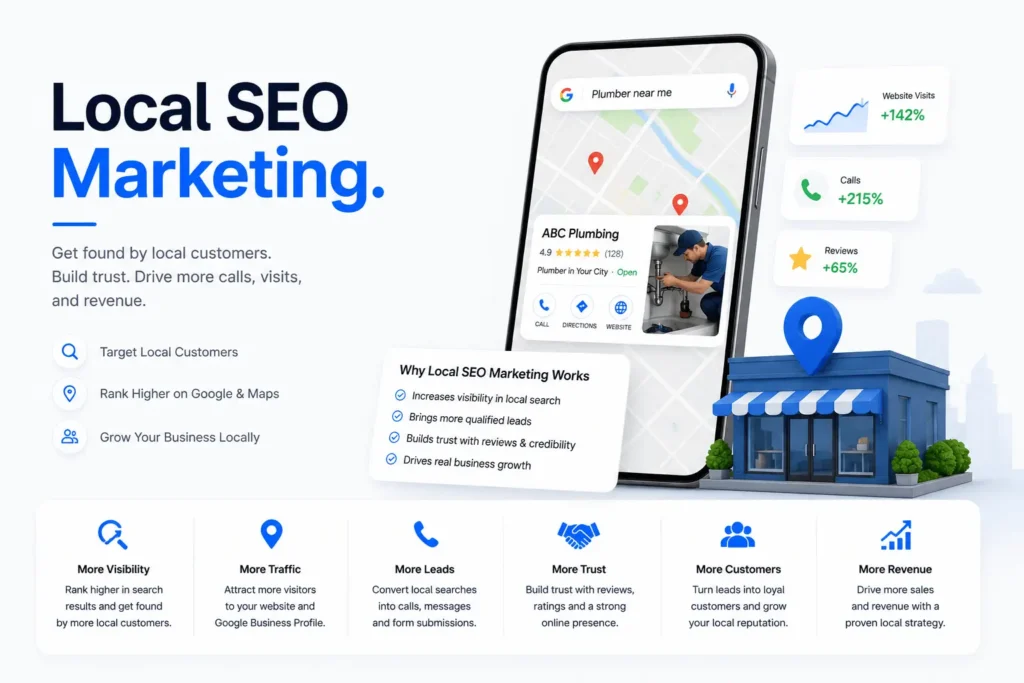
A customer needs a plumber, dentist, attorney, roofer, restaurant, accountant, or nearby service provider.
They open Google, Google Maps, or an AI search tool and ask for a local recommendation.
The businesses that appear first are not there by accident.
They have built enough location relevance, service clarity, trust, authority, and online consistency for search platforms to recognize them as strong local options.
That is what local SEO marketing is designed to achieve.
Local SEO marketing helps a business appear when nearby customers search for its services, compare local providers, read reviews, ask AI tools for recommendations, or look for directions, hours, prices, and contact information.
It combines Google Business Profile optimization, website SEO, local content, reviews, citations, backlinks, structured data, technical SEO, community visibility, and conversion tracking into one connected growth strategy.
This guide follows 12 clearly defined sections:
- What Is Local SEO Marketing?
- How Local SEO Marketing Helps Local Businesses Grow
- How Local SEO Marketing Works Across the Local Search Ecosystem
- How to Do Local SEO Marketing Step by Step
- The Local SEO Marketing Channels That Matter Most
- How to Succeed With Local SEO Marketing
- How Long Local SEO Marketing Takes to Work
- How to Measure Local SEO Marketing Performance
- Common Local SEO Marketing Mistakes
- A 90 Day Local SEO Marketing Action Plan
- How LocalMighty Helps Businesses Grow Through Local SEO Marketing
- Local SEO Marketing Turns Local Demand Into Measurable Growth
1. What Is Local SEO Marketing?
Local SEO marketing is the process of improving a business’s visibility for searches connected to a specific city, neighborhood, service area, or physical location.
Its purpose is to help nearby customers discover and choose the business.
A local SEO marketing campaign may help a company appear in:
- Google Maps
- The local map pack
- Organic search results
- Google AI Overviews
- ChatGPT recommendations
- Gemini responses
- Perplexity citations
- Apple Maps
- Bing Places
- Local directories
- Industry platforms
- Review websites
- Voice search results
Traditional SEO often focuses on reaching a broad national or international audience.
Local SEO focuses on geographic intent.
Someone searching for “how to repair a leaking pipe” has informational intent.
Someone searching for “emergency plumber near me” has immediate local intent.
The second search is much closer to a phone call, appointment, or booked job.
Local SEO Marketing Versus Traditional SEO
Traditional SEO can help a website rank for broad topics regardless of the searcher’s location.
Local SEO marketing connects the business to searches with geographic or local buying intent.
Traditional SEO may target:
- How to prepare a tax return
- Types of dental implants
- Signs of roof damage
- What estate planning includes
Local SEO may target:
- Accountant near me
- Dental implants in Phoenix
- Roof repair company in Dallas
- Estate planning attorney San Diego
Both approaches can work together.
Informational content builds authority and captures early demand for research.
Local service pages, location pages, Google Maps visibility, reviews, and citations help convert that authority into local leads.
Local SEO Marketing Is More Than Google Maps
Many businesses assume local SEO only means optimizing a Google Business Profile.
Google Business Profile is important, but it is only one part of the complete system.
A business can have a strong profile and still struggle if:
- The website is slow
- Service pages are weak
- Location signals are unclear
- Reviews are inconsistent
- Business information conflicts across platforms
- Competitors have stronger local authority
- The website does not convert visitors
- Search engines cannot understand the business entity
- AI platforms cannot verify the company’s services and reputation
Successful local SEO marketing connects all the signals.
2. How Local SEO Marketing Helps Local Businesses Grow
Local SEO marketing places a business in front of people who are already searching for what it offers.
This makes local search different from many forms of interruption-based advertising.
The business is not trying to create demand from nothing.
It is capturing demand that already exists.
It Increases Visibility at High Intent Moments
Local searches often happen close to a decision.
A homeowner searching for emergency AC repair is likely dealing with an immediate problem.
A parent searching for a pediatric dentist nearby may be ready to schedule an appointment.
A business owner searching for a local accountant may be preparing to hire professional help.
Strong local visibility puts the business in front of these prospects before a competitor earns the call.
It Generates More Calls, Messages, Visits, and Bookings
Local search results can create several direct actions:
- Phone calls
- Website visits
- Direction requests
- Appointment bookings
- Quote requests
- Form submissions
- Online orders
- Walk-in visits
- Consultation requests
This is why local SEO should be measured beyond rankings.
A number-one ranking that generates no calls has limited business value.
A strong campaign connects rankings to real conversions.
It Builds Trust Before the First Conversation
Customers often investigate a business before making contact.
They may compare:
- Review count
- Review recency
- Review quality
- Photos
- Business hours
- Website quality
- Service descriptions
- Team credentials
- Licenses
- Local experience
- Social activity
- Directory listings
- Brand mentions
Local SEO strengthens these trust signals.
By the time a prospect calls, they may already feel familiar with the company.
It Reduces Dependence on Paid Advertising
Paid advertising can generate leads quickly, but visibility usually stops when spending stops.
Local SEO builds assets that can continue creating demand over time.
These assets include:
- Optimized service pages
- Location pages
- Google Business Profile authority
- Reviews
- Local content
- Citations
- Backlinks
- Brand searches
- Community mentions
- AI citations
Local SEO still requires ongoing work, but it can create a more durable acquisition channel.
It Helps Smaller Businesses Compete Locally
A local business may not have the budget or national authority of a large brand.
However, it can often compete effectively within its real service area.
A smaller company can win through:
- Better local relevance
- More specific service pages
- Stronger reviews
- Faster response times
- Better photos
- More useful local content
- Stronger community relationships
- Better conversion experience
Local search gives businesses an opportunity to compete where proximity, relevance, and local trust matter.
It Improves Visibility in AI Search
People increasingly ask conversational platforms questions such as:
- Who is the best roofer near me?
- Which local dentist has strong reviews?
- Find an estate planning attorney in San Diego
- What HVAC companies offer emergency service nearby?
- Recommend a local SEO agency for a service business
AI platforms look for clear, consistent, and verifiable information.
A strong local SEO presence provides these systems with more evidence to understand better and potentially recommend a business.
3. How Local SEO Marketing Works Across the Local Search Ecosystem
Local customers do not follow one fixed path.
A person may first discover a business in Google Maps, read its reviews on another platform, visit its website, watch a video, and later search the business name directly.
Local SEO marketing supports that entire journey.
Google Maps and the Local Pack
The local pack commonly displays businesses alongside map results.
Three broad factors generally influence visibility:
- Relevance
- Distance
- Prominence
Relevance reflects how closely the business matches the search.
Distance considers the relationship between the searcher and the business.
Prominence reflects how established, trusted, and well-known the business appears.
A business cannot control every proximity factor, but it can improve relevance and prominence through stronger categories, services, content, reviews, citations, links, and brand signals.
Organic Search Results
Organic results give businesses more space to explain services and target specific searches.
A website may rank through:
- Service pages
- Location pages
- Industry pages
- Blog content
- Cost guides
- Comparison guides
- Emergency service pages
- Frequently asked questions
- Project pages
- Case studies when real
Google Maps and organic SEO work best together.
The profile captures quick local actions.
The website provides deeper information and supports a wider range of searches.
Review and Directory Platforms
Customers may also discover or validate businesses through:
- Yelp
- Apple Maps
- Bing Places
- Better Business Bureau
- Angi
- Houzz
- Thumbtack
- TripAdvisor
- OpenTable
- Zocdoc
- Zillow
- Realtor.com
- Industry directories
- Local chambers of commerce
The relevant platforms depend on the industry.
A strong local marketing strategy identifies which websites appear for the target searches and builds visibility there.
AI Search and Answer Engines
AI platforms gather information from multiple sources.
They may use:
- Website content
- Business profiles
- Reviews
- Directories
- News mentions
- Structured data
- Social profiles
- Community discussions
- Trusted third-party references
This makes consistency increasingly important.
If the website says one thing, the Google profile says another, and directory listings contain outdated information, search systems receive conflicting signals.
Branded Search
Branded search happens when someone searches for the business by name.
Examples include:
- Business name reviews
- Business name phone number
- Business name services
- Business name complaints
- Business name location
A growing number of branded searches can indicate stronger local awareness.
Local SEO marketing should not only capture generic searches.
It should also help make the brand more recognizable and trusted.
4. How to Do Local SEO Marketing Step by Step
Local SEO works best when execution follows the right order.
Publishing random blogs or buying backlinks before fixing the foundation often wastes time and money.
Step 1: Define the Real Business Goals
Start with outcomes.
Possible goals include:
- More phone calls
- More booked appointments
- More quote requests
- More store visits
- More consultations
- More qualified leads
- More visibility in selected cities
- Better visibility for high-value services
- Growth across multiple locations
The strategy should prioritize services that matter financially.
A company with ten services may generate most of its revenue from only three of them.
Those services should usually receive the strongest initial focus.
Step 2: Audit Current Local Visibility
Review the business across:
- Google Business Profile
- Google Maps rankings
- Organic rankings
- Website structure
- Service pages
- Location pages
- Reviews
- Citations
- Backlinks
- Technical SEO
- AI search visibility
- Conversion tracking
Look for gaps, not just rankings.
A business may already receive traffic but lose leads because the phone number is hard to find or the website loads poorly on mobile.
Step 3: Research Local Search Demand
Keyword research should reflect how real customers search.
Group keywords by intent:
Service intent
- Plumber
- Personal injury attorney
- Dental implants
- Commercial landscaping
- Tax preparation
Location intent
- Plumber in Phoenix
- Attorney in San Diego
- Dentist in Austin
- Landscaper in Mesa
Urgent intent
- Emergency plumber near me
- Same day AC repair
- 24-hour garage door repair
Research intent
- How much does roof replacement cost?
- When should I replace my air conditioner?
- How do I choose an estate planning attorney?
Comparison intent
- Best local SEO companies
- Independent insurance agent versus national company
- Repair versus replacement
Each keyword group should have a clear destination.
Do not force every keyword onto the homepage.
Step 4: Map Keywords to the Right Pages
A clean keyword map prevents pages from competing against one another.
Use the principle:
One clear search intent equals one strong page.
A local service business may need:
- One homepage
- One page for each core service
- One page for each major location
- Supporting pages for high-intent subservices
- Blog posts for educational questions
- Comparison or cost guides for research intent
The website should make it obvious what the business does and where it works.
Step 5: Optimize Google Business Profile
Complete and strengthen the profile.
Key areas include:
- Real business name
- Accurate primary category
- Relevant secondary categories
- Correct address or service area
- Accurate phone number
- Website URL
- Business hours
- Holiday hours
- Opening date
- Service list
- Business description
- Photos
- Videos
- Posts
- Questions and answers where appropriate
- Review responses
Choose the primary category carefully.
The category should reflect the main service the business wants to rank for.
Avoid adding unrelated categories that weaken topical focus.
Step 6: Build Strong Service Pages
Every important service should have a dedicated page.
A strong service page should explain:
- What the service includes
- Who needs it
- Problems it solves
- How the process works
- Why the business is qualified
- Where the service is available
- Common questions
- What the visitor should do next
Thin service pages make it difficult for users and search engines to understand the offer.
Step 7: Build Useful Location Pages
Location pages can help businesses target important cities, neighborhoods, or service areas.
Each location page should contain real local value.
Useful elements include:
- Services available in the area
- Local conditions or customer needs
- Nearby neighborhoods
- Relevant project experience
- Travel or response information
- Local testimonials where real
- Frequently asked questions
- Links to relevant service pages
- Clear contact options
Changing only the city name creates weak pages.
Each page should feel like it belongs to that location.
Step 8: Improve On-Page SEO
Optimize each important page with:
- Clear title tag
- Useful meta description
- One descriptive H1
- Logical H2 and H3 structure
- Main keyword used naturally
- Supporting terms and entities
- Internal links
- Image alt text
- Clear calls to action
- Relevant schema
- Clean URL
On-page SEO should improve clarity, not make the writing sound unnatural.
Step 9: Create a Review Generation System
Do not depend on occasional review requests.
Build reviews into the customer process.
A simple system may include:
- Ask after a successful service
- Send a direct review link
- Follow up by SMS or email
- Use QR codes where appropriate
- Train staff to ask naturally
- Respond to every review
Steady review activity usually looks more natural and trustworthy than sudden bursts.
Reviews also help prospects understand the customer experience.
Step 10: Build Accurate Citations
Make sure the business appears consistently across relevant platforms.
Check:
- Business name
- Address
- Phone number
- Website
- Categories
- Hours
- Description
Start with major platforms.
Then expand into industry directories and local organizations.
Do not chase hundreds of low-quality directory links.
Prioritize platforms that customers and search engines actually use.
Step 11: Earn Relevant Local Authority
Backlinks and mentions can strengthen prominence.
Useful sources include:
- Local news websites
- Chambers of commerce
- Community organizations
- Local charities
- Industry associations
- Suppliers
- Business partners
- Local events
- Podcasts
- Relevant guest articles
- Resource pages
A relevant local link can be more useful than an unrelated link from a larger website.
Step 12: Publish Local Content That Supports Revenue
Content should help customers make decisions.
Useful topics include:
- Service costs
- Local regulations
- Seasonal problems
- Emergency advice
- Comparison guides
- Maintenance guidance
- Neighborhood-specific information
- Frequently asked questions
- How to choose a provider
- Signs that professional help is needed
Every blog post should connect to a service, customer question, or stage of the buying journey.
Step 13: Optimize for AI Search and Structured Understanding
Make important information easy for machines to interpret.
Use:
- Clear service descriptions
- Consistent business details
- Question-based headings
- Direct answers
- Local entities
- Structured data
- Author and business information
- Visible credentials
- Reviews and third-party mentions
- Crawlable HTML content
AI search optimization does not replace traditional local SEO.
It strengthens and extends it.
Step 14: Fix Technical SEO and Website Security
Technical problems can block every other strategy.
Check:
- Mobile speed
- HTTPS
- Crawlability
- Indexing
- XML sitemap
- Canonical tags
- Redirects
- Broken links
- Duplicate pages
- Structured data errors
- Core Web Vitals
- Mobile usability
- Contact form functionality
Security also matters.
Use:
- Two-factor authentication
- Strong passwords
- Regular backups
- Updated plugins
- Updated themes
- Malware monitoring
- Secure hosting
A hacked or unstable website can damage rankings and customer trust.
Step 15: Improve Conversion Paths
Local SEO traffic should lead to action.
Make sure every important page includes:
- Visible phone number
- Click-to-call option
- Clear CTA
- Short contact form
- Trust signals
- Reviews
- Real photos
- Service area information
- Hours
- Expected response process
Do not make visitors search for the next step.
Step 16: Track Results and Improve Continuously
Set up tracking for:
- Calls
- Forms
- Bookings
- Website clicks
- Direction requests
- Google Maps visibility
- Organic rankings
- Review growth
- Brand searches
- Conversion rates
- Revenue where possible
Local SEO is not a one-time setup.
The campaign should improve as new data becomes available.
5. The Local SEO Marketing Channels That Matter Most
A complete campaign uses multiple channels, but each channel has a different role.
Google Business Profile
Best for:
- Map visibility
- Calls
- Directions
- Reviews
- Quick business information
- Local discovery
The profile often becomes the first point of contact.
Website SEO
Best for:
- Service detail
- Location targeting
- Organic rankings
- Long-form content
- Conversion
- Trust building
- AI understanding
The website is the business’s most controllable search asset.
Reviews
Best for:
- Trust
- Conversion
- Reputation
- Local prominence
- AI recommendation signals
- Customer validation
Recent, genuine reviews can strongly influence customer choice.
Local Content
Best for:
- Topical authority
- Educational searches
- Long tail keywords
- Seasonal demand
- Internal linking
- AI visibility
Content should support commercial pages and real customer questions.
Citations and Directories
Best for:
- Entity consistency
- Additional discovery
- Local trust
- Industry visibility
- Third-party validation
- Quality and relevance matter more than raw quantity.
Local Backlinks and Mentions
Best for:
- Authority
- Prominence
- Referral traffic
- Brand recognition
- Community trust
Strong relationships often create stronger links than automated outreach.
Social Media and Community Visibility
Best for:
- Brand awareness
- Community engagement
- Branded search
- Events
- Visual proof
- Customer familiarity
Social media may not replace SEO, but it can strengthen the brand signals that support search performance.
AI Search Optimization
Best for:
- Conversational discovery
- Business recommendations
- Question answering
- Entity understanding
- Visibility beyond traditional results
AI visibility becomes stronger when the business already has consistent, credible signals across the web.
6. How to Succeed With Local SEO Marketing
Knowing how to do local SEO marketing is not enough.
Success depends on execution quality, consistency, and business alignment.
Focus on Leads, Not Rankings Alone
Rankings are useful indicators.
They are not the final business goal.
A successful campaign should improve:
- Qualified calls
- Appointment requests
- Booked jobs
- Consultations
- Store visits
- Revenue
Track rankings, but connect them to conversions.
Fix the Foundation Before Scaling
Do not build more pages on a broken website.
Do not buy backlinks before fixing crawlability.
Do not run ads to a page that cannot convert.
Do not create dozens of location pages before building strong service pages.
A better order is:
- Technical stability
- Website structure
- Service clarity
- Google Business Profile
- Reviews
- Citations
- Content
- Authority building
- Conversion improvement
- Scaling
Match the Strategy to the Market
A dentist in a small town may need a different investment than a personal injury law firm in a major city.
Competition depends on:
- Industry
- City size
- Number of competitors
- Competitor authority
- Review strength
- Website quality
- Service value
- Geographic reach
There is no universal package that fits every local business.
Build Consistency Across Every Platform
Search engines should see the same business across all platforms.
Keep these details aligned:
- Name
- Address
- Phone number
- Website
- Categories
- Services
- Hours
- Brand description
Consistency improves entity clarity.
Publish Better Pages, Not More Pages
A strong service page can be more valuable than ten weak blog posts.
A detailed location page can outperform dozens of copied city pages.
Prioritize usefulness, depth, and intent.
Maintain Steady Review Velocity
A business with hundreds of old reviews may still appear less active than a competitor that consistently receives fresh reviews.
Build review generation into daily operations.
Use Real Photos and Real Proof
Local customers want evidence.
Show:
- Team members
- Office
- Vehicles
- Projects
- Completed work
- Events
- Before and after results
- Real environment
Authenticity improves trust and conversion.
Align SEO With Customer Experience
SEO may bring the lead, but the business still needs to convert it.
Slow response times, missed calls, poor follow-up, or confusing pricing can waste strong search visibility.
Local SEO success also depends on operations.
Keep Improving Based on Data
Review which:
- Pages generate leads
- Keywords produce calls
- Cities convert
- Services create revenue
- Posts gain visibility
- Reviews mention recurring strengths
- Competitors are gaining ground
Use this information to refine the campaign.
7. How Long Local SEO Marketing Takes to Work
Local SEO does not have one fixed timeline.
Some improvements can happen quickly.
Others require months of consistent work.
Early Improvements
During the first several weeks, a business may see progress from:
- Google Business Profile corrections
- Category improvements
- Technical fixes
- Better service pages
- Improved internal linking
- New review activity
- Tracking setup
Developing Momentum
Over the next few months, growth may come from:
- Stronger map visibility
- More indexed pages
- Better local rankings
- Increased calls
- More reviews
- Improved brand searches
- New citation and link signals
Long-Term Growth
Competitive markets often require sustained work across:
- Content
- Reviews
- Links
- Brand authority
- Location expansion
- Conversion optimization
- AI visibility
Local SEO should be viewed as a compounding channel.
The work builds on itself when the foundation is strong.
8. How to Measure Local SEO Marketing Performance
The best reporting connects search visibility to business outcomes.
Visibility Metrics
Track:
- Local map rankings
- Organic rankings
- Search impressions
- Google Business Profile views
- Search queries
- Brand searches
- AI search mentions where observable
Engagement Metrics
Track:
- Website clicks
- Phone calls
- Direction requests
- Form submissions
- Appointment bookings
- Chat interactions
- Time on important pages
Reputation Metrics
Track:
- New reviews
- Review velocity
- Average rating
- Review response rate
- Review sentiment
- Common service mentions
Conversion Metrics
Track:
- Qualified leads
- Booked jobs
- Consultations
- Sales
- Lead to customer rate
- Revenue from organic search
- Revenue by location or service
Recommended Tracking Tools
A complete setup may include:
- Google Analytics
- Google Search Console
- Google Tag Manager
- Google Business Profile performance data
- Call tracking
- Form tracking
- Local rank tracking grids
- Customer relationship management software
- UTM parameters
Reporting should answer:
What improved?
What created leads?
Which services performed best?
Which locations need more work?
What should happen next?
9. Common Local SEO Marketing Mistakes
Treating Google Business Profile as a One-Time Setup
Profiles need ongoing accuracy, reviews, photos, posts, and monitoring.
Targeting Every Keyword on the Homepage
This creates confusion and limits the website’s ability to rank for specific services.
Creating Duplicate Location Pages
Changing the city name is not a local strategy.
Each location page needs genuine local value.
Buying Cheap Backlinks
Low-quality links can waste money and create risk.
Prioritize relevance and authority.
Ignoring Conversion Rate
More traffic does not guarantee more leads.
The website must make contact easy.
Using Fake Reviews or Fake Locations
Shortcuts can lead to suspensions, reputational problems, and long-term damage.
Publishing Generic AI Content
Mass-produced content often lacks experience, local detail, useful examples, and original insight.
Use AI to support research and workflow, not to replace expertise.
Ignoring Mobile Users
Many local searches happen on phones.
A slow or confusing mobile site loses calls.
Tracking Rankings Without Tracking Leads
A campaign cannot improve properly without conversion data.
Stopping Too Early
Local SEO compounds over time.
Businesses often stop just as authority begins to build.
10. A 90 Day Local SEO Marketing Action Plan
Days 1 to 30: Build the Foundation
Complete:
- Local SEO audit
- Competitor review
- Keyword research
- Keyword mapping
- Google Business Profile cleanup
- Category review
- Citation audit
- Technical SEO fixes
- Conversion tracking
- Service page planning
The first month should create clarity.
Days 31 to 60: Strengthen Relevance and Trust
Complete:
- Core service page optimization
- Location page improvements
- Review generation system
- Photo uploads
- Google Business Profile posts
- Internal linking
- Schema implementation
- Important directory listings
- Local content publishing
The second month should strengthen relevance and customer confidence.
Days 61 to 90: Build Authority and Refine Performance
Complete:
- Local link outreach
- Community partnership opportunities
- Additional content
- Conversion testing
- Ranking grid analysis
- Underperforming page improvements
- AI search visibility checks
- Review response improvement
- Lead quality analysis
The third month should turn early progress into a repeatable growth process.
11. How LocalMighty Helps Businesses Grow Through Local SEO Marketing
LocalMighty provides local SEO services that help local businesses improve Google Maps visibility, strengthen service and location pages, optimize Google Business Profiles, build reviews and local authority, improve technical SEO, and create content that supports visibility across Google Search and AI platforms.
The focus extends beyond rankings.
Every strategy is built around generating more calls, qualified leads, customers, and measurable revenue from local search.
12. Local SEO Marketing Turns Local Demand Into Measurable Growth
Local SEO marketing helps businesses become visible when nearby customers are actively searching for a solution.
It integrates Google Maps, website SEO, reviews, local content, citations, backlinks, technical performance, AI visibility, and conversion optimization into a single, complete customer acquisition system.
The businesses that succeed do not depend on a single listing, page, or tactic.
They build a consistent local presence across every platform customers use to discover, compare, and trust local companies.
That is how local SEO marketing turns search visibility into calls, appointments, booked jobs, customers, and long-term business growth.
The structure is intentionally mapped so every section listed in the opening roadmap matches the actual guide headings.
Frequently Asked Questions About Local SEO Marketing
Local SEO marketing helps a business appear when nearby customers search for its products or services on Google Maps, in organic search results, on directories, and on AI platforms.
Regular SEO may target broad audiences. Local SEO focuses on searches connected to a city, neighborhood, service area, or nearby location.
Start by auditing the website and Google Business Profile, researching local keywords, mapping each search intent to the correct page, fixing technical issues, and building a consistent review process.
Yes. Google Business Profile is one of the most important assets for local map visibility, calls, directions, reviews, and customer discovery.
Blog content can help when it answers real customer questions and supports service pages. The business should build strong service and location pages first.
Create pages only for locations the business genuinely serves and can describe with useful, unique content. Do not create hundreds of thin pages.
Yes, but hiding an address does not automatically expand ranking reach. The business still needs strong service area signals, reviews, content, citations, and website relevance.
Yes. Strong entity information, reviews, local content, structured data, citations, and brand mentions can improve how AI systems understand and reference a business.
Some foundational work can be completed once, but rankings, reviews, competitors, content, and search behavior continue changing. Ongoing management usually produces stronger long-term performance.
Cost depends on competition, location, industry, website condition, number of services and locations, and campaign scope. A single-location business in a smaller market may require less work than a multi-location company in a highly competitive industry.