
A homeowner rarely searches for a roofing company at a convenient time.
They may notice water spreading across a ceiling during a storm. They may find missing shingles while cleaning the yard. Their insurance company may have told them to schedule an inspection. Their roof may simply be approaching the end of its expected life.
Whatever caused the search, the homeowner usually wants answers quickly:
• Is the damage serious?
• Can someone inspect it today?
• Does the roofer work in my area?
• Is the company licensed, insured, and reputable?
• Will someone explain the insurance process?
• How much could the repair or replacement cost?
Local SEO helps your roofing company become visible during these moments.
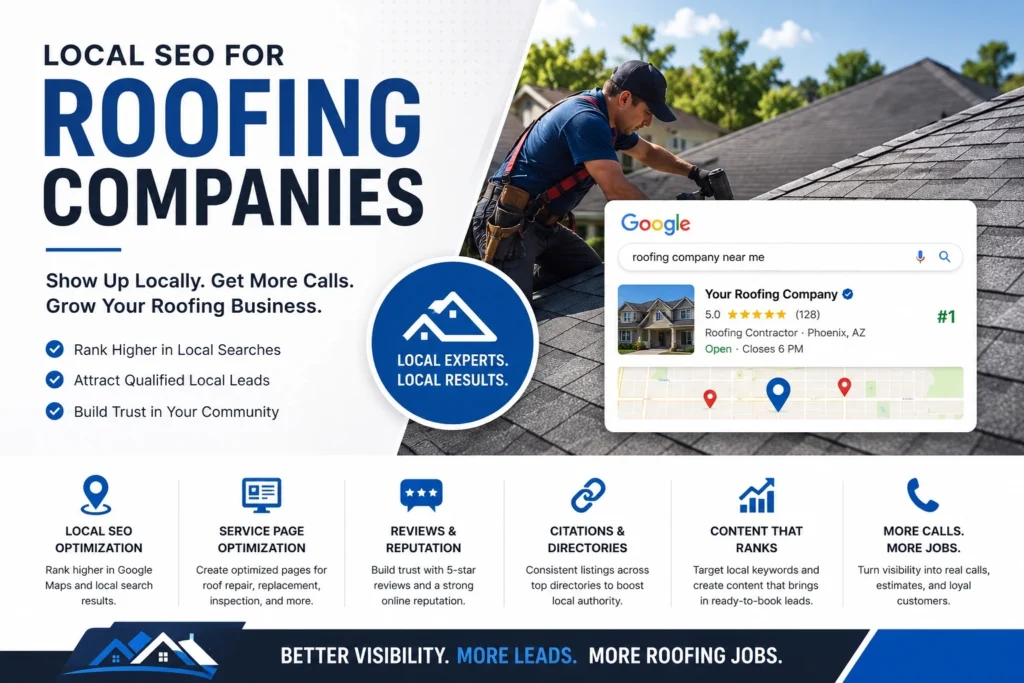
Local SEO for roofers is the process of improving a roofing company’s visibility across Google Search, Google Maps, local business listings, review platforms, and AI-powered search experiences for people within its real service area.
The objective is not simply to generate more website traffic.
The objective is to produce more:
• Qualified phone calls
• Roof inspection requests
• Emergency repair inquiries
• Replacement estimates
• Storm damage leads
• Commercial roofing opportunities
• Revenue from the locations and services that matter most
A complete local roofing SEO strategy integrates your Google Business Profile, website, reviews, local authority, content, technical foundation, AI visibility, and conversion experience.
When these elements work together, your company becomes easier to find and easier to trust.
The Roofing Local SEO Revenue System
Roofing companies do not win local search with a single isolated tactic.
They win by building seven connected layers:
- Local demand intelligence
- Google Business Profile visibility
- Service and location page relevance
- Reviews and reputation
- Local authority and brand mentions
- Technical and AI search accessibility
- Conversion and revenue tracking
Weakness in any layer reduces the value of the others.
A strong Google Business Profile cannot compensate for a website that fails to convert. An excellent website may generate little local demand if the business has weak map visibility. Hundreds of reviews will not protect a company whose profile violates Google’s eligibility guidelines.
The strongest roofing companies treat local SEO as a complete customer acquisition system.
1. Understand How Roofing Customers Search
Before optimizing anything, separate roofing searches by the problem, urgency, and stage of the buying decision.
Emergency Roofing Searches
Emergency searches occur when the homeowner believes the property is at immediate risk.
Common searches include:
• Emergency roof repair near me
• Roof leak repair today
• Roofer open now
• Storm damage roofer near me
• Emergency tarping service
• Fallen tree roof repair
• Same-day roof inspection
These searchers often prioritize:
• Availability
• Response time
• Proximity
• Recent reviews
• Clear phone access
• Emergency service confirmation
• Evidence that the company handles the exact problem
They are less likely to read a long company history before calling.
Your profile and landing page must reduce uncertainty immediately.
Planned Repair Searches
These homeowners know something is wrong, but the situation is not yet an emergency.
Examples include:
• Roof repair company near me
• Shingle repair in [city]
• Flashing repair contractor
• Chimney leak roofer
• Roof vent repair
• Flat roof repair near me
These customers are more likely to compare:
• Experience
• Repair process
• Warranties
• Materials
• Reviews
• Pricing factors
• Inspection availability
A generic roofing page may not satisfy these searches. Dedicated service content usually provides a better match.
Roof Replacement Searches
Replacement customers often represent the highest potential project value.
Typical searches include:
• Roof replacement company in [city]
• New roof cost in [city]
• Best roofing contractors near me
• Asphalt shingle roof replacement
• Metal roofing company near me
• How long does roof replacement take?
• Should I repair or replace my roof?
These homeowners may research for days or weeks.
They need deeper information about:
• Replacement cost factors
• Roofing systems
• Material differences
• Installation process
• Financing
• Warranties
• Contractor credentials
• Project timelines
• Cleanup and property protection
Storm Damage and Insurance Searches
Storm-related searches combine urgency, confusion, and financial concern.
Examples include:
• Hail damage roof inspection
• Storm damage roofing contractor
• Does homeowners insurance cover roof damage?
• How to document hail damage
• Roofer who works with insurance claims
• Emergency roof tarp after storm
Content targeting these queries must be accurate and carefully worded.
Do not promise that insurance will cover a claim. Do not imply that the roofing company can perform regulated insurance services unless it is legally authorized to do so.
Explain what the company genuinely provides, such as:
• Damage documentation
• Roof inspections
• Repair estimates
• Photographs
• Communication with the homeowner
• Supporting information requested by an insurer
Rules involving insurance claims can vary by jurisdiction. Have local compliance language reviewed where necessary.
Commercial Roofing Searches
Commercial buyers behave differently from homeowners.
They may search for:
• Commercial roofing contractor in [city]
• Flat roof repair company
• TPO roofing contractor
• Apartment roofing company
• HOA roofing contractor
• Industrial roof inspection
• Emergency commercial roof repair
Their decision may involve:
• Property managers
• Facility managers
• HOA boards
• Building owners
• Insurance representatives
• Procurement teams
Commercial roofing deserves a distinct content and conversion strategy when it represents a meaningful service line.
2. Know What Drives Local Roofing Visibility
Google states that local results are mainly determined by relevance, distance, and prominence.
Relevance
Relevance reflects how well the business matches the search.
For a roofing company, relevance is strengthened through:
• The correct Google Business Profile category
• Accurate roofing services
• Service-specific website pages
• Clear business descriptions
• Relevant reviews
• Location and service context
• Strong internal linking
• Complete profile information
A business that only describes itself as a “home improvement company” may be less relevant to a roof repair search than a company clearly identified as a roofing contractor.
Distance
Distance refers to how far the business is from the searcher or from the location included in the query.
This is especially important for service area roofing companies.
Adding twenty cities to a Google Business Profile does not automatically make the company equally competitive in every city. Service areas indicate where a business operates, but they do not eliminate Google’s distance consideration.
No legitimate SEO strategy can eliminate proximity completely.
The goal is to strengthen relevance and prominence within the markets the company can realistically serve.
Prominence
Prominence reflects how established and recognized the business appears.
Google may consider information about a business from across the web, including reviews, links, articles, and directories. Google also confirms that review count, review score, and the business’s position in traditional web results can influence local visibility.
For roofing companies, prominence can grow through:
• Genuine customer reviews
• Local press mentions
• Relevant backlinks
• Manufacturer or industry profiles
• Chamber and community participation
• Strong organic rankings
• Consistent business information
• Branded searches
• A recognizable local reputation
This is why local SEO cannot be limited to editing a Google Business Profile.
3. Audit the Roofing Market Before Making Changes
A local SEO strategy should begin with the market, not the website.
Map the Actual Service Area
Document:
• Cities currently served
• Cities producing the best customers
• Average drive time
• Emergency response boundaries
• Crew capacity
• High-value neighborhoods
• Commercial service markets
• Areas the company does not want to target
Do not build a strategy around cities the company cannot service profitably.
Separate Services by Lead Value
List every meaningful service and estimate:
• Average project value
• Closing rate
• Profitability
• Seasonality
• Service capacity
• Geographic limitations
• Urgency
• Sales cycle
A roofing company may discover that emergency repairs generate many calls but roof replacements produce most of its revenue. Both matter, but they should not receive identical resources.
Review Local Competitors
Evaluate competitors across three surfaces:
Google Maps
Review:
• Categories
• Review volume and recency
• Review themes
• Profile completeness
• Photos
• Services
• Business names
• Physical locations
• Service areas
Organic Search
Review:
• Service pages
• City pages
• Content depth
• Backlinks
• Site speed
• Internal linking
• Trust signals
• Pricing information
• Project galleries
AI Search
Test commercial prompts in ChatGPT, Gemini, Perplexity, and Google’s AI features.
Examples:
• Who are the best roofers in [city]?
• Which roofing companies handle storm damage in [city]?
• What should I look for when hiring a roofer in [city]?
• Which roofing contractors offer emergency repairs near [location]?
Record which businesses and third-party sources appear.
This reveals the broader information network that influences local recommendations.
4. Optimize the Google Business Profile Correctly
For many roofing companies, the Google Business Profile is the first and most important conversion point.
A homeowner may call directly from Google Maps without visiting the website.
The profile must answer four questions immediately:
• Is this a real roofing company?
• Does it provide the service I need?
• Does it serve my location?
• Can I trust it enough to call?
Choose the Correct Business Type
Many roofing companies operate as service-area businesses because crews travel to customers, and clients do not visit the company’s address.
Google instructs service area businesses to hide their addresses when they do not serve customers at the location. A business may show an address only when the location is genuinely staffed, receives customers during stated hours, and otherwise meets Google’s storefront guidelines.
Do not use:
• Virtual offices
• Mailboxes
• Unstaffed coworking spaces
• Employee homes presented as branches
• Temporary storm offices
• Addresses where customers cannot receive service
A profile suspension during storm season can be devastating.
Use the Real Business Name
The Google Business Profile name should match the roofing company’s real-world name as used on its website, vehicles, signage, licenses, stationery, and customer-facing materials. Google prohibits adding unnecessary services, cities, or promotional terms to the name field.
Use:
Mighty Peak Roofing
Do not use:
Mighty Peak Roofing | Best Emergency Roof Repair in Dallas
Keyword stuffing may create short-term visibility in some markets, but it also creates policy and suspension risk.
Select the Best Primary Category
The primary category should represent the company’s main business.
For most roofing companies, this will be:
Roofing contractor
Google confirms that categories affect local rankings and advises businesses to select categories based on what they actually do, not simply as keywords.
Secondary categories may be appropriate when the company genuinely offers those services at a meaningful level.
Possible examples include:
• Gutter cleaning service
• Siding contractor
• Skylight contractor
• Insulation contractor
Do not add categories for occasional or aspirational services.
Define Accurate Service Areas
Google currently allows service area businesses to enter up to 20 service areas. It recommends keeping the overall area within approximately two hours of driving time from the business base and using specific cities, postal codes, or other supported areas.
Use service areas to communicate where the company actually works.
Do not assume that selecting a city will make the profile rank throughout that city.
Complete the Services Section
Add each service the company genuinely provides.
Examples include:
• Roof repair
• Emergency roof repair
• Roof replacement
• Storm damage repair
• Hail damage inspection
• Roof inspection
• Flat roof repair
• Metal roof installation
• Asphalt shingle roofing
• Commercial roofing
• Roof ventilation
• Skylight repair
• Gutter installation
Write concise descriptions that explain:
• The problem addressed
• The type of property served
• The general process
• The service area
• Whether emergency scheduling is available
Avoid unsupported superlatives and repetitive keyword stuffing.
Write a Clear Business Description
A useful description should explain:
• Who the company serves
• Where it operates
• Which roofing services it provides
• What distinguishes the company
• Relevant experience or credentials
Example:
Mighty Peak Roofing provides residential and commercial roof repair, replacement, inspection, and storm damage services throughout the Dallas area. Our team works with asphalt shingles, metal roofing, and low-slope systems, and provides emergency response for active leaks and severe weather damage.
This is more useful than vague language about “quality, integrity, and excellence.”
Keep Hours Accurate
Update:
• Regular business hours
• Weekend hours
• Holiday hours
• Seasonal hours
• Emergency availability
Do not list 24-hour service unless someone can genuinely respond at all hours.
Add Real Roofing Photos and Videos
Google recommends clear, well-lit images that accurately represent the business and do not contain excessive filters or AI manipulation.
Useful roofing photos include:
• Branded vehicles
• Uniformed crews
• Safety equipment
• Roof inspections
• Before and after repairs
• Material installations
• Commercial projects
• Jobsite protection
• Cleanup procedures
• Office or shop exterior when applicable
• Team certifications
• Owner and crew portraits
Protect customer privacy.
Do not expose:
• Addresses
• Insurance documents
• License plates
• Personal belongings
• Children
• Sensitive property information
Quality and authenticity matter more than reaching an arbitrary photo count.
Publish Useful Profile Updates
Google Business Profile posts can display current text, photos, videos, offers, and business updates on Search and Maps.
Roofing post ideas include:
• Storm response availability
• Seasonal inspection reminders
• Recent project highlights
• Material education
• Financing announcements
• Team training
• Maintenance advice
• Service area updates
• Holiday hours
Do not treat posts as a substitute for service pages or reviews.
Use them to keep the profile useful and up to date.
Track Profile Links With UTM Parameters
Add UTM parameters to the website link so Google Business Profile traffic can be separated in GA4.
A common format is:
?utm_source=google&utm_medium=organic&utm_campaign=gbp
Use consistent naming across locations.
5. Build a Roofing Review System That Supports Trust
Reviews influence both visibility and conversion.
A homeowner may forgive a company for ranking second. They may not call if the company has weak, outdated, or concerning reviews.
Do Not Chase an Arbitrary Review Number
There is no universal number of reviews every roofing company must reach.
The competitive benchmark varies by:
• City
• Service
• Business age
• Review quality
• Competitor strength
• Searcher location
• Market maturity
Compare your company with legitimate competitors that consistently appear in local search results.
Focus on a steady review process rather than a one-time campaign.
Ask Every Eligible Customer Consistently
A simple workflow may include:
- Complete the project
- Confirm that the customer is satisfied
- Send the review link
- Send one polite reminder
- Respond when the review appears
Train office staff and project managers so the request is consistent.
Do Not Incentivize or Manipulate Reviews
Google prohibits:
• Paying for reviews
• Offering discounts or gifts for reviews
• Asking only satisfied customers
• Pressuring customers
• Requesting five-star ratings
• Asking customers to include required wording
• Discouraging negative reviews
Google’s policy requires reviews to reflect genuine experiences and specifically prohibits incentives, selective solicitation, and requests for prescribed content.
Do not give the customer a keyword script.
Encourage Useful Feedback Without Dictating It
A compliant request might say:
Thank you for trusting our team with your roofing project. Would you be willing to leave an honest review about your experience? Your feedback helps local homeowners make informed decisions.
This invites genuine detail without demanding specific phrases.
Respond to Every Review Thoughtfully
A strong response should:
• Thank the customer
• Reference the experience naturally
• Remain professional
• Avoid repetitive templates
• Protect private information
• Offer a next step when needed
Example:
Thank you, Sarah. We appreciate your trust in our team after the recent storm. We are glad that the inspection and repair process helped protect the home ahead of the next round of rain.
Handle Negative Reviews Calmly
Do not argue publicly.
Use the response to demonstrate professionalism to future customers.
A useful structure is:
- Acknowledge the concern
- State that the company takes it seriously
- Avoid disclosing private details
- Invite direct communication
- Explain the next step
Flag a review only when it violates policy, not simply because it is unfavorable.
6. Build the Right Roofing Website Architecture
A roofing website should support local visibility, customer education, and conversion.
It should not be a collection of generic pages created only to target keywords.
Essential Roofing Website Pages
Most established roofing websites should consider:
• Homepage
• Roof repair
• Emergency roof repair
• Roof replacement
• Roof inspection
• Storm damage roofing
• Hail damage repair
• Commercial roofing
• Residential roofing
• Metal roofing
• Asphalt shingle roofing
• Flat or low-slope roofing
• Gutter services, if offered
• Financing, if available
• Warranties
• About
• Projects or gallery
• Reviews or testimonials
• Service areas
• Contact
• Privacy policy
The exact structure should reflect the actual business.
Do not create pages for services the company does not provide.
Separate Services With Different Intent
Roof repair, replacement, emergency repair, and storm restoration solve different problems.
Each deserves a dedicated page when:
• Search intent is different
• The process is different
• Pricing factors are different
• The customer’s questions are different
• The company wants leads for the service
Do not split minor variations across multiple pages when a single comprehensive page would better serve users.
Build Service Pages Around Decisions
A roofing service page should answer:
• What is the service?
• What problems does it solve?
• When should someone call?
• What does the inspection involve?
• What happens during the project?
• How long might it take?
• What affects the cost?
• Which materials are available?
• What warranties may apply?
• Which areas are served?
• What should the homeowner do next?
The page should make the next step feel safe and clear.
7. Use a High-Converting Roofing Service Page Format
Above the Fold
Include:
• Clear service heading
• Primary service area
• Phone number
• Click-to-call button
• Quote or inspection CTA
• Short value proposition
• Relevant trust proof
Example H1:
Emergency Roof Repair in Dallas, TX
Supporting copy:
Get fast help for active leaks, missing shingles, fallen branches, and storm damage. Contact our local roofing team to request an emergency inspection.
Do not make visitors scroll to understand what the company does.
Direct Answer
Answer the main question in the opening paragraph.
Example:
Emergency roof repair provides immediate protection when a leak, storm, fallen object, or structural issue puts the property at risk. A roofer may first install temporary protection, then complete a full inspection and permanent repair when conditions are safe.
This structure helps customers, search engines, and AI retrieval systems understand the page quickly.
Problem and Warning Signs
Describe symptoms such as:
• Active leaks
• Missing shingles
• Damaged flashing
• Sagging roof areas
• Water stains
• Granule loss
• Punctures
• Fallen branches
• Wind uplift
• Hail impact
Avoid fear-based exaggeration.
Service Process
Explain the actual workflow:
- Initial call
- Urgency assessment
- Inspection
- Temporary protection when needed
- Damage documentation
- Repair or replacement recommendation
- Estimate
- Scheduling
- Final inspection
- Cleanup
Pricing Factors
Roofing companies often avoid discussing cost entirely.
A useful page can explain the factors influencing price without publishing an inaccurate universal quote.
Common factors include:
• Roof size
• Material
• Pitch
• Access
• Damage severity
• Decking condition
• Labor requirements
• Disposal
• Permit requirements
• Emergency timing
• Warranty options
Provide local ranges only when the company has reliable data and can keep it up to date.
Trust Section
Include verifiable proof such as:
• Applicable licenses
• Insurance
• Manufacturer certifications
• Years of relevant experience
• Workmanship warranties
• Project photographs
• Customer reviews
• Financing options
• Safety training
• Professional associations
Do not display badges or certifications the company has not earned.
Frequently Asked Questions
Answer questions specific to the service.
Examples:
• Can a roof leak be repaired during rain?
• How quickly should storm damage be inspected?
• Can one section of a roof be repaired?
• What happens if damaged decking is found?
• Does the homeowner need to leave during replacement?
Conversion Section
End with:
• Clear CTA
• Phone number
• Form
• Service area reminder
• Expected response process
8. Build Location Pages Without Creating Doorway Content
Location pages can help a roofing company explain its relevance to individual markets.
They can also become a serious quality problem when hundreds of nearly identical pages are generated by swapping city names.
Google defines scaled content abuse as producing large amounts of low-value or unoriginal content primarily to manipulate rankings. This includes mass-generating pages with AI when they provide little value to users.
Create a Location Page When
• The company genuinely serves the location
• The location has meaningful demand
• The company has capacity there
• The page can provide unique local information
• The company has projects, reviews, or experience in the area
• The location represents a strategic market
Every Location Page Should Include
• Services available in the city
• Real response or scheduling information
• Relevant roofing systems
• Local project examples
• Local photographs when available
• Neighborhoods or surrounding communities served
• Local testimonials when genuine
• Weather or building considerations when accurate
• Permit or inspection information when verified
• Clear contact information
• Links to relevant service pages
Do Not Create
• Pages for cities the company does not serve
• Identical city pages with replaced names
• Fake local offices
• Fake project examples
• Invented testimonials
• Thin pages containing only a map and form
• Hundreds of AI-generated location pages
Ten useful location pages are more valuable than one hundred weak ones.
9. Optimize Roofing Pages for Traditional and AI Search
Google states that the same core SEO principles remain relevant for AI Overviews and AI Mode. There are no special technical requirements beyond being indexed and eligible to appear in Search. Google’s AI features may use query fan-out, issuing related searches across subtopics before forming an answer.
This means roofing content should satisfy both the original query and likely follow-up questions.
Use Answer-First Sections
Place a clear answer under important headings.
Example:
How Much Does Roof Replacement Cost?
Roof replacement cost depends on the roof’s size, material, pitch, access, decking condition, labor requirements, disposal fees, permits, and warranty. A local inspection is usually required before a roofing company can provide an accurate quote.
Then explain each factor.
Write Sections That Stand Alone
Avoid vague paragraphs such as:
This is why it is so important.
Use:
A professional roof inspection helps identify damaged shingles, flashing failures, moisture intrusion, ventilation problems, and decking concerns before repair or replacement decisions are made.
The second paragraph remains understandable when extracted from the page.
Increase Fact Density
Citation-ready roofing content may include:
• Specific process details
• Original pricing data
• Material comparisons
• Manufacturer specifications
• Inspection checklists
• Maintenance timelines
• Local project data
• Climate considerations
• Warranty differences
• Documented testing
Do not invent statistics.
Show Experience
Google encourages helpful, reliable, people-first content and points to experience, expertise, authority, and trust as important quality considerations.
Roofing content can demonstrate experience through:
• Real project photographs
• Inspector observations
• Named authors
• Owner commentary
• Material recommendations with context
• Examples of common local damage
• Clear limitations
• Safety warnings
• Updated information
Build a Verifiable Roofing Entity
Keep the following information consistent across the web:
• Business name
• Phone number
• Website
• Address or service area
• Services
• Leadership
• Credentials
• Manufacturer relationships
• Social profiles
Do not obsess over harmless punctuation differences such as “Street” versus “St.”
Focus on preventing meaningful conflicts involving the business identity, location, phone number, or service offering.
10. Build Roofing Topic Clusters That Generate Leads
Random blogging rarely produces sustainable roofing leads.
Build content around valuable service lines.
Roof Repair Cluster
Main page: Roof Repair Services
Supporting topics:
• Signs a Roof Needs Repair
• Can Missing Shingles Be Replaced?
• How to Find the Source of a Roof Leak
• Roof Flashing Repair Guide
• Repair or Replace a Damaged Roof?
• What Happens During a Roof Inspection?
Storm Damage Cluster
Main page: Storm Damage Roofing Services
Supporting topics:
• How to Identify Hail Damage
• What to Do After Wind Damage
• Emergency Roof Tarping Explained
• How Roof Damage Is Documented
• Storm Damage Versus Normal Wear
• How Soon Should a Roof Be Inspected After a Storm?
Roof Replacement Cluster
Main page: Roof Replacement Services
Supporting topics:
• Roof Replacement Cost Factors
• How Long Roof Replacement Takes
• Asphalt Shingles Versus Metal Roofing
• What Happens During Roof Replacement?
• How to Prepare Your Property
• What Is Included in a Roofing Warranty?
Commercial Roofing Cluster
Main page: Commercial Roofing Services
Supporting topics:
• Commercial Roof Inspection Checklist
• TPO Roofing Repair
• Flat Roof Leak Detection
• Preventive Roof Maintenance
• Signs a Commercial Roof Needs Replacement
• Emergency Roofing for Property Managers
Local Decision Cluster
Useful local content includes:
• How to Choose a Roofer in [City]
• Questions to Ask a Roofing Contractor
• Roofing Permit Considerations in [City]
• Common Roofing Materials in [Region]
• Roof Maintenance for Local Weather Conditions
Verify all local regulations and facts before publishing.
11. Build Local Citations and Brand Authority
Local citations help reinforce that the company is legitimate and operates within a specific market.
Maintain Accurate Core Information
Audit:
• Business name
• Address or hidden-address status
• Phone number
• Website
• Hours
• Categories
• Services
• Service areas
Important platforms may include:
• Google Business Profile
• Bing Places
• Apple Business Connect
• Yelp
• Better Business Bureau
• Local Chamber of Commerce
• Relevant trade associations
• Manufacturer directories
• State or local licensing databases
• Industry-specific directories
Do not buy hundreds of low-quality directory submissions.
Earn Local Mentions
Useful local authority opportunities include:
• Local news interviews
• Storm preparedness commentary
• Community sponsorships
• Housing or property management publications
• Real estate partnerships
• Homeowner education events
• Charity roofing projects
• Local business associations
• Supplier and manufacturer features
• Podcasts
• Home improvement publications
One relevant local article can provide more value than dozens of unrelated directory links.
Create Assets Worth Referencing
Roofing companies can publish:
• Local roof replacement cost reports
• Annual storm damage summaries
• Homeowner inspection checklists
• Roofing material comparisons
• Property manager maintenance calendars
• Emergency response guides
• Roof lifespan calculators
• Local weather damage resources
Original resources help earn links, media coverage, and AI citations.
12. Strengthen the Technical SEO Foundation
Even strong roofing content may underperform if search engines cannot crawl, index, render, or understand it.
Technical SEO Checklist
• Important pages return a 200 status code
• Robots.txt does not block valuable content
• XML sitemap is accurate
• Canonicals are correct
• Redirect chains are removed
• Broken links are repaired
• Pages are mobile-friendly
• HTTPS is active
• Important content appears in HTML
• Images are compressed
• Forms work on mobile
• Click-to-call works
• Tracking is installed
• Duplicate pages are consolidated
• Orphan pages receive internal links
Improve Core Web Vitals
Google’s current Core Web Vitals benchmarks recommend:
• LCP within 2.5 seconds
• INP below 200 milliseconds
• CLS below 0.1
These metrics measure loading, responsiveness, and visual stability. Google recommends good Core Web Vitals for search success and user experience, while also making clear that perfect scores alone do not guarantee rankings.
For roofing websites, prioritize:
• Mobile load speed
• Stable call buttons
• Compressed project images
• Lightweight galleries
• Fast forms
• Minimal popups
• Reliable hosting
Use Structured Data Carefully
Structured data provides explicit clues about page content. It can improve machine understanding, but it does not guarantee rankings or rich results.
Useful types may include:
• Organization
• LocalBusiness
• WebSite
• WebPage
• BreadcrumbList
• Article
• VideoObject
• Service when accurately implemented through Schema.org
Important Review Schema Warning
Do not expect review stars in organic results by adding AggregateRating markup for testimonials about your own roofing company.
Google does not display self-serving review rich results for LocalBusiness or Organization pages controlled by the reviewed business.
Important FAQ Schema Warning
FAQ sections can still help users and clarify content. However, Google generally limits FAQ rich results to authoritative government and health websites.
Do not add FAQ schema to every roofing page expecting expanded search results.
Use schema because it accurately describes the page, not because someone promised instant rankings.
13. Convert Roofing Traffic Into Calls and Estimates
Ranking without conversion creates reports, not revenue.
Above-the-Fold Conversion Checklist
Every high-intent page should quickly display:
• Service
• Location
• Phone number
• Click-to-call button
• Quote or inspection CTA
• Trust signal
• Availability information
Emergency Pages Need a Different Experience
Emergency visitors need:
• Immediate phone access
• Clear response boundaries
• Safety instructions
• Explanation of temporary protection
• Areas served
• What information to provide
• What happens after the call
Only advertise response times the company can reliably meet.
Show Trust Early
Trust elements may include:
• Applicable licenses
• Insurance
• Certifications
• Manufacturer credentials
• Warranty information
• Recent reviews
• Project photographs
• Local experience
• Team information
Keep Forms Short
An initial roofing form may ask for:
• Name
• Phone
• Email
• Property address
• Service needed
• Brief message
Do not create a twenty-field form before the company has earned trust.
Create a Useful Thank-You Page
After submission, confirm:
• The inquiry was received
• Expected response timing
• What happens next
• Emergency contact instructions
• How to prepare for an inspection
• Additional trust information
The lead has not fully committed simply because the form was submitted.
14. Measure Roofing SEO by Leads and Revenue
Google Business Profile performance can report profile views, search terms, calls, website clicks, directions, messages (where available), and bookings (where supported).
These metrics are useful, but they should be connected to business outcomes.
Primary Roofing SEO KPIs
• Qualified roofing calls
• Inspection requests
• Estimate requests
• Booked appointments
• Closed projects
• Revenue by service
• Revenue by location
• Cost per qualified lead
• Lead-to-job conversion rate
Supporting Metrics
• Google Business Profile calls
• Website clicks
• Search visibility
• Map pack coverage
• Organic clicks
• Service page conversions
• Branded searches
• Review growth
• Local backlinks
• AI referrals
• Citation appearances
Use Call Tracking Carefully
Call tracking helps identify lead sources, but the main business number should remain consistent in core listings.
Use dynamic number insertion on the website when properly configured.
Do not replace the primary citation number across the web with inconsistent tracking numbers.
Track Forms by Service
Add a service field or infer the page source so the business can separate:
• Repair leads
• Emergency leads
• Replacement leads
• Storm damage leads
• Commercial leads
• Gutter leads
Traffic alone does not reveal whether SEO is attracting profitable work.
Track AI Referral Traffic
Review GA4 referral sources for visits from platforms such as:
• ChatGPT
• Perplexity
• Gemini
• Microsoft Copilot
Then evaluate:
• Landing pages
• Engagement
• Form submissions
• Calls
• Assisted conversions
AI visibility may also influence branded searches without generating a direct referral, so monitor changes in brand demand as well.
Common Local SEO Mistakes Roofing Companies Should Avoid
Keyword Stuffing the Business Name
This violates Google’s naming guidelines and poses a risk of suspension.
Using a Virtual Office
An unstaffed address should not be presented as a customer-facing roofing location.
Adding Every Nearby City as a Service Area
Service areas do not automatically produce rankings across all selected locations.
Creating Duplicate City Pages
Changing only the city name creates weak content and may resemble content abuse by scaling.
Buying Reviews
Fake or incentivized reviews can be removed and may result in profile restrictions.
Telling Customers What to Write
Ask for honest feedback without prescribing keywords or a five-star rating.
Publishing Generic Blogs
Topics should support real services, customer questions, local expertise, and sales decisions.
Hiding Pricing Completely
Explain cost factors and realistic considerations even when exact quotes require an inspection.
Ignoring Mobile Conversion
Many roofing searches happen on phones during urgent situations.
Using Fake Project Photos
Stock images and AI-generated crews weaken credibility. Use authentic work whenever possible.
Overusing Schema
Markup should describe visible, accurate content. It is not a shortcut around weak SEO.
Measuring Rankings Without Leads
A ranking that produces no qualified calls has limited business value.
Local SEO Checklist for Roofers
Google Business Profile
• Verified and policy compliant
• Correct business type
• Real business name
• Roofing contractor primary category
• Accurate service areas
• Complete services
• Current hours
• Authentic photos
• Current updates
• Working website link
• Tracking parameters installed
Website
• Clear homepage
• Dedicated service pages
• Emergency roofing page
• Useful location pages
• About and contact pages
• Mobile click-to-call
• Strong forms
• Project photographs
• Pricing factors
• Warranties and credentials
• Logical internal linking
Reviews
• Consistent request process
• No incentives
• No review gating
• No required wording
• Professional responses
• Negative review protocol
• Review trends monitored
Authority
• Core listings accurate
• Manufacturer profiles
• Relevant directories
• Local links
• Community mentions
• Local press
• Original roofing resources
Technical SEO
• Crawlable pages
• Accurate sitemap
• Correct canonicals
• No broken links
• Fast mobile performance
• Secure website
• Valid structured data
• Working analytics
• Call and form tracking
Content and AI Visibility
• Answer-first sections
• Conversational questions
• Topic clusters
• Original expertise
• Accurate data
• Updated content
• Clear entity information
• AI referral monitoring
• Commercial prompt testing
How LocalMighty Helps Roofing Companies Generate More Leads
Growing a roofing company takes more than ranking for a handful of local keywords. LocalMighty helps roofers improve Google Maps visibility, optimize Google Business Profiles, build high-converting service and location pages, strengthen local authority, and create helpful content for homeowners researching repairs, replacements, storm damage, and emergency roofing services.
Our strategies combine local SEO, AI search optimization, technical SEO, reputation management, entity optimization, and conversion optimization to help roofing companies generate more qualified calls, increase inspection and estimate requests, build homeowner trust, and achieve sustainable growth across Google Search, Google Maps, and modern AI search platforms.
Final Thoughts
Local SEO for roofing companies is not a collection of isolated marketing tricks.
It is the process of making the roofing company the clearest and most trustworthy local answer when a property owner needs help.
That requires:
• A legitimate and fully optimized Google Business Profile
• Service pages that match real roofing problems
• Useful location content
• A steady flow of genuine reviews
• Strong local authority
• Technical accessibility
• Answer-focused content for traditional and AI search
• A website that turns visibility into calls and estimates
• Measurement tied to booked projects and revenue
The roofing companies that build this system do more than improve rankings.
They reduce dependence on paid leads, strengthen their reputation, capture emergency and planned demand, and create a local position that becomes more difficult for competitors to replace.
That is what successful roofing local SEO should accomplish.
Not more traffic for the sake of traffic.
More qualified opportunities from homeowners and property managers who are ready to choose a roofer.
Frequently Asked Questions About Local SEO for Roofers
Local SEO for roofers is the process of improving a roofing company’s visibility for geographically relevant searches across Google Search, Google Maps, business directories, review platforms, and AI search tools. The objective is to generate qualified calls, inspection requests, estimates, and booked roofing projects.
There is no guaranteed timeline. Results depend on the website’s current condition, Google Business Profile history, competition, location, reviews, authority, technical issues, and content quality. Foundational improvements may produce early movement, while competitive markets often require sustained work.
A roofing company can qualify as a service-area business without showing its address when it travels to customers. If customers do not receive service at the location, Google requires the address to be hidden. A public address should only be used when the location genuinely meets Google’s storefront requirements.
Hiding an address does not prevent a legitimate service area business from having a Google Business Profile. However, entering service areas does not override Google’s distance factor or guarantee equal visibility across every selected city.
Google currently allows up to 20 service areas and recommends keeping the overall boundary within approximately two hours of driving time from the business base.
Create city pages only for real service markets where the company can provide unique, useful local information. Avoid mass-producing duplicate pages that simply replace city names.
For most roofing companies, the most appropriate primary category is Roofing contractor. Secondary categories should only be added when they accurately represent meaningful services.
Google states that review count and review score can contribute to local prominence. Reviews also influence whether homeowners trust the business and contact it.
Roofing pages can include helpful FAQs, but businesses should not expect FAQ rich results because Google generally limits that feature to authoritative government and health websites. The FAQ schema should be used only when it accurately represents the visible content.
Yes. Strong traditional SEO, clear entity information, useful answer-first content, third-party mentions, reviews, and topical authority can improve the company’s eligibility for AI-powered search experiences. Google confirms that its established SEO best practices remain relevant for AI Overviews and AI Mode.