
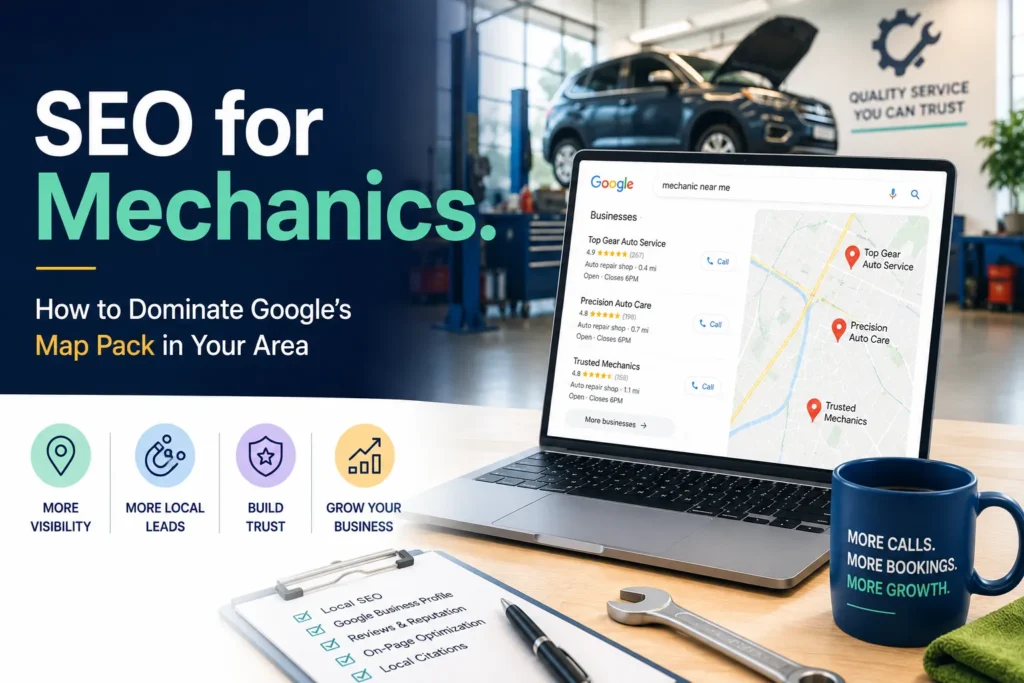
When a vehicle starts making unusual noises, the check engine light appears, or a car suddenly breaks down, most drivers immediately search online for a trusted mechanic nearby. They compare reviews, repair services, business hours, pricing, and location before deciding where to take their vehicle.
If your auto repair shop isn’t visible when customers search for repair services in your area, those valuable jobs are likely going to competing mechanics that rank higher in Google Search or Google’s Map Pack.
SEO for mechanics helps auto repair shops improve their visibility across Google Search, Google Maps, and AI-powered search platforms. A successful strategy combines Google Business Profile optimization, service-focused website architecture, local SEO, technical SEO, reputation management, content marketing, conversion optimization, and AI search optimization to consistently generate qualified repair inquiries.
This guide explains how mechanics can improve online visibility, dominate Google’s Map Pack, attract more local customers, and convert searches into booked repair appointments.
How Customers Search for Mechanics
Most customers search for a mechanic when they have an immediate problem with their vehicle. Others research maintenance services before scheduling an appointment.
Common searches include:
- Mechanic near me
- Auto repair shop
- Car repair near me
- Brake repair
- Oil change
- Engine diagnostics
- Transmission repair
- Suspension repair
- Vehicle inspection
- Auto AC repair
- Check engine light repair
Many customers also search using vehicle brands, repair services, symptoms, emergency situations, or city names.
Your website should target these different search intents with dedicated service pages rather than relying on a single generic auto repair page.
Google Business Profile Best Practices for Mechanics
Google Business Profile is often the first impression potential customers have of your repair shop. Many people choose a mechanic directly from Google Maps after comparing reviews, repair services, photos, and opening hours.
A complete and active profile improves both local visibility and customer trust.
Choose the Right Business Categories
Select Auto Repair Shop as your primary category.
Add secondary categories only when they accurately represent your services, such as Brake Shop, Oil Change Service, Car Inspection Station, Transmission Shop, Auto Electrical Service, or Tire Shop where applicable.
Upload Professional Shop Photos
Customers want confidence that they are choosing a reputable repair shop.
Upload authentic photos of:
- Workshop
- Service bays
- Mechanics at work
- Diagnostic equipment
- Reception area
- Customer waiting area
- Shop exterior
- Team members
- Service vehicles where appropriate
Professional images help increase trust before customers contact your business.
Showcase Every Repair Service
List each major repair service individually rather than combining them into a single description.
Include services such as:
- Brake repair
- Oil changes
- Engine diagnostics
- Transmission repair
- Suspension repair
- Steering repair
- Auto electrical repairs
- Air conditioning repair
- Battery replacement
- Tire services
- Scheduled maintenance
Clearly describing your services helps both Google and prospective customers understand your expertise.
Configure Your Service Areas
Most mechanics primarily serve customers within a local radius.
Clearly define every city, neighborhood, and community you actively serve, and ensure your website includes relevant location pages where appropriate.
Publish Helpful Google Posts
Keep your profile active by sharing:
- Vehicle maintenance tips
- Seasonal driving advice
- Shop updates
- Community involvement
- Frequently asked questions
- New equipment
- Holiday hours
- Safety reminders
Helpful educational content typically performs better than purely promotional updates.
Maintain Consistent Business Information
Your business name, address, phone number, website, opening hours, and repair services should remain consistent across your website, Google Business Profile, automotive directories, and local citations.
Consistency strengthens both local trust signals and customer confidence.
Complete Every Available Profile Section
Complete every available field, including:
- Business description
- Service list
- Opening hours
- Appointment information
- Photos
- Business attributes
- Website
- Social profiles
A complete profile provides a better customer experience while strengthening local SEO.
Use Gemini to Improve Google Business Profile Management
Gemini can help generate ideas for Google Posts, draft professional responses to customer reviews, improve service descriptions, organize profile updates, and summarize profile performance.
Always review AI-generated suggestions before publishing to ensure your repair services, pricing, opening hours, and business information remain accurate and up to date.
Website Structure for Auto Repair Shops
Your website should do more than list your phone number and business hours. It should explain your repair services, demonstrate your expertise, answer common vehicle repair questions, and make it easy for customers to schedule an appointment.
A well-structured website also helps Google understand your services, repair specialties, locations, and expertise, improving your ability to rank for high-intent automotive searches.
Build a High-Converting Homepage
Your homepage should immediately communicate what types of vehicle repairs you offer, who you serve, and why drivers should trust your shop.
Include:
- Auto repair services
- Emergency repairs where available
- Preventive maintenance
- Customer reviews
- Certified technicians where applicable
- Years of experience
- Online appointment booking
- Click-to-call phone number
- Clear calls to action
Visitors should quickly understand whether your repair shop can solve their vehicle problem.
Create Dedicated Repair Service Pages
Every major repair service should have its own optimized landing page rather than combining everything into a single general auto repair page.
Create pages for:
- Brake repair
- Oil changes
- Engine diagnostics
- Transmission repair
- Suspension repair
- Steering repair
- Auto electrical repairs
- Air conditioning repair
- Battery replacement
- Tire services
- Scheduled maintenance
Each service page should explain common symptoms, repair process, expected turnaround times, frequently asked questions, and how customers can schedule service.
Create Vehicle Brand Pages
Many customers search for mechanics who specialize in particular vehicle manufacturers.
If your shop services multiple brands, create dedicated pages for:
- Toyota repair
- Ford repair
- Honda repair
- BMW repair
- Mercedes-Benz repair
- Audi repair
- Nissan repair
- Hyundai repair
- Kia repair
- Volkswagen repair
Each page should explain your experience with that manufacturer, common repair issues, maintenance recommendations, and available services.
Create Local Service Area Pages
If you serve multiple cities or neighborhoods, create optimized pages for each primary service area.
Each page should include:
- Repair services available
- Local service information
- Nearby communities served
- Appointment details
- Frequently asked questions
- Contact information
Avoid creating duplicate city pages that only change the location name. Every page should provide meaningful local information.
Support Multi-Location Repair Shops
If your business operates from multiple workshops, create an individual page for each location.
Each location page should include:
- Workshop address
- Phone number
- Opening hours
- Available repair services
- Customer reviews
- Directions
- Appointment booking information
This improves local visibility while helping customers find the nearest repair shop.
Showcase Your Automotive Expertise
Vehicle owners want confidence that qualified technicians will repair their cars correctly.
Highlight:
- Certified technicians where applicable
- Years of experience
- Diagnostic equipment
- Manufacturer expertise
- Warranty information where offered
- Fleet maintenance where available
- Emergency repair services
- Customer satisfaction guarantees where applicable
These trust signals help increase inquiries and appointment bookings.
Build an Automotive Resource Center
Many drivers research vehicle problems before contacting a repair shop.
Publish educational content covering:
- Check engine light explanations
- Brake maintenance
- Oil change intervals
- Tire care
- Battery maintenance
- Air conditioning problems
- Seasonal vehicle maintenance
- Preventive maintenance tips
- Frequently asked questions
Helpful content strengthens topical authority while attracting additional organic traffic.
Improve Appointment Conversions
Every important page should make it easy for customers to schedule repairs.
Include:
- Online booking forms
- Service request forms
- Click-to-call buttons
- Emergency contact information where available
- Customer testimonials
- Warranty information
- Financing options where applicable
- Clear calls to action
Reducing friction throughout the booking process helps convert more visitors into paying customers.
ASE Certification and Shop Credential Pages for Mechanics
“Certified technicians where applicable” is the only nod to credentials in this entire guide, and it names nothing. ASE (Automotive Service Excellence) is the actual industry-recognized certification, and a driver comparing shops specifically looks for it by name.
Name Your ASE Certifications Specifically
State which ASE certifications your technicians hold (engine repair, brakes, electrical, transmission) rather than a vague “certified” claim. If a technician holds a manufacturer-specific certification for a brand you service heavily, name that too. A driver with a transmission problem wants to know the person working on their car is ASE-certified in transmissions specifically, not just certified in general.
State Your Shop’s Industry Affiliations
If you’re AAA Approved Auto Repair or a NAPA AutoCare Center, state it explicitly. These affiliations carry their own vetting standards, giving drivers an external source to verify your shop beyond your own reviews and star rating.
Estimate Process and Warranty Terms for Mechanics
“Warranty information where offered” appears twice but never gets explained, and there’s no mention anywhere of how the estimate and approval process actually works, despite surprise repair bills being one of the most common reasons drivers distrust auto shops.
Explain Your Diagnostic and Estimate Process
Walk through what happens after a car is dropped off: whether the diagnostic fee is waived if the customer proceeds with the repair, and how you communicate before doing any work beyond the original estimate. A driver who’s been surprised by a bill before specifically looks for a shop that addresses this upfront.
Publish Your Actual Warranty Terms
State how long parts and labor are covered, and whether the warranty is shop-specific or backed by a national network useful for drivers who travel. A driver comparing two shops for the same repair often decides based on warranty length, and a vague mention doesn’t compete with real stated terms.
Reviews and Reputation for Mechanics
Reviews are one of the strongest factors influencing both Google Maps rankings and customer decisions. Before choosing a mechanic, most drivers compare ratings, repair quality, pricing, communication, turnaround times, and customer service.
A strong online reputation improves both local visibility and conversion rates.
Respond to Every Customer Review
Respond professionally to every review, whether positive or negative.
Thank customers for their feedback, acknowledge concerns respectfully, and demonstrate your commitment to excellent customer service.
Professional responses reassure future customers and strengthen your reputation.
Focus on Trusted Review Platforms
Google should remain your highest priority because reviews directly influence your visibility on Google Maps.
You should also maintain profiles on relevant platforms such as:
- Better Business Bureau
- Yelp where relevant
- Automotive directories
- Local business directories
- Chamber of Commerce listings
Prioritize platforms that drivers commonly use when researching local mechanics.
Build a Consistent Review Strategy
Encourage satisfied customers to leave honest reviews after repairs are completed.
Review requests can be shared through:
- Follow-up emails
- Service completion messages
- Digital invoices
- Customer satisfaction surveys
- QR codes
Never purchase reviews or offer incentives in exchange for positive feedback.
Maintain Consistent Review Growth
A steady flow of authentic reviews demonstrates consistent customer satisfaction.
Recent reviews strengthen both customer confidence and your local search visibility over time.
Comprehensive SEO Checklist for Mechanics
A successful SEO for mechanics strategy combines local SEO, service page optimization, technical SEO, reputation management, educational content, and conversion optimization.
Target High-Intent Automotive Keywords
Focus on keywords that customers actively use when searching for repair services.
Examples include:
- Mechanic near me
- Auto repair shop
- Brake repair
- Oil change
- Engine diagnostics
- Transmission repair
- Auto AC repair
- Car repair near me
Naturally include these keywords throughout your service pages, location pages, Google Business Profile, blogs, FAQs, and educational resources.
Optimize Every Service Page
Each repair service page should include:
- Unique title tag
- Optimized meta description
- Clear headings
- Service overview
- Common symptoms
- Frequently asked questions
- Internal links
- Appointment request options
- Strong calls to action
Every page should educate customers while encouraging them to schedule a repair.
Publish Helpful Automotive Content
Educational content helps vehicle owners make informed maintenance decisions while strengthening your topical authority.
Useful topics include:
- Why the check engine light comes on
- Signs you need brake repair
- Oil change frequency
- Tire maintenance tips
- Battery replacement signs
- Preventive maintenance schedules
- Winter vehicle preparation
- Frequently asked automotive questions
Helpful resources attract qualified visitors while supporting long-term organic growth.
Strengthen Google Maps Visibility
Google’s Map Pack is one of the most valuable lead sources for local mechanics.
Keep your Google Business Profile active by:
- Publishing Google Posts
- Uploading workshop photos
- Updating repair services
- Responding to customer reviews
- Answering customer questions
- Monitoring profile performance
Build Accurate Local Citations
Maintain consistent business information across:
- Google Business Profile
- Automotive directories
- Local business directories
- Chamber of Commerce listings
- Trusted citation websites
Consistent citations strengthen local trust while improving search visibility.
Earn High-Quality Local Backlinks
Build relationships with:
- Car dealerships
- Tire retailers
- Auto parts suppliers
- Towing companies
- Insurance agents
- Fleet management companies
- Local publications
- Community organizations
- Chambers of Commerce
These partnerships generate valuable backlinks while creating referral opportunities.
Build Community Authority
Increase your visibility by participating in:
- Community events
- Car shows
- Driver safety workshops
- Charity initiatives
- Local business associations
- Automotive education events
Community involvement generates valuable local mentions while strengthening your reputation.
Implement Structured Data
Use structured data such as:
- AutoRepair
- LocalBusiness
- Service
- Organization
- FAQ
- Review
- Breadcrumb
- Website schema
Proper schema helps search engines better understand your repair shop and improves your eligibility for enhanced search results.
Strengthen Entity Optimization
Clearly connect your repair shop with your services, technicians, vehicle brands, workshop locations, customer reviews, diagnostic expertise, and educational resources.
Strong entity optimization helps Google, ChatGPT, Gemini, Claude, Perplexity, and other AI-powered search platforms accurately understand your expertise and recommend your business for relevant automotive repair searches.
AI Search Optimization for Mechanics
Vehicle owners are increasingly using AI-powered search platforms to diagnose car problems, compare repair options, estimate repair costs, and find trusted local mechanics before booking a service. Google AI Overviews, ChatGPT, Gemini, Claude, and Perplexity are becoming valuable discovery channels alongside traditional Google Search.
For auto repair shops, AI visibility depends on whether these platforms can clearly understand your repair services, vehicle expertise, certifications, service areas, customer reviews, and overall business authority.
Repair shops that consistently publish helpful automotive content, maintain complete business information, and demonstrate genuine technical expertise are more likely to appear in AI-generated recommendations.
Improve Visibility Across AI Search
Create practical, customer-focused content that answers the questions drivers ask before choosing a repair shop.
Clearly explain:
- Vehicle repair services
- Common vehicle problems
- Diagnostic process
- Preventive maintenance
- Repair timelines
- Vehicle brands you service
- Warranty information where offered
- Frequently asked questions
- Emergency repair services where available
- What customers should expect during the repair process
Avoid publishing generic repair advice copied from manufacturer websites. Original troubleshooting guides, technician insights, maintenance recommendations, and real repair expertise help both customers and AI systems understand your authority.
AI SEO Checklist for Mechanics
| AI SEO Element | Best Practice |
| Entity Optimization | Clearly define your repair shop, technicians, repair services, vehicle brands serviced, workshop locations, and automotive expertise. |
| Structured Content | Organize service pages with descriptive headings, FAQs, maintenance guides, and repair resources. |
| Schema Markup | Implement AutoRepair, LocalBusiness, Service, Organization, FAQ, Review, Breadcrumb, and Website schema where appropriate. |
| Helpful Content | Publish original repair advice, maintenance guides, troubleshooting articles, and seasonal vehicle care resources. |
| Google Business Profile | Keep your profile complete with accurate repair services, opening hours, workshop photos, service areas, and contact information. |
| Customer Reviews | Consistently earn authentic customer reviews and respond professionally to every review. |
| Internal Linking | Connect repair services, vehicle brand pages, maintenance guides, blogs, FAQs, and appointment pages naturally. |
| Brand Consistency | Maintain identical business information across your website, Google Business Profile, automotive directories, and trusted local listings. |
Measure AI Search Visibility
Keyword rankings remain important, but they should not be your only performance indicator.
Monitor:
- Branded searches
- Organic traffic
- Google Business Profile interactions
- Appointment bookings
- Phone calls
- Contact form submissions
- Direction requests
- Online service requests
- Organic conversions
- Revenue generated from organic search
The objective of SEO for mechanics is to generate more qualified repair bookings and long-term customer relationships rather than simply increasing website traffic.
Technical SEO Checklist for Mechanics
Auto repair websites often contain service pages, vehicle brand pages, maintenance resources, location pages, and educational content. Strong technical SEO ensures that search engines can crawl your website efficiently while customers enjoy a fast, reliable experience.
| Technical SEO Element | What to Check |
| Crawlability | Ensure Google can access all important service, vehicle brand, location, and blog pages. |
| Indexing Status | Monitor indexed, excluded, duplicate, and discovered pages in Google Search Console. |
| XML Sitemap | Include valuable pages and update the sitemap whenever new services or locations are added. |
| Robots.txt | Allow search engines to crawl important website resources. |
| Index Bloat | Prevent duplicate archive pages, search results, parameters, and unnecessary URLs from being indexed. |
| Orphan Pages | Ensure every repair service and vehicle brand page receives internal links. |
| Crawl Depth | Keep important repair pages within a few clicks of the homepage. |
| URL Structure | Use clean, descriptive URLs for services, vehicle brands, and workshop locations. |
| Website Architecture | Organize repair services, vehicle brands, maintenance resources, blogs, FAQs, and appointment pages into a logical hierarchy. |
| Internal Linking | Connect related repair services, maintenance guides, vehicle brand pages, blogs, and FAQs naturally. |
| Breadcrumbs | Improve navigation and communicate website hierarchy. |
| Title Tags | Create unique, descriptive title tags for every important page. |
| Meta Descriptions | Write compelling descriptions that encourage vehicle owners to book a repair. |
| Heading Structure | Maintain one H1 followed by logical H2 and H3 headings. |
| Duplicate Content | Avoid publishing nearly identical repair service or city pages. |
| Canonical Tags | Correctly consolidate duplicate URLs where necessary. |
| Thin Pages | Expand pages with limited repair information or customer value. |
| Site Speed | Optimize loading performance across desktop and mobile devices. |
| Core Web Vitals | Monitor LCP, INP, and CLS performance regularly. |
| Mobile Experience | Ensure customers can request appointments, call your workshop, and browse services easily on mobile devices. |
| Booking Forms | Regularly test appointment requests, contact forms, and quote requests. |
| Accessibility | Improve navigation, readability, semantic HTML, forms, and image alt text. |
| Image Optimization | Compress workshop and service images, use descriptive filenames, and include appropriate alt text. |
| Schema Markup | Validate structured data implementation regularly. |
| HTTPS | Secure the entire website using HTTPS. |
| Security | Monitor for malware, spam, hacked pages, and unauthorized content. |
| Broken Links | Repair broken internal and external links promptly. |
| Redirects | Eliminate unnecessary redirect chains and correctly redirect pages that were removed. |
| GA4 | Configure analytics to measure customer behavior and repair inquiries. |
| Google Search Console | Monitor indexing, impressions, clicks, and technical issues. |
| Conversion Tracking | Track appointment bookings, phone calls, quote requests, contact forms, and other valuable actions. |
| Google Business Profile Tracking | Monitor calls, website visits, direction requests, and profile engagement where available. |
SEO Mistakes Mechanics Should Avoid
Many repair shops rely heavily on word-of-mouth referrals while overlooking the long-term value of search visibility.
Avoid these common mistakes:
- Using one generic page for every repair service.
- Publishing duplicate city pages with very little unique information.
- Ignoring Google Business Profile updates and customer reviews.
- Not creating dedicated pages for vehicle brands or specialized repair services.
- Publishing thin content that provides little value to drivers.
- Neglecting mobile usability and website speed.
- Using inconsistent business information across automotive directories.
- Building low-quality backlinks instead of earning trusted automotive and local references.
- Failing to demonstrate technician expertise and certifications.
- Measuring SEO success only through rankings instead of repair bookings, customer retention, and revenue.
Long-term success comes from combining technical expertise, helpful automotive content, strong local authority, and an outstanding customer experience.
How LocalMighty Helps Mechanics Grow
LocalMighty helps auto repair shops generate more qualified repair bookings through SEO strategies tailored to automotive businesses. We optimize Google Business Profiles, improve service and vehicle brand pages, strengthen technical SEO, build topical authority, implement automotive schema, enhance AI search visibility, and create educational content that attracts drivers actively searching for trusted local mechanics.
Our approach combines local SEO services, technical SEO, AI search optimization, entity optimization, reputation management, and conversion optimization to help repair shops increase visibility across Google Search, Google Maps, and AI-powered search platforms while generating more booked appointments, repeat customers, and sustainable business growth.
Recover Rankings After a Google Update
Google regularly updates its search algorithms to improve the quality of local search results. Auto repair websites may experience ranking changes if they contain outdated repair information, duplicate service pages, weak content, or technical SEO issues.
If your rankings decline:
- Review Google Search Console for indexing and crawl issues.
- Identify which repair service or vehicle brand pages lost visibility.
- Audit technical SEO before making major website changes.
- Improve thin or outdated repair content.
- Update maintenance guides and automotive resources.
- Strengthen internal linking between services, vehicle brands, blogs, FAQs, and appointment pages.
- Validate structured data implementation.
- Continue collecting authentic customer reviews.
- Build authoritative automotive and local backlinks.
- Monitor performance before making significant SEO changes.
Repair shops that consistently publish helpful automotive content, maintain strong technical foundations, and provide an excellent customer experience are generally better positioned to recover after algorithm updates.
Closing Notes
Successful SEO for mechanics combines automotive expertise, technical excellence, local visibility, and customer trust. Your website, Google Business Profile, repair service pages, vehicle brand pages, customer reviews, local citations, and educational content should work together to help drivers confidently choose your repair shop.
By investing in comprehensive service pages, helpful maintenance resources, reputation management, technical SEO, and AI search optimization, mechanics can attract more qualified customers, dominate Google’s Map Pack, increase repair bookings, and build sustainable long-term growth.
As drivers increasingly discover repair shops through Google Search, Google Maps, Google AI Overviews, ChatGPT, Gemini, Claude, Perplexity, and other AI-powered platforms, businesses that prioritize helpful content, accurate business information, genuine automotive expertise, and exceptional customer service will be best positioned to increase visibility, earn long-term customer loyalty, and grow their local market share.