
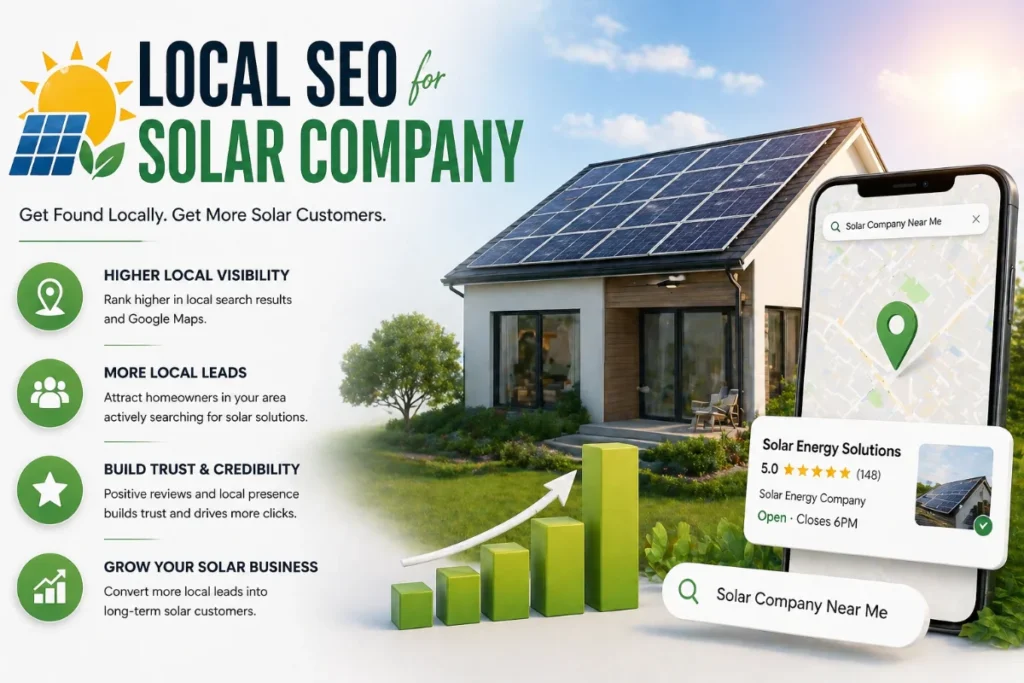
Solar customers do not browse casually.
They come with a utility bill in hand.
They have watched electricity costs climb for three straight years.
They want panels on their roof before next summer.
They need someone local, credible, and available.
And when they search, they search with urgency wrapped in research.
Unlike a plumber or electrician, the solar buying cycle is longer. But the decision moment is just as concentrated. It happens in Google. It happens in AI answers. It happens when trust has been built enough across enough touchpoints that a homeowner picks up the phone.
Local SEO for solar companies in 2026 is not about stuffing city names into blog posts.
It is about dominating every surface a buyer encounters, from initial curiosity to the signed contract.
This is the full blueprint.
How Solar Companies Get Found in Local and AI Search
Before tactics, understand the discovery landscape.
Solar searches now happen across multiple surfaces:
- Google Maps and the local 3-pack
- Organic service and location pages
- Google AI Overviews
- ChatGPT, Gemini, and Perplexity answers
- YouTube installation and review videos
- Reddit and community forum threads
- Review platforms, including Google, Yelp, and the Better Business Bureau
- Comparison sites and solar marketplaces
- Brand searches such as “[company name] solar reviews”
If your solar business exists only as a homepage and an incomplete Google Business Profile, you are invisible to most buyers until they reach the decision stage.
Durable growth in solar requires visibility across all discovery layers simultaneously.
Four Search Intent Types That Drive Solar Revenue
Solar search intent falls into four major categories. Your Local SEO must address all of them.
1. Research and Education Intent
Examples:
- How much do solar panels cost
- Are solar panels worth it in [city]
- How long does solar installation take
- Solar panel ROI calculator
These searches happen early. Buyers are educating themselves. AI tools are heavily consulted here. Content depth, trust signals, and clear answers win at this stage.
2. Incentive and Savings Intent
Examples:
- Solar tax credit 2026
- Solar rebates in [state]
- Net metering [city]
- How to go solar with no money down
Financial motivation drives most solar decisions. Pages that clearly explain incentives, savings timelines, and financing options convert at significantly higher rates. AI answers frequently pull from pages that provide structured, direct cost and savings information.
3. Local Installer Intent
Examples:
- Solar company near me
- Best solar installer in [city]
- Licensed solar contractor [city]
- Solar panel installation [city]
Map Pack visibility dominates here. Review count, licensing visibility, proximity, and recent activity determine who gets called. This is where local SEO execution directly converts into inbound leads.
4. Trust Verification Intent
Examples:
- [Company name] solar reviews
- Is [company name] a good solar company
- [Company name] Better Business Bureau
- [Company name] complaints
Solar is a high-ticket, long-term commitment. Buyers verify before they call. Brand signals, third-party reviews, and consistent online presence protect against losing leads at the final trust check.
A strong solar SEO strategy supports all four intent categories simultaneously.
Solar Company SEO Ecosystem in 2026
To dominate locally, solar companies must win across nine core systems:
- Google Business Profile dominance
- Website and service page architecture
- Multi-city authority structure
- Review velocity and reputation control
- Entity optimization
- Content strategy
- Local link building
- Technical SEO foundation
- Conversion optimization
Here is how to execute each one.
1. Google Business Profile Optimization for Solar Companies
Your Google Business Profile is your strongest lever for local Map Pack rankings. In a high-consideration industry like solar, it also serves as a trust anchor before a prospect ever visits your website.
Primary Category
Use:
- Solar energy company
This is the most specific and highest-intent category available. Do not use the generic “Contractor” category.
Secondary Categories
Only if accurate:
- Solar energy equipment supplier
- Solar energy equipment and systems dealer
- Roofing contractor (if you handle roof preparation)
- Electrician (if you hold an electrical license)
Over-categorization creates confusion. Only add categories that reflect services you actively provide.
Service Section Strategy
Each service must exist as its own entry:
- Residential solar panel installation
- Commercial solar installation
- Battery storage and backup systems
- Solar panel repair and maintenance
- EV charger installation
- Roof-mounted solar systems
- Ground-mounted solar systems
- Solar financing and leasing
Every service entry should include a short explanation, the problem it solves, a natural city mention, and savings or efficiency context. No blank service sections.
Photos and Visual Proof
Upload weekly:
- Completed residential installs with panel counts
- Before-and-after roof photos
- Monitoring dashboards showing real savings
- Team photos and branded vehicles
- Aerial drone shots of installations
- Battery storage system photos
Avoid stock solar imagery. Authentic job site photography strengthens engagement signals and builds trust at a glance.
Posting Strategy
Post weekly about:
- Local solar incentive updates
- Utility rate increases in your service area
- Completed project spotlights
- Battery backup and energy independence tips
- Seasonal solar production expectations
- EV charger installation demand
Consistent posting signals an active, legitimate business. Google weighs activity when determining Map Pack rankings.
2. Solar Company Website Structure That Converts
Solar buyers spend more time researching than almost any other home service customer. Your website must serve both the fast scanner and the deep researcher.
Your homepage must answer within seconds:
- What you install
- Where you serve
- How much customers typically save
- How to get a free quote
A clear call-to-action above the fold is non-negotiable. For solar, that means a savings-estimator tool or a prominent free-consultation button.
Dedicated Service Pages
Each core service needs its own page. Never bundle:
- Residential solar installation
- Commercial solar installation
- Battery storage systems
- Solar panel repair
- EV charger installation
- Solar financing options
Separate pages help Google understand the depth of your service and match specific searches to relevant content.
Each page must include:
- Service overview and how it works
- Who needs this service and why
- Cost ranges and financing options
- Federal and state incentives applicable
- Timeline from consultation to activation
- Energy savings projections
- FAQ section
- Strong call to action
Depth builds authority. Thin pages lose to competitors who answer every question a buyer has.
3. Multi-City and Neighborhood SEO Strategy
Solar companies typically serve large geographic territories. Multi-city SEO must be executed carefully to avoid the most common ranking killer: duplicate pages.
If serving multiple cities, create unique pages such as:
- /solar-installation-phoenix
- /solar-installation-scottsdale
- /solar-installation-tempe
Avoid copy-paste city swaps at all costs.
Each page should reference:
- Local utility company and average rates
- State-specific solar incentives and rebates
- Average peak sun hours for the region
- Local building permit requirements
- Neighborhood-specific roof types and orientations
- HOA solar regulations in the area
An embedded Google Map and local customer testimonials strengthen geographic relevance signals. Duplicate city pages are among the biggest ranking killers in the solar industry.
4. Reviews and Reputation Management
Solar is a five-figure purchase. Customers research more thoroughly than almost any other home service buyer. Trust is not a nice-to-have. It is the prerequisite for every conversion.
Review Acquisition System
Use:
- SMS request within 24 hours of system activation
- Email follow-up at 30 days with savings data included
- Direct Google review link in every post-install communication
- Sales team trained to ask for reviews at project completion
- QR code on the monitoring app setup documentation
Consistency matters more than volume spikes. A steady stream of new reviews signals ongoing business activity to Google.
Review Response Strategy
Respond to every review.
Include:
- System type or service referenced
- City or neighborhood mention
- Savings or performance context
- Appreciation and invitation to refer neighbors
Example: “We are thrilled your 14-panel system in Mesa is already generating above projected output. Thank you for trusting our licensed team with your home energy independence.”
Recent reviews carry more algorithmic weight than old ones. Maintaining consistent review velocity is an ongoing operational requirement, not a one-time campaign.
5. Entity and Trust Signals for Solar Companies
Google does not rank isolated pages. It ranks trusted entities.
Solar companies must reinforce:
- Consistent NAP data across all directories
- State contractor license numbers displayed prominently
- NABCEP certification, if applicable
- Insurance and bonding status visible
- Years in business and installation count
- Real team photos with names and credentials
- Manufacturer certifications displayed
Mismatch across directories weakens trust signals. An inconsistent phone number between your website, GBP, and Yelp listing actively suppresses your rankings.
6. Content Strategy That Works for Solar Companies
More content is not better. Solar buyers ask specific, high-intent questions. Your content must answer them directly before expanding on the details.
Solar companies should prioritize:
- Cost transparency and savings projections
- Incentive and tax credit education
- System performance and monitoring explanations
- Roof and home suitability guides
- Battery storage and energy independence content
- Utility rate trends and their impact on ROI
High-performing topics:
- How much do solar panels cost in [city] in 2026
- How long until solar panels pay for themselves
- What solar incentives are available in [state]
- Can I install solar if I have a shaded roof
- How does net metering work in [city]
- Battery storage vs. grid tie-in: which is better
Use question-based headings. Provide direct 40-to-60-word answers before expanding. This structure improves AI answer extraction and increases the likelihood of appearing in Google AI Overviews and ChatGPT responses.
7. Local Link Building for Solar Companies
Backlinks still matter. Relevance and local authority matter more than raw quantity.
Focus on:
- Chamber of Commerce membership and listing
- State and local clean energy organizations
- Home builders associations
- Real estate agent partnerships and co-marketing
- HOA newsletters and community publications
- Local news features about energy savings and renewable installations
- Utility company partner or referral program listings
- Environmental advocacy group directories
Brand mentions without links still strengthen entity recognition. A mention in a local news article about solar adoption in your city contributes to your authority even without a hyperlink. Avoid link farms and generic directory submissions that add no geographic or topical relevance.
8. Technical SEO Foundation for Solar Companies
Technical stability determines whether rankings hold during peak seasons. Solar search volume spikes in spring and early summer. Your site must be ready before demand arrives.
Technical checklist:
- 200 status codes across all pages
- Fast mobile speed under 3 seconds
- Secure HTTPS across the entire site
- Clean URL structure without parameters
- XML sitemap submitted to Search Console
- Canonical tags implemented on multi-city pages
- No duplicate city page content
- Structured data validation passing
Add schema markup:
- LocalBusiness schema with GeoCoordinates
- Service schema for each installation type
- FAQ schema across all service and location pages
- Review schema with aggregate ratings
- OpeningHoursSpecification
- SolarEnergyInstaller business type is supported
AI crawlers struggle with heavy JavaScript. Keep all key service descriptions, savings claims, and FAQ content visible in plain HTML. Interactive savings calculators are valuable for conversion, but should not be the only place your core value proposition lives.
9. Conversion Optimization
Solar traffic is high intent but requires a friction-free path to inquiry. Every second of confusion costs you a lead.
Above the fold must include:
- Primary phone number with click-to-call
- Free quote or savings estimate CTA
- Service area confirmation
- License number visible
- Trust badges: NABCEP, manufacturer certifications, BBB
Mobile must include:
- Sticky call button throughout scroll
- One-tap form submission
- Savings calculator accessible within two taps
After form submission, immediately reassure with the expected response time, what happens next in the process, and a link to your project gallery. Solar buyers are anxious about making the right choice. Reassurance at every step reduces drop-off and increases consultation show rates.
Engagement signals influence rankings indirectly through behavioral metrics. A site that converts also signals to Google that it deserves to rank.
AI SEO Checklist for Solar Companies
| Optimization Area | Checklist Items |
| Customer Questions & Answers | • Add real questions solar buyers ask daily • Use headings like “how much do solar panels cost in [city]” or “is solar worth it in [state]” • Start each answer with a direct 40-60-word response • Expand with savings data and local context |
| Content Structure for AI | • Use proper H1 and H2 hierarchy • Keep paragraphs short and direct • Use bullet points for steps, incentives, and comparisons • Avoid dense walls of text that AI crawlers cannot parse efficiently |
| Local Relevance Signals | • Mention your city and service areas naturally throughout • Reference local utility companies, state incentive programs, and regional sun hours • Keep NAP consistent across all platforms • Build service + location pages |
| Trust and E-E-A-T Signals | • Display contractor licenses and NABCEP certifications clearly • Mention insured and bonded status • Show years of experience and total system count installed • Include real project photos and verified savings data |
| Reviews Strategy | • Collect reviews that mention energy savings, installation experience, and customer service quality • Respond to every review • Maintain consistent review velocity throughout the year, not just peak seasons |
| Google Business Profile | • Use Solar Energy Company as the primary category • Add all services individually • Upload real project photos weekly • Keep hours updated • Post weekly tips on savings, incentives, and seasonal production |
| FAQ Optimization | • Add FAQ sections across all pages • Focus on real financial and installation questions • Use natural conversational phrasing that matches how buyers actually search and ask AI tools |
| Schema Markup | • Implement LocalBusiness schema with GeoCoordinates • Add Service schema for each system type • Include FAQ schema • Add Review schema with aggregate ratings where applicable |
| Directory and Listing Consistency | • Optimize on Google, Yelp, Bing, Apple Maps, and BBB • List on clean energy and contractor directories • Ensure NAP is perfectly consistent everywhere |
| Content Clarity | • Use simple language that homeowners understand • Explain savings in dollars, not percentages • Make answers about cost, timeline, and process direct and actionable |
| Content Freshness | • Ensure fast-loading pages under 3 seconds • Add a sticky click-to-call button • Simplify quote request forms to the fewest required fields |
| Mobile Optimization | • Ensure fast-loading pages under 3 seconds • Add a sticky click-to-call button • Simplify quote request forms to the fewest required fields |
| Local Authority Building | • Get featured in local news about energy and sustainability • Partner with builders, real estate agents, and HOA management companies • Participate in community clean energy events and programs |
How to Recover Lost Traffic Fast
When solar rankings drop, do not publish random blog content and wait.
Instead:
- Identify top-performing service and location pages
- Expand missing FAQ content with current incentive information
- Add new project photos to GBP and service pages
- Improve internal linking between service pages and location pages
- Increase review velocity with a focused post-install outreach push
- Boost brand mentions through local news and partner co-marketing
Recovery pattern:
- Brand searches rise
- Impressions stabilize
- Traffic returns to service pages
- Map Pack positions strengthen
For solar companies, recovery typically takes 60 to 90 days when executed correctly and consistently.
Measurement and Reporting
Rankings alone do not indicate business success.
Track:
- Google Map Pack visibility by city and service
- Phone calls from Google Business Profile
- Direction requests by neighborhood
- Brand search volume growth
- Quote form conversion rate by page
- Call tracking quality and consultation show rate
- AI referral traffic from ChatGPT and Perplexity
- Utility rate search impression trends
Solar SEO success is measured in consultations booked, contracts signed, and systems installed. Not impressions. Not clicks. Not keyword positions alone.
SEO Tools for Solar Companies in 2026
- Google Business Profile Insights
- Google Search Console
- GA4 with source and medium tracking
- Ahrefs or Semrush for keyword and competitor research
- Local grid rank tracking tools for Map Pack visibility
- Call tracking software tied to specific landing pages
- Solar-specific CRM with lead source attribution
Tools guide decisions. Strategy drives growth. Do not confuse access to data with having a plan.
The Reality of Solar Company SEO in 2026
Solar companies that win local search do not chase rankings.
They:
- Dominate Google Maps in every city they serve
- Maintain consistent review velocity year-round
- Build deep service and location pages that answer every buyer’s question
- Maintain entity consistency across all directories and platforms
- Strengthen brand demand through education and community presence
- Appear in AI answers across ChatGPT, Gemini, and Perplexity
- Stay technically stable through seasonal traffic spikes
Solar companies that behave like trusted local authorities build durable visibility. Solar companies that chase rankings remain fragile.
Local SEO for solar companies in 2026 is a full ecosystem strategy.
Google Maps.
Organic search.
AI answers.
Reviews.
Community trust.
When a homeowner finally decides they are done paying the utility company, the first solar company to appear, trusted and visible, gets the consultation.
The company that has built its authority consistently over the months keeps the calendar full.