
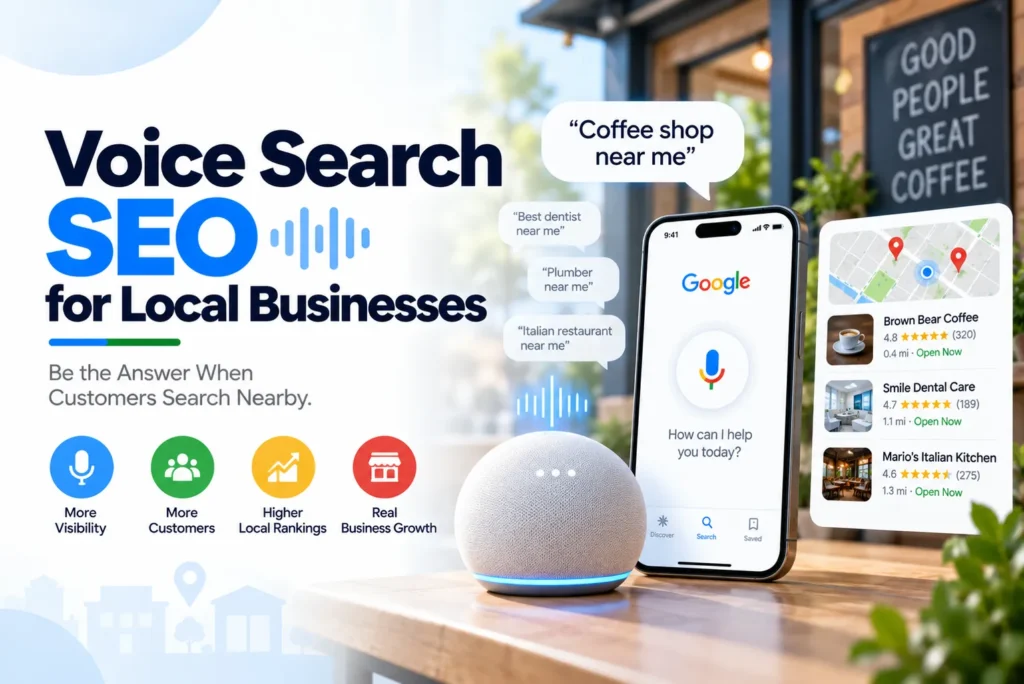
A customer is driving through Austin and says, “Hey Siri, find an auto repair shop near me that’s open right now.”
The assistant needs a clear answer. It needs to know which businesses are relevant, whether they are open, where they are, and whether they actually provide the requested service.
That answer usually starts with local business data, especially the business’s Google Business Profile, then gets confidence from other consistent information on the website and across trusted directories.
This is the practical side of voice search SEO for local businesses. You are not trying to create a special version of your website for voice assistants. You are making your Google Business Profile and website agree on the facts and describe your services in the same natural language your customers use when they speak.
How Spoken Local Searches Differ From Typed Searches
Someone typing into Google may search for:
“emergency plumber Dallas”
Someone speaking to Google Assistant might say:
“OK Google, who’s the closest emergency plumber that’s open right now?”
The intent is similar, but the wording is different.
Typed searches often contain short fragments. Spoken searches tend to be complete questions or sentences. People also add details that reflect immediate intent, such as “near me,” “closest,” “open now,” “right now,” “today,” or “that takes walk-ins.”
Here are examples a US consumer might actually say:
- “Hey Siri, find a 24-hour pharmacy near me.”
- “OK Google, who’s the closest emergency plumber open right now?”
- “Hey Siri, find a family dentist near me that takes new patients.”
- “Alexa, find a hair salon in Scottsdale that takes walk-ins today.”
- “Hey Google, what’s the closest auto repair shop that can replace a battery?”
The difference matters because your local information must answer the full question.
If your Google Business Profile says you are an auto repair shop but your website never clearly explains that you offer battery replacement, the assistant has less consistent information to work with.
That leads to the central rule for local voice search:
Your Google Business Profile should state what you do, where you are, when you are available, and what customers can expect. Your website should confirm those same facts using natural, conversational language.
Google Business Profile Is the Primary Place to Start
For most local businesses, Google Business Profile should be the first place you work on.
The profile gives Google structured information about your business. Your website then provides supporting information that confirms those details.
The goal is consistency, not repetition for its own sake.
Keep Your Name, Address, and Phone Number Consistent
Your business name, address, and phone number should match between your Google Business Profile and website.
For example:
Google Business Profile
Mike’s **** Services
1250 W. Camelback Rd.
Phoenix, AZ *****
(602) 555-xxxx
Your website should not show a different phone number, abbreviated business name, or an old address elsewhere.
The same principle applies to major directories such as Yelp, Apple Maps, and Bing Places.
A voice assistant has to decide whether different records refer to the same business. Consistent NAP information gives it fewer reasons to hesitate.
Choose the Category That Matches What You Actually Do
Your primary Google Business Profile category matters because it tells Google what kind of business you are.
A dentist should not select a broad category simply because it sounds popular. A salon should not try to represent every service through its primary category.
Choose the category that most accurately describes the core business.
Then use your services, website content, and supporting information to explain the specific work you provide.
For example, an HVAC company might be categorized around HVAC services while its profile and website clearly mention:
- AC repair
- air conditioning installation
- furnace repair
- emergency HVAC service
- ductwork
- heat pump installation
This gives Google a clearer connection between the business category and the specific phrases customers may speak.
Fill Out Services and Attributes Naturally
Do not turn the services section into a keyword list.
If you run a Dallas dental office, write service names the way patients understand them:
“Emergency dental appointments”
“Same-day tooth extraction”
“Family dentistry”
That is more useful than awkward variations designed to repeat the city name.
Use attributes when they accurately describe the business. If you accept walk-ins, offer wheelchair accessibility, or provide specific payment options, make that information accurate.
A voice answer depends on reliable facts. Do not add an attribute simply because you think it might help rankings.
Keep Business Hours Accurate
Hours become especially important when someone asks:
“Who’s open right now?”
If your profile still shows regular Tuesday hours during a holiday schedule, the answer may be wrong.
US businesses should pay particular attention to dates such as Thanksgiving, Christmas, Independence Day on July 4, Memorial Day, and Labor Day.
A restaurant in Chicago that closes early on Thanksgiving should update its holiday hours rather than relying on its normal schedule.
The same applies to emergency plumbers, pharmacies, urgent care clinics, auto repair shops, and other businesses where customers often need immediate help.
Use Google Business Profile Q&A for Spoken Questions
The Q&A section is easy to overlook.
It can also give you a useful place to address questions customers naturally ask.
A Phoenix auto repair shop might answer questions such as:
“Do you replace car batteries the same day?”
“Yes. We replace most standard car batteries the same day, subject to availability. Call (602) 555-0184 before visiting so we can confirm your vehicle and battery are in stock.”
A hair salon could address:
“Do you take walk-ins for haircuts?”
“Yes. We accept walk-ins for haircuts when a stylist is available. Appointments are recommended during evenings and weekends.”
Keep the answers factual and concise. Do not stuff city names or keywords into every question.
Treat Reviews as Local Language
Reviews can reinforce the language customers use to describe your business.
A review that says, “I needed same-day AC repair in Plano, and they arrived within two hours” contains useful context about the service, location, and customer experience. Never tell customers to write artificial reviews or insert specific keywords.
Instead, ask for honest feedback about the service they received.
Your responses can also naturally reinforce relevant facts:
“Thanks for trusting us with your same-day AC repair in Plano.”
That adds natural language to the profile without turning the review section into an SEO exercise.
Make the Website Confirm the Google Business Profile
Your website should make it easy for Google to verify the information on your profile.
Think of the relationship this way:
Google Business Profile = the primary local business record
Website = supporting evidence and detail
If the two disagree, you create unnecessary uncertainty.
Use LocalBusiness Structured Data
Add appropriate LocalBusiness schema to relevant pages.
Important information includes:
- Business name
- Address
- Phone number
- Opening hours
- URL
- Service area when applicable
- Relevant business type
- Location information for individual branches
For a Chicago dental practice, the address and phone number in structured data should match the information visible on the page and the Google Business Profile.
Structured data does not guarantee a voice result. Its purpose is to make important business information easier for search systems to interpret.
Validate your markup after implementation and fix errors rather than assuming the code is correct.
Answer Spoken Questions Directly
Create FAQ sections around questions customers actually ask.
Instead of a heading such as:
Emergency Plumbing Services in Dallas
use a question such as:
“Can a plumber come out right now in Dallas?”
Then answer it directly:
“Yes. We provide emergency plumbing service in Dallas and nearby communities. Call (214) 555-0147 for current availability.”
After the direct answer, provide additional details about service areas, common emergencies, pricing policies, and scheduling.
This structure gives both the user and search systems a clear answer.
Use Speakable Content Carefully
Speakable structured data can identify content that is suitable for text-to-speech in supported search experiences.
For a local business, the useful content is usually short and factual. A section answering “What time does your urgent care open?” is more useful than marking an entire 2,000-word page as something an assistant should read.
Structured Q&A can also make important answers easier to interpret.
Without clear structure, the information may still be found, but the system has to determine which part of the page best answers the question.
Build Useful Location and Service Pages
If you operate in multiple US locations, do not force every location into one generic page.
A regional HVAC company serving Dallas, Fort Worth, and Arlington should have useful pages that explain the actual services and coverage for each market.
A location page should answer questions such as:
- Do you serve this city?
- What services do you provide there?
- Where is the local office?
- What are the hours?
- What phone number should customers call?
- Are emergency appointments available?
For franchises and regional chains, each location needs accurate local information. Do not copy one generic page and replace the city name.
Structure Content So the Answer Comes First
Voice-oriented content should not make the user wait for the answer.
Aim for a direct opening response of roughly 40 to 60 words before expanding.
For example:
Do you provide emergency HVAC service in Phoenix?
“Yes. Our Phoenix HVAC team provides emergency air conditioning and heating repairs seven days a week. Service availability depends on technician schedules, so call (602) 555-0184 for current availability.”
Then explain the service area, common problems, scheduling process, and other useful details.
Use real questions as H3 headings:
“Is there a dentist near me that accepts new patients?”
“Do you offer same-day AC repair?”
“Can I walk in for a haircut today?”
Avoid long introductions before the answer. If the question has a simple answer, give it immediately.
Research Voice Queries Based on Real Customer Language
Don’t just take your existing keyword and add “near me.”
If your keyword is “Dallas plumber,” think about how someone would actually say the request.
They might say:
“Who can fix a leaking water heater near me?”
“Can a plumber come out tonight?”
“What’s the closest plumber that handles burst pipes?”
Research these phrases by listening to customers, reviewing Google Business Profile questions, checking customer reviews, examining Search Console queries, and looking at the questions sales or front-desk staff hear repeatedly.
The device also changes the language.
Mobile Searches
Mobile users often include location and urgency:
“best dentist near me open Saturday”
Smart Speakers
A person using an Amazon Echo or Google Nest may phrase the request as a complete question:
“What’s a good family dentist near me?”
In-Car Searches
Apple CarPlay and Android Auto searches often have immediate local intent:
“Find the nearest gas station.”
“Find an auto repair shop near me.”
“What’s the closest tire shop that’s open?”
Your business type also changes the vocabulary.
A plumber gets searches about emergencies and availability. A spa gets searches about appointments, services, prices, and hours. An auto repair shop gets searches about batteries, tires, brakes, towing, and same-day repairs.
Build your content around those actual customer needs.
Reviews and Reputation Are Ongoing Voice SEO Inputs
Treat reviews as an ongoing source of natural local language.
Ask customers for honest reviews on Google and Yelp. Do not provide scripts telling them exactly what keywords to use.
A customer might naturally mention:
“family-owned salon in Tampa”
“same-day brake repair”
“walk-in dentist in Brooklyn”
“AC repair in Mesa”
Those details can help reinforce what the business does and where it operates.
Your owner responses matter too.
If a customer says, “They fixed my furnace the same day in Aurora,” a natural response could say:
“Thank you for choosing us for your same-day furnace repair in Aurora.”
The response reinforces the same service and location language without sounding manufactured.
Get the Technical Basics Right
Technical SEO matters here for a practical reason: a voice result can send someone to your website after answering the initial question.
If the page takes too long to load on a phone, the visitor may leave.
Make sure your key local pages:
- Load quickly on mobile connections.
- Work properly on iPhones and Android phones.
- Use HTTPS.
- Have readable text and usable buttons.
- Do not hide important business information behind difficult navigation.
- Use valid structured data.
- Keep address, phone, and hours consistent with the Google Business Profile.
Do not spend weeks chasing technical details while your profile still shows an old phone number or incorrect holiday hours.
For a local business, fixing the information that answers “where,” “what,” and “when” usually comes first.
How to Measure Voice Search Without Guessing
Google and other platforms generally do not give local businesses a clean report showing exactly which calls or visits came from voice assistants.
Do not pretend otherwise.
Instead, measure the outcomes that voice optimization should influence.
Track:
Google Business Profile activity
- Calls
- Website clicks
- Direction requests
- Discovery and branded searches where available
Google Search Console
Look for growth in conversational and local queries, including phrases containing “near me,” service questions, city names, and longer question-based searches.
Branded searches
If more people search for your business name after discovering you through local results, that can be a useful supporting signal.
Business outcomes
Track calls, appointment requests, walk-ins, and booked jobs. When practical, ask customers how they found you.
The goal is not to prove that every conversion came from Siri or Google Assistant. The goal is to see whether better local information produces more qualified local actions.
Common Voice Search Mistakes US Businesses Make
Inconsistent Business Information
Your Google Business Profile says one phone number, Yelp shows another, Apple Maps has an old address, and your website has a third version.
Clean this up.
Outdated Hours
Normal hours are not enough. Review holiday hours and temporary closures throughout the year.
Ignoring Google Business Profile Q&A
Real questions are valuable. Give customers clear answers instead of leaving the section empty or unanswered.
Writing Location Pages for Search Engines
A page that repeats “plumber in Dallas” twenty times does not answer a customer’s question.
Explain what the business actually does in Dallas, when it is available, and how customers can get help.
Using One Generic Page for Multiple Locations
A franchise with locations in Atlanta, Charlotte, and Nashville should not rely on one generic “Locations” page.
Each location should have accurate local information that matches its individual Google Business Profile.
Your Local Voice Search Action Checklist
Start with the Google Business Profile, then make the website confirm it.
Work through these steps in order:
- Check your Google Business Profile name, address, and phone number. Make sure the website matches.
- Confirm your primary category. It should accurately represent your core business.
- Review every listed service. Use customer-friendly service names and remove anything inaccurate.
- Update regular and holiday hours. Check Thanksgiving, July 4th, Labor Day, Christmas, and other closure dates that affect your schedule.
- Add useful Q&A content. Start with questions customers actually ask by phone or in person.
- Review your website’s local business information. Make sure your address, phone, hours, and service areas match the profile.
- Add or validate LocalBusiness structured data. Make sure the markup reflects the visible information.
- Rewrite key FAQs around spoken questions. Put the direct answer first, then provide supporting detail.
- Create useful city and service pages for each real market you serve. This is especially important for franchises and multi-location businesses.
- Ask for honest Google and Yelp reviews. Let customers describe their experience naturally.
- Review your owner responses. Use natural service and location language when it genuinely fits the review.
- Track local actions. Watch GBP calls, directions, website clicks, Search Console queries, and real leads.
The core strategy is straightforward: make your Google Business Profile the clearest version of your business, then make your website confirm it.
When a customer asks an assistant for a nearby business, you want the assistant to find one consistent set of facts instead of conflicting information across your profile, website, directories, and reviews.
That is where practical local voice search optimization starts.