
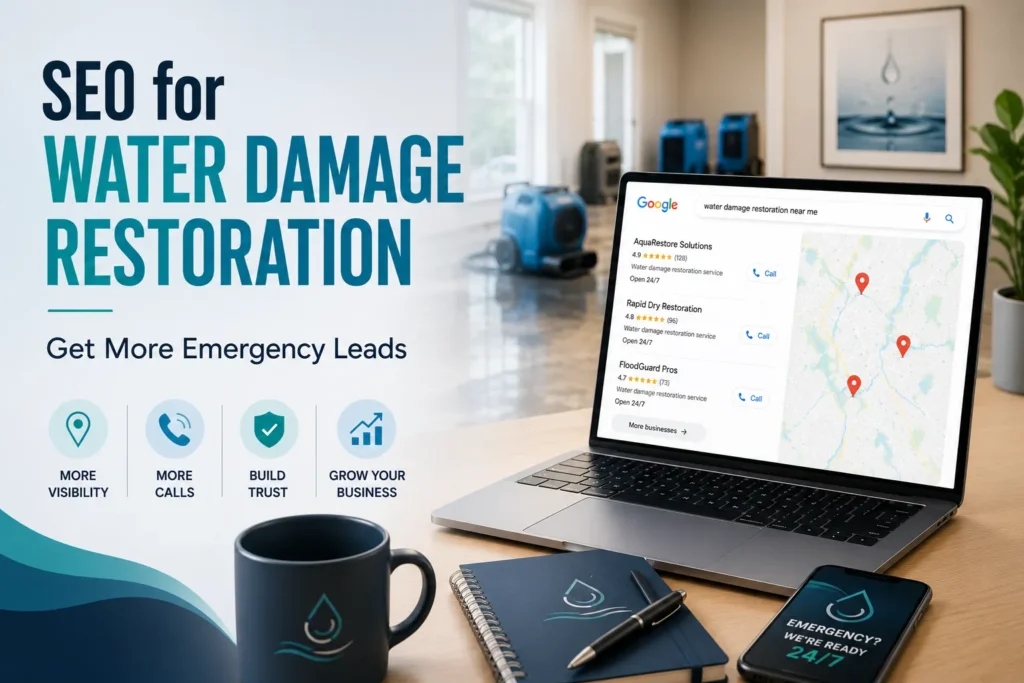
Water damage emergencies happen without warning. Whether it’s a burst pipe, flooding, storm damage, sewage backup, or appliance leak, homeowners and businesses immediately search online for a restoration company that can respond quickly. They compare response times, reviews, certifications, emergency availability, and local reputation before making a call.
If your restoration company isn’t visible when customers search during these urgent situations, those high-value emergency jobs are likely going to competitors that rank higher in Google Search or Google Maps.
SEO for water damage restoration helps restoration companies improve their visibility across Google Search, Google Maps, and AI-powered search platforms. A successful strategy combines Google Business Profile optimization, restoration service-focused website architecture, local SEO, technical SEO, reputation management, content marketing, conversion optimization, and AI search optimization to consistently generate qualified emergency inquiries.
This guide explains how water damage restoration companies can improve online visibility, attract more emergency calls, dominate local search results, and convert searches into booked restoration projects.
How Customers Search for Water Damage Restoration
Water damage searches are highly urgent. Most customers need immediate assistance and choose a company that appears trustworthy, nearby, and available around the clock.
Common searches include:
- Water damage restoration near me
- Emergency water damage restoration
- Flood damage restoration
- Water extraction services
- Basement flood cleanup
- Burst pipe cleanup
- Sewage cleanup
- Emergency restoration company
- Water removal services
- Storm damage restoration
- Water mitigation services
Many customers also search using emergency situations, property types, insurance-related terms, or city names.
Your website should target these different search intents with dedicated service pages instead of relying on one general restoration page.
Google Business Profile Best Practices for Water Damage Restoration Companies
Google Business Profile is often the first place customers evaluate a restoration company. During emergencies, many people contact businesses directly from Google Maps after comparing reviews, response times, photos, and business hours.
A complete and active profile improves both local visibility and customer confidence.
Choose the Right Business Categories
Select Water Damage Restoration Service as your primary category.
Add secondary categories only when they accurately represent your services, such as Fire Damage Restoration Service, Carpet Cleaning Service, General Contractor, or Mold Remediation Service where applicable.
Upload Professional Project Photos
Authentic project photos help demonstrate your experience and professionalism.
Upload photos of:
- Water extraction equipment
- Drying equipment
- Restoration projects
- Flood cleanup
- Team members
- Service vehicles
- Office location
- Before-and-after restoration projects where appropriate
Professional images increase trust before customers make an emergency call.
Showcase Every Restoration Service
List every major restoration service individually instead of grouping everything together.
Include services such as:
- Emergency water extraction
- Flood damage restoration
- Structural drying
- Basement flood cleanup
- Burst pipe cleanup
- Sewage cleanup
- Storm damage restoration
- Moisture detection
- Mold remediation where offered
- Contents restoration where available
Clearly describing your services helps both Google and prospective customers understand your expertise.
Configure Your Service Areas
Restoration companies often serve multiple cities and surrounding communities.
Clearly define every service area while ensuring your website contains relevant location pages where appropriate.
Publish Helpful Google Posts
Keep your profile active by sharing:
- Water damage prevention tips
- Storm preparation advice
- Emergency response information
- Company updates
- Community involvement
- Seasonal maintenance tips
- Frequently asked questions
- Insurance claim guidance
Educational content builds trust while demonstrating expertise.
Maintain Consistent Business Information
Your business name, address, phone number, website, emergency contact number, and service areas should remain consistent across your website, Google Business Profile, restoration directories, and local citations.
Consistency strengthens both local trust signals and customer confidence.
Complete Every Available Profile Section
Complete every available field, including:
- Business description
- Service list
- Business hours
- Emergency contact information
- Photos
- Business attributes
- Website
- Appointment information
A complete profile improves the customer experience while strengthening local SEO.
Use Gemini to Improve Google Business Profile Management
Gemini can help generate ideas for Google Posts, draft professional responses to customer reviews, improve restoration service descriptions, organize profile updates, and summarize profile performance.
Always review AI-generated suggestions before publishing to ensure your emergency services, service areas, business hours, and contact information remain accurate and current.
Website Structure for Water Damage Restoration Companies
Your website should do more than list emergency phone numbers. It should clearly explain your restoration services, demonstrate your expertise, build trust during stressful situations, and make it easy for property owners to request immediate assistance.
A well-structured website also helps Google understand your restoration services, emergency response capabilities, service areas, and expertise, improving your ability to rank for high-intent local searches.
Build a High-Converting Homepage
Your homepage should immediately communicate that your company provides fast, professional water damage restoration services.
Include:
- 24/7 emergency response where available
- Water damage restoration services
- Flood cleanup
- Water extraction
- Structural drying
- Customer reviews
- IICRC certifications where applicable
- Insurance assistance where offered
- Click-to-call emergency phone number
- Clear calls to action
Visitors should immediately know how to contact your team during an emergency.
Create Dedicated Restoration Service Pages
Every major restoration service should have its own optimized landing page instead of combining everything into one generic restoration page.
Create pages for:
- Emergency water extraction
- Water damage restoration
- Flood damage cleanup
- Basement flood cleanup
- Burst pipe cleanup
- Structural drying
- Sewage cleanup
- Storm damage restoration
- Moisture detection
- Mold remediation where offered
- Contents restoration where available
Each service page should explain the emergency response process, common causes of damage, restoration timeline, frequently asked questions, and how customers can request immediate service.
Create Property Type Pages
Many customers search based on the type of property that has been affected.
Create dedicated pages covering:
- Residential water damage restoration
- Commercial water damage restoration
- Apartment restoration
- Office building restoration
- Retail property restoration
- Industrial property restoration
Explain the unique restoration challenges for each property type and your experience handling them.
Create Local Service Area Pages
If your company serves multiple cities or surrounding communities, create dedicated pages for your primary service areas.
Each page should include:
- Emergency restoration services
- Typical response times
- Nearby communities served
- Insurance assistance where applicable
- Frequently asked questions
- Emergency contact information
Avoid creating duplicate location pages with only the city name changed. Every page should provide valuable local information.
Support Multi-Location Restoration Companies
If your restoration business operates from multiple offices, create an individual page for each location.
Each location page should include:
- Office address
- Emergency phone number
- Business hours
- Available restoration services
- Customer reviews
- Directions
- Service coverage
This structure improves local visibility while helping customers contact the nearest emergency response team.
Showcase Your Restoration Expertise
Property owners want confidence that your team can quickly minimize damage and restore their property.
Highlight:
- Years of experience
- IICRC certifications where applicable
- Advanced drying equipment
- Moisture detection technology
- Insurance claim assistance
- Emergency response capabilities
- Commercial restoration experience
- Residential restoration expertise
- Licensed and insured information where applicable
These trust signals help increase emergency calls and consultation requests.
Build a Water Damage Resource Center
Many property owners search for guidance immediately after discovering water damage.
Create helpful content covering:
- What to do after water damage
- How to minimize water damage
- Burst pipe emergency steps
- Flood cleanup safety
- Mold prevention after flooding
- Insurance claim guidance
- Storm preparation tips
- Frequently asked questions
Helpful educational content builds topical authority while attracting additional organic traffic.
Improve Emergency Lead Conversions
Every important page should make it easy for customers to request emergency service.
Include:
- Emergency phone number
- Click-to-call buttons
- Emergency request forms
- Insurance information
- Customer testimonials
- 24/7 availability where applicable
- Service guarantees where offered
- Clear calls to action
Reducing friction during emergency situations helps convert more visitors into immediate restoration projects.
IICRC Certification and State Licensing Pages for Water Damage Restoration Companies
“IICRC certifications where applicable” is named but never explained, and a homeowner in the middle of an emergency doesn’t know what that acronym means or why it matters. Explaining it plainly turns a vague trust badge into an actual reason to choose your company.
Explain What IICRC Certification Actually Verifies
State which specific IICRC certifications your technicians hold (Water Damage Restoration Technician, Applied Structural Drying) and briefly explain what the training covers: proper extraction techniques, moisture mapping, and drying standards that prevent secondary damage like mold growth. A homeowner comparing companies during a stressful moment benefits from knowing this isn’t just a badge; it’s training that affects whether their property gets dried correctly the first time.
Name Your State Mold Remediation License Where Required
If your company handles mold remediation, note that many states require a separate mold remediation license distinct from general water damage restoration credentials. State your license number where applicable. Homeowners whose water damage has already led to mold growth specifically search for this credential, and naming it explicitly differentiates you from companies that only offer basic water extraction.
Insurance Claims Assistance and Direct Billing Pages for Water Damage Restoration Companies
“Insurance assistance where offered” appears four times throughout this guide but never explains what that actually means. For most homeowners facing water damage, how insurance gets handled is one of the biggest factors in choosing a restoration company, right up there with response time.
Explain Your Direct Billing Process
State clearly whether you bill the insurance company directly or require the homeowner to pay upfront and seek reimbursement. Direct billing removes a huge financial stress point during an already difficult situation, and a company that offers it should say so explicitly rather than burying it in a vague “insurance assistance” mention.
Describe How You Work With Adjusters and Estimates
Explain whether your team uses industry-standard estimating software like Xactimate, and how you coordinate directly with insurance adjusters to document damage and justify the scope of work. Homeowners who’ve dealt with lowball insurance estimates before specifically look for a restoration company willing to advocate on their behalf during the claims process, and stating this plainly builds real confidence before the first phone call.
Reviews and Reputation for Water Damage Restoration Companies
Reputation is one of the strongest factors influencing customer decisions during emergencies. Property owners often compare reviews, response times, professionalism, restoration quality, communication, and customer service before choosing a restoration company.
A strong online reputation improves both local rankings and conversion rates.
Respond to Every Customer Review
Respond professionally to every review, whether positive or negative.
Thank customers for their feedback, address concerns respectfully, and demonstrate your commitment to excellent service throughout the restoration process.
Professional responses reassure future customers during stressful situations.
Focus on Trusted Review Platforms
Google should remain your highest priority because reviews directly influence Google Maps visibility.
You should also maintain profiles on trusted platforms such as:
- Better Business Bureau
- Yelp where relevant
- Restoration directories
- Local business directories
- Chamber of Commerce listings
Focus on platforms that homeowners and businesses commonly use when researching restoration companies.
Build a Consistent Review Strategy
Request honest reviews after successfully completing restoration projects.
Review requests can be shared through:
- Follow-up emails
- Project completion messages
- Customer satisfaction surveys
- Digital invoices
- QR codes
Never purchase reviews or offer incentives in exchange for positive feedback.
Maintain Consistent Review Growth
A steady flow of authentic reviews demonstrates ongoing customer satisfaction.
Recent reviews strengthen both your credibility and your local search visibility over time.
Comprehensive SEO Checklist for Water Damage Restoration Companies
A successful SEO for water damage restoration strategy combines local SEO, emergency service optimization, technical SEO, reputation management, educational resources, and conversion optimization.
Target High-Intent Restoration Keywords
Focus on keywords used by customers actively searching for emergency restoration services.
Examples include:
- Water damage restoration near me
- Emergency water damage restoration
- Flood damage restoration
- Water extraction services
- Basement flood cleanup
- Burst pipe cleanup
- Sewage cleanup
- Water mitigation services
Naturally include these keywords throughout your service pages, location pages, Google Business Profile, FAQs, blogs, and educational resources.
Optimize Every Service Page
Each restoration service page should include:
- Unique title tag
- Optimized meta description
- Clear headings
- Service overview
- Emergency response process
- Frequently asked questions
- Internal links
- Emergency contact options
- Strong calls to action
Every page should educate property owners while encouraging immediate contact.
Publish Helpful Restoration Content
Educational content helps property owners understand what to do before professional help arrives while strengthening your topical authority.
Useful topics include:
- What to do after a flood
- Preventing mold after water damage
- Insurance claim guidance
- Water damage warning signs
- Emergency drying process
- Storm preparation tips
- Basement flood prevention
- Frequently asked restoration questions
Helpful resources attract qualified visitors while supporting long-term organic growth.
Strengthen Google Maps Visibility
Google Maps is one of the most valuable lead sources for emergency restoration companies.
Keep your Google Business Profile active by:
- Publishing Google Posts
- Uploading restoration project photos
- Updating restoration services
- Responding to customer reviews
- Answering customer questions
- Monitoring profile performance
Build Accurate Local Citations
Maintain consistent business information across:
- Google Business Profile
- Restoration directories
- Local business directories
- Chamber of Commerce listings
- Trusted citation websites
Consistent citations strengthen local trust while improving search visibility.
Earn High-Quality Local Backlinks
Build relationships with:
- Insurance agencies
- Plumbing companies
- Roofing contractors
- Property management companies
- General contractors
- Home inspectors
- Local publications
- Community organizations
- Chambers of Commerce
These partnerships generate valuable backlinks while creating referral opportunities.
Build Community Authority
Increase your visibility by participating in:
- Disaster preparedness events
- Community safety workshops
- Emergency response initiatives
- Local business associations
- Charity projects
- Homeowner education seminars
Community involvement generates valuable local mentions while strengthening your reputation.
Implement Structured Data
Use structured data such as:
- LocalBusiness
- HomeAndConstructionBusiness
- Service
- Organization
- FAQ
- Review
- Breadcrumb
- Website schema
Proper schema helps search engines better understand your restoration company while improving eligibility for enhanced search results.
Strengthen Entity Optimization
Clearly connect your restoration company with your emergency services, technicians, certifications, service areas, restoration equipment, customer reviews, and educational resources.
Strong entity optimization helps Google, ChatGPT, Gemini, Claude, Perplexity, and other AI-powered search platforms accurately understand your expertise and recommend your business for relevant emergency restoration searches.
AI Search Optimization for Water Damage Restoration Companies
Property owners increasingly use AI-powered search platforms to understand water damage, compare restoration companies, estimate repair timelines, and determine the next steps after an emergency. Google AI Overviews, ChatGPT, Gemini, Claude, and Perplexity are becoming important discovery channels alongside traditional Google Search.
For restoration companies, AI visibility depends on whether these platforms can clearly understand your emergency services, response capabilities, certifications, service areas, expertise, and online reputation.
Restoration businesses that publish practical educational resources, maintain complete business information, demonstrate industry expertise, and build strong local authority are more likely to appear in AI-generated recommendations.
Improve Visibility Across AI Search
Create practical content that answers the urgent questions property owners ask immediately after discovering water damage.
Clearly explain:
- Emergency water extraction
- Water mitigation process
- Structural drying
- Flood cleanup
- Sewage cleanup
- Mold prevention
- Insurance claim assistance where offered
- Emergency response timelines
- Frequently asked questions
- What customers should do before restoration professionals arrive
Avoid publishing generic restoration advice copied from competitors. Original emergency guidance, technician insights, insurance education, and practical restoration information help both customers and AI systems understand your expertise.
AI SEO Checklist for Water Damage Restoration Companies
| AI SEO Element | Best Practice |
| Entity Optimization | Clearly define your restoration company, technicians, emergency services, certifications, service areas, equipment, and restoration expertise. |
| Structured Content | Organize service pages with descriptive headings, emergency guides, FAQs, insurance resources, and restoration articles. |
| Schema Markup | Implement LocalBusiness, HomeAndConstructionBusiness, Service, Organization, FAQ, Review, Breadcrumb, and Website schema where appropriate. |
| Helpful Content | Publish original emergency response guides, restoration advice, insurance resources, and water damage prevention content. |
| Google Business Profile | Keep your profile complete with accurate emergency services, operating hours, service areas, photos, and contact information. |
| Customer Reviews | Consistently earn authentic customer reviews and respond professionally to every review. |
| Internal Linking | Connect restoration services, property type pages, emergency guides, blogs, FAQs, and contact pages naturally. |
| Brand Consistency | Maintain identical business information across your website, Google Business Profile, restoration directories, and trusted local listings. |
Measure AI Search Visibility
Keyword rankings remain important, but they should not be your only performance metric.
Monitor:
- Branded searches
- Organic traffic
- Google Business Profile interactions
- Emergency phone calls
- Contact form submissions
- Service requests
- Direction requests
- Quote requests
- Organic conversions
- Revenue generated from organic search
The objective of SEO for water damage restoration is to generate more qualified emergency calls and restoration projects rather than simply increasing website traffic.
Technical SEO Checklist for Water Damage Restoration Companies
Water damage restoration websites often contain emergency service pages, property type pages, location pages, insurance resources, and educational content. Strong technical SEO ensures search engines can efficiently crawl your website while property owners enjoy a fast and reliable experience during emergencies.
| Technical SEO Element | What to Check |
| Crawlability | Ensure Google can access all important service, property type, location, and educational pages. |
| Indexing Status | Monitor indexed, excluded, duplicate, and discovered pages in Google Search Console. |
| XML Sitemap | Include all valuable pages and update the sitemap whenever new services or locations are added. |
| Robots.txt | Allow search engines to crawl important website resources. |
| Index Bloat | Prevent duplicate archive pages, internal search pages, parameters, and unnecessary URLs from being indexed. |
| Orphan Pages | Ensure every restoration service and location page receives internal links. |
| Crawl Depth | Keep important emergency service pages within a few clicks of the homepage. |
| URL Structure | Use clean, descriptive URLs for restoration services, property types, and service areas. |
| Website Architecture | Organize restoration services, emergency resources, blogs, FAQs, insurance information, and contact pages into a logical hierarchy. |
| Internal Linking | Connect related restoration services, emergency guides, insurance articles, FAQs, and service area pages naturally. |
| Breadcrumbs | Improve navigation and communicate website hierarchy. |
| Title Tags | Create unique, descriptive title tags for every important page. |
| Meta Descriptions | Write compelling descriptions that encourage property owners to request emergency assistance. |
| Heading Structure | Maintain one H1 followed by logical H2 and H3 headings. |
| Duplicate Content | Avoid publishing nearly identical service or location pages. |
| Canonical Tags | Correctly consolidate duplicate URLs where necessary. |
| Thin Pages | Expand pages with limited restoration information or customer value. |
| Site Speed | Optimize loading performance across desktop and mobile devices. |
| Core Web Vitals | Monitor LCP, INP, and CLS performance regularly. |
| Mobile Experience | Ensure customers can request emergency service quickly from any mobile device. |
| Contact Forms | Regularly test emergency request forms, quote requests, and contact forms. |
| Accessibility | Improve navigation, readability, semantic HTML, forms, and image alt text. |
| Image Optimization | Compress restoration project images while maintaining quality and using descriptive filenames and alt text. |
| Schema Markup | Validate structured data implementation regularly. |
| HTTPS | Secure the entire website using HTTPS. |
| Security | Monitor for malware, spam, hacked pages, and unauthorized content. |
| Broken Links | Repair broken internal and external links promptly. |
| Redirects | Eliminate unnecessary redirect chains and properly redirect removed pages. |
| GA4 | Configure analytics to measure emergency enquiries and customer behaviour. |
| Google Search Console | Monitor indexing, impressions, clicks, and technical issues. |
| Conversion Tracking | Track emergency calls, contact forms, quote requests, service bookings, and other valuable actions. |
| Google Business Profile Tracking | Monitor calls, website visits, direction requests, and profile engagement where available. |
SEO Mistakes Water Damage Restoration Companies Should Avoid
Many restoration companies depend heavily on insurance referrals and paid advertising while overlooking the long-term value of organic search visibility.
Avoid these common mistakes:
- Using one generic page for every restoration service.
- Publishing duplicate location pages with very little unique information.
- Ignoring Google Business Profile updates and customer reviews.
- Not creating dedicated pages for emergency services or different property types.
- Publishing thin content that provides little practical guidance during emergencies.
- Neglecting mobile usability and website speed.
- Using inconsistent business information across restoration directories.
- Building low-quality backlinks instead of earning trusted industry and local references.
- Failing to highlight certifications, emergency response capabilities, and restoration expertise.
- Measuring SEO success only through rankings instead of emergency calls, booked restoration projects, and revenue.
Long-term success comes from combining restoration expertise, helpful educational content, strong technical SEO, and outstanding emergency customer service.
How LocalMighty Helps Water Damage Restoration Companies Grow
LocalMighty helps water damage restoration companies generate more qualified emergency leads through SEO strategies designed specifically for restoration businesses. We optimize Google Business Profiles, improve restoration service and location pages, strengthen technical SEO, build topical authority, implement structured data, enhance AI search visibility, and create educational content that attracts property owners actively searching for emergency restoration services.
Our approach combines local SEO, technical SEO, AI search optimization, entity optimization, reputation management, and conversion optimization to help restoration companies increase visibility across Google Search, Google Maps, and AI-powered search platforms while generating more emergency calls, restoration projects, and long-term business growth.
Recover Rankings After a Google Update
Google regularly updates its search algorithms to improve the quality of local service search results. Restoration websites may experience ranking changes if they contain outdated information, duplicate service pages, weak educational content, or technical SEO issues.
If your rankings decline:
- Review Google Search Console for indexing and crawl issues.
- Identify which restoration service or location pages lost visibility.
- Audit technical SEO before making major website changes.
- Improve thin or outdated restoration content.
- Update emergency response guides and insurance resources.
- Strengthen internal linking between restoration services, property type pages, blogs, FAQs, and contact pages.
- Validate structured data implementation.
- Continue collecting authentic customer reviews.
- Build authoritative restoration and local backlinks.
- Monitor performance before making significant SEO changes.
Restoration companies that consistently publish helpful emergency content, maintain strong technical foundations, and provide exceptional customer service are generally better positioned to recover after algorithm updates.
Final Notes
Successful SEO for water damage restoration combines emergency response expertise, technical excellence, local visibility, and customer trust. Your website, Google Business Profile, restoration service pages, location pages, customer reviews, local citations, and educational content should work together to help property owners confidently choose your company during stressful situations.
By investing in comprehensive service pages, practical emergency resources, reputation management, technical SEO, and AI search optimization, water damage restoration companies can attract more qualified emergency calls, increase restoration projects, and build sustainable long-term growth.
As customers increasingly discover restoration companies through Google Search, Google Maps, Google AI Overviews, ChatGPT, Gemini, Claude, Perplexity, and other AI-powered platforms, businesses that prioritize helpful content, accurate business information, proven restoration expertise, and exceptional customer service will be best positioned to increase visibility, earn trust during emergencies, and become the preferred restoration provider in their market.