
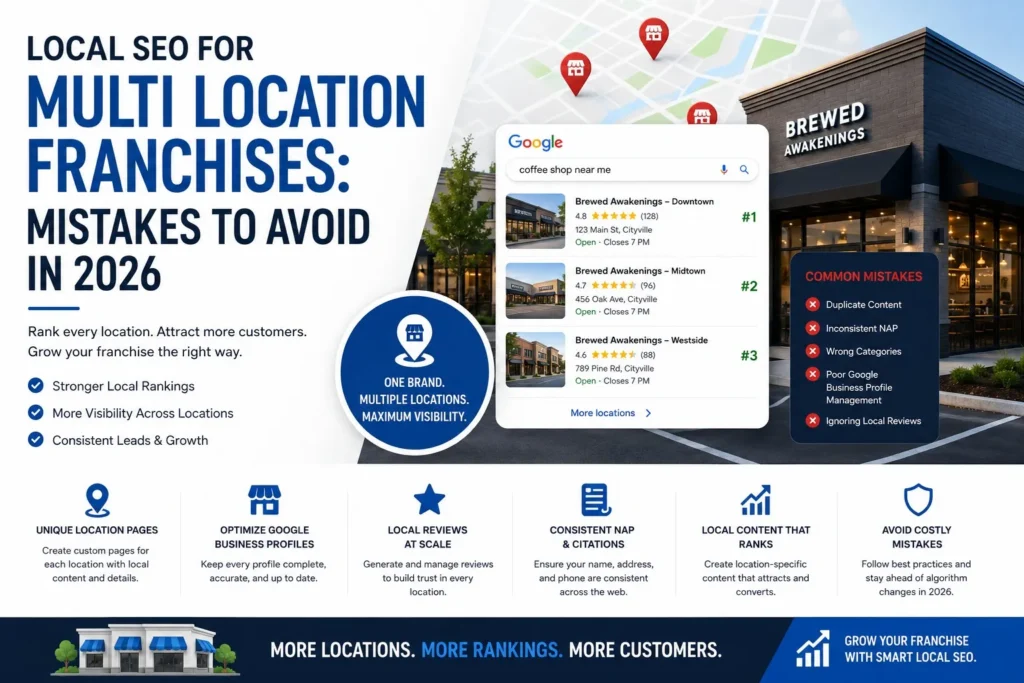
A franchise with forty locations does not automatically outrank a single local shop in any one of its markets. That catches many operators off guard. They assume that the brand name and a slick national website confer local visibility, only to watch an independent competitor beat their branch in the local pack on its own street. The pattern repeats because of one root cause: local search rewards individual locations, not logos, and most franchise SEO problems come from treating dozens of locations like a single business.
Here is the encouraging part. The issues holding multi-location brands back are predictable, and almost all of them are fixable without tearing anything down. What follows are the mistakes that quietly cap franchise visibility in 2026, each paired with the fix. They run from location pages and duplicate content to profile management, listings hygiene, local relevance, keyword targeting, reviews, site structure, local presence, closed locations, and how you measure the whole thing. Sort these out, and every branch starts competing like the strong local business it already is.
Why Each Branch Competes on Its Own
One idea reframes everything before the fixes. Google does not rank your brand. It ranks each location as its own local business, scored on its own signals, which is why a branch that dominates one city does nothing for the branch across the state. Each one carries its own:
- Google Business Profile and reviews
- Local competitors and search intent
- Citations and local links
- Service area and performance numbers
That is precisely how a small independent, with sharper local relevance and cleaner data, so often beats a national brand in a single market. It is not outspending you. It is beating you on local relevance at one address. Treat every branch as the independent local business Google already thinks it is, and that weakness flips into your advantage.
Mistake 1: One Page for Every Market
The most common franchise error is funneling every market to a single page, or worse, to a corporate homepage with a store locator bolted on. When ten branches share one page, Google has no location signal to rank any of them for their own cities.
Each physical location needs its own page, built to win in that market. Someone searching in one suburb and someone searching two towns over want different branches, and only a dedicated page answers each with the right address, hours, and neighborhood context. These pages are the backbone of multi-location visibility, and getting how each location page is built and optimized right is what lets Google tie a specific branch to a specific search. Ask one page to do the work of dozens, and it will fail every time.
Mistake 2: Cookie Cutter Location Pages
Creating a page per location is only half the job. The next slip fills each one with the same paragraph and swaps the city name. Search engines spot this instantly. Near-identical pages compete with each other, water down relevance, and can be flagged as thin or duplicate content, which sinks them all.
A location page earns its ranking by reflecting the real branch. The details that make each one distinct include:
- The branch address, phone number, and hours
- Staff names, photos, and specifics for that location
- The neighborhoods and nearby areas it serves
- Services, products, or promotions unique to that branch
- Reviews and testimonials from that location’s customers
- Local landmarks, parking notes, and directions
- Answers to questions specific to that branch, like parking, insurance accepted, or same-day availability
- An embedded map and the location’s own structured data
You do not need a thousand words of original prose per page. You need real, specific details no other branch could claim. That specificity is the line between a page that ranks and one that dissolves into the rest of the brand.
Mistake 3: Business Details That Drift Apart
Across dozens of branches, business details quickly fall out of alignment. A phone number changes at one location, the website keeps the old one, a directory lists a third version, and the Google profile shows a fourth. Every mismatch chips away at Google’s confidence, and inconsistent details are a frequent cause of weak rankings and even suspensions.
At scale, consistency has to be a system, not something you remember to do. Each location’s name, address, and phone number should match exactly across your website, your Google profiles, and every directory. Keeping name, address, and phone details consistent across the web is one of the highest-return habits in franchise SEO, because a single, clean data set lifts every location at once. Manage that data centrally so every platform pulls the same values, instead of maintaining them in a dozen disconnected places.
Mistake 4: Profiles Left Half Managed
For a franchise, the Google Business Profile is where most local discovery happens, yet many brands leave profiles unclaimed, half-filled, or managed to a different standard at every branch. One location has photos and correct hours; the next has an empty profile in the wrong category. The result is uneven visibility that has nothing to do with how good each branch actually is.
Every location needs its own verified, complete profile held to the same bar: the right primary category, accurate hours, real photos, full services, and a working contact or booking path. Applying consistent Google Business Profile management across every branch turns a scattered set of listings into a network that ranks together.
Scale changes the mechanics, too. For 10 or more locations, Google offers business groups and bulk verification so you can manage multiple profiles under a single organized account instead of juggling separate logins. Just as important is governance: decide who owns and edits each profile, because rogue profiles created by individual franchisees or old agencies are a top source of duplicates and suspensions. A central process with local accuracy beats both rigid corporate control and every branch doing its own thing.
Mistake 5: Duplicate Listings Nobody Cleaned Up
Multi-location brands end up with duplicate Google listings almost by accident. A branch gets auto-generated, a former manager spun up a second profile, an old address was never retired. Duplicates confuse Google about which listing is real, split your reviews and ranking signals, and can trigger suspensions.
Hunt them down. Search each location in Maps and look for more than one listing at the same address or for the same branch. When you find them, follow the proper steps to merge or remove the extra listings rather than ignoring them or, worse, creating another. Consolidating duplicates pulls your reviews and authority into a single strong profile per location, rather than scattering them across several weak ones.
Mistake 6: Too Much Corporate, Too Little Local
Some franchises overcorrect toward control. Corporate owns every page, every profile, and every word, and nothing reflects the individual market. The brand looks tidy, but every branch reads like a clone, and none of them feels local to the people searching nearby.
The fix is balance, not a fight between brand and local. Let brand standards govern design, messaging, and quality, then give each location room for what makes it relevant: local staff, local events, local services, and the way people in that market actually talk. The strongest brands hand franchisees a clear local strategy they can follow and then let genuine local detail fill it in. Both customers and search engines favor the branch that feels present in its community over the one that reads like a corporate placeholder.
Mistake 7: Brand Terms Over Local Searches
Franchise marketing often optimizes for the brand name and a few national service terms, assuming everyone already knows the brand. Local searchers rarely think that way. They type things like “emergency plumber near me,” “pediatric dentist in Scottsdale,” or “auto repair downtown,” never your brand name, and a brand-focused page misses that intent entirely.
Every market has its own search patterns, and each location page should target its own. Real keyword research for each market surfaces the service-and-place combinations people actually type, which vary from city to city. Intent even splits between branches: one location might see heavy demand for “family dentist” while another leans toward “cosmetic dentist.” Build each page around its market’s real searches instead of a single national keyword set, and individual locations start winning.
Mistake 8: Reviews Left to Chance
Reviews move both rankings and customer decisions, yet across many branches they are usually handled at random. One location has hundreds of recent reviews, another has six from three years ago, and negative reviews sit unanswered. That unevenness explains, more than anything, why some branches outrank others in the same brand.
A franchise needs a review system, not a hope that each branch figures it out. A repeatable process for managing reviews at every location usually includes:
- One consistent way to ask every customer at every branch
- Per-location monitoring instead of a single brand-wide inbox
- Replies at each branch, to positive and negative reviews alike
- Clear ownership so no location gets ignored
- Tracking of review volume and rating by location, not just overall
When every branch follows the same habit, the weak profiles catch up and the whole brand climbs.
Mistake 9: A Structure That Cannot Scale
As locations multiply, a messy site turns into a real ranking problem. Random URLs, a weak store locator, and thin internal linking make it hard for Google to crawl and understand which page belongs to which branch. Add inconsistent, unstructured data, and machines struggle to read your locations at all.
Clean architecture fixes it. Use a logical, consistent URL pattern and a store locator that links to every location page, and tie the network together with regional landing pages, breadcrumb navigation, and internal links so both people and crawlers can move through it.
| URL structure | Example | Result |
| Clear and consistent | /locations/austin/ | Easy to crawl and scale |
| Flat or random | /store4821final | Hard to crawl and understand |
Give each branch its own location-specific schema markup, with the exact name, address, phone number, opening hours, geographic coordinates, services, and review data for that spot. Clean structure and accurate schema also make each location far easier for AI assistants and AI Overviews to read and recommend, which matters more every year. Architecture is invisible to customers, but it sets the ceiling on how well everything else can perform.
Mistake 10: Ignoring Local Links and Community Presence
Here is one franchise leaves on the table constantly. Because marketing runs from headquarters, individual branches rarely build a local footprint of their own, and local relevance suffers as a result. Links and mentions within a community are strong signals that a business genuinely belongs there.
Push this responsibility down to the branch. Local sponsorships, chamber memberships, partnerships with nearby businesses, community events, and coverage in local press all earn links and real visibility that a national campaign never will. A franchisee sponsoring a youth team or hosting a neighborhood event is building local presence in the community, which lifts both trust and rankings in that specific market. Multiply that across the network and the brand compounds an advantage no single competitor can match.
Mistake 11: Forgetting Closed and Moved Locations
Growth gets attention. Closures and moves get forgotten, and they quietly cause damage. A shuttered branch left live can mislead customers and attract negative reviews for a location that no longer exists. A relocated branch with a stale address becomes an instant NAP inconsistency across the web.
Handle transitions deliberately. Mark a permanently closed location as closed in Google rather than deleting the profile, since deleting can leave a ghost listing that resurfaces as a duplicate. Redirect a closed or moved location page to the nearest relevant branch or your locator rather than leaving a dead URL. When a branch relocates, update the address everywhere at once: the profile, the website, and every citation, so the move does not read as conflicting data. Clean transitions protect the trust the rest of your locations depend on.
Mistake 12: Reporting Only at the Brand Level
The last mistake is judging success by brand-wide totals. Overall traffic and total leads look healthy, so leadership assumes local SEO is working, even as three struggling markets hide within the average. Brand-level reporting conceals the exact problems you need to see.
Report by location. Track calls, form submissions, bookings, map views, and rankings for each branch, so you can see which markets win and which need help.
| Reporting level | What it tells you |
| Brand level only | The overall trend, while weak locations hide |
| Location level | Which markets perform and which need work |
A regular, location-by-location review, backed by a structured audit of each branch, turns vague brand reporting into clear action. You stop guessing why growth stalled in one region and start fixing the specific branches dragging on the brand.
Turn It Into a Repeatable System
Brands that scale well stop fixing locations one by one and never flatten everything into a single rigid corporate campaign. They build a system every branch runs on. A workable one covers the recurring jobs that keep a network healthy:
- Profile management and photo updates held to one standard
- Regular citation checks and cleanup
- A location page template with room for genuine local detail
- A review process every branch follows
- Technical and schema audits on a schedule
- Monthly reporting broken out by location
- Ongoing competitor checks in each market
Bake this into a launch checklist as well, so every new location opens with the fundamentals already in place, rather than scrambling to catch up months later. A documented workflow is what keeps forty locations improving in parallel rather than drifting apart, and it is the difference between a brand that scales its visibility and one that just scales its problems.
The Advantage Franchises Keep Leaving Behind
Multi-location brands hold an edge most independents never will: scale, budget, and a name people recognize. Yet they lose local searches to single-location rivals again and again, not because the brand is weaker, but because each branch is treated as a copy rather than a real local business. Every mistake here traces back to that one habit.
Fix the fundamentals, branch by branch; keep the brand consistent without flattening what is local; and a franchise stops competing as one big logo and starts winning as dozens of strong local businesses. That advantage has been sitting there the entire time, waiting for someone to claim it.