
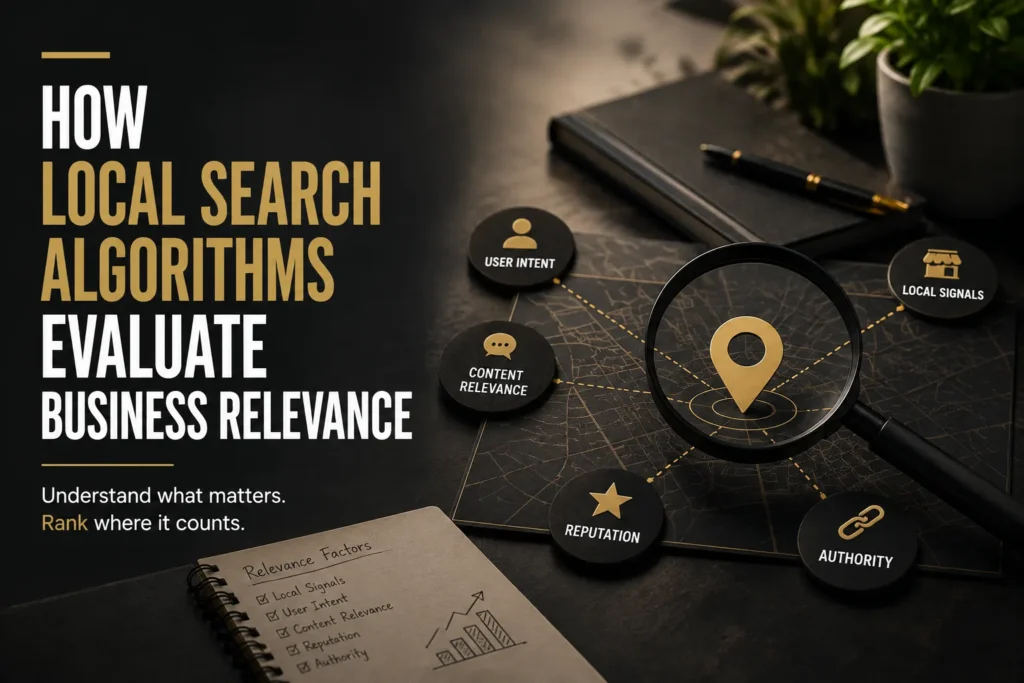
Local relevance is not a synonym for keywords, and it is not a reward for being closest to a searcher. It is a question of fit: does the information available about a business support treating it as a genuine match for what someone is looking for?
Google describes relevance in plain terms: it is “how well a Business Profile matches what someone is searching for.” Google says local results are based mainly on relevance, distance, and prominence. That statement is the most useful starting point available, but it is not a blueprint of Google’s internal system. Google has never published the weighting, sequencing, or thresholds behind it.
This article works from that limit rather than around it. Every claim below is marked by where it comes from: a direct Google statement, a reasonable implication drawn from Google’s documentation, an independent study or survey, a practitioner’s tested observation, or a mechanic that is not public. That separation is the point of the article. Most local SEO content treats all five of these as one undifferentiated pile of “ranking factors.” Relevance deserves better than that, because it is the layer that decides whether a business is even a candidate before distance or popularity get involved.
What Relevance Actually Means in Local Search
Google’s own definition frames relevance as a relationship between a search and a Business Profile, not as a score for how good the business is. A business can be excellent, well reviewed, and two minutes away and still be a weak match for a specific query. A different business across town can be a near-perfect match and still lose the visibility contest, because relevance is only one of three considerations Google names. Google evaluates it alongside, not instead of, the other two.
The practical implication is that relevance starts with accurate representation, not persuasive copywriting. A business needs to communicate what it is, what it does, and where it operates in terms that make sense to both customers and the systems interpreting them. That doesn’t mean every field on a profile is a separately scored ranking input, and it doesn’t mean more text produces more visibility. It means the information has to be true and specific enough to support a match.
This is also why the same business can be highly relevant for one search and effectively invisible for another. A general contractor whose profile, services, and website genuinely reflect kitchen remodeling work is a legitimate candidate for “kitchen remodel contractor.” The same business is not automatically relevant for “roofing contractor” just because it operates in construction broadly. Category defines the core identity. Services and products can extend that identity into specific, real offerings. The website and outside references can corroborate it. None of those descriptions should be stretched past what the business actually does, to chase another type of search.
Relevance, Distance, and Prominence are Separate Considerations
Google says these three factors work together to produce the best result for a search, but they answer different questions, and they can pull against each other.
| Relevance | How well a Business Profile matches a search | Business category, services, and how closely they relate to the query | That the business is nearest or best known |
| Distance | How far a business is from the searching customer | The searcher’s known or inferred location, and the business’s location or service area | That the business matches the need most closely |
| Prominence | How well known a business is | Signals such as inbound links, review counts, and ratings | That the business actually offers what was searched for |
This table is a plain-language reading of Google’s own definitions, not a claim that Google runs three isolated scores through a formula. Google has never published the weighting or order it applies to these factors for a given query. It is more accurate to say a relevant business can be displaced by distance or prominence than to say relevance functions as a hard eligibility gate that always wins or always loses cleanly.
Distance is also more situational than most explanations suggest. Google states that when a customer has not shared a location, it uses what it can infer from the device or the query itself. A location named directly in the search, such as a city or neighborhood, can further shift the geographic context Google applies. Google has not explained in mechanical detail how it resolves searcher location, business location, defined service areas, and a location typed into the query.
Prominence is a different kind of signal entirely. Google names links pointing to a business, review volume, and positive ratings as factors that can contribute to prominence. Those signals can help an already relevant business stand out from other relevant businesses. They cannot make an unrelated business a match, no matter how many reviews or links it has.
How Search Systems Interpret a Query Before Relevance can be Assessed
Before the system can judge a business as a match, it has to figure out what the person is actually asking for. Google’s general Search documentation states that its systems aim to return results it judges relevant to the query, and that location, language, and device context can shape that judgment. That documentation wasn’t written specifically about local search, but it supports a reasonable inference: the wording and context of a search change which pieces of business information matter.
Local intent shows up in several distinct forms, and each one changes what counts as a legitimate candidate.
| Explicit local (a city or neighborhood named directly) | A need tied to a stated place | Does the business genuinely operate in or serve that place? |
| Implicit local (no place named, but local results are useful) | A need where nearby options are the practical answer | Does the business match the need and the searcher’s apparent context? |
| Service or product specific | A named offering | Is that offering actually and clearly represented? |
| Category or class of business | A type of business, not a specific one | Does the business’s category accurately describe its core identity? |
| Brand or navigational | A known, specific business | Can that exact entity, and its correct address or hours, be identified? |
| “Near me” | Location-anchored intent with an implied radius | Is the business close enough and genuinely offering the thing searched for? |
| Neighborhood or city level | A defined geographic scope | Does the business’s location or service area actually cover that scope? |
| Problem-based (“why is my basement flooding”) | A symptom rather than a service name | Does anything in the business’s information connect that problem to a relevant service? |
| Discovery (“best coffee shops downtown”) | Comparison shopping, not a single decision | Is there enough information to place the business fairly among competitors? |
| Transactional | Readiness to act, such as booking or ordering | Does the profile make it clear the business can fulfill that action? |
A brand search is largely a navigational task. The system already has a specific entity in mind, and the job is to confirm identity and surface the correct location details, not to weigh that business against a category of competitors. A non-brand or category search asks the system to evaluate a whole class of candidates against a concept, which is where category accuracy, service information, and website content do the most work. Discovery searches tend to widen the candidate pool further, since the person is comparing options rather than looking for an already known place.
None of this is a disclosure of Google’s actual candidate selection process. It describes how differently worded searches carry different intent, and why a business that is a strong match for one phrasing of a need can be a poor match for a slightly different phrasing of the same need.
Categories Establish the Foundation of Business Identity
Google states directly that “the categories you select affect your local ranking on Google.” That is one of the more explicit statements Google makes about any single profile field, which is part of why category selection gets more attention in local SEO discussion than almost anything else.
Google’s guidance frames category as an identity claim, not a keyword field. Its own representation guidelines describe the exercise as completing the sentence “this business is a,” rather than “this business has a.” A motel with a swimming pool should list itself as a motel, not add “swimming pool” as a category to chase that search term. The primary category should be the most specific, accurate description available; for example, choose “Nail salon” over the broader “Salon” if it fits. Additional categories exist to describe genuine departments or sub-identities within the business, illustrated by Google’s own grocery store example, where a store with an in-house bakery and deli lists “Grocery store” as its primary category and adds “Bakery” and “Deli” as additional categories, because both of those are real, customer-facing parts of that specific business.
Independent research complicates the picture without overturning it. BrightLocal’s 2023 study tracked 1,050 business locations across seven categories (day spa, dentist, department store, electrician, HVAC contractor, lawyer, and real estate agent) and used a 500-meter geogrid to measure average map position. Profiles with four additional categories averaged the strongest position in that sample, at 5.9, while profiles with no additional categories averaged the weakest, at 7.6. But the pattern was not uniform. Real estate listings showed a consistent relationship between more categories and better position. Electricians, which averaged only one additional category across the sample, showed no clear correlation. The study itself acknowledges gaps in its data, including an absence of department stores using exactly two categories, and it does not claim to isolate category count from every other variable affecting those rankings.
Sterling Sky has published a similar practitioner account: a landscaping business that initially listed only “Landscaper” reportedly began ranking for adjacent searches like “landscape designer” and “landscape architect” after adding those as genuine additional categories that matched real parts of the business. That is one agency’s documented case, not a controlled experiment, and it should be read that way.
Put together, the honest position is this: Google’s own instruction is to use the fewest categories that accurately describe the business, and it explicitly warns against using categories to describe amenities or individual services. Independent research suggests that additional categories, when they are true, can correlate with stronger visibility in some industries and not others. Neither finding licenses adding categories that don’t reflect what the business actually is. The dividing line Google draws, and the one worth keeping, is whether a category describes the business’s actual identity or is being used as a keyword.
Services and Products Extend, Rather than Replace, Category Relevance
Category establishes what a business fundamentally is. Services and products describe what it specifically does within that identity, and Google treats them as a distinct layer of information. Google’s own guidance on managing services states that a listed service “may be highlighted” when a customer searches for that specific offering, which directly confirms that services can affect discoverability. Google has not published a statement that each service entry functions as an independently scored ranking input.
| Category relevance | The business’s core, overall identity | This is the type of business it is |
| Service relevance | Specific work the business performs | This is a service the business genuinely provides |
| Product relevance | Specific goods the business sells or stocks | This is a product genuinely available from the business |
| Query relevance | How well the above align with a particular search | The available information supports this specific match |
Sterling Sky’s testing history illustrates why this area deserves caution rather than confident claims. In 2019, the agency tested adding services to profiles and found no measurable ranking effect. In 2022, retesting with different examples, including adding “DUI injury litigation” to a lawyer’s profile and a specific treatment name to a dermatology client’s profile, they observed ranking movement within 24 to 72 hours. They also reported that explicit keyword matches (the literal phrase used in the service name) produced more dramatic movement than implicit or related terms, and that results varied by industry and market. That contradiction between their 2019 and 2022 findings is worth sitting with. It suggests either that Google’s handling of this field changed over time, or that testing conditions differed enough to produce different results, and there is no way to be certain which explanation is correct from outside Google.
The defensible approach is to list real offerings using the terms customers actually use, keep the Business Profile, service pages, and product listings consistent, and stop there. Inventing a service because a phrase gets search volume is a compliance risk as much as a relevance strategy. Google’s own service policy prohibits gibberish, profanity, personal information, prices, and phone numbers in custom service entries, and reserves the right to reject anything that does not fit.
Building a Clear Picture of What a Business Is
A search system can encounter a business through many separate channels: its own profile, its website, directory listings, reviews, links, and mentions elsewhere online. Individually, none of these is decisive. Together, they can build a coherent, corroborated picture of a business’s name, category, location, and offerings, or they can create conflicting signals about what the business actually is.
Google’s representation guidelines specifically ask businesses with multiple locations to keep names and categories consistent across all of them, precisely so that customers, and by extension Google’s systems, can tell those locations apart correctly. Consistency in this sense is about resolving genuine ambiguity, not about repeating identical wording everywhere for its own sake. A correct phone number and an accurate service description prevent a search system from encountering conflicting claims about the same business. That is a meaningfully different goal from assuming that every mention or citation functions as its own scored ranking signal, which Google has never confirmed.
The Business Website’s Role in Relevance
A website can reinforce the same identity a Business Profile is trying to establish, in more depth than the profile format allows. Service pages can explain what the business actually does in the language customers use. Location information can describe real operating context rather than a generic template. Internal links can connect related material so both users and crawlers can find it. Structured data can help make a page eligible for certain search features and can help systems interpret page content more precisely. Still, Google’s own documentation is explicit that structured data does not guarantee a ranking improvement. It affects eligibility for a particular presentation in search results, not relevance scoring directly.
Local content earns its place only when it serves a real audience with information the page doesn’t duplicate elsewhere. Google’s spam policies define doorway abuse as pages built to rank for similar queries that all funnel users to the same underlying destination, and scaled content abuse as generating many pages, including through templated variation, without adding real value. A folder of near-identical city or neighborhood pages that swap a place name and little else is not a relevance strategy under that policy. It is closer to the behavior Google specifically warns against. A single, accurate page that genuinely explains how a business serves a particular area, written because there is something real and specific to say, is a different thing entirely from a manufactured geographic variant built to catch more search traffic.
What a Google Business Profile Communicates
Google’s local ranking guidance instructs businesses to provide complete, detailed information so Google can better understand the business and match it to relevant searches. Completeness, in that framing, means accuracy and specificity, not filling every optional field with promotional language.
| Name and contact details | Core identity and how to reach the business | Match the real-world business name exactly; no taglines or descriptors |
| Primary and additional categories | What the business fundamentally is, and any genuine sub-identities | Choose the most specific, accurate primary category and only true additional categories |
| Services and products | What the business specifically offers | List real offerings using terms customers actually use |
| Address or service area | Where the business operates | Reflect the actual geography the business serves |
| Website | Supporting depth on the business | Link to a maintained site whose content matches the profile |
| Hours and attributes | Practical, customer-facing context | Keep current and factually correct |
| Description, photos, and reviews | Context about the business and the experience of using it | Inform accurately; do not use the description as a keyword field |
Attributes and descriptions can clarify real context. They are not a license to restate target search terms repeatedly or to make claims the business cannot support. Photos may help customers understand a location or its offerings, but Google has not stated that uploading them directly improves ranking; their value is more plausibly about customer decision making than about a scored signal.
Prominence: A Separate Layer that Amplifies Relevant Businesses
Prominence answers a different question than relevance does. Google defines it as how well known a business is, and names links, review counts, and ratings as information that can contribute to it. A business can be highly relevant to a search and still not be especially prominent, which is one reason a newer or smaller business can be a perfect match for a query and still lose visibility to a more established competitor that is a slightly weaker match.
This is also why prominence cannot substitute for relevance, even though the two are constantly discussed together. A business with hundreds of reviews and a strong backlink profile is not thereby relevant to a search for a service it does not actually provide. Prominence can raise a genuinely relevant business above other genuinely relevant businesses. It does not create relevance where none exists, and Google’s own three-factor framing treats it as a separate consideration for exactly that reason.
Google has not published a complete list of everything that contributes to prominence. Links and reviews are the two categories it names explicitly in its own local ranking guidance. Broader web presence, media coverage, and offline recognition are reasonable extensions of the same idea. Still, they go beyond what Google has directly confirmed and should be treated as informed inference, not settled fact.
External References: Citations, Mentions, and Backlinks
These three terms are often used interchangeably in local SEO writing, but they describe different things. A citation is typically a directory or listing entry that includes identifying details such as name, address, and phone number. A brand mention names a business without necessarily linking to it. A backlink is a hyperlink from another page to the business’s own site. Each can say something about a business’s identity or reputation, but they aren’t interchangeable, and Google hasn’t confirmed they work the same way.
Local SEO blogs often cite a specific percentage, claiming consistent citations make a business a fixed amount more likely to appear in the local pack. That number circulates widely without a traceable original methodology, so we don’t repeat it here. What we can say with more confidence is narrower: consistent, accurate information across external references reduces the chance that a search system encounters conflicting claims about who a business is and where it operates. That is a clarity benefit, not a confirmed ranking multiplier.
What Reviews Reveal About Relevance
Reviews sit at an intersection of prominence and relevance, but Google’s own language places them primarily under prominence. Its guidance states plainly that reviews can help a business stand out and give customers useful information, and separately, that more reviews and positive ratings can help local ranking. Neither statement claims that review content is parsed for keyword matching in the way a service listing might be.
What reviews can do, naturally, is reveal real information about a business: the services customers actually used, the products they bought, the neighborhood they mention, and the language they use to describe all of it. That is valuable as a mirror of reality, not as a field to be engineered. The 2026 Whitespark local search survey, which reflects the aggregated opinion of 47 experienced practitioners rather than a Google-confirmed weighting, rated review quantity and review recency among the more influential local pack factors in its panel’s judgment, with recency drawing particular attention as a rising factor in that year’s results. That is useful evidence about what experienced practitioners are observing in client accounts. It is not proof of the underlying mechanism.
Asking customers to leave reviews is a legitimate practice Google itself encourages. Asking them to include a specific keyword or service name in that review is a different matter entirely, and it edges toward manufactured content rather than a genuine account of a customer’s experience. Google’s policies prohibit fake engagement and misleading content, and no confirmed ranking mechanism rewards a keyword appearing inside a review in the first place. The honest use of reviews is to read what customers naturally say and treat it as a signal about where the business’s information might be unclear, not as a field to script.
A Transparency Framework for Relevance Claims
Every claim about local relevance falls into one of five categories, and naming which one applies is the difference between a defensible statement and a guess dressed up as fact.
- Confirmed. Google states it directly. Its definitions of relevance, distance, and prominence, and its statement that categories affect local ranking, fall here.
- Documented implication. Google’s guidance supports a narrow, reasonable conclusion without stating it outright. The idea that accurate service information helps both customers and systems understand an offering falls here.
- Independent observation. A study, survey, or controlled test reports a pattern. BrightLocal’s category study and Whitespark’s annual survey both fall here.
- Practitioner interpretation. An experienced professional’s read on how several observations fit together, without independent verification. Sterling Sky’s category and service case studies fall here.
- Unknown. A claim about exact weighting, sequencing, or internal mechanics that Google has never made public. How distance is calculated and how prominence inputs are weighted against each other both fall here.
This framework exists to prevent two specific mistakes: treating a correlation as a confirmed rule, and dismissing every non-Google source as worthless. Independent research and practitioner testing are genuinely useful for forming hypotheses and designing audits. They stop being useful the moment people repeat them as settled fact, which is how most local SEO misinformation spreads.
An Explanatory Model for Assembled Relevance
The following model organizes the material above for planning and auditing. It is not a description of Google’s algorithm, and no part of it should be read as a claim that Google literally calculates four separate scores or processes them in this sequence.
Identity layer. The category, business name, and core facts that establish what the business fundamentally is.
Offering layer. The services, products, and website content that clarify specific needs the business can meet within that identity.
Location layer. The address, service area, and geographic context that establish where the business is a realistic match.
Corroboration layer. The degree to which the profile, website, reviews, and outside references agree with each other, which reduces ambiguity about the first three layers.
This model keeps relevance work from collapsing into a single field, like category selection or keyword placement. Relevance is closer to a coherent story told consistently across four different kinds of information than it is to any one setting a business can adjust.
Relevance Across Local Search Surfaces
Google can present local information through the Local Pack, the expanded Local Finder, Google Maps, and ordinary organic web results, and it has never stated that all four surfaces use identical inputs or apply them the same way.
| Local Pack | A query with clear local intent shown in standard web search | A short list of businesses with map, ratings, and address | Draws heavily on Business Profile information |
| Local Finder | Clicking “more places” from the Local Pack | An expanded, filterable list of businesses | Same underlying profile data, presented at greater depth |
| Google Maps | A direct search within the Maps app or site | Businesses plotted geographically, with profile details | Profile-driven, with a stronger emphasis on location context |
| Local organic results | A query where a business’s own web pages compete in standard search | Individual pages ranked among other web content | Draws on website content and standard web ranking systems, not just the profile |
A Business Profile is the dominant source of information in the first three surfaces. The fourth surface evaluates a web page more directly against general web ranking systems. That difference is one reason a business can be strong in the Local Pack and comparatively invisible in local organic results, or vice versa, without contradiction. It also means research or reporting that blends data from multiple surfaces into one set of conclusions should be read carefully. A pattern observed in the Local Pack does not automatically transfer to Local Finder or organic behavior. When a search instead returns an AI-generated summary, the process behind what gets surfaced may differ again.
Why Relevance is not Static
Relevance is not something a business sets once and leaves alone. It shifts when a business adds or drops a service, changes what it sells, opens a new location, expands or narrows a service area, or changes its hours. Customer language and seasonal demand shift too, changing the words a system tries to match against and keeping information accurate as the business genuinely changes matters more than protecting an optimization decision made months or years earlier.
Advanced Relevance Scenarios
Multi-location businesses. Google’s own guidance requires multi-location businesses to use consistent names and categories across locations so each one can be identified correctly. Consistency does not mean offering identical services everywhere. Each location should include only the categories, services, and local claims that are genuinely true for that specific address. When a multi-location business applies a corporate template to a location that does not actually offer a listed category or service, it creates the exact kind of relevance mismatch Google is designed to catch.
Multi-category and multi-service businesses. A business that genuinely spans more than one distinct identity, such as a bakery that also runs a catering operation, faces a real choice about which identity is primary. Google’s instruction is to choose the category that best describes the overall core business and use additional categories for genuine sub-identities, not to hedge across two loosely related businesses by picking whichever category has more search volume.
Service-area businesses. These businesses do not serve customers at a fixed address, and Google’s rules reflect that structurally. Service areas are defined by city or postal code, not by a radius; businesses can list up to twenty of them, and Google recommends staying within roughly a two-hour driving boundary from the business’s base. A business that does not serve walk-in customers is expected to remove its public address entirely rather than presenting an unstaffed location as a storefront. Because there is no single fixed point to measure distance from, as there is for a physical storefront, relevance and distance interact differently for these businesses than they do for a business with a public address.
Brand versus non-brand queries. A brand search is largely a navigational task. The system already has a specific business in mind, and the job is mostly to confirm identity and location details correctly. A non-brand or category search asks the system to evaluate a class of candidates against a concept, where category accuracy, services, and website content carry more weight. Treating these as the same kind of search leads to strategies built for one that do not transfer to the other.
Local independent businesses versus national or multi-market brands. A national brand often carries a real prominence advantage from accumulated reviews, links, and recognition across many markets. That advantage doesn’t establish relevance for a specific local offering if the local branch or franchise location doesn’t genuinely provide it. An independent local business with a closer, more accurate match to a specific search can still compete on relevance even against a more prominent competitor. However, it may need to work harder on the prominence side to close the remaining gap.
Common Misconceptions About Local Business Relevance
“More Keywords in the Business Profile Means More Relevance”
Google’s own representation guidelines prohibit stuffing the business name with taglines, service descriptions, or locations, and repeating keywords elsewhere on a profile is not a documented way to improve relevance. Accuracy and specificity communicate identity. Repetition does not.
“Adding Every Available Category Improves Visibility”
Google explicitly instructs businesses to use the fewest categories that accurately describe them, and warns against selecting a category for every product or service. Independent research shows a correlation between additional categories and stronger average position in some industries, and no clear pattern at all in others. Categories that aren’t true to the business remain a policy violation, regardless of what any study suggests.
“Keyword-Stuffing the Business Name Improves Relevance”
This is not a relevance strategy; it is a policy violation. Google’s guidelines specifically prohibit adding taglines, service terms, or location names to a business name, and doing so risks suspension of the profile entirely.
“More Citations Automatically Mean Better Rankings”
Google’s own local ranking guidance does not name citation volume as a confirmed factor. Consistent citations reduce ambiguity about who a business is, which is a real benefit. Still, Google has not confirmed that the leap from “consistent” to “more is automatically better” is true.
“More Reviews Automatically Make a Business More Relevant”
Google frames reviews as prominence, not relevance. Reviews can reveal real information about a business’s services and location. That content can be useful context, but review count does not establish that a business matches a particular search in the way category and service information does.
“A Nearby Business Always Ranks First”
Distance is one of three factors Google names, not the deciding one. A closer business that is a weak match for the query, or that is far less prominent than the alternatives, does not automatically outrank a business that is a stronger match, even from slightly farther away.
“Location Pages Automatically Improve Local Relevance”
Google’s spam policies specifically define doorway abuse and scaled content abuse in terms that describe templated, near-duplicate location pages built to capture search traffic. Pages built around real, distinct, useful information about how a business serves a specific area are different. Still, a location page alone is not a relevance signal, and mass-producing them carries real policy risk.
“Brand Mentions are a Direct Ranking Factor”
Google names links, reviews, and ratings as inputs to prominence in its own guidance. It has not confirmed that an unlinked mention of a business name functions as a ranking input. This idea is a reasonable industry theory, but it remains unconfirmed until Google says otherwise.
“Exact-Match Keywords Determine Local Relevance”
Google’s general ranking documentation describes systems built to understand the meaning behind a query, not just to match strings of text. Aligning categories and services with what a business genuinely offers is a more defensible relevance strategy than repeating an exact phrase across a profile and website.
A Practical Relevance Audit
This is a focused check on relevance specifically. It is not a substitute for a full technical SEO review, a reputation management plan, or a conversion audit.
- Define the real queries and needs. Group demand by the services, products, categories, and locations the business genuinely serves. Leave out anything it does not actually offer.
- Check category alignment. Confirm the primary category is the most specific, accurate description available, and that additional categories reflect genuine parts of the business rather than a wish list.
- Check service and product alignment. Compare what is listed with what you actually offer today, and remove anything outdated or aspirational.
- Check profile and website consistency. Make sure the name, contact details, service descriptions, and hours match across the profile and the site, especially after any recent business changes.
- Check location and service-area accuracy. Confirm the address or service area reflects where the business genuinely operates, not where it once operated or hopes to expand.
- Check external references for material accuracy. Prioritize correcting real inaccuracies on directories and citations that matter, rather than chasing citation volume for its own sake.
- Check what reviews naturally reveal. Read recent reviews for recurring language that points to a service or offering the profile does not currently describe clearly.
- Check supporting content against real search intent. Keep pages that provide genuinely distinct information, and reconsider anything that exists only to repeat a location or keyword.
An audit like this can surface real gaps and mismatches. It cannot predict a ranking position because Google hasn’t published the full system or how it resolves conflicts between relevance, distance, and prominence for any specific query.
Relevance in AI-powered and Generative Local Search
Generative search makes clear, corroborated business information more valuable, not less, but it does not make unverified claims about how it works any safer to repeat.
Whitespark’s research on AI Overviews in local search offers one of the few grounded data points currently available. Across three US cities (Houston, Phoenix, and Denver) and six industries (plumbers, lawyers, dentists, optometrists, clinics, and real estate agents), the study ran 540 queries and found AI Overviews appearing in roughly 68 percent of local-business-type searches on average. However, the rate varied by city and industry. The more revealing finding was the breakdown by intent: AI Overviews appeared for only about 15 percent of clearly local-intent queries, compared with 92 percent of informational queries and 97 percent of hybrid queries. The Local Pack, by contrast, appeared for around 39 percent of queries overall, with an inverse relationship to AI Overview presence depending on query type. In other words, the more a query reads as “find me a business to use right now,” the more likely it currently is to produce a traditional Local Pack rather than an AI-generated summary, at least within the sample this study covered.
That is useful, specific evidence about a real pattern in one study, not a universal rule about how AI-generated answers select sources. Whitespark’s broader 2026 survey also asked its panel of experienced practitioners to rate factors they believe influence AI search visibility, including dedicated service pages and inclusion on expert-curated lists. Those ratings reflect professional judgment from people watching client accounts closely, not a disclosed mechanism from Google or any other AI system.
What can be said with reasonable confidence is that the underlying signals this article has already covered category accuracy, real service and product information, and corroborated identity across the profile and the web, remain the material an AI system would need to correctly represent a business, regardless of which surface eventually shows the result. What cannot yet be said is a complete list of AI-specific ranking signals, a reliable method for being cited inside a generated answer, or a fixed relationship between AI Overview visibility and Local Pack visibility, because that mechanism has not been made public and is still actively changing.
Conclusion
Business relevance in local search is the disciplined alignment of a real search need with a business’s real identity, offerings, and operating context. Google confirms that relevance, distance, and prominence all matter, and it has been unusually direct about what relevance itself means, without disclosing the mechanics behind any of it. The durable work that follows from that is plain rather than clever: choose truthful categories, describe actual services and products, keep location and contact information current, build supporting content that says something real, and correct genuine inconsistencies wherever they show up. That is the same information a customer needs to decide whether the business is a fit, which is likely why a search system also tries to evaluate it.
Frequently Asked Questions
No. Google defines relevance as how well a profile matches a search, and keywords can help describe an offering accurately. Still, category, service, location, and identity information all shape whether a business reads as a genuine match. Repeating a keyword does not substitute for any of that.
No. Google says complete, detailed information helps it understand and match a business to relevant searches, which is a real benefit, but it does not promise a specific position, since distance, prominence, and the query itself also factor in.
Google says categories affect local ranking, and instructs businesses to use a few categories that genuinely describe the business. Independent research shows a correlation between additional categories and stronger average position in some industries and none in others. No confirmed rule says more categories automatically mean better rankings, and inaccurate categories remain a policy violation.
Reviews sit primarily under prominence in Google’s own framing, and can naturally reveal real information about services and location. No confirmed mechanism shows that adding a specific word to a review makes a business relevant for that service, and asking customers to insert keywords crosses into manufactured content.
Google’s own local ranking guidance names links, reviews, and ratings under prominence. It does not publish a rule assigning citation count a direct ranking value. Accurate, consistent citations still reduce ambiguity about who a business is, which has real value even without a confirmed ranking multiplier.
The Local Pack is the short list of businesses shown directly in standard search results for a local query. The Local Finder is the expanded, filterable list that appears after clicking through from the Local Pack. Both draw on the same underlying Business Profile information, with the Local Finder presenting more of it at once.
Google names links, reviews, and ratings as confirmed inputs to prominence. It has not confirmed that an unlinked mention of a business name functions as a ranking factor on its own. This remains a reasonable industry theory, not a settled fact.