
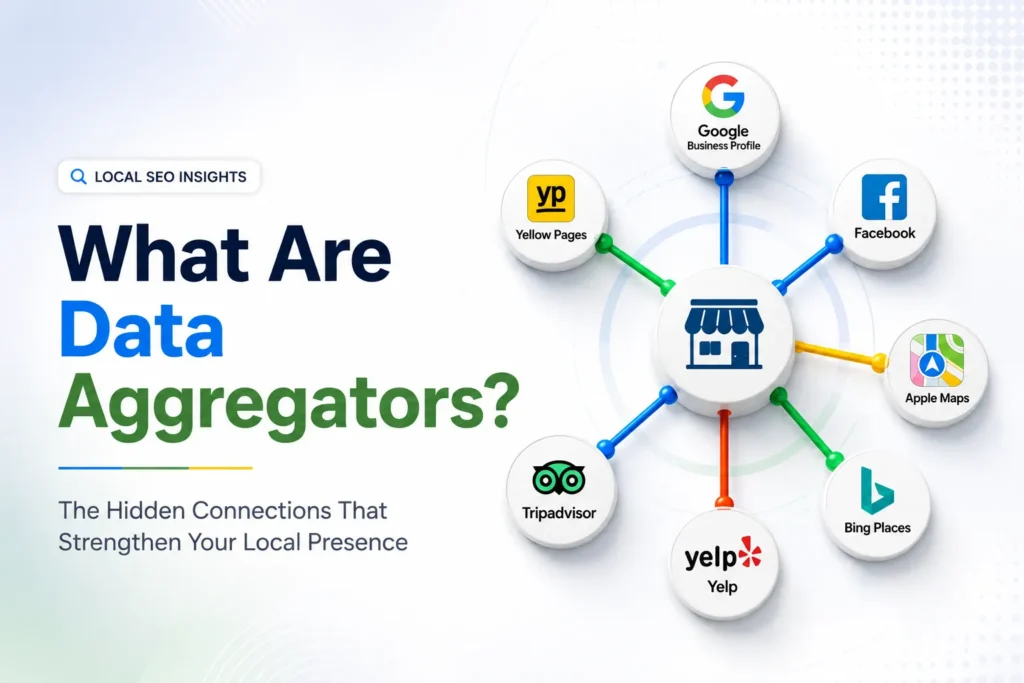
Data aggregators collect, verify, organize, and distribute local business information to search engines, maps, directories, navigation tools, and other platforms. They’re one part of the behind-the-scenes system that helps customers find the right business name, address, phone number, hours, and category online.
This matters more than it used to. AI tools such as ChatGPT can also surface local business information from these broader data sources, not just Google. In this guide, you’ll learn how aggregators work, which ones matter, how they affect local SEO and AI search, and how to keep your business information under control.
What Is a Data Aggregator?
A data aggregator is a company that collects business details, checks and standardizes them, then distributes that information to search engines, directories, map products, navigation apps, and other partners. It acts as a wholesale source of local business data, helping one submitted listing reach many places at once.
Think of an aggregator as the modern, technology-powered backbone of the old Yellow Pages system. Instead of sending your business details to every individual publisher one by one, you give accurate information to an aggregator, and its network can pass that data along for you.
The key difference is who the information serves. An aggregator is mainly a data wholesaler. A directory, such as Yelp or YellowPages, is a consumer-facing retailer of that data. People visit a directory to find businesses directly. Other platforms simply use an aggregator’s data to help build or update their own listings.
How Data Aggregators Work (The Data Supply Chain)
The process is easier to understand once you see it as a supply chain. Your business provides information at one end, and a potential customer sees it on a search result, map, app, or AI answer at the other.
Step 1: The Business Submits or Claims its Data
A business starts by submitting a new profile or claiming an existing one. The core details usually include the business name, physical address, phone number, website, hours, business category, and service area.
Some platforms also allow photos, descriptions, payment options, accessibility details, and social profiles. The basics matter most, though. If your name, address, and phone number are wrong, extra details won’t make the listing any more reliable.
Step 2: The Aggregator Verifies and Cleans the Data
The aggregator checks whether the information looks legitimate and whether another listing already exists for the same business. This can include phone verification, review processes, standardizing address formats, and removing duplicates.
Cleaning matters because local business data tends to get messy. A business might appear as “Smith Dental,” “Smith Dental Clinic,” and “Smith Family Dentistry” across different sites. Those may all refer to one location, but a platform needs enough confidence before it publishes conflicting records.
Step 3: The Data is Distributed Through Feeds and Partnerships
Once a profile is accepted, the aggregator can distribute it through data feeds, partnerships, and connected platforms. That doesn’t mean every partner updates instantly, or that every partner accepts every field exactly as submitted.
Still, one accurate source can have a much wider effect than a single directory listing. That’s the main value of an aggregator network.
Step 4: The Information Reaches Search, Maps, GPS, and AI tools
The data can then appear in search engines, online directories, GPS and navigation apps, local discovery products, and AI assistants. The flow, in simple terms, looks like this:
Business → Aggregator → Search engines, directories, GPS apps, and AI assistants → Customer
A customer may never even know an aggregator exists. They just search for a nearby plumber, ask an AI assistant for a restaurant, or open a navigation app. The quality of the answer they get often depends on how accurate the data was as it moved through that chain.
Data Aggregators vs. Directories vs. Citations: What’s the Difference?
These three terms are often used together, but they’re not interchangeable.
| Term | What It Is | Example | Is It Consumer-Facing? |
| Aggregator | A wholesale provider that collects and distributes business data to other platforms | Data Axle, Foursquare Places | Usually no |
| Directory | A site or app where people search for businesses directly | Yelp, YellowPages | Yes |
| Citation | An online mention of a business’s name, address, and phone number | A business profile or a simple mention on a directory, local news site, or map platform | It can be either |
A citation doesn’t have to be a full business profile. It can be as simple as mentioning your business name, address, and phone number in a local news article or on a community website. The important part is consistency. If five sources list five slightly different versions of your address or phone number, search engines and customers both get mixed signals.
The Major Data Aggregators You Need to Know
The local-data ecosystem has changed a lot over the years. Older articles often repeat a list of “the big four” aggregators that still includes Acxiom, as if it operates a local business directory today. That advice is outdated, and it’s worth knowing why before you go submitting your business anywhere.
Here are the names that actually matter right now.
Foursquare (Foursquare Places / Foursquare for Business)
Foursquare began as a consumer check-in app, then grew into a major location-data company. It merged with Factual in 2020, bringing together two important location-data businesses under one roof.
Today, Foursquare Places and Foursquare for Business help power location information in apps and products including Uber and Nextdoor. It’s also a primary local-data source that ChatGPT relies on for local business information, which makes an accurate Foursquare presence useful for a lot more than traditional map visibility.
Businesses can generally claim or add their presence through Foursquare for Business. The right approach is to search for an existing venue first, claim it if it exists, then make sure its name, address, phone number, category, and hours match your other core profiles.
Costs can vary by product and business needs. The practical priority isn’t buying every possible feature. It’s making sure the core listing exists, is claimed where possible, and contains current information.
Data Axle (Formerly Infogroup)
Data Axle was previously known as Infogroup. It’s one of the better-known local business-data providers in the United States and operates platforms including Local Listings and BulkUpdate.
Data Axle uses verification processes that can include phone verification, and it works to organize records and reduce duplicate or conflicting information. Data Axle itself states that its partnerships cover about 98 percent of U.S. search volume. That’s Data Axle’s own figure rather than an independently verified number, but it gives you a sense of how wide its reach is meant to be.
A business can submit or manage information through Data Axle’s listing products. For a small business, the useful starting point is confirming whether the company already has a record, reviewing it carefully, and correcting any inaccurate NAP details before expanding into paid or bulk-management options.
TransUnion Digital Business Profile (Formerly Neustar Localeze)
TransUnion Digital Business Profile is the current name for what many local SEO guides still call Neustar Localeze. If you see both names floating around in older advice, they refer to the same lineage of local listing products, not two separate tasks you need to complete.
The service has direct, authorized relationships with local search platforms. Its profile option costs around $99 per year per business profile. That can be a reasonable expense for a business that needs stronger data control, especially if it has multiple locations, a history of listing problems, or frequent operational changes.
For a stable single-location business, it’s usually less urgent than getting Google Business Profile, Foursquare, Apple Business Connect, Bing Places, and major directory details right first. Cost should follow need, not fear.
GPS Network and YP Network
GPS Network focuses on data used by navigation products. For businesses that depend on in-person visits, accurate navigation data can matter just as much as a strong search listing. A correct pin, address, and phone number can be the difference between a customer arriving easily and giving up halfway there.
YP Network covers familiar directory brands including Yellow Pages, SuperPages, and DexKnows. These platforms are consumer-facing, but their wider data relationships still make them relevant to citation consistency.
Neither network should replace attention to your core profiles. They’re part of the broader ecosystem, not a shortcut around Google Business Profile or Apple Business Connect.
What Happened to Acxiom?
Acxiom closed its local business directory in 2019. Foursquare largely absorbed the role Acxiom once played in local business-data conversations.
That’s why any current “big four” list that still presents Acxiom as active local listing infrastructure needs a date check. Local SEO advice can stay online for years, even after the platforms it describes have changed names, changed ownership, or shut down entirely.
The Secondary Power Players
Some platforms operate as major consumer directories while also carrying real weight in the wider local-data ecosystem. Yelp, YellowPages.com, Foursquare, and CityGrid are often treated as secondary power players because their data can feed other products or heavily cross-feed within the ecosystem.
They’re not all identical in function, though. Yelp is very consumer-facing, for example, while Foursquare doubles as a major data engine. The lesson is simple: don’t treat a listing on one popular site as isolated. A mistake can travel, and a well-maintained profile can reinforce consistency elsewhere.
| Aggregator or Network | Formerly Known As | Approximate Cost | Who It Feeds | Best For |
| Foursquare Places / Foursquare for Business | Factual merged into Foursquare in 2020 | Varies by product | Location-based apps such as Uber and Nextdoor, plus local-data uses including ChatGPT | Businesses that want dependable location data and AI-search readiness |
| Data Axle | Infogroup | Varies by listing and bulk products | A broad partner network, which Data Axle says covers about 98 percent of U.S. search volume | U.S. businesses managing core business data at scale |
| TransUnion Digital Business Profile | Neustar Localeze | Around $99 per year per profile | Authorized local-search relationships | Businesses that need a paid, controlled profile option |
| GPS Network | Not applicable | Varies | Navigation apps | Businesses that rely on driving directions and walk-in visits |
| YP Network | Not applicable | Varies | Yellow Pages, SuperPages, and DexKnows | Businesses improving directory coverage and citation consistency |
Why Data Aggregators Still Matter for Local SEO
Data aggregators aren’t a replacement for local SEO. They’re part of the foundation that makes the rest of your local SEO work easier to trust.
NAP Consistency is a Trust Signal
NAP means name, address, and phone number. When those details match across trusted sources, search platforms can more easily understand they’re looking at one real business, not several.
Small differences don’t always create a disaster. “Suite 200” versus “Ste. 200” is usually less serious than an old phone number, a former business name, or a different street address. But consistency reduces ambiguity, and ambiguity rarely helps in local search.
They can Influence Local Pack and Maps accuracy.
Many factors shape Google’s Local Pack and Maps. An aggregator alone won’t push a business to the top of local results. Reviews, relevance, proximity, Google Business Profile quality, and your own website all play a part.
But clean, consistent third-party information supports accuracy behind the scenes. It helps platforms confirm the core facts about your business and makes it less likely that stale information takes over.
They Save Time Compared with Manual Submissions
Submitting manually to every directory can turn into a long, repetitive task. It also creates more places to forget when your address, hours, brand name, or phone number changes down the road.
Aggregators help centralize part of that work. They don’t eliminate the need to claim important direct listings, but they can cut down on the one-by-one cleanup you’d otherwise have to do.
They Help Reduce Duplicate and Incorrect Listings
Duplicate listings can confuse customers and fragment reviews, calls, or directions across two or three versions of the same business. Incorrect listings can send people to an old location or make them think your business has closed.
A recurring pattern in local business listing audits is that the biggest problems are rarely glamorous. An old tracking phone number, a previous suite number, or a duplicate profile can quietly confuse for months before anyone notices. Regular checks catch those issues before they spread further.
Data Aggregators and AI Search: Why This Matters More in 2026
Local search doesn’t happen only inside a browser anymore. People now ask AI tools questions such as, “Where can I find a late-night pharmacy near me?” or “Which local accountant handles small businesses?”
A large share of the business information these tools surface can come from third-party sources rather than directly from a company’s own website. Your website still matters, but it isn’t always the only source shaping the answer you get back.
How Different AI Products use Local Information
ChatGPT leans heavily on Foursquare’s data for local business information, giving Foursquare a more visible role in AI search than many business owners realize.
Perplexity relies more on real-time web crawling, along with sources such as Reddit, YouTube, and news sites. That makes a business’s broader web presence especially relevant there.
Apple Intelligence draws mainly from Apple Maps and Yelp. For businesses that serve Apple users, accurate Apple Business Connect and Yelp information can affect how clearly they show up in Apple’s local experiences.
Accurate Data Affects Whether AI Answers are Useful
AI tools try to assemble a useful answer from whatever information they can find. If your address, category, hours, or phone number is inconsistent across major sources, the tool may show an incomplete answer, give conflicting details, or leave your business out entirely when it can’t confidently match the information.
The same principle applies to traditional search engines, but AI makes the impact feel more immediate. A customer might get one confident recommendation instead of scanning ten blue links. You want the facts behind that recommendation to be right.
A Practical AI-search Readiness Checklist
- Keep identical name, address, and phone details across Foursquare, Data Axle, Google Business Profile, Bing Places, and Apple Business Connect.
- Use the most specific, accurate business category available, not the broadest one.
- Add basic LocalBusiness structured data to your website.
- Update hours, closures, phone numbers, moves, and rebrands as soon as they happen.
- Ask for detailed, genuine customer reviews that mention actual services, products, or experiences.
- Check how your business appears in major maps and directories, not just in Google Search.
A pile of vague reviews is less useful than a handful of reviews that clearly describe what customers value. Specific feedback gives both people and AI systems more context about what your business actually does.
How to Submit Your Business to Data Aggregators (Step-by-Step)
You don’t need to tackle every site in one afternoon. Start with a clean record, work through the most important platforms, and build a repeatable maintenance habit.
Step 1: Audit Current Listings
Search for your business name, address, phone number, past business names, and old phone numbers. Look for duplicate profiles, outdated addresses, incorrect categories, and inconsistent hours.
Write down the official version of every core detail before you change anything. This becomes your source-of-truth record.
Step 2: Choose Manual Submission or a Management Tool
Manual submission often makes sense for a single, stable local business. It takes time, but it gives you direct control and may cost little or nothing.
A listing-management tool can make more sense for multi-location businesses, agencies, franchises, and businesses with frequent changes. It’s also worth it when staff time costs more than the service itself.
Step 3: Submit or Claim Profiles
Claim or create profiles on the most relevant major platforms. Start with Google Business Profile, Apple Business Connect, Bing Places, Foursquare for Business, Data Axle, and any paid or network options that fit your needs.
Use the same core NAP details everywhere. Don’t create keyword-stuffed versions of your business name. If your legal or public-facing name is “Riverside Plumbing,” don’t turn it into “Riverside Plumbing Best Emergency Plumber Dallas.”
Step 4: Monitor and Refresh Regularly
Review your core listings every few months. Check them immediately after a move, rebrand, new phone number, business-hours change, or ownership change.
Partners don’t all update at the same speed. A correction may take a while to move through the supply chain, so keep notes on what you changed and when.
Practical submission checklist:
- Create one approved master record for your business information.
- Audit existing listings before creating new ones.
- Claim duplicate-prone profiles rather than creating unnecessary new entries.
- Verify phone and ownership requests promptly.
- Use accurate, specific categories.
- Add current hours, website, and service details.
- Check Google Business Profile, Apple Business Connect, Bing Places, Foursquare, and Data Axle first.
- Recheck listings every few months and after any business change.
Common Mistakes Businesses Make With Data Aggregators
The biggest issues are usually preventable.
Using inconsistent NAP details: A business name with extra keywords on one platform, an old phone number on another, and a former suite number somewhere else all create unnecessary uncertainty.
Choosing vague or wrong categories: Categories help platforms match your business with relevant searches. A specific, accurate category beats a broad one you picked because it sounded popular.
Forgetting updates after a change: Moving offices, changing hours, rebranding, or switching phone providers should always trigger a listing update. Waiting until customers complain is too late.
Relying only on aggregators: Aggregators support local visibility, but they don’t replace an actively managed Google Business Profile, useful website content, strong reviews, or direct map profiles.
Ignoring the data AI tools use: A business might look fine on Google while still carrying inaccurate information on Foursquare, Yelp, Apple Maps, or other sources. That gap matters more now that customers lean on AI and map products for local recommendations.
Do You Still Need to Pay for Data Aggregators?
Sometimes, yes. Sometimes, no. It depends on how much complexity you’re dealing with.
A single local shop with one stable location, consistent business details, and enough time to claim major listings manually may not need a paid aggregator package right away. In that case, prioritize the essentials: Google Business Profile, Apple Business Connect, Bing Places, Foursquare, Data Axle, core directories, and your own website.
A paid option such as TransUnion Digital Business Profile is worth considering once a business has several locations, recurring listing errors, frequent operational updates, or no internal time to manage the work. Around $99 per year per profile is a reasonable trade if it prevents lost calls, wrong directions, or ongoing cleanup down the line.
For multi-location and enterprise businesses, centralized management usually pays for itself. The more locations you run, the more expensive inconsistency becomes, and a manual process that works fine for one shop can fall apart across twenty locations.
So the real question isn’t whether you need every paid listing service out there. It’s whether the manual approach still gets accurate data everywhere your customers are looking, and for most small, single-location businesses, it does for a while.
Best Tools and Services to Manage Data Aggregator Submissions
Several tools can help manage listings and citations. None of them is automatically the best choice for every business.
| Tool or Service | Coverage and Approach | General Pricing Approach | Best For |
| Yext | Broad listing-management platform with centralized controls | Typically subscription-based | Larger businesses and multi-location brands |
| Moz Local | Listing distribution and local-presence management | Subscription-based | Small and mid-size businesses wanting a guided option |
| BrightLocal | Local SEO platform with citation and reporting features | Subscription-based, often flexible by usage | Agencies, consultants, and hands-on local marketers |
| Synup | Listing management and local marketing tools | Subscription-based | Businesses with multiple locations or local marketing teams |
| Whitespark | Citation-focused local SEO tools and services | Tool, service, or campaign-based options | Businesses and agencies focused on citation building and cleanup |
Pricing, coverage, and connected partners can change, so review current plans before you commit. The right tool depends on how many locations you have, the condition of your existing listings, how often your details change, and whether you’d rather have software, managed help, or a fully manual process.
Key Takeaways
- Data aggregators are wholesale sources that distribute local business information to many other platforms.
- Foursquare, Data Axle, TransUnion Digital Business Profile, GPS Network, and YP Network each play a different role in the local-data ecosystem.
- Acxiom is no longer an active local business directory, so older “big four” advice can be outdated.
- Consistent NAP details reduce customer confusion and support trustworthy local-search information.
- Accurate aggregator profiles now matter for AI search visibility as well as traditional search and map results.
Start with a clean master record, claim your core profiles, and review them whenever your business details change.
Frequently Asked Questions
Yes. Data aggregators still help distribute and validate local business information across search, maps, directories, navigation tools, and AI-related experiences. They’re not a replacement for Google Business Profile or a strong website, but accurate aggregator data helps keep information consistent across the wider local-search ecosystem.
Foursquare is a major location-data engine with products such as Foursquare Places and Foursquare for Business. Data Axle, formerly Infogroup, is a business-data provider with listing and bulk-update products. Both distribute local data, but they run different networks, verification processes, and product lineups.
There’s no guaranteed timeline. Aggregators may verify and publish changes before their partners refresh their own data. Some updates show up fairly quickly, while others take longer. Keep records of what you submitted, check core platforms directly, and fix urgent errors at the destination platform when you can.
TransUnion Digital Business Profile is the current name for the service many older local SEO articles still call Neustar Localeze. You don’t need to treat them as separate aggregators. The name change is one reason older local listing advice can feel confusing or out of date.
Not always. Many businesses can claim or submit important profiles manually for free, especially with one stable location. Paid options tend to be worthwhile once a business has multiple locations, frequent changes, persistent listing errors, or limited internal time for managing profiles and citations.
Acxiom closed its local business directory in 2019. Foursquare largely absorbed the role Acxiom once held in local-data conversations. If an article still lists Acxiom as an active major local business aggregator, it’s working off older information and should be treated carefully.
AI tools can pull local business facts from third-party data sources, not only from your website. ChatGPT leans heavily on Foursquare for local business information, while other tools draw from a different mix of sources. Accurate, matching profiles improve the odds that your business details show up correctly in AI-generated answers.
You can submit or claim many listings yourself, and manual work is often practical for a single local business with stable information. A service becomes more helpful once you’re managing several locations, need ongoing monitoring, or want help tracking down widespread duplicate or inconsistent listings.