
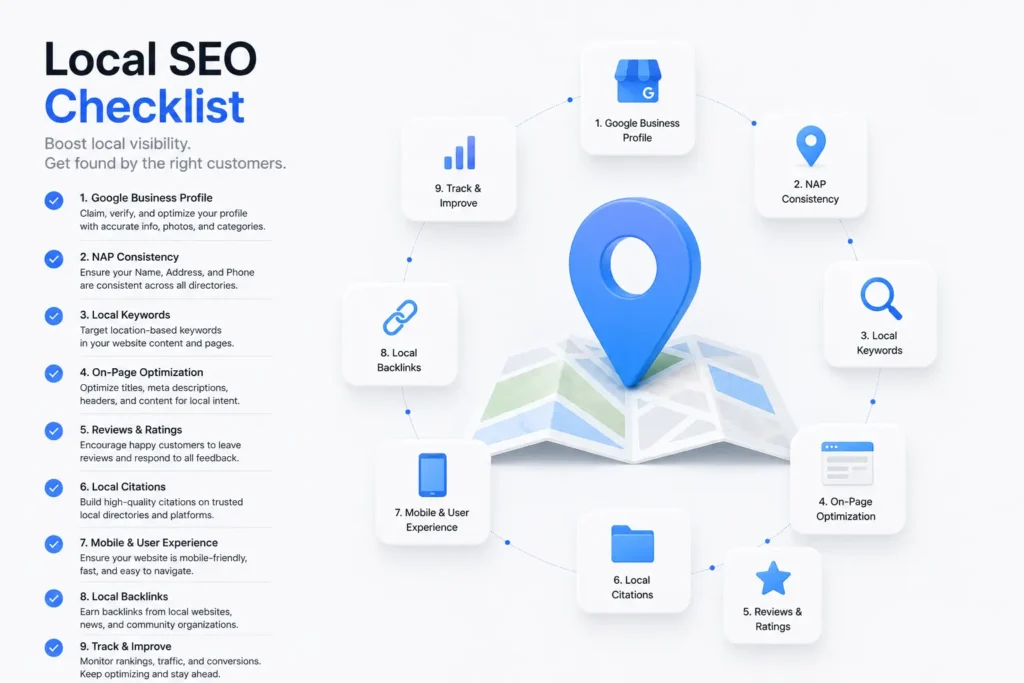
If local SEO feels messy, it usually is for one reason. Most businesses do the steps out of order. They jump to backlinks before the basics are clean. They post on Google Business Profile while their service pages still read like templates. They chase more keywords while their offers and trust signals are unclear.
This Local SEO Checklist from LocalMighty is built like a real workflow. It moves from foundation to visibility to authority and long-term business growth. You can follow it once for a full reset, then repeat the maintenance steps monthly.
You will notice two things as you read. First, this local SEO workflow is designed to drive leads, not vanity rankings. Second, this local seo checklist is written so search engines and AI systems can clearly understand who you serve, what you do, and why you deserve trust.
The Ultimate Local SEO Checklist for 2026
| Local SEO Growth Layer | What to Optimize |
|---|---|
| 1. Local Business Foundation | • Define exact business name and positioning • Choose clear service categories • Keep business details standardized everywhere • Build strong local identity |
| 2. Google Business Profile Setup | • Claim and fully verify Google Business Profile • Complete every available field • Select the correct primary category • Add secondary categories carefully • Keep hours accurate |
| 3. Service & Product Optimization | • Add every core service individually • Write service descriptions naturally • Avoid keyword stuffing • Update services regularly |
| 4. Location & Service Area Configuration | • Define realistic service areas • Avoid overexpansion • Match service coverage with real operations |
| 5. Local Keyword Targeting | • Research service + city combinations • Target conversational searches • Build pages based on actual customer language |
| 6. Website Homepage Optimization | • Clarify who you help, where you operate, and why customers should choose you within seconds |
| 7. Service Page Expansion | • Create dedicated pages for each major service • Add FAQs, trust signals, and strong CTAs |
| 8. Location Page Strategy | • Build unique pages for each city or location • Avoid duplicated content • Include local context |
| 9. Internal Linking Architecture | • Connect homepage → service pages → location pages → blogs • Build clear topical relationships |
| 10. Reviews & Reputation Engine | • Build a consistent review acquisition process • Respond to all reviews • Encourage detailed experiences |
| 11. Review Response Optimization | • Respond naturally • Mention services and customer outcomes where appropriate • Show activity and professionalism |
| 12. Local Content Authority | • Publish helpful local content • Answer customer questions • Create city and industry-specific resources |
| 13. Photo & Media Signals | • Upload real photos consistently • Team • Office • Work • Process • Before and after • Avoid stock images |
| 14. Google Business Profile Activity | • Publish posts regularly • Add updates • Answer questions • Refresh photos and services |
| 15. Local Conversion Optimization | • Add click-to-call • Easy forms • Clear CTAs • Reduce friction across the customer journey |
| 16. Mobile First Experience | • Ensure fast mobile loading • Simple navigation • One-thumb usability |
| 17. Technical Local SEO | • Optimize indexing • XML sitemap • Canonicals • Structured HTML • Fast server response |
| 18. Local Schema Implementation | • Implement LocalBusiness schema • FAQ • Organization • Service • Review schema where applicable |
| 19. Citation Consistency | • Keep Name, Address, Phone consistent across all listings • Remove duplicates |
| 20. Directory Optimization | • Optimize major platforms • Bing • Apple Maps • Industry directories |
| 21. Entity Building | • Strengthen brand identity across the website, citations, social profiles, and external mentions |
| 22. Trust Signal Layer | • Add credentials • Awards • Certifications • Testimonials • Memberships • Case examples |
| 23. Local Link Acquisition | • Build local backlinks through sponsorships, community involvement, partnerships, and PR |
| 24. Community Presence | • Participate locally • Events • Charities • Partnerships • Community activities |
| 25. Behavioral Signal Optimization | • Improve engagement • Increase calls • Increase directions • Improve interaction quality |
| 26. Brand Search Growth | • Encourage direct searches for your business name • Build memorability and awareness |
| 27. Local Content Cluster Building | • Create supporting articles around services and locations to build topical authority |
| 28. Competitive Position Monitoring | • Track competitors’ reviews, categories, content, and Google activity |
| 29. Reporting & KPI Tracking | • Measure calls, leads, bookings, direction requests, rankings, and revenue |
| 30. Local SEO Maintenance System | • Review performance monthly • Update assets quarterly • Refresh content consistently |
Below is a step-by-step implementation process to help your local business grow:
Step 1: Identify Your Local Money Keywords
Local SEO becomes profitable when your keyword list reflects how real buyers search. Not how tools label keywords.
Start by separating your target terms into three buckets.
- High-value service keywords that usually come with bigger budgets
- Local intent keywords that include a place name
- Local intent keywords that do not include a place name
Here is the simplest way to build that list without overthinking.
Build your high-value service list
Ask yourself what work you want more of, not what work you get most often. Many service businesses accidentally build content around lower-value work because it is common, not because it is profitable.
Write down the services that typically mean:
- Higher ticket jobs
- Repeat contracts
- Ongoing maintenance plans
- Commercial work where appropriate
- Complex jobs where expertise matters
Collect explicit local keywords
These are searches where people type the city, area, neighborhood, or landmark.
Examples look like:
- Service in the city
- Service near the neighborhood
- Service near the landmark
Use these to scale across multiple cities and to support location pages.
Collect implicit local keywords
These are searches where people still want a nearby provider but do not type a location.
Examples look like:
- Emergency service
- Near me related searches
- Open now type searches
- Best service provider
To validate these keywords, search them from a phone and confirm you see map results. If you look at the map pack, the query is a local intent.
Expand with real customer language
SEO tools are helpful, but customer language is the cheat code. Pull terms from:
- Contact form submissions
- Email inquiries
- Phone call notes
- Chat transcripts
- Google reviews for your business and competitors
Listen for the words customers use when they describe urgency, quality, pricing, and outcomes. Add those phrases to your plan. They often become your highest converting headings.
Step 2: Strengthen Your Local Entity Signals
Entity signals are the difference between being indexed and being understood.
Your job is to make it easy for Google to connect the dots:
- Your brand name
- Your service category
- Your locations and service areas
- Your proof of expertise
- Your trust signals across the web
Do this across your website and your Google Business Profile, using consistent language and supporting details.
A strong entity foundation includes:
- Clear business description that matches your real services
- Consistent business name everywhere
- Visible address or a clear service area statement
- Team credentials were relevant
- Accreditations, licenses, and certifications
- Photos that show real operations and real people
If your brand identity shifts between platforms, AI platforms get confused. Keep your business story consistent across your site, social profiles, directory listings, and author bios.
Step 3: Optimize Google Business Profile Basics
Most local ranking gains come from doing the basics correctly and consistently.
Start with this core setup.
- Primary category is correct and specific
- Secondary categories are relevant and not excessive
- Business name matches real-world branding
- Hours are accurate and include holiday hours
- Service areas are realistic and match how you serve
- Phone number and website link are correct
- The Services section is filled with descriptions
- Business description is clear, human, and locally relevant
- Photos are recent and show trust
Make your profile support justifications naturally
Justifications appear when Google finds supporting relevance signals in:
- Your website content
- Your reviews
- Your posts
- Your services
- Your questions and answers
You do not need to force them. You need to align your content and profile so they happen naturally.
Step 4: Create High-Converting Service Pages
Local SEO is not only about being found. It is about being chosen.
Your service pages should answer the real questions buyers have, quickly, in a human voice, with proof.
Every core service page should include:
- A clear promise of what you do
- A simple explanation of who it is for
- The areas you serve
- Pricing guidance where possible
- What happens after someone calls or submits a form
- Trust proof such as reviews, credentials, and process clarity
- A strong call to action above the fold and again later
Keep the language natural. Avoid stuffing city names. Use geographic references as context, not as decoration.
Step 5: Build Location Pages the Right Way
Location pages work when they are real pages, not clones.
If you target multiple cities, each location page should feel like it was written specifically for that city. That is what protects you from duplicate content issues and makes the page useful for humans.
A strong location page typically includes:
- Service plus city in the main heading
- Local context, such as neighborhoods, landmarks, and service patterns
- A clear explanation of how the service works in that area
- A map embed where relevant
- Crawlable business details and contact information
- Unique questions and answers that match that location’s needs
Do not build fifty pages fast. Build a few pages correctly, then scale once you have a repeatable quality standard.
Step 6: Optimize Site Structure and Internal Linking
Internal links are how you guide both users and search engines.
A simple internal linking structure looks like this:
- Homepage links to core services and key locations
- Service pages link to relevant location pages
- Location pages link back to primary services
- Blog posts link to the most relevant service or location page
- High-performing pages receive more internal links over time
Keep it natural. A link that genuinely helps the reader take the next step.
Step 7: Create Trust-Driven Content
Most local business blogs fail because they write for keywords, not for people with problems.
Your content should do three things:
- Answer real questions clearly
- Prove experience and local knowledge
- Make the next action feel easy
Good local content angles include:
- Cost guides and pricing expectations
- What to do next problem-solving posts
- Comparison posts that explain options
- Seasonal guides tied to local realities
- Mistakes to avoid and how to prevent them
- Short checklists people can use today
If you want AI systems to cite you, write like a helpful expert who explains things cleanly. Be direct. Give definitions. Explain the steps. Avoid fluff.
Step 8: Build High-Quality Citations
Citations still matter because they reinforce identity consistency.
Your goal is to ensure the same name, address, and phone details are consistent across trusted platforms, with no duplicates or mismatches.
Prioritize:
- Major platforms your customers trust
- Industry-specific directories are relevant
- Local directories with editorial control
- Chambers and community sites, when possible
Then do regular cleanup. Fix duplicates, outdated phone numbers, and old addresses. Consistency is a long game that quietly improves trust.
Step 9: Earn Relevant Local Backlinks
The best local links come from genuine local relationships and real stories, not from mass outreach.
Think of link building as building local authority.
Strong link sources include:
- Local sponsorship pages
- Community event pages
- Local publications and city blogs
- Industry publications with local relevance
- Partner businesses and associations
- Resource pages that list trusted services
Competitor backlink audits can reveal what works in your city. Use them to identify patterns, then create a better pitch and better content.
Avoid shortcuts that create risk. One strong local mention is often worth more than dozens of weak links.
Step 10: Manage Reputation for Rankings and Conversions
Reputation is now a ranking factor and a conversion factor. If your reviews slow down, rankings often follow.
A simple reputation system includes:
- A consistent review request process after service
- A clear link that makes it easy to leave feedback
- Respond to every review with a calm, professional tone
- A plan for addressing negative reviews without drama
- Review monitoring so you can catch issues early
Do not script keyword-stuffed reviews. Encourage honesty. Customers naturally mention services and locations when they write honest feedback.
Step 11: Maintain Technical SEO Health
Technical SEO is not the fun part, but it is often the difference between stable growth and sudden drops.
Keep these areas under control:
- Indexing and crawlability
- Mobile performance and page speed
- Broken links and redirects
- Duplicate content and thin pages
- Canonical issues where applicable
- A schema that explains your business clearly
- Tracking setup for conversions and calls
At minimum, connect:
- Google Search Console
- Analytics tracking
- Call tracking where appropriate
- Conversion tracking for forms and calls
Local SEO without tracking becomes guesswork.
Step 12: Maintain Monthly SEO Momentum
Local SEO is not one-and-done. It is a system.
Here is a simple monthly rhythm that keeps momentum without busywork.
- Update your Google Business Profile with new photos
- Publish one or two posts that reflect real services and seasonal needs
- Collect reviews consistently
- Check ranking movement for priority keywords
- Review competitor activity in the map pack
- Refresh one key page with clarity improvements
- Look for one local link opportunity worth pursuing