
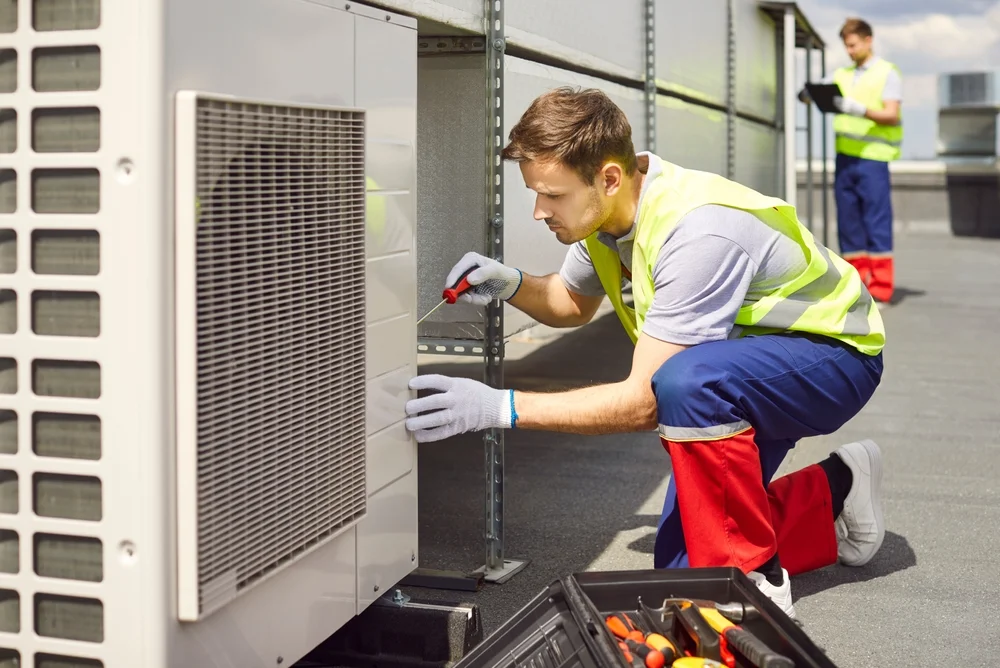
The HVAC industry is one of the most competitive local markets in the U.S. Every city has dozens of heating and cooling companies fighting for the same map pack spots, especially in 2026, when AI search results, behavior-driven rankings, and Google’s new local intent signals are shifting the game.
But here’s the truth most HVAC businesses will never hear:
Ranking isn’t luck. It’s a system. A predictable, repeatable set of actions that move your Google Business Profile from invisible to top 3 in less than 12 weeks.
We’ve used this exact system to take HVAC and home service companies from nowhere to map dominance in multiple states. The process works because it aligns with how Google actually evaluates local businesses: relevance, authority, proximity, authenticity, and ongoing activity.
Below is the full blueprint, built from firsthand experience, real HVAC campaigns, real wins, and years of understanding how local search behaves.
Copy it. Apply it. Watch what happens.
1. Start with GBP Categories That Drive Rankings
Choosing the right primary and secondary Google Business Profile categories helps Google understand your services and directly impacts your local rankings and visibility. They also factor into up to 50% of your rankings.
Most HVAC companies choose “HVAC contractor” and stop there.
In 2026, that’s not enough.
Your categories must reflect everything you want to rank for.
What to do
- Download GMB Everywhere (browser extension)
- Search your service area
- Open the top 5 HVAC competitors ranking in the map pack
- Identify every category they’re using
- Add the ones that match your services
This is not guesswork. It’s matching Google’s own market expectations.
Why it matters
Google heavily relies on categories to understand:
- Are you relevant for “AC repair near me”?
- Are you relevant for “furnace installation”?
- Are you relevant for “duct cleaning”?
Categories create ranking eligibility. Without them, nothing else you do matters.
2. Track Your Map Rankings and Fix Root Issues
Stop relying on local search impressions inside GBP.
They don’t show the full picture.
Use real tools:
- Local Falcon
- GMB Dominator
- SEMrush
Run a 7×7 or 9×9 grid every 2 weeks.
What the grid actually means:
- Red = weak authority, weak proximity, or weak relevance
- Yellow = partially competitive
- Green = you’re visible to real customers
Most HVAC owners panic when they see red.
The correct approach is to identify why that zone is red:
- Weak reviews in that part of town
- Weak category match
- No service page on your site supporting that keyword
- No local links from that neighborhood
- Competitor density is too high
- Weak proximity signals
The grid tells a story. The story guides your actions.
3. Add Secondary Categories to Expand Search Visibility
Most HVAC companies set one primary category and leave the rest empty.
That mistake alone kills over 50% of their rankings.
Add 4–5 secondary categories, for example:
- Air conditioning repair service
- Air conditioning contractor
- Heating contractor
- Furnace repair service
- HVAC installation service
Each category unlocks a new group of keyword rankings.
4. Business Name Still Impacts Local Rankings
Google says keywords in your business name don’t help.
Real-world results say otherwise.
If all top competitors use “heating,” “cooling,” or “HVAC” in their name, and you don’t, you’re handicapping your relevance.
The ethical solution
File a DBA.
Match the pattern of your competitors.
Examples:
- Precision Heating → acceptable
- Precision Heating & Cooling → better
- Precision HVAC & Air Conditioning → more complete
Don’t keyword stuff.
Just align with industry norms.
5. Fully Optimize the Services Section
Every service you add becomes an internal keyword trigger.
Google uses services to decide:
- What queries should you appear for
- How to match your business to long-tail HVAC searches
- When to rank you for “near me” queries
Action step:
Add everything Google suggests:
- AC repair
- Furnace installation
- Heat pump repair
- Duct cleaning
- Thermostat installation
- Air quality solutions
- Emergency HVAC service
These become hidden ranking signals that competitors ignore.
6. Post Photos and Videos Weekly for Better Visibility
Google doesn’t want dead listings on the map.
If your profile hasn’t posted a photo in weeks, your activity score drops.
Upload weekly:
- Before & after HVAC jobs
- Your trucks
- Technicians at work
- Job site photos
- Seasonal projects (AC installs in summer, furnace repairs in winter)
Even better: upload short vertical videos.
Google pushes video harder than photos in 2026.
Consistency = activity
Activity = trust
Trust = ranking
7. Reviews Influence Your Map Rankings More Than Backlinks
In HVAC, the market sets the rules.
If the top three competitors have:
- 400+ reviews
- 4.7+ stars
- Fresh reviews weekly
…that becomes the baseline you must match or beat.
Build a repeatable review system:
- Post-service text automation
- QR codes on trucks
- Review links on invoices
- Ask on every completed job
- Incentivize techs internally
Consistency beats volume.
15–20 reviews per month outperform 200 dumped in one week.
Google values velocity and authenticity more than raw count.
8. Optimize Your Website to Support GBP Rankings
Most HVAC owners think GBP and local SEO for websites are separate – they are not. Google Business Profile pulls signals from your website, so clear, well-optimized pages help improve your local rankings and overall visibility.
Your map ranking is directly influenced by:
- Page titles
- H1s
- Heading structure
- Location pages
- Service pages
- Internal links
The minimum:
- Create individual pages for AC repair, furnace repair, installation, duct cleaning, etc.
- Create separate location pages for every city you serve
- Clean up titles (no stuffing, but clear relevance)
- Add internal links pointing to your high-value pages
After fixing on-page SEO, send two or three real backlinks to your most important pages (not spam, not random sites).
This alone can significantly improve your map ranking.
9. Local Backlinks Build Trust and Authority
People obsess over domain authority.
But for local, authority comes from proximity and relevance.
Best HVAC local links:
- Chamber of Commerce
- Local newspapers
- Home service blogs
- Neighborhood associations
- Local podcasts
- City business directories
- Sponsorships (Little League, charity events, community groups)
Local links hit harder than 50 random websites from other countries.
10. Vet Every Link for Relevance and Authority
Before you build or buy a link, check:
- Does the site look like a real business?
- Does it get real U.S. traffic?
- Is the content relevant to home services?
- Does it rank for any HVAC keywords?
Avoid:
- Weird country traffic
- Low-quality directory blasts
- Niche edits on irrelevant blogs
- Cheap Fiverr backlinks
Pay for relevance, not volume.
Five good links beat 200 bad ones.
Technical SEO Foundation for HVAC Websites
Technical SEO is not optional in HVAC. When someone searches for emergency AC repair at 2 AM, your site cannot afford to be slow, broken, or confusing.
Before expecting rankings or phone calls, this technical layer must be clean.
Core Crawl & Indexing Health
Checklist:
• All important pages return 200 status codes
• No redirect chains on service or location pages
• No orphan pages
• XML sitemap submitted and clean
• Robots.txt not blocking key directories
• Proper canonical tags on service and location pages
• No duplicate city URLs
• Pagination handled correctly if used
• Index bloat removed
HVAC sites often suffer from duplicate city pages and filtered URLs. Clean these early.
Optimize Mobile Performance for Emergency Searches
Most HVAC searches occur on mobile during urgent situations.
Requirements:
• Mobile load time under 3 seconds
• Core Web Vitals within acceptable range
• Largest Contentful Paint optimized
• No heavy above-the-fold scripts
• Minimal popups on mobile
• Click-to-call visible without scrolling
If your phone number is not instantly accessible, you lose the call.
Use Schema Markup for HVAC Websites
At a minimum, include:
• HVACBusiness schema
• LocalBusiness schema per location
• Service schema for each core service
• FAQ schema where applicable
• AggregateRating schema if valid
• Breadcrumb schema
• GeoCoordinates schema
• OpeningHoursSpecification
Multi-location HVAC companies should not use one generic schema across all pages.
Each location page must contain its own entity definition.
Common Technical SEO Mistakes for HVAC Sites
Avoid:
• Dozens of thin city pages
• Service pages competing for the same keyword
• Hidden text for keyword stuffing
• Slow WordPress themes
• Excessive plugins
• Multiple H1s per page
• Mixed http and https resources
• Broken review schema
These issues quietly suppress rankings.
AI Search Optimization Checklist for HVAC
Use this checklist to make your HVAC business visible in AI search results, Google, and recommendation engines:
- Add real homeowner questions as headings across pages
- Start each answer with a clear 40–60-word direct response
- Expand answers with helpful details after the short response
- Use a clean H1 and H2 structure with simple, readable formatting
- Break key points into bullet lists for easy AI extraction
- Mention your city and service areas naturally across the content
- Add neighborhood or local references where relevant
- Keep NAP (name, address, phone) consistent everywhere
- Create service + location pages (AC repair in [city], furnace install in [area])
- Show strong trust signals on every page
- Add licenses, certifications, and years of experience
- Include real customer reviews and testimonials
- Use before-and-after job examples where possible
- Mention warranties, guarantees, and response times
- Fully optimize your Google Business Profile
- Choose accurate categories (HVAC contractor, AC repair, heating service)
- Add all services individually
- Upload real photos regularly
- Keep business hours and availability updated
- Post weekly updates, FAQs, and tips
- Add FAQ sections to service pages, blogs, and location pages
- Focus on real customer concerns, not generic questions
- Use conversational phrasing that matches how people search
- Implement schema markup for better AI understanding
- Use LocalBusiness schema
- Add Service schema for each offering
- Include FAQ schema for key pages
- Add Review schema where applicable
- Maintain a consistent presence across platforms
- Optimize listings on Google, Yelp, Bing, Apple Maps
- Ensure identical business details across all directories
- Build brand mentions on local and industry platforms
- Structure content for clarity and fast answers
- Avoid long, unstructured paragraphs
- Use short sections with clear intent
- Make pages easy to scan and understand
- Keep content fresh and updated
- Update pricing expectations and services
- Refresh seasonal HVAC content
- Add new FAQs based on customer queries
- Optimize for a mobile-first experience
- Ensure fast page speed
- Use click-to-call buttons
- Reduce friction in forms and booking
The Ranking Combination That Drives HVAC Results in 2026
Here is the real, battle-tested formula.
Winning in 2026 requires the right mix of Google Business Profile optimization, strong website SEO, local authority signals, and AI-driven search visibility.
1. GBP fully optimized
→ Categories aligned with core services, not generic labels.
→ Services are mapped directly to matching service pages.
→ Real job photos are uploaded weekly.
→ Seasonal posts tied to actual demand spikes.
→ Accurate service areas without overextension.
→ Emergency availability is clearly reflected.
→ Attributes and Q&A are actively maintained.
Maps movement starts here.
2. Website cleaned and structured
→ Dedicated pages for AC repair, AC installation, furnace repair, maintenance, and emergency service.
→ One clear H1 per page.
→ Strong internal linking between services and city pages.
→ Fast mobile load times under three seconds.
→ Clear call to action above the fold.
→ No duplicate city pages or overlapping service intent.
Google must clearly understand what you do and where you do it.
3. Local, relevant backlinks
→ City-based authority sources.
→ Home service and contractor relevance.
→ Local news, sponsorships, chambers, and trade associations.
→ Press angles are tied to heat waves, emergency service expansion, or community activity.
Random links do not move HVAC rankings. Relevant ones do.
4. Review velocity plus quality
→ Weekly fresh reviews, not bulk bursts.
→ Mentions of specific services and neighborhoods.
→ Photo reviews when possible.
→ Responses within 24 hours.
→ Multi-platform presence where applicable.
Review consistency often determines Map Pack stability.
5. Consistent posting and updates
→ Seasonal AC tune-up reminders.
→ Heat wave emergency notices.
→ Before and after job photos.
→ Maintenance plan promotions.
→ Short service videos.
→ Holiday availability updates.
Active profiles outperform dormant ones, even when they have similar review counts.
When you execute all five together, HVAC companies move up the map faster than almost any other industry because urgency amplifies every signal.
This is how we have taken HVAC businesses from invisible to dominating their city in 90 to 120 days repeatedly.
Final Thoughts
2026 is the year when Google’s local algorithm rewards businesses that look alive, trusted, accurate, and relevant. HVAC companies that understand this will own the maps. Those who don’t will slowly disappear as competitors who simply know the system better take over. Discover HVAC SEO tips to get more leads.
Implement the steps above exactly as written, and you’ll build the kind of authority Google can’t ignore.
If you want the full HVAC Local SEO process and system personally implemented by LocalMighty, just tell us, and we’ll map your entire city and build a ranking plan that moves the needle fast.