
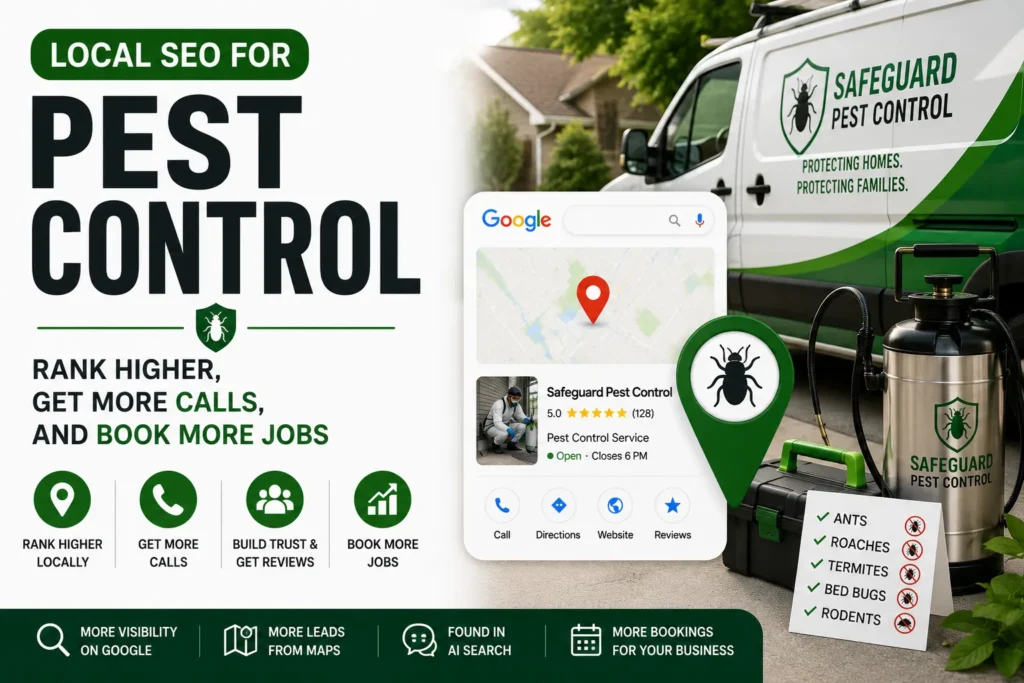
When homeowners discover termites, rodents, bed bugs, or other pests, they usually want help immediately. They search Google for a trusted pest control company nearby, compare reviews, check service availability, and call the business that appears most reliable.
If your company isn’t visible during these high-intent searches, you’re missing valuable opportunities while competitors capture those leads.
According to Google, local searches continue to drive strong purchase intent, and many people who search for nearby businesses contact one within a day. For pest control companies, appearing prominently in Google Search and Google Maps often means more inspections, treatment appointments, and recurring service contracts.
Local pest control SEO helps exterminators and pest management companies improve visibility across Google Search, Google Maps, and AI-powered search platforms. A successful strategy combines Google Business Profile optimization, a service-focused website, reputation management, technical SEO, local SEO, and AI search optimization to consistently generate qualified leads.
This guide explains how pest control businesses can improve local visibility, earn more customer trust, and convert online searches into booked inspections and recurring customers.
How Customers Search for Pest Control Services
Customers search differently depending on the pest problem, urgency, property type, and location. While some are researching preventive treatments, many are seeking immediate professional help.
Common searches include:
- Pest control near me
- Exterminator nearby
- Termite inspection
- Rodent removal service
- Bed bug treatment
- Ant control company
- Mosquito control service
- Emergency pest control
Your website should target these different search intents by creating dedicated pages for every major pest control service. Separate pages for termite control, rodent removal, bed bug treatments, ant control, cockroach extermination, mosquito treatments, wildlife removal (where applicable), commercial pest management, residential pest control, and recurring maintenance plans help Google better understand your expertise and improve visibility for highly qualified searches. Because many pest control searches are urgent, how the local map pack captures that immediate intent should shape your prioritization of your Google Business Profile over every other SEO task.
Google Business Profile Best Practices for Pest Control Companies
Google Business Profile is one of the largest sources of leads for pest control companies. Before contacting a business, customers often compare reviews, treatment services, service areas, operating hours, and completed work directly within Google Search and Google Maps.
A complete, actively managed profile improves local visibility and helps customers choose your company with confidence.
Choose the Right Business Categories
Select Pest Control Service as your primary category. Add secondary categories only when they accurately represent additional services such as Wildlife Control Service, Animal Control Service, or Lawn Care Service where applicable.
Upload Real Service Photos
Customers want to see evidence of your professionalism. Upload high-quality photos of technicians, service vehicles, equipment, termite inspections, pest prevention work, commercial projects, residential treatments, and completed jobs. Avoid using excessive stock photography whenever possible.
Showcase Every Pest Control Service
List each major service individually rather than relying on a single broad description. Include termite control, rodent removal, bed bug treatment, cockroach extermination, mosquito control, ant control, flea treatments, wasp removal, wildlife control where applicable, commercial pest management, residential pest control, and preventative maintenance plans.
Configure Your Service Areas
Most pest control businesses operate as service area businesses without a public storefront. Define every city and community you actively serve, ensuring your Google Business Profile matches your service area pages.
Publish Helpful Google Posts
Share seasonal pest prevention tips, treatment advice, completed projects, educational content, company updates, community involvement, and maintenance reminders. Regular updates keep your profile active while demonstrating expertise.
Maintain Consistent Business Information
Keep your business name, address, phone number, website, business hours, emergency availability, and service descriptions consistent across your website, Google Business Profile, trade directories, and local citations. Consistency strengthens local trust signals while improving rankings.
Complete Every Profile Section
Complete every available profile field, including your business description, appointment links, service options, accessibility details, opening date, social profiles, highlights, and business attributes. A complete profile helps customers make informed decisions while supporting stronger local SEO. The full Google Business Profile optimization best practices walk through every section worth completing.
Use Gemini to Improve Google Business Profile Management
Gemini can help eligible Google Business Profile users manage their profile more efficiently by assisting with review response drafts, profile improvement suggestions, Google Post ideas, service description updates, performance summaries, and profile management recommendations.
While Gemini does not directly improve rankings, it helps maintain a complete, accurate, and active Google Business Profile that supports stronger local visibility and provides a better experience for prospective customers.
Website Structure for Pest Control Companies
Your website should do more than describe your services. It should build trust, answer common customer questions, and make it easy for homeowners and businesses to request an inspection or schedule treatment. Whether someone needs immediate pest removal or ongoing prevention, your website should guide them toward contacting your company.
A well-organized website also helps Google understand your services, service areas, and expertise, improving your ability to rank for high-intent local searches.
Build a High-Converting Homepage
Your homepage should clearly explain the pest control services you provide, the areas you serve, your experience, certifications, treatment methods, and why customers should choose your company. Include click-to-call phone numbers, request inspection forms, customer reviews, guarantees where applicable, and trust badges throughout the page.
Create Dedicated Service Pages
Every major pest control service should have its own optimized page. Separate pages for termite control, rodent removal, bed bug treatment, ant control, cockroach extermination, mosquito control, wasp removal, wildlife control where applicable, commercial pest management, residential pest control, and preventative pest maintenance help target highly relevant searches while strengthening topical authority.
Create Local Service Area Pages
If you serve multiple cities or neighborhoods, create a unique location page for each service area. Include locally relevant content, common pest problems in that area, completed projects, customer testimonials, and nearby landmarks instead of duplicating the same content across every city.
Support Multi-Location Growth
Pest control companies with multiple branches should create dedicated pages for each office. Include office-specific contact information, technicians, service coverage, reviews, business hours, and local expertise to improve both search visibility and customer experience.
Expand Your Service Coverage
As your business grows, continue adding pages for seasonal pest prevention, commercial pest management, eco-friendly treatments, crawl space protection, attic insulation services where applicable, wildlife exclusion, recurring maintenance plans, and industry-specific solutions. A comprehensive website structure creates additional opportunities to rank for valuable searches.
Improve Lead Generation
Many customers need pest control quickly, so every page should make it easy to contact your business. Display click-to-call phone numbers, online inspection requests, emergency contact options, financing information, where available, warranties, service guarantees, customer testimonials, before-and-after photos where appropriate, and frequently asked questions throughout your website.
Licensing, Treatment Safety, and Recurring Plan Pages for Pest Control Companies
When a parent searches for an exterminator with a toddler at home, their first concerns are whether the company is licensed to use pesticides and if the treatment is safe for their kids and pets. Most pest control websites do not answer these questions, which causes cautious customers who could become loyal clients to look elsewhere.
Publish Your State Pesticide License and Certifications
List your state pesticide applicator license number and any certifications held by your technicians. For a business that uses regulated chemicals in homes, this information is essential. If customers have to look up your license themselves, they may already be considering a competitor who makes it easy to find. Put this information on your homepage and every service page, not just in the footer. Clear credentials are among the strongest signals of experience and expertise a pest control site can display, especially for safety-sensitive services.
Explain Treatment Safety for Kids and Pets
Each service page should clearly state if the treatment is safe for kids and pets after it dries, how long people should avoid treated areas, and if you offer eco-friendly or low-tox options. Addressing these common concerns up front helps parents feel confident about calling your company.
Build Out Your Recurring Maintenance Plan Page
You may mention “recurring maintenance plans” on your site, but customers choosing between a one-time treatment and an ongoing plan want real details. Tell them how often technicians visit, what is included between visits, and the actual monthly or quarterly cost. Clear numbers help people compare options and make decisions.
WDO Inspections and Real Estate Termite Letters for Pest Control Companies
People selling or refinancing a home rarely look up “termite control.” Instead, they search for terms like “WDO inspection near me” or “termite letter for closing.” They often need these services quickly, typically due to a deadline set by a lender or a real estate contract. Most pest control websites hide this information under a general termite page, if they mention it at all.
Build a Dedicated WDO Inspection Page
Describe what a Wood Destroying Organism inspection is, why lenders and buyers need it, and how quickly you can deliver the report. Many closings require this within 48 hours. Make it clear if you offer the standard NPMA-33 form, since real estate agents and title companies often look for this by name. A page that uses their terms, mentions closing deadlines, lender requirements, and the standard form will perform better than a generic “termite inspection” page aimed at homeowners concerned about an active infestation.
Build Relationships with Real Estate Agents and Title Companies
It helps to mention this referral relationship directly on your page. Real estate agents, title companies, and mortgage lenders often need a fast, reliable WDO inspection provider for their clients. Add a short section inviting these partners to contact you, and provide a dedicated way for them to reach out. This can turn your page into a lead source beyond homeowner searches and also create a good backlink opportunity.
Reviews and Reputation for Pest Control Companies
Reviews play a major role in both local rankings and customer decisions. Before hiring a pest control company, most homeowners compare ratings, read customer experiences, and evaluate how businesses respond to feedback.
A strong online reputation improves Google Maps visibility and increases customer confidence in urgent situations.
Respond to Every Customer Review
Respond professionally to both positive and negative reviews. Thank customers for their feedback, address concerns respectfully, and demonstrate your commitment to effective treatments and excellent customer service.
Focus on Trusted Review Platforms
Google should remain your primary review platform because it directly influences local rankings and Google Maps visibility. Maintain complete profiles on trusted home service directories and local business platforms to strengthen your online reputation.
Build a Consistent Review Strategy
Encourage satisfied customers to leave honest reviews shortly after completing a treatment or inspection. Follow up via email, text messages, or QR codes to make the review request process quick and convenient rather than something that only happens when staff remembers to ask.
Maintain Consistent Review Growth
A steady flow of authentic reviews sends stronger trust signals than collecting many reviews at once. Regular feedback demonstrates consistent service quality while strengthening your local search performance.
Comprehensive Local SEO Checklist for Pest Control Companies
A successful pest control SEO strategy combines local optimization, technical SEO, helpful content, reputation management, and authoritative service pages. Companies that consistently optimize every area typically outperform competitors relying on only one SEO tactic.
Target High-Intent Local Keywords
Focus on searches that indicate customers are actively looking to hire a pest control company.
Examples include:
- Pest control near me
- Exterminator nearby
- Termite treatment
- Rodent removal service
- Bed bug exterminator
- Mosquito control
- Commercial pest control
Use these naturally throughout your service pages, location pages, Google Business Profile, FAQs, and educational content. Thorough local keyword research surfaces the pest-specific and neighborhood-level terms customers in your service area actually type, including the WDO and real estate inspection terms that most competitors miss entirely.
Optimize Every Service Page
Each service page should target a single primary pest control service and include unique headings, title tags, meta descriptions, internal links, frequently asked questions, and helpful content. Explain how treatments work, expected timelines, prevention methods, and when customers should schedule professional pest control services.
Publish Helpful Pest Prevention Content
Educational content helps build trust while answering common customer questions. Publish articles about termite prevention, seasonal pest control, rodent exclusion, mosquito reduction, bed bug identification, home pest prevention, commercial pest management, and warning signs that indicate professional treatment is needed.
Strengthen Google Maps Visibility
Google Maps remains one of the largest lead sources for pest control businesses. Keep your Google Business Profile fully optimized, upload fresh project photos, publish Google Posts regularly, answer customer questions, and continue collecting authentic reviews.
Build Accurate Local Citations
Maintain consistent business information across Google, pest control directories, contractor directories, local business listings, chambers of commerce, and reputable citation websites. Inaccurate or inconsistent citations quietly undermine local rankings, especially when a business serves multiple cities and has listings spread across many directories.
Earn High-Quality Local Backlinks
Develop relationships with property managers, real estate agents, home inspectors, landscapers, roofing companies, builders, restoration companies, and local business organizations. These partnerships can generate valuable backlinks while strengthening your authority within your service area. The WDO inspection referral relationship with real estate agents and title companies is one of the most overlooked local link-building opportunities in the pest control industry.
Build Community Visibility
Participate in community events, home improvement expos, neighborhood associations, educational seminars, and local sponsorships. Community involvement increases brand awareness while generating valuable local mentions and referrals.
Implement Structured Data
Use Organization, LocalBusiness, PestControlService where appropriate, Service, FAQ, Review, Breadcrumb, and Website schema to help search engines better understand your business and improve eligibility for enhanced search results.
Strengthen Entity Optimization
Clearly connect your pest control company with your treatment services, certifications, technicians, service areas, target pests, equipment, and completed projects throughout your website. Strong entity optimization helps both search engines and AI platforms better understand your expertise.
AI Search Optimization for Pest Control Companies
More homeowners and businesses are using AI-powered search to identify pest problems, compare treatment options, and find trusted exterminators before requesting an inspection. Google AI Overviews, ChatGPT, Gemini, Claude, and Perplexity increasingly recommend businesses with accurate information, strong local authority, and comprehensive service content.
Pest control companies with complete Google Business Profiles, detailed service pages, authentic customer reviews, and consistent business information are better positioned to appear in these AI-generated search experiences.
Improve Visibility Across AI Search
Create content that answers common customer questions while clearly explaining your pest control services, treatment methods, inspection process, service areas, warranties where applicable, prevention strategies, and frequently asked questions. Well-organized information helps both customers and AI systems understand your expertise and confidently recommend your business. Applying generative engine optimization principles to your pest control content means structuring answers so AI systems can extract and cite them directly, giving your business a presence when a homeowner asks, “what’s the best pest control company near me?”
AI SEO Checklist for Pest Control Companies
| AI SEO Element | Best Practice |
| Entity Optimization | Clearly define your company, services, target pests, certifications, technicians, and service areas. |
| Structured Content | Use descriptive headings and answer common customer questions directly. |
| Schema Markup | Implement LocalBusiness, PestControlService, Service, FAQ, Review, Organization, Breadcrumb, and Website schema where appropriate. |
| Google Business Profile | Keep every profile section complete, accurate, and regularly updated. |
| Reviews | Build authentic customer reviews and respond professionally. |
| Content Quality | Publish helpful pest prevention and treatment content that satisfies search intent. |
| Internal Linking | Connect service pages, pest guides, location pages, and educational articles naturally. |
| Brand Consistency | Maintain identical business information across your website, GBP, directories, and social profiles. |
Measure AI Search Visibility
Look beyond keyword rankings when measuring SEO success. Track branded searches, phone calls, inspection requests, recurring service sign-ups, Google Search Console performance, Google Business Profile insights, referral traffic, and qualified leads to understand how your business performs across both traditional and AI-powered search.
Technical SEO Checklist for Pest Control Companies
Technical SEO ensures your website is easy for search engines to crawl while delivering a fast, secure, and reliable experience for homeowners and businesses. A technically optimized website also helps convert more visitors into booked inspections and long-term customers.
| Technical SEO Element | What to Check |
| Crawlability | Ensure Google can crawl your homepage, service pages, location pages, blog posts, and contact page. |
| Indexing Status | Review indexed, excluded, duplicate, discovered, and crawled pages in Google Search Console. |
| XML Sitemap | Include all important service, location, and educational pages, and exclude unnecessary URLs. |
| Robots.txt | Confirm important pages and resources remain crawlable. |
| Index Bloat | Remove or noindex thin, duplicate, outdated, and low-value pages. |
| Orphan Pages | Ensure important service and location pages receive internal links. |
| Crawl Depth | Keep important pages within two or three clicks from the homepage. |
| URL Structure | Use clean, descriptive URLs for pest services and service areas. |
| Website Architecture | Organize services, locations, pest guides, and customer resources logically. |
| Internal Linking | Connect related service pages, location pages, and educational content naturally. |
| Breadcrumbs | Improve navigation and crawl efficiency. |
| Title Tags | Create unique, keyword-focused titles for every important page. |
| Meta Descriptions | Write compelling descriptions that encourage inspection requests. |
| Heading Structure | Maintain one H1 with logical H2 and H3 hierarchy. |
| Duplicate Content | Avoid repeating content across service and location pages. |
| Canonical Tags | Point duplicate URLs to the preferred version. |
| Thin Pages | Expand weak pages with valuable customer information. |
| Site Speed | Optimize loading speed across desktop and mobile devices. |
| Core Web Vitals | Monitor LCP, INP, and CLS performance. |
| Mobile Experience | Ensure customers can quickly find contact information and request service on mobile devices, since most urgent pest searches happen on phones. |
| Click to Call | Make phone numbers clickable across every page. |
| Accessibility | Improve readability, forms, buttons, navigation, and image alt text. |
| Image Optimization | Compress images while using descriptive file names and alt text. |
| Service Photos | Showcase real technicians, treatment work, service vehicles, and completed projects. |
| Schema Markup | Validate all structured data implementation. |
| NAP Consistency | Keep business information consistent across all online platforms. |
| Service Coverage | Create dedicated pages for every major pest control service. |
| Location Pages | Build unique pages for every service area. |
| Broken Links | Repair broken internal and external links. |
| Redirects | Review redirect chains, outdated URLs, and unnecessary redirects. |
| HTTPS | Secure every page using HTTPS. |
| Security | Monitor for malware, spam, hacked pages, and indexing issues. |
| Contact Forms | Test inspection request forms, emergency contact forms, and quote forms regularly. |
| GA4 | Verify analytics tracking is working correctly. |
| Google Search Console | Monitor indexing, impressions, clicks, and search performance. |
| Conversion Tracking | Track phone calls, inspection requests, and contact form submissions. |
| GBP Tracking | Measure calls, website visits, direction requests, and profile interactions from Google Business Profile. |
Local SEO Mistakes Pest Control Companies Should Avoid
Many pest control businesses lose valuable leads because they overlook important local SEO fundamentals. Avoiding these common mistakes can significantly improve both rankings and customer acquisition.
- Using one generic page for every pest control service.
- Leaving Google Business Profile incomplete or outdated.
- Publishing duplicate service area pages.
- Ignoring customer reviews.
- Not showcasing completed treatments and inspections.
- Publishing thin service pages with little educational value.
- Neglecting technical SEO.
- Weak internal linking between service pages and pest education content.
- Inconsistent business information across directories.
- Measuring rankings instead of inspections, recurring customers, and booked treatments.
How LocalMighty Helps Pest Control Companies Generate More Qualified Leads
Growing a pest control business requires more than appearing higher in search results. LocalMighty helps pest control companies improve Google Maps visibility, optimize Google Business Profiles, build service-focused website structures, strengthen local authority, and create educational content that attracts customers with immediate service needs. Our local SEO services combine technical SEO, AI search optimization, reputation management, entity optimization, and conversion optimization to help businesses generate more inspection requests, treatment appointments, recurring service contracts, and sustainable long-term growth across Google Search, Google Maps, and modern AI search platforms.
Recover Rankings and Leads After a Google Update
Google updates can temporarily affect local rankings, especially in competitive home service industries. Rather than reacting immediately, focus on improving overall website quality and customer experience.
If your rankings decline:
- Review Google Search Console to identify affected pages.
- Compare traffic changes with recent Google updates.
- Audit technical SEO before modifying content.
- Refresh outdated service pages and pest prevention articles.
- Add new project photos and strengthen trust signals.
- Improve internal linking across services, pest guides, and location pages.
- Continue earning authentic customer reviews.
- Keep your Google Business Profile complete and regularly updated.
- Monitor performance over several weeks before making significant SEO changes.
Pest control companies that consistently improve content quality, technical performance, and customer experience typically recover more successfully than those that make reactive changes after each algorithm update.
Closing Notes on Pest Control SEO
Successful SEO for pest control is built on trust, visibility, and responsiveness. Your website, Google Business Profile, service pages, customer reviews, technical SEO, and local authority all work together to influence whether homeowners and businesses choose your company over competing providers.
As search continues evolving through Google Search, Google Maps, AI Overviews, ChatGPT, Gemini, Claude, Perplexity, and future AI search platforms, pest control companies that invest in accurate business information, helpful educational content, strong local SEO, and an outstanding customer experience will continue generating more qualified leads, increasing recurring customers, and building long-term growth within their service areas.