
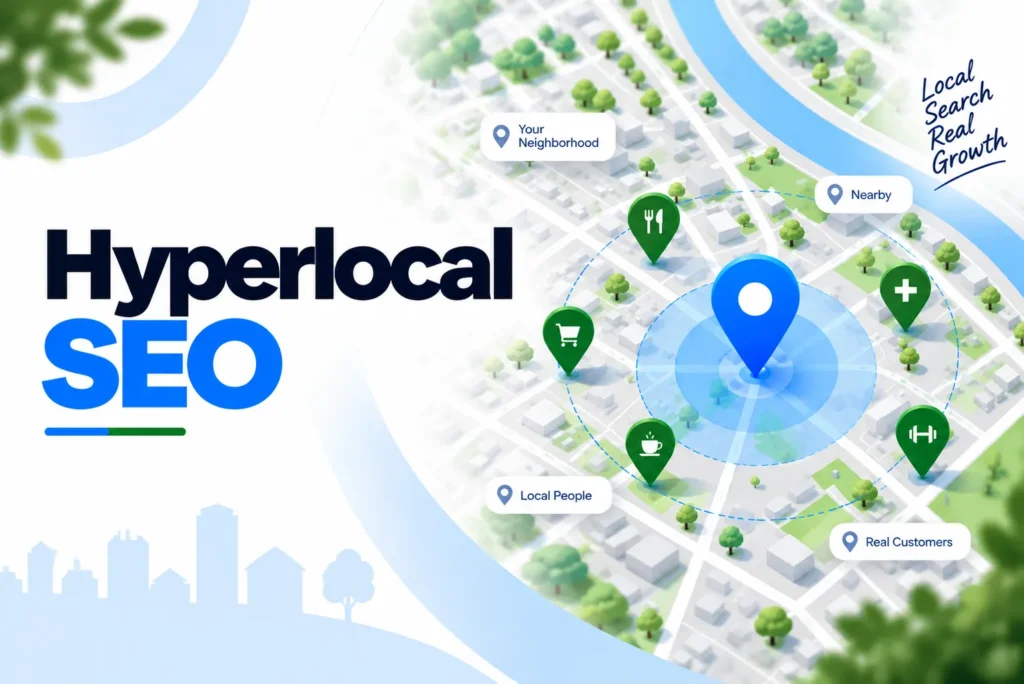
Hyperlocal SEO is the practice of improving a business’s visibility for searches tied to a specific neighborhood, district, community, area, or physical radius rather than an entire city. It takes local SEO one level closer to the searcher by focusing on where the customer actually is and the precise area they want to find a business in.
This guide explains how hyperlocal SEO works, how Google handles neighborhood and near me searches, how to build useful area pages without creating doorway pages, how to optimize Google Business Profile for local proximity, how AI answer engines interpret hyperlocal business information, and how to measure rankings at the neighborhood level.
What Is Hyperlocal SEO?
Hyperlocal SEO focuses on ranking a business for searches associated with a very specific geographic area. That area might be a neighborhood, subdivision, district, commercial corridor, landmark area, ZIP code, or a small radius around a searcher’s current location.
General local SEO often targets visibility across a city or broader service area. Hyperlocal SEO narrows the target so a business can become more relevant to searches originating from or referring to a particular part of that market.
For example, a business may want visibility for searches connected to a city such as Dallas. Still, its customers may actually search from areas such as Uptown, Oak Lawn, Lakewood, or Bishop Arts. Hyperlocal SEO addresses that difference.
The key distinction is simple:
Local SEO helps a business compete within a local market. Hyperlocal SEO helps that business become relevant within smaller geographic pockets of that market.
This matters because Google doesn’t necessarily show the same local results to everyone searching for the same service in the same city. The searcher’s physical location can change which businesses appear most prominently.
Hyperlocal SEO therefore combines geographic relevance, genuine area coverage, strong business signals, useful neighborhood content, and a technically clear website structure.
It applies the broader local SEO process at a more granular geographic level, built specifically around neighborhoods, districts, and near me intent.
Hyperlocal SEO, Neighborhood SEO, and Near Me SEO Explained
Hyperlocal SEO, neighborhood SEO, and near me SEO describe closely related strategies, but they are not identical terms.
| Term | What it targets | Primary geographic signal |
| Hyperlocal SEO | Very specific local areas | Neighborhood, district, community, or proximity |
| Neighborhood SEO | Named neighborhoods and communities | Neighborhood name |
| Near me SEO | Searches based on the searcher’s current location | Device location and local context |
| Local SEO | Broader geographic markets | City, town, region, or service area |
Hyperlocal SEO is the broader strategy. Neighborhood SEO focuses on named geographic areas, while near me SEO focuses on searches where the searcher’s location plays a major role in determining the results.
A person searching for “plumber in Lakewood” gives Google an explicit neighborhood signal. A person searching for “plumber near me” gives Google a proximity-based intent signal. Both searches can require the same business to demonstrate genuine relevance to the surrounding area.
Both rely on identifying the right near me and neighborhood keywords, a process covered in full by the dedicated keyword research guide.
The important point is that businesses do not rank for near me searches simply because they place the phrase “near me” on a page.
Google interprets the query and uses available location signals to determine which businesses are relevant and sufficiently prominent for that search context.
Google does not publicly document its ranking mechanics in enough detail to assign a precise weight to every signal. A sound hyperlocal strategy therefore focuses on signals businesses can control rather than attempting to reverse-engineer an unpublished formula.
Why Hyperlocal SEO Can Change Your Local Visibility
A business can have strong citywide visibility and still perform poorly in individual neighborhoods.
That happens because local search isn’t a single, static ranking environment. A business’s position can change based on the searcher’s location, the query’s wording and intent, nearby businesses, each business’s relevance, and available prominence signals.
A searcher two miles away may see a different local result set from another searcher elsewhere in the same city.
This creates an important opportunity for businesses that serve concentrated local markets.
Instead of asking only:
“Do we rank in Dallas?”
A better hyperlocal question is:
“Where in Dallas do we consistently appear when people search for our services?”
That shift changes how you build pages, optimize your Business Profile, create content, acquire local mentions, and measure performance.
How Google Handles Neighborhood and Near Me Searches
Google uses location-related signals to understand where a local search is taking place and which businesses are relevant to that context. The searcher’s device can provide location information, while other signals can help Google establish geographic context when precise device location is unavailable or limited.
For a near me search, the phrase itself does not identify a particular neighborhood. The searcher’s location supplies much of that missing context.
For a neighborhood search, the query provides the geographic intent directly.
For both types of searches, Google still needs to determine which businesses are relevant to the requested service or product and which businesses have sufficient prominence to appear prominently.
Device Location Matters
A mobile search can give Google a much more precise sense of where the searcher is located than a city name typed into a desktop search.
That means two people searching for the same phrase can receive different local results.
Consider two people searching for “emergency dentist near me” from different parts of a metropolitan area. The businesses that make sense for one searcher may not be equally useful for another.
This is why a single city-level ranking check cannot tell you the full story of hyperlocal performance.
IP Location Provides Broader Geographic Context
When precise device location is unavailable, Google can use other signals to estimate geographic context. IP-based location can provide a broader indication of where a search originates, but it generally doesn’t offer the same precision as a device-based location signal.
Businesses should therefore avoid assuming that every search is evaluated from the same geographic point.
Google Business Profile Provides Business Location Context
Your Google Business Profile gives Google important information about where your business operates and what it does.
For storefront businesses, the verified business location provides a significant geographic reference.
For service area businesses, the service areas help communicate where the business serves customers.
This information must reflect reality. Expanding a service area to appear farther away does not create genuine local relevance.
Relevance Is Evaluated at the Local Level
Google must determine whether a business matches the searcher’s intent.
A business that is geographically close but irrelevant to the query should not outrank a business that provides the requested service.
This matters especially for hyperlocal SEO because geographic proximity alone does not compensate for weak service relevance.
Prominence Still Matters
A business can be close to a searcher and still face competition from another nearby business with stronger prominence signals.
Reviews, links, mentions, business information, website quality, and other signals can contribute to how Google understands a business’s prominence.
The practical lesson is straightforward:
Hyperlocal SEO is not about choosing between relevance and proximity. You need enough relevance, geographic suitability, and prominence to compete in the specific area.
For a broader explanation of local relevance, distance, and prominence, see the deeper local search relevance resource before applying those concepts specifically to neighborhood searches.
How to Build Neighborhood and Area Pages That Rank
Neighborhood pages can help a business demonstrate genuine relevance to areas it actually serves, but only when each page provides meaningful value.
The biggest mistake is creating dozens of pages with the same text, changing only the neighborhood name.
That approach creates thin, repetitive pages rather than useful local resources.
A strong neighborhood page should answer a real question:
Why is this business genuinely relevant to customers in this particular area?
Start With Real Geographic Coverage
Only create a neighborhood page when the business genuinely serves that area or has a legitimate reason to provide information about it.
A storefront business can create a useful page for a nearby neighborhood when customers from that neighborhood actually use the business.
A service area business can create area-focused content when it genuinely operates in that location.
The page should never imply a physical office exists in a neighborhood when it does not.
Give Each Neighborhood Page a Distinct Purpose
Every area page should have a reason to exist beyond capturing another keyword.
Useful neighborhood pages can explain:
- Which services are most relevant to customers in the area
- How customers in that area typically access the business
- Relevant streets, landmarks, districts, or community features
- Service considerations specific to the neighborhood
- Travel or access information when appropriate
- Local factors that affect the service
- Areas within the neighborhood that the business actually serves
- Relevant frequently asked questions.
- Clear next steps for contacting or booking the business
The exact content depends on the business.
A plumbing company may discuss older housing stock, common service situations, and the areas it regularly visits.
A dental practice may explain parking, appointment access, and its relationship to nearby communities.
A landscaping company may discuss property characteristics that affect outdoor services in a particular area.
The content should reflect the business’s actual knowledge, not generic neighborhood descriptions copied from another website.
Use Neighborhood Names Naturally
Use the actual neighborhood name where it helps the reader understand the page.
Do not force the neighborhood name into every heading, sentence, image caption, or call to action.
Natural geographic language is more useful than repetition.
A page that repeatedly says “plumber in Neighborhood X” can look less credible than a page that naturally discusses the streets, communities, services, and customer needs associated with that area.
Include Local Details You Can Verify
Specific local information makes an area page more useful.
Depending on the business, this may include:
- Nearby landmarks
- Major roads
- Recognizable districts
- Local commercial areas
- Community facilities
- Relevant access routes
- Real service coverage
- Local environmental or property conditions
Only include information that is accurate and useful.
Do not manufacture local expertise by inserting random landmarks to create geographic relevance.
Connect the Area Page to the Relevant Service Page
A neighborhood page should not become an isolated content island.
Connect it to the relevant service pages so visitors can move from geographic intent to service intent.
For example, an area page about a neighborhood served by a roofing company could connect naturally to the company’s roof repair, roof replacement, and inspection services.
The relationship should make sense to the reader first.
How Much Content Does a Neighborhood Page Need?
No reliable universal word count makes a neighborhood page rank.
The correct depth depends on how much genuinely useful information exists about the business’s relationship with that area.
A useful page might be relatively concise when the business has a narrow service offering and a straightforward relationship with the neighborhood.
A more complex area may justify a substantially deeper page.
The test is not word count.
The test is whether the page provides enough original, specific information to satisfy someone who searched for that area and service.
How Many Neighborhood Pages Should You Create?
Create as many pages as you can support with genuine, distinct information and real business coverage.
Do not create one page for every neighborhood name you can find in a city.
If you have ten areas where you have strong customer demand, real service coverage, and meaningful information, ten useful pages can be better than fifty nearly identical pages.
A practical rule is:
If you cannot explain what makes one neighborhood page meaningfully different from another, you should not create both pages.
A Strong Neighborhood Page Structure
A useful structure can look like this:
H1: Service in Neighborhood
Introduce the business and explain its relationship to the neighborhood.
Service relevance
Explain which services customers in the area can use and why the business is relevant to those needs.
Local coverage
Describe the parts of the neighborhood or surrounding area the business actually serves.
Local considerations
Explain conditions, access issues, property characteristics, or other factors that genuinely affect the service.
Nearby landmarks and areas
Reference relevant geographic context naturally where it helps customers understand the coverage area.
Service options
Connect visitors to the relevant service pages.
Local customer questions
Answer questions specific to using the service in that area.
Contact and conversion information
Make it easy to call, request service, get directions, or submit an inquiry.
This structure creates a useful local resource, not a collection of geographic keywords.
When Neighborhood Pages Become Doorway Pages
A neighborhood page becomes risky when its primary purpose is to create another URL that targets a geographic variation without offering meaningful independent value.
Warning signs include:
- Identical paragraphs across dozens of pages
- Only the neighborhood name changes
- No unique local information
- No genuine service relationship with the area
- Artificial claims about having locations
- Pages created solely to capture search variations
- Little or no internal navigation value
- No meaningful reason for a customer to visit the page
The solution is not to avoid geographic pages entirely.
The solution is to make each page genuinely useful and ensure it represents real business coverage.
Businesses that need more guidance on service area businesses and businesses without a physical storefront can use the dedicated service area resource rather than repeating that entire framework here.
Google Business Profile for Hyperlocal Ranking
Your Google Business Profile should communicate accurate geographic coverage, precise business relevance, and a clear connection between the business and the communities it serves.
Do not treat the profile as a place to insert every neighborhood keyword you want to rank for.
Keep the Service Area Accurate
Your service area should reflect where you genuinely provide services.
If the Business Profile interface allows you to define service areas using supported geographic options, keep those areas accurate and current.
Don’t inflate the coverage area to create the appearance of greater reach.
A larger service area does not automatically create stronger relevance for every location inside it.
For service area businesses, accurate coverage matters because customers need to know whether the business actually serves them.
Use the Correct Primary Category
Your primary category should describe the core business.
Secondary categories should represent legitimate additional services or business functions.
Don’t change categories to target different neighborhoods.
Category relevance should describe what the business is. In contrast, geographic relevance should come from accurate business location and service area information, useful website content, genuine local signals, and the search context.
Use Real Location Photography
Photos can strengthen the credibility of the business’s local presence when they show real work, real staff, real facilities, and real service environments.
For hyperlocal campaigns, organize photography around genuine service locations when appropriate.
For example, a contractor may have authentic project photos from several neighborhoods it serves.
The important point is authenticity.
Do not assume that adding geographic metadata to an image file creates a direct ranking advantage. The stronger strategy is to use genuine images that support the business’s geographic claims and provide useful context.
Publish Local Google Business Profile Posts
When relevant, Business Profile Posts can reference real local events, community activity, service areas, or seasonal needs.
Include a neighborhood reference only when the post is genuinely relevant to that community.
Do not turn every post into a list of neighborhood names.
Seed Useful Neighborhood Questions and Answers
Where appropriate, the question-and-answer section can address questions customers may have about local coverage.
Useful questions might clarify:
- Whether the business serves a particular neighborhood
- Which nearby areas are included in the service area
- Whether appointments or visits are available in a particular community
- What should customers know before requesting service?
Keep the information accurate and customer-focused.
Encourage Natural Neighborhood Language in Reviews
Do not ask customers to write reviews containing specific keywords.
Instead, ask customers to describe their experience.
If a customer naturally mentions the neighborhood, street, community, or nearby landmark, that language can provide useful geographic context.
The safest strategy is to earn genuine reviews rather than scripting them.
On-Page and Schema Signals for Area Targeting
Your website should make the relationship between your business, services, and geographic coverage easy for search engines and answer engines to understand.
Schema markup can support that clarity, but it should represent information that already exists on the page.
LocalBusiness Schema
Use an appropriate LocalBusiness type when it accurately describes the business.
Relevant properties can include:
- Business name
- Address when applicable
- Telephone number
- URL
- GeoCoordinates when appropriate
- Area served
- Opening hours when applicable
- Relevant business identifiers
Do not add geographic claims to schema that the business does not actually support.
Area Served
The area served property can help communicate geographic coverage in machine-readable form.
Use it to represent real service areas, not every neighborhood where you want visibility.
Geo Coordinates
For a business with a legitimate physical location, accurate geographic coordinates can provide structured geographic information about that location.
Do not create coordinates for a fictitious storefront.
Place and Neighborhood Entities
You can represent named geographic entities in structured data when the implementation accurately describes the content and follows schema requirements.
The purpose is clarity, not manipulation.
If a page specifically discusses a legitimate neighborhood or geographic area, the structured data should reflect the relationship shown on the page.
Breadcrumb Schema
Area pages should have a clear hierarchy.
A logical structure might look like:
City > Neighborhood > Service
Or:
City > Area > Business Service
Breadcrumb markup can reinforce that hierarchy when it accurately reflects the visible page structure.
Schema Does Not Replace Content
Structured data does not turn a weak neighborhood page into a strong one.
The strongest implementation is consistent:
The page explains the area.
The business genuinely serves the area.
The Business Profile supports the same information.
The structured data reflects the same information.
External sources provide compatible geographic context.
That consistency gives search engines and answer systems fewer conflicting signals to interpret.
Hyperlocal Content Beyond Neighborhood Pages
Neighborhood pages are only one part of a hyperlocal content strategy.
Businesses can also create resources that demonstrate real involvement with the communities they serve.
Neighborhood Guides
Useful guides can answer questions related to the business and the local area.
A guide should connect the neighborhood to the service, not become a generic travel article.
For example, a home service business could create practical information about maintaining properties in a specific local community.
Local Landmark Content
Landmarks can provide geographic context when they have a genuine relationship to the business.
The content should explain something useful rather than simply mentioning a landmark to insert a location term.
Community Event Content
Businesses that genuinely participate in local events can create useful content around those activities.
This may include event preparation, sponsorship information, community resources, or post-event coverage.
Local Resource Content
A business can create resources that help residents solve problems related to its services.
Useful resources are more likely to attract attention from community organizations, local publishers, associations, and other relevant websites.
Connect Content Back to Commercial Pages
Hyperlocal informational content should clearly relate to the business’s commercial pages.
A neighborhood guide might link to the relevant area page.
An area resource might connect to the appropriate service page.
A community resource might connect to the business’s local contact page.
The links should help users continue their journey.
Reviews and Reputation at the Neighborhood Level
Reviews can provide useful geographic context when customers naturally mention where the service took place.
A review that genuinely describes service in a particular neighborhood can communicate more local context than a generic statement such as “Great company.”
That does not mean businesses should manipulate review wording.
Ask for Honest Feedback
The best review request is simple.
Ask customers to describe their experience.
Customers may naturally mention:
- Their neighborhood
- Their community
- Their property location
- A nearby landmark
- The specific service performed
That language can make the review more useful to future customers while providing genuine context.
Respond With Geographic Context When Appropriate
Responses should reinforce the experience without stuffing geographic terms.
If a customer mentions a neighborhood, the business can acknowledge the location naturally.
The response should sound like a real business responding to a real customer.
Avoid writing every response around the same neighborhood phrase.
Never Script Reviews
Do not provide customers with artificial review language designed to influence rankings.
The goal is authentic reputation building.
The geographic information should come from the customer’s experience.
Hyperlocal Off-Page Signals
Hyperlocal off-page signals come from real relationships and references within the communities a business serves.
The strongest opportunities usually involve organizations that already have a reason to mention the business.
Neighborhood Associations
Local neighborhood associations can provide legitimate opportunities for sponsorships, resources, events, partnerships, or community participation.
The objective is not to obtain a link at any cost.
The objective is to become a legitimate local participant worth mentioning.
Hyperlocal News and Community Websites
Community publications and neighborhood websites can provide geographically specific visibility.
A business may earn coverage through:
- Community involvement
- Local events
- Educational resources
- Expert commentary
- Sponsorships
- Local initiatives
The dedicated brand mentions guide covers these local mentions in more depth.
Local Event Sponsorships
Sponsoring a genuine neighborhood event can create both community value and legitimate local visibility.
The business should choose events that align with the communities it actually serves.
Nearby Business Partnerships
Non-competing businesses can sometimes create useful local partnerships.
A nearby business may refer customers, participate in a community event, collaborate on a resource, or mention a useful local service provider.
The relationship should go beyond SEO.
Hyperlocal Directories
Relevant neighborhood directories and community resources can reinforce local business information.
Quality matters more than volume.
Do not treat every directory as equally valuable. A small community resource that residents actually use can be more relevant to a neighborhood strategy than a large directory with no meaningful local connection.
For the broader citation process, use the dedicated local citations resource rather than repeating the full citation building workflow here.
How AI Search Handles Hyperlocal and Near Me Queries
AI answer engines can use a combination of sources to identify businesses that appear relevant to a user’s location and intent.
For hyperlocal searches, the practical goal is to make your business information clear, consistent, structured, and easy for machines to interpret.
A business is more likely to be understood correctly when its website, Business Profile, structured data, and external references communicate compatible information about what the business does and where it operates.
AI Systems Need Entity Clarity
An answer engine needs to distinguish one business from another.
This matters most when several businesses share similar names or offer the same service in the same city.
Your business information should consistently communicate:
- Who the business is
- What services it provides
- Where it operates
- Where its physical location exists when applicable
- Which communities it serves
- How customers can contact it
Machine-Readable Information Helps
Structured data can help machines interpret business information.
Clear headings, direct answers, descriptive page titles, accurate location information, and consistent business details also make the content easier to process.
The goal is not to write for machines instead of people.
The goal is to make the same information understandable to both.
Extractable Answers Matter
AI systems often need to identify a concise answer before they can cite a source.
Area pages should therefore answer important geographic questions directly.
For example:
“Do you serve this neighborhood?”
“Which parts of the city do you cover?”
“What services do you provide in this area?”
“Where is the business located?”
“How far does the business travel for service?”
The answers should be factual and easy to find.
Consistency Across Sources Matters
If your website says you serve one set of neighborhoods while your Business Profile communicates a different area, the conflicting information creates ambiguity.
The same applies to business name, address, telephone number, service description, and geographic coverage.
Hyperlocal SEO benefits from consistency because the search engine or answer engine has a clearer entity to understand.
AI Citations Are Not Guaranteed
No optimization technique guarantees that ChatGPT, Gemini, Perplexity, Google AI Overviews, or another answer engine will cite a particular business.
The practical objective is to increase the clarity, authority, usefulness, and machine readability of your local information.
That gives answer systems stronger material from which to determine whether your business belongs in an answer.
Keep AI Optimization Separate From AI Automation
Optimizing content and business information so answer engines can understand a local entity is different from using AI tools to automate SEO work.
This article focuses on the first.
The separate LocalMighty AI local SEO resource covers the automation side.
A Short Note on Gemini
Gemini can help with Business Profile-related workflows such as drafting review responses or suggesting profile improvements, but that differs from optimizing a business to become a cited answer for neighborhood and near me questions.
The core hyperlocal strategy remains accurate business information, genuine geographic relevance, useful content, strong reputation, and clear structured data.
Mobile Experience for Near Me Searches
Near me searches often happen when people are already moving through or spending time in a local area.
That makes mobile usability especially important.
An area page should make the next action obvious.
Visitors shouldn’t have to search through a long page to find the phone number, appointment option, directions, or contact form.
Make Phone Actions Easy
For businesses that depend on calls, make the phone number easy to tap.
The call action should work correctly on mobile devices.
Make Directions Easy to Find
For storefront businesses, directions can be an important action.
Do not bury location information beneath large blocks of text.
Keep Area Pages Fast
A neighborhood page can contain useful local content without becoming unnecessarily heavy.
Compress images, remove unnecessary scripts, and make sure the page loads quickly enough for someone searching on a mobile device.
Use Comfortable Tap Targets
Buttons and interactive elements should be easy to use on a phone.
The visitor should be able to call, request service, navigate, or submit a form without struggling with tiny controls.
Mobile optimization matters here because a technically difficult page can waste the intent generated by a successful local search appearance.
How to Track Hyperlocal SEO Performance
A citywide ranking report is not enough for a hyperlocal campaign.
The better approach is to measure visibility from multiple geographic points across the neighborhoods you actually care about.
Use a Geo Grid
A geo grid divides a target market into multiple search points.
Instead of checking one ranking from a single location, you can measure how the business appears across a neighborhood or service area.
The grid can reveal patterns such as:
- Strong visibility around the business location
- Weak visibility several miles away
- Strong performance in one neighborhood
- Poor performance in another
- Competitors dominating particular geographic pockets.
- Improvements after area pages or local signals become established
Track Map Pack Visibility
Measure how often the business appears in local map results across the selected geographic points.
A useful metric is share of map visibility across the target grid.
The objective is not necessarily to rank number one at every point.
The objective is to understand whether visibility is expanding across the areas that matter commercially.
Track Neighborhood By Neighborhood
Create a reporting structure around the geographic areas that matter to the business.
For example:
| Area | Map visibility | Organic visibility | Main service | Priority |
| Neighborhood A | Track | Track | Core service | High |
| Neighborhood B | Track | Track | Core service | High |
| Neighborhood C | Track | Track | Secondary service | Medium |
The actual metrics and neighborhoods should reflect business priorities.
Expect Geographic Improvement to Develop Unevenly
Hyperlocal improvements do not necessarily appear uniformly across an entire city.
A business may improve in one neighborhood before another.
One area may already have strong proximity and prominence signals, while another may require more geographic relevance and local authority.
This is why geographic reporting matters.
How Long Does Hyperlocal SEO Take?
There is no universal timeline for hyperlocal SEO results.
The speed of improvement depends on the business’s existing authority, competition, website quality, Business Profile strength, geographic proximity, content quality, reputation, and the number of changes being made.
Some changes can affect visibility relatively quickly, while stronger geographic authority can take considerably longer to establish.
The right expectation is to measure progress over time rather than promise a fixed ranking date.
Hyperlocal SEO Checklist
| Hyperlocal SEO Task | What to Check | Why It Matters |
| Define priority neighborhoods | Identify areas with real demand and coverage | Keeps the campaign focused |
| Confirm service coverage | Verify every target area is genuinely served | Prevents inaccurate geographic claims |
| Build useful area pages | Create distinct content for priority areas | Establishes neighborhood relevance |
| Add local service details | Explain how services apply to each area | Connects geography with intent |
| Reference real local context | Use accurate landmarks, roads, and communities | Strengthens geographic usefulness |
| Connect area and service pages | Link related commercial pages naturally | Builds topical and geographic relationships |
| Optimize Business Profile | Keep location and service information accurate | Supports local entity clarity |
| Review business categories | Use categories that accurately describe the business | Improves service relevance |
| Use authentic local photography | Show real work and locations where appropriate | Supports credibility |
| Publish useful local updates | Reference real events and community activity | Builds current local relevance |
| Answer local questions | Address geographic service questions | Helps customers and answers questions |
| Earn natural local reviews | Encourage honest customer feedback | Builds reputation and geographic context |
| Engage with communities | Participate in real local activities | Creates genuine local signals |
| Earn local mentions | Pursue relevant community coverage | Reinforces geographic prominence |
| Maintain directory accuracy | Keep relevant local information consistent | Reduces conflicting business data |
| Create local resources | Publish useful neighborhood-focused information | Builds local authority |
| Optimize mobile actions | Make calls, directions, and forms easy | Supports near me conversion |
| Track geo grid visibility | Measure rankings from multiple points | Reveals geographic performance |
| Compare neighborhoods | Identify strong and weak areas | Guides campaign priorities |
| Review coverage regularly | Update service areas as the business changes | Keeps geographic signals accurate |
Technical SEO Checklist for Hyperlocal Targeting
| Technical Area | Hyperlocal Requirement | Verification |
| Area page URLs | Use clear geographic page paths | Review URL structure |
| Page titles | Describe service and target area naturally | Check titles |
| H1 headings | Clearly identify the geographic and service focus | Check visible headings |
| Internal links | Connect area pages to relevant service pages | Crawl the site |
| Breadcrumbs | Reflect the city and neighborhood hierarchy | Review visible breadcrumbs |
| Breadcrumb schema | Match the visible hierarchy | Test structured data |
| LocalBusiness schema | Represent the actual business | Validate markup |
| Area served | Represent genuine service coverage | Compare with Business Profile |
| GeoCoordinates | Use accurate coordinates for legitimate locations | Verify location data |
| Place information | Represent geographic entities accurately | Check structured data |
| Business name | Keep the entity name consistent | Compare sources |
| Address | Use the real business address when applicable | Compare official listings |
| Telephone | Keep contact information consistent | Compare sources |
| Canonical URLs | Prevent duplicate area URL problems | Inspect canonicals |
| Indexability | Make valuable area pages indexable | Inspect robots and indexing |
| Page uniqueness | Avoid near-identical geographic templates | Review page content |
| Mobile usability | Make calls, directions, and forms easy | Test on phones |
| Page performance | Keep area pages efficient | Test loading performance |
| Image context | Use authentic local imagery where relevant | Review images |
| Geo grid tracking | Track multiple local search points | Verify tracking setup |
| Neighborhood reporting | Separate performance by area | Review reporting dashboard |
| Service area accuracy | Keep geographic coverage current | Audit regularly |
Common Hyperlocal SEO Mistakes
Hyperlocal SEO often fails because businesses try to manufacture geographic relevance instead of building it.
Stuffing “Near Me” Into the Page
“Near me” describes the searcher’s intent.
It is not a keyword that you need to repeat throughout your copy.
Don’t write awkward sentences like “Our Dallas plumber near me service is the best plumber near me for plumbing near me.”
Google can interpret the intent without this manipulation.
Write naturally for the person and make the geographic relationship clear.
Creating Dozens of Nearly Identical Neighborhood Pages
Changing only the neighborhood name does not create meaningful local content.
If ten pages say essentially the same thing, the site has not demonstrated ten distinct local relationships.
Create fewer pages with stronger substance when necessary.
Inflating the Service Area
Do not claim areas that the business does not actually serve.
A broad service area can create misleading expectations and weaken the credibility of the business information.
Creating Vanity Addresses
A business should never create a fake address to appear closer to customers in another neighborhood.
A physical address should represent a legitimate business location.
Service area businesses should use the appropriate Business Profile configuration instead of inventing storefronts.
Ignoring the Mobile Experience
A business can earn a local impression and still lose the customer because the page makes calling, booking, navigating, or submitting an inquiry difficult.
Near me intent often demands immediate action.
Make that action easy.
Treating the Business Profile Service Area as Permanent
Business coverage changes.
Businesses expand, reduce territories, open locations, close locations, or change their operating model.
Review the service area periodically and keep it aligned with reality.
Assuming Schema Alone Creates Rankings
Schema supports interpretation.
It does not create geographic authority by itself.
Use structured data to reinforce accurate information already present on the site.
Measuring Only One City-Wide Ranking
A single ranking report can hide substantial differences between neighborhoods.
If the business depends on customers from multiple local areas, measure those areas separately.
How LocalMighty Can Help With Hyperlocal SEO
Hyperlocal SEO requires more than creating a few neighborhood pages and adding location terms to a website.
LocalMighty helps businesses build local visibility around the areas that matter to their customers. The strategy can include geographic page architecture, local search optimization, Business Profile improvements, local content, reputation signals, and neighborhood-level performance tracking.
The goal is practical: help the right customers find the business in the areas where it actually operates.
If your business needs stronger visibility across specific neighborhoods or service areas, a hyperlocal SEO strategy can provide a more useful direction than measuring success only at the city level.
For a broader look at why local SEO matters for small businesses in general, the linked guide below covers the complete case.
Frequently Asked Questions About Hyperlocal SEO
Hyperlocal SEO is the process of improving a business’s visibility for searches tied to specific neighborhoods, districts, communities, areas, or a searcher’s immediate location. It narrows traditional local SEO from a broad city-level focus to smaller geographic areas where customers actually search and buy.
Local SEO generally targets visibility across a broader geographic market such as a city or town, while hyperlocal SEO focuses on smaller geographic areas inside that market. Hyperlocal SEO can target named neighborhoods, districts, communities, local corridors, or searches where the searcher’s exact location strongly influences the results.
Neighborhood SEO is the practice of improving a business’s visibility for searches associated with named neighborhoods and communities. It usually involves useful neighborhood-focused pages, accurate Business Profile information, relevant local content, genuine customer reputation signals, and geographically relevant mentions.
Near me SEO is the practice of optimizing a business so it appears when people search for a product or service with location-based intent, such as “dentist near me” or “coffee shop near me.” The phrase “near me” does not need to appear repeatedly on the website because Google interprets the searcher’s geographic context separately from the literal words.
Yes. The searcher’s location can significantly influence local results. Precise device location can provide strong geographic context, while other location signals can provide broader context. As a result, the same near me search can produce different results for people searching from different locations.
Yes. Two businesses can receive different rankings for the same near me query because their geographic proximity, relevance, prominence, business information, and competitive environment can differ. A business that ranks strongly in one neighborhood may have weaker visibility in another part of the same city.
You do not need to repeatedly insert “near me” into website copy to rank for near me searches. Focus instead on accurate geographic information, genuine service coverage, useful local content, strong business relevance, reputation, and a clear relationship between the business and the areas it serves.
Create neighborhood pages only for areas where the business has genuine coverage and enough useful information to make each page meaningfully different. There is no fixed ideal number. A smaller set of genuinely useful pages is preferable to a large collection of nearly identical geographic pages.
A strong neighborhood SEO page should explain the services available in that area, the business’s genuine coverage, relevant local context, useful geographic information, area-specific customer questions, and clear next steps. It should provide information specific enough to be useful on its own, independent of other neighborhood pages.
Yes. A service area business can appear for relevant local and near me searches when its Business Profile, service coverage, website, content, reputation, and other local signals accurately communicate where it operates. A storefront is not the only way to establish local relevance.
No. A service area business should create area pages only when it can provide genuine, useful, distinct information about those areas. Creating a page for every neighborhood with substantially identical content can create low-value geographic pages instead of meaningful local resources.
Natural neighborhood references in genuine reviews can provide useful geographic context because they describe where the customer actually received the service. Businesses should not script or manipulate review language. The best approach is to encourage honest customer feedback.
You can ask customers for honest feedback about their experience, but you should not tell them to include specific neighborhoods or keywords for ranking purposes. If geographic details are genuinely relevant to the customer’s experience, customers may choose to mention them naturally.
Authentic photos connected to real local work can support credibility and geographic context, but businesses should not assume that image metadata alone creates a direct ranking advantage. The stronger strategy is to use real photographs that demonstrate genuine work and local presence where appropriate.
Business Profile service area information helps communicate where a service area business operates, but it should not be treated as a simple ranking radius. Accurate service coverage supports geographic clarity, while local visibility still depends on the overall relevance, proximity, prominence, and competitive context.
No. Business Profile categories should accurately describe the business and its services. Geographic targeting should come from genuine location and service area information, relevant website content, local reputation, and other legitimate geographic signals rather than changing categories for individual neighborhoods.
Schema markup can help search engines and other systems interpret business and geographic information, but it does not replace strong content or genuine local relevance. Use accurate LocalBusiness information, area served data, geographic coordinates where appropriate, and breadcrumb information that reflects the visible page structure.
No. Structured data should represent real business information. Adding a neighborhood to schema does not create genuine service coverage or geographic relevance.
Yes. The content doesn’t need to be completely unrelated from one page to another, but each page should include enough area-specific information to provide independent value. Simply replacing one neighborhood name with another is not a meaningful local content strategy.
Track organic visibility and local map visibility from multiple geographic points. A geo grid can show whether visibility improves within the neighborhoods you target. Also monitor calls, form submissions, directions, bookings, and other conversions the business can reliably attribute.
Different neighborhoods can have different competitive environments, proximity relationships, local relevance, business prominence, search behavior, and existing search signals. A business can therefore perform strongly in one area and weakly in another even when both neighborhoods are in the same city.
There is no fixed timeline. Results depend on the business’s existing local authority, competition, website condition, Business Profile strength, geographic proximity, content quality, reputation, and the improvements made. Evaluate hyperlocal performance through geographic visibility trends rather than a promised ranking date.
Yes. Hyperlocal SEO can be especially useful when a small business has a concentrated service area and wants to compete for customers in specific communities rather than relying only on broad city-level visibility.
No. Storefront businesses can target nearby neighborhoods, while service area businesses can target genuine areas where they provide services. Implementation differs by business model, but both can build geographic relevance without making inaccurate location claims.
The biggest mistake is trying to manufacture geographic relevance through keyword stuffing, fake addresses, inflated service areas, or too many duplicate neighborhood pages. Hyperlocal SEO works best when the website, Business Profile, customer experience, reputation, and local relationships all support the geographic claims.