
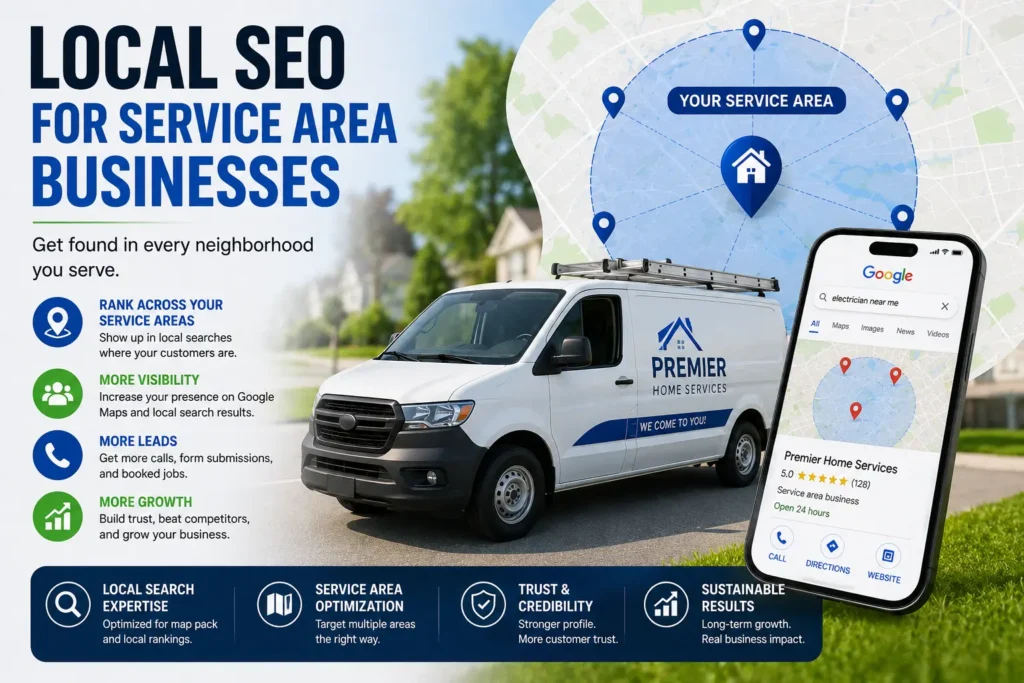
Most service area businesses struggle with local SEO for one simple reason:
They are trying to rank like storefront businesses.
That approach no longer works consistently in 2026.
Google treats service area businesses differently. Customers search differently. Competition behaves differently. And AI-driven search is changing local visibility faster than most business owners realize.
This guide explains exactly how local SEO for service area businesses works today, what actually drives rankings, and how to build a system that generates consistent local leads without relying on a physical storefront.
What Is a Service Area Business
A service area business is a company that travels to customers instead of serving them primarily at a public office location.
Examples include:
• HVAC companies
• Plumbers
• Electricians
• Roofing contractors
• Cleaning companies
• Movers
• Mobile locksmiths
• Landscaping businesses
• Pest control companies
Unlike storefront businesses, service area businesses depend heavily on Google Maps visibility, trust signals, and local intent searches.
Why Local SEO Is Different for Service Area Businesses
Ranking a service area business is harder than ranking a storefront business.
Why?
Because Google must determine:
• Where you truly operate
• Whether you are relevant to a search area
• Whether your business is trustworthy without a public office
This means proximity alone is not enough.
Google evaluates:
• Service area relevance
• Google Business Profile optimization
• Review quality and velocity
• Brand authority
• Engagement signals
• Website depth and local relevance
Most businesses fail because they only optimize one piece.
Winning businesses build a full local ecosystem.
The Biggest Mistake Service Area Businesses Make
Most service area businesses create generic pages and expect rankings.
Example:
“Best HVAC services in Texas”
This is too broad and weak.
Google wants highly relevant local signals.
A better approach:
• AC repair in Austin
• Emergency electrician in Dallas
• Move-out cleaning in Brooklyn
Specificity wins local search.
How Google Understands a Service Area Business in 2026
Google now relies heavily on entity signals and behavioral data.
It looks at:
• Where your reviews come from
• Where customers request directions or calls
• Location relevance in content
• Service-area consistency across the web
• Brand mentions across platforms
AI systems also evaluate these signals when recommending businesses.
This is why local SEO today is no longer just “ranking pages.”
It is about creating a trusted local entity.
Google Business Profile Optimization for Service Area Businesses
Your Google Business Profile is your most important local SEO asset.
For service area businesses, proper setup matters even more.
Choose the Correct Business Setup
If customers do not visit your location:
• Hide your address
• Define service areas properly
• Avoid adding excessive cities
Keep service areas realistic and relevant.
Primary and Secondary Categories Matter
Your primary category significantly impacts your ranking.
Examples:
• Plumber
• HVAC Contractor
• Electrician
• House Cleaning Service
Then add secondary categories only if truly relevant.
Avoid category stuffing.
Service Sections Are Underutilized
Most businesses ignore this area.
Add:
• Individual services
• Clear descriptions
• Natural keyword variations
This improves relevance dramatically.
Photos Are Local SEO Signals
Upload:
• Team photos
• Vehicle branding
• Job-site photos
• Before-and-after work
• Equipment and process visuals
Avoid stock images.
Real photos increase engagement and trust.
Google Posts Still Matter
Weekly posts help maintain profile activity.
Post:
• Seasonal tips
• Service updates
• FAQs
• Promotions
• Recent projects
This reinforces local relevance over time.
How Reviews Influence Service Area Rankings
Reviews are among the strongest local ranking factors for service-area businesses.
But not all reviews are equal.
Google evaluates:
• Review freshness
• Keywords naturally mentioned
• Geographic relevance
• Review consistency over time
• Response activity
What High-Quality Reviews Look Like
Strong reviews often include:
• Service type
• Location
• Experience details
• Speed and professionalism
Example:
“The team fixed our AC quickly in downtown Dallas during a weekend emergency.”
That creates local relevance naturally.
Website Strategy for Service Area Businesses
Most service area websites are too thin.
Google needs depth and clarity.
Build Service-Specific Pages
Every major service deserves its own page.
Examples:
• Water heater repair
• Roof replacement
• Deep cleaning service
• Emergency moving service
Each page should include:
• Clear explanation
• Process
• FAQs
• Local relevance
• Trust signals
• Strong CTA
Build City and Service Area Pages Correctly
This is where most businesses fail.
Please do not create doorway pages with duplicated content.
Instead:
• Make each page unique
• Include local references
• Mention service challenges specific to the area
• Add real project examples if possible
Google can now easily detect low-value city pages.
Internal Linking Strategy That Helps Rankings
Your pages should support each other.
Examples:
• Blog → service page
• Service page → city page
• FAQ → service page
This helps Google understand relationships between topics and locations.
Local Content Strategy for Service Area Businesses
Most competitors publish random blogs.
That does not build authority.
Instead, build topical clusters.
Example for HVAC
Main page:
AC Repair Services
Supporting content:
• Why AC systems fail during summer in Phoenix
• Signs your HVAC system needs replacement
• AC maintenance checklist for homeowners
All linked together.
This builds local topical authority.
Local Link Building for Service Area Businesses
Links remain critical in local SEO.
But local relevance matters more than volume.
Valuable Link Sources
• Local news websites
• Community sponsorships
• Industry associations
• Chamber of Commerce
• Local business collaborations
One strong local mention can outperform dozens of weak backlinks.
AI Search Optimization for Service Area Businesses
AI search is changing local discovery.
People now ask:
• “Best emergency plumber near me”
• “Most trusted movers in Chicago”
• “Affordable roofing company nearby”
To appear in AI-generated recommendations:
• Structure answers clearly
• Use conversational headings
• Add FAQs
• Keep content easy to extract
AI systems favor businesses with clear trust and entity signals.
Mobile Optimization Is Non-Negotiable
Most local service searches happen on phones.
Your website must:
• Load quickly
• Have click-to-call buttons
• Use simple forms
• Be easy to navigate
Slow mobile experiences destroy conversions.
How to Track Local SEO Success
Most businesses track rankings only.
That is incomplete.
Track:
• Calls
• Form submissions
• Direction requests
• Google Business interactions
• Review growth
• Conversion rates
Local SEO should be measured by leads, not impressions alone.
The Real Ranking Factors for Service Area Businesses in 2026
Based on real-world local SEO performance, the biggest factors today are:
• Google Business Profile optimization
• Review quality and consistency
• Local relevance in content
• Strong service pages
• Mobile experience
• Local backlinks and mentions
• Engagement signals
• Brand trust
Most businesses already know these.
Very few execute them consistently.
Why Some Service Area Businesses Still Fail
Even after investing in SEO, many businesses plateau because:
• Their content is generic
• Their reviews are weak
• Their Google profile is inactive
• Their city pages are duplicated
• Their branding lacks trust signals
Local SEO is no longer about shortcuts.
It is about building a trusted local brand.
The Future of Local SEO for Service Area Businesses
The businesses winning local search in 2026 are not the biggest.
They are the clearest, most trusted, and most locally relevant.
Google and AI systems increasingly prioritize:
• Real-world trust
• Consistent business signals
• Helpful content
• Strong customer experience
Businesses that build authority systematically will dominate.
Final Thoughts
Local SEO for service area businesses is no longer about stuffing city names into pages.
It is about building a strong local presence that Google can confidently recommend to customers when they are ready to hire.
When your:
• Google Business Profile
• Reviews
• Service pages
• Local authority
• User experience
When all align, rankings become much more stable and profitable.
The businesses that treat local SEO as a long-term growth strategy will continue to win in 2026 and beyond.