
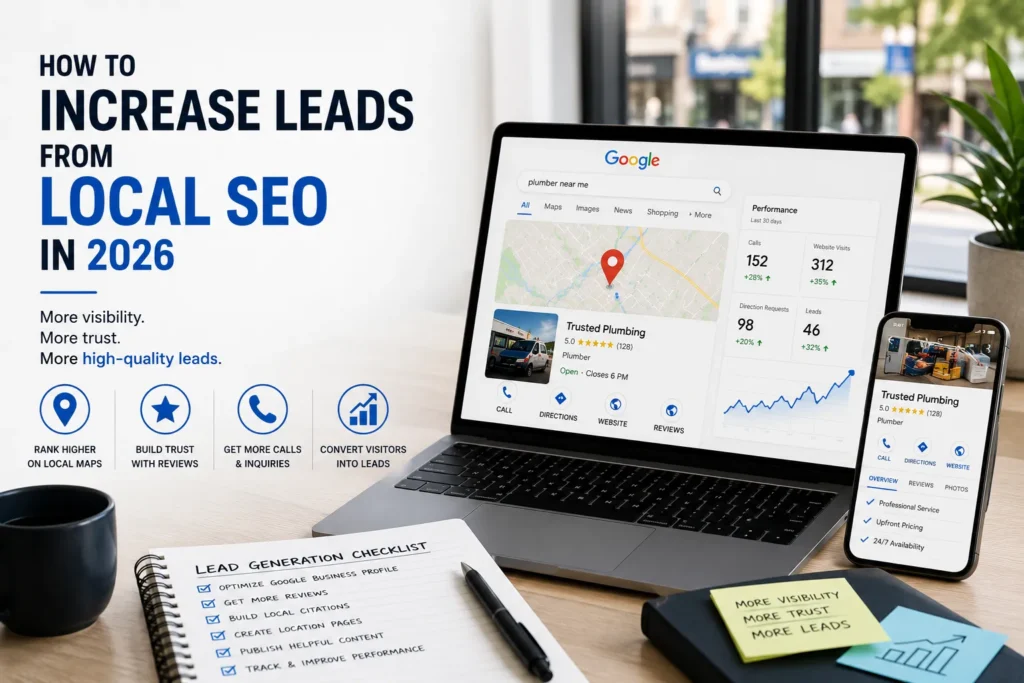
Ranking locally isn’t the same as getting leads. A business can hold the top three spots in the Local Pack for its city and still lose the sale to a competitor who ranks lower but has a faster-loading landing page, states a price range up front, and has a phone number you can tap without hunting for it.
Getting more leads out of local search comes down to three things working together: being discovered by the right searchers, giving them enough confidence to act once they find you, and making that action easy to complete and easy to measure. Miss any one of those and visibility doesn’t turn into revenue. This guide follows that logic in order, using one framework throughout:
Visibility → Relevance → Trust → Action → Conversion → Measurement → Optimization
A note on accuracy before diving in: where this guide states something Google has confirmed, it says so directly and quotes the source. Everything else is either established best practice or reasonable strategic thinking for how local search works in 2026, and it’s labeled that way. No specific ranking, traffic, or lead outcome is guaranteed here, because those depend on your market and competition as much as on anything covered below.
1. What Actually Drives Local SEO Leads
Leads come from relevant visibility multiplied by conversion behavior, not visibility alone. Pull one lever without the other, and lead volume barely moves.
| Stage | Measures | Doesn’t tell you |
| Visibility | How often you appear in the Local Pack, Maps, and local organic results | Whether anyone clicked |
| Traffic | Clicks to your site or profile | Whether the visitor found what they needed |
| Engagement | Time on page, profile interactions | Whether it led to a lead |
| Leads | Calls, forms, bookings, messages | Whether the lead is a real prospect |
| Qualified leads | Leads matching your service area, budget, and timeline | Whether it will actually close |
| Customers/revenue | Paying business and its value | N/A |
Each stage in this chain, from search demand through visibility, click-through, a profile or website action, conversion rate, qualification, and close rate, has its own conversion rate. Weakness anywhere compounds through everything after it. A business ranking for forty broad keywords at a 1.2% conversion rate can end up with fewer leads than one ranking for fifteen tightly targeted, high-intent terms converting at 6%, simply because the second business isn’t paying for irrelevant traffic in the first place.
A useful number to track is lead efficiency: qualified leads divided by local organic sessions, or by profile actions. Tracking it by page, service, and location shows which assets are pulling their weight and which are soaking up visibility without producing anything. Section 15 builds a full diagnostic process around exactly that kind of mismatch.
2. Match Local SEO to Search Intent
Keyword targeting on its own doesn’t produce leads, because a keyword describes a topic, not someone’s readiness to act. The searches worth chasing are the ones that carry buying intent, not the ones with the highest volume.
| Intent category | Example | Lead likelihood |
| Informational | “how often should HVAC filters be changed” | Low |
| Service research | “types of roof repair for flat roofs” | Low to moderate |
| Commercial investigation | “best roofing company [city]” | Moderate to high |
| Transactional | “roof repair [city]” | High |
| Urgent | “emergency roof leak repair near me” | Very high |
| Navigational / brand | “[Business Name] [city]” | High, for existing pipeline |
The searches most likely to become a lead usually pair a service term with something else: “near me,” urgency language like “same-day” or “open now,” transactional words like “quote,” “estimate,” or “pricing,” or a specific problem paired with a service (“leaking pipe repair” rather than just “plumber”). High-volume category terms attract a broad mix of intent, including many people who aren’t close to contacting anyone. A narrow phrase like “emergency pipe burst repair Eastside” gets a fraction of the searches “plumber” does, but nearly everyone typing it needs help right now. Put urgent and transactional terms first, commercial-investigation terms second, specific problem-plus-service terms third, and treat informational content mostly as a way to build topical depth and support AI-search answerability, covered in Section 18, rather than as a direct source of leads.
3. Optimize the Google Business Profile for Leads
Treat your Business Profile as a conversion asset first and a ranking asset second. Google says local ranking is based mainly on relevance, distance, and prominence, and defines relevance as “how well a Business Profile matches what someone is searching for.” But every field on that profile also does something separate: it either helps or hurts a searcher’s decision to act in the moment.
| Element | Why it matters for leads | Common mistake |
| Primary category | Decides which searches you’re even eligible for | Going broad instead of precise (“Contractor” instead of “Roofing contractor”) |
| Secondary categories | Extends eligibility to adjacent services | Adding categories you don’t actually offer |
| Business name | Trust, and Google’s own guidelines | Keyword-stuffing the name field |
| Description and services | Lets people confirm you do what they need before they click | Vague copy, or a blank services list |
| Service areas | Keeps leads inside your actual fulfillment range | Setting an unrealistic radius |
| Hours | Wrong hours read as “closed,” and closed means lost | Forgetting seasonal or holiday hours |
| Phone number | The most direct line to a lead | Call-center numbers, or unreliable forwarding |
| Website URL | Sends interested searchers somewhere useful | Always linking the homepage, no matter what was searched |
| Booking/messaging | Skips a step in the journey | Turned on but never checked |
| Photos and videos | Builds visual trust | Stock imagery instead of real work |
| Q&A | Answers objections before they block a call | Public questions left unanswered |
Google’s own guidance is to pick categories that complete the sentence “this business is a,” not “this business has a,” and to choose the single most specific option available. A business that goes broad to “cast a wider net” makes itself less relevant for the exact searches that turn into leads. Completeness matters less as a ranking trick and more as a confidence signal: missing hours, no photos, or a generic description all read, consciously or not, as reasons to keep comparing rather than pick up the phone.
4. Win More Local Pack and Maps Opportunities
Relevance and prominence are mostly within your control. Distance isn’t. Winning the right opportunities, not just any visibility, means going after searches you can both realistically rank for and actually fulfill.
| Factor | What it means | How much control you have |
| Relevance | How well your profile matches the search | High: category, service detail, description |
| Distance | How far you are from the searcher | No search-by-search; only which searches you compete for |
| Prominence | How well-known you are (reviews, links, mentions) | Moderate: review generation, genuine local authority |
A business that ranks across an entire metro area, including neighborhoods forty-five minutes outside its real service radius, racks up impressions and clicks that can never become leads. Find the opportunities actually worth chasing by cross-referencing what you can realistically rank for, what falls inside a service area you can fulfill, and what carries the intent signals from Section 2. A search that only checks the first box gives you visibility without leads.
5. Build Service-Location Relevance
Tie together what you offer, where you offer it, and who you serve, through pages that provide real local value rather than a template with the city name swapped out.
A dedicated location or service-area page earns its place when your business genuinely serves that area differently enough to say something specific and true about it (different regulations, different response times, real local project photos), and when there’s genuine, independent search demand for that combination. It doesn’t earn its place when it exists only to cover another city name, when you can’t actually serve that area well, or past the point your business can credibly support. A single-location plumber doesn’t need fifty neighborhood pages. What actually makes a page useful: specific coverage boundaries, local needs that genuinely differ by area (climate, building types), service-specific detail, local operating notes, and proof from that area, whether that’s reviews or project photos. If the only thing that changes on a page is the city name, that’s a sign a dedicated page isn’t warranted yet.
6. Optimize Local Landing Pages for Conversions
Local traffic only becomes a lead when the page removes doubt and friction fast enough to match how urgently the searcher needs an answer. Someone searching with local, high-intent language usually decides within seconds whether a page is worth their time.
Above the fold, a page should answer three questions without any scrolling: what does this business do, does it serve my area, and how do I reach it right now? That means a headline pairing service and location, a phone number you can tap, a call to action matched to intent, and a trust signal you can see immediately.
| Element | Purpose |
| Service + location headline | Confirms the page matches what was searched |
| Trust signals (reviews, credentials) | Lowers the risk of contacting a stranger |
| Pricing or a price range | Reduces hesitation and filters out mismatched leads |
| Click-to-call | Removes mobile friction |
| Short forms | Every extra field costs completions |
| Mobile usability | Most local search happens on a phone |
Match the call to action to the industry’s natural next step. Home services usually mean a call or a quote request; healthcare and dental mean booking an appointment; legal work means a consultation; automotive means a service booking; professional services mean a consultation request. Put a long intake form on a landing page meant for urgent searches and conversion drops, even if everything else about the page is solid.
7. Turn Google Business Profile Interactions into Leads
Calls, website clicks, direction requests, bookings, and messages are each their own lead opportunity, and each only converts if the profile and whatever page it links to agree on identity, service, location, availability, and next step.
Calls are usually the highest-intent action available; they mostly fail because the phone goes unanswered or rings too slowly. Website clicks hand the visitor off to whatever page you link to, so never route a specialized profile to a generic homepage. Bookings skip a whole step where they’re available. Messages capture people who’d rather not call, but only if someone’s actually watching.
A lot of local demand gets wasted quietly, not just underperformed, through preventable mechanical failures: a broken link on the profile, wrong hours listed, a phone number that’s disconnected or misrouted, a landing page that’s slow or broken on mobile. Check for these before any new visibility work, because fixing them recovers leads immediately from demand you’ve already earned.
8. Use Reviews to Improve Local Lead Generation
Reviews do two separate jobs. They feed into prominence as a ranking signal, and independently, they’re the trust check most people run before they’ll contact a business they haven’t used before. For lead generation specifically, that second job usually matters more.
Volume, recency, and how specific a review is all count more than the star rating alone. A review that names the exact service and describes the outcome builds far more pre-contact confidence than a five-star rating with no text attached. Google itself tells businesses to “embrace a mix of positive and negative feedback,” noting that a mix “often feels more trustworthy” than an unbroken run of perfect scores.
To build reviews the right way: ask every customer, not a filtered subset, right after the job is done, with a link that takes one tap. Respond to everything, good and bad. Google explicitly bans incentivized reviews and review gating (only asking satisfied customers), and both put your profile at real risk of suspension. A thoughtful, specific response to a bad review often gets read more closely than the review itself, because it’s direct proof of how you handle things going wrong.
9. Create Local Content That Attracts Potential Buyers
Not every blog post produces a lead, and it shouldn’t try to. Local content earns its place when it builds relevance and trust around specific services and hands the reader a path to contact you, not just when it attracts traffic.
| Content type | Lead potential | Role |
| High-intent service content | High | Can convert directly with a strong link into the service page |
| Problem-solving local content | Moderate to high | Reaches people already dealing with the problem you solve |
| Commercial comparison content | Moderate | Supports comparison shopping, needs a clear next step |
| Supporting informational content | Low direct | Builds depth, feeds AI-search answerability (Section 18) |
Before writing anything, run it through a quick test: does this topic reflect something your services actually solve, is there a natural place to link into a service or location page, and would the person reading it realistically be in the market soon? A topic that fails all three isn’t part of a lead-generation plan, no matter what other value it might have. Content that never links anywhere useful is built for coverage, not leads.
10. Build Local Authority and Prominence
Authority-building helps leads indirectly: it strengthens prominence in the rankings and reinforces the trust someone needs before contacting an unfamiliar business, but only when the links, mentions, and citations are genuinely tied to your location and industry.
That means local backlinks and mentions from businesses and organizations actually connected to your community, real trade associations, local press coverage, and directories that are actually relevant rather than mass listing networks. A handful of genuinely relevant links beats dozens from generic directories, which carry almost no ranking weight now and can make your business information inconsistent across the web. A fair test: would this link exist at all in a world where SEO didn’t exist?
11. Fix Technical and On-Page Issues That Block Leads
Technical SEO is a supporting layer here. It keeps demand you’ve already earned from failing to convert, but it rarely creates demand on its own.
The priorities: mobile speed and usability (most local search happens on a phone), indexability, HTTPS, LocalBusiness structured data, titles and meta descriptions that actually mention the service and location, internal links that point from content into conversion pages, and click-to-call that actually works. Google is explicit that structured data “does not guarantee that features that consume structured data will show up in search results.” Schema makes real information easier to parse, not a substitute for good information in the first place. A minimal example:
{
“@context”: “https://schema.org”,
“@type”: “LocalBusiness”,
“name”: “Example Plumbing Co.”,
“telephone”: “+1-555-0100”,
“address”: {
“@type”: “PostalAddress”,
“streetAddress”: “123 Main St”,
“addressLocality”: “Austin”,
“addressRegion”: “TX”,
“postalCode”: “78701”
},
“areaServed”: [“Austin”, “Round Rock”],
“openingHoursSpecification”: {
“@type”: “OpeningHoursSpecification”,
“dayOfWeek”: [“Monday”, “Tuesday”, “Wednesday”, “Thursday”, “Friday”],
“opens”: “08:00”,
“closes”: “18:00”
}
}
A technically flawless page with weak relevance and no trust signals will still underperform a page that has strong relevance and a few technical rough edges. Treat this layer as removing barriers, not as the thing that generates the leads.
12. Make the Website Easy to Contact
Friction is the most controllable reason traffic fails to turn into leads, and fixing it is faster and cheaper than any ranking work you could do instead.
Look for it in the obvious places: click-to-call that’s missing or hard to find, forms that ask for too much, vague buttons (“Learn More” instead of “Call Now”), no confirmation after someone submits a form, and calls to action that don’t match how urgently someone searched. Someone searching for emergency help wants a call button. Someone earlier in their research might respond better to “Get a Free Estimate.” Friction doesn’t throw an error message. It just makes someone leave, quietly, with no record of what almost happened. Regularly checking the actual mobile experience, not just a one-time setup, should be standard practice.
13. Optimize for Local SEO Conversion Rate
More leads don’t require more traffic. Improving conversion rate on the traffic you already have is often faster and cheaper than winning new rankings.
The basic relationship is local traffic times conversion rate equals leads, which extends further: relevant local traffic times conversion rate times lead quality equals actual business opportunity. You can raise raw lead count while lowering real opportunity if the extra leads come from poorly matched traffic. Improve conversion at every stage: click-through rate (titles, meta descriptions, how well your profile matches the search), landing page conversion, call conversion (answer rate and qualification), form conversion (length and clarity), and lead qualification itself. Taking a page’s conversion rate from 1% to 2% produces the same lead gain as doubling its traffic, but it’s cheaper, faster, and benefits every future visitor rather than depending on holding a ranking that could slip.
14. Track Local SEO Leads Properly
Visibility and traffic data alone can’t show whether local SEO is actually generating leads. That takes connecting visibility, engagement, and real lead events to a common source, ideally all the way through to a closed sale.
| Category | Tells you | Doesn’t tell you |
| Visibility (GBP data, Search Console) | Impressions, position, click-through rate | Whether anyone acted |
| Engagement (Analytics) | On-site behavior, traffic sources | Whether it converted, unless it’s configured to track that |
| Lead metrics (call tracking, forms) | Which source produced which action | Lead quality, unless that’s captured separately |
| Quality (CRM) | Qualification and close rate | Nothing, if the lead source wasn’t captured at intake |
| Revenue | Customer value by source | N/A |
A workable baseline: check GBP performance monthly, connect Search Console and Analytics with conversion events actually configured, run call tracking on the site and profile, and capture lead source at intake so it ties back to CRM outcomes. A report built only from visibility and engagement can show “growth” every month while leads and revenue stay completely flat. That’s the single most common reason a business misjudges whether local SEO is working.
15. The Local Lead Loss Diagnosis Framework
Low lead volume almost always traces back to one specific, identifiable break point. Treating every shortfall the same way, as “we just need more SEO,” wastes effort when the real problem is somewhere in conversion, tracking, or sales follow-up.
| Pattern | Likely cause | Fix first |
| Deep impressions, low clicks | Weak relevance or trust signal in the snippet or profile | Snippet and profile presentation (Sections 3, 11) |
| High clicks, low conversions | Landing page isn’t persuading or enabling action | Landing page (Section 6) |
| High calls, low qualified leads | Wrong searchers, or weak call qualification | Service-area and service relevance (Sections 3, 4) |
| High leads, low close rate | Sales follow-up or the offer itself, not SEO | Sales process, outside SEO’s scope |
| Strong rankings, weak leads | Ranking for the wrong queries | Intent alignment, then landing page (Sections 2, 6) |
| Strong profile visibility, weak site conversions | Landing page or technical issue | Landing page and technical basics (Sections 6, 11) |
| Strong traffic, poor mobile conversion | Device-specific friction | Mobile audit (Section 12) |
| Many reviews, weak conversion | Review content or recency, or reviews aren’t shown on the page | Review strategy (Section 8) |
| Good rankings, wrong intent | Ranking for informational rather than transactional queries | Re-target keyword strategy (Section 2) |
Start from whichever row your available data actually supports. “Not enough leads” is a symptom, not a diagnosis, and the fix depends entirely on which stage is actually broken.
16. Prioritize Local SEO Lead Generation Work
Prioritize by impact, effort, and lead potential, not by whichever tactic happens to be trending in local SEO advice. Where you should start depends on your situation, and no single order fits every business.
Quick wins come first: fixing profile accuracy, broken links, and overly long forms, because they recover leads from demand you’ve already earned. Foundational fixes come next: accurate categories, consistent business information everywhere, core conversion elements, and basic tracking. Then medium-term work like genuine service or location pages and a structured review process, followed by longer-term authority building. A business with solid traffic but weak conversion should work on Sections 6, 12, and 13 well before chasing new visibility. A business with a strong site but weak visibility should focus on Sections 3, 4, 5, and 10 instead.
17. Local SEO Strategies That Often Fail to Generate Leads
Most of these failures come down to optimizing a proxy metric, like rankings, traffic, or page count, instead of the actual goal: leads.
Chasing volume instead of intent pulls in traffic that isn’t ready to act. Thin or duplicated location pages provide little real value and rarely rank or convert. Neglecting the Business Profile gives up the highest-intent, lowest-friction channel most local businesses have. Weak or stale reviews fail the trust check people run before reaching out. Hidden phone numbers and long forms add friction exactly where it hurts most. Skipping call tracking means you can’t tell what’s actually working. Measuring rankings instead of leads creates a false sense of progress. Publishing content with no path to contact you wastes the effort. Low-quality citations and irrelevant backlinks add little benefit and some real risk. Nearly all of these can look like productive work in a monthly report while doing nothing for actual lead volume.
18. How AI Search Changes Local Lead Generation in 2026
AI-powered search, including AI Overviews and AI Mode, draws on the same signals that already matter for local SEO, rather than demanding a separate playbook. Google says so directly: there are “no additional requirements to appear in AI Overviews or AI Mode, nor other special optimizations necessary” beyond standard indexing, snippet eligibility, and the usual SEO fundamentals.
Here’s what’s confirmed: these features rely on standard search eligibility, use a “query fan-out” approach across related searches, and don’t require new markup or AI-specific files. Here’s what’s a reasonable inference, not a confirmed mechanic: a system synthesizing an answer about a local business probably draws on the profile, the site, reviews, and third-party mentions together, so staying consistent across all of them probably helps. And here’s what would be speculation, which this guide isn’t claiming: that any specific trick guarantees a spot in an AI-generated answer.
In practice, the work already covered here (accurate, consistent business information; genuine reviews; clear service and location content) is also the foundation for AI-search visibility. The most useful thing to add is making sure your content plainly answers specific questions: does this business provide the service, where, for whom, how can someone reach it, does it take appointments or give quotes, and what makes it relevant to this particular location. There’s no real evidence of a separate “AI optimization” ranking system beyond being relevant, clear, credible, and consistent.
19. The Local SEO Lead Generation Funnel
Search demand leads to local visibility, which leads to a search result interaction, which leads to a profile interaction or a website visit, which leads to landing page engagement, then a CTA interaction, then a lead, a qualified lead, a customer, and finally revenue.
| Where the problem shows up | Type | Fix |
| Weak visibility | Visibility problem | Sections 3, 4, 5, 10 |
| Visibility is fine, wrong searches | Relevance/intent problem | Sections 2, 4 |
| Impressions are fine, clicks are low | Trust/presentation problem | Sections 3, 8, 11 |
| Clicks happen, no action follows | Conversion problem | Sections 6, 12, 13 |
| Actions happen, leads aren’t qualified | Relevance/targeting problem | Sections 2, 4, 5 |
| Leads exist, but you can’t tell what’s working | Measurement problem | Section 14 |
20. A Practical 90-Day Plan
Actual results depend on market competition, location, industry, your existing authority, and the quality of your site and offer. Treat this as a sequence, not a promise.
| Phase | Focus | Key actions |
| Days 1 to 15 | Stop wasting demand you already have | Fix profile accuracy, broken links, click-to-call, and NAP consistency |
| Days 16 to 30 | Cut conversion friction | Shorten forms, match CTAs to intent, get call and conversion tracking running |
| Days 31 to 50 | Strengthen relevance and trust | Rewrite thin service descriptions, start a review process, confirm service areas |
| Days 51 to 70 | Build service-location relevance | Add two to four genuinely distinct service-area pages with clear CTAs |
| Days 71 to 90 | Expand authority and content | Go after relevant local links and mentions, publish one or two high-intent pieces with real conversion links |
| Ongoing | Sustain it | Run the diagnostic in Section 15 monthly, revisit priorities in Section 16 quarterly |
21. Checklist
Profile: precise category, complete and specific services, accurate service area and hours, a reliable direct phone number, the right website link, booking or messaging turned on and actually monitored, current photos.
Visibility: ranks for core service-plus-location terms, visibility concentrated inside your actual service area, NAP consistent everywhere.
Website: fast on mobile, HTTPS, indexable, LocalBusiness schema in place, titles and meta descriptions that mention service and location.
Landing pages: service, location, and value proposition clear above the fold, visible trust signals, CTA matched to intent, click-to-call that works, short forms, location pages with genuinely unique content.
Reviews: healthy volume and recency, requests going to every customer, every review answered, nothing incentivized or gated.
Authority: links and mentions genuinely tied to your location and industry, not mass directory submissions.
Conversion and tracking: conversion rates known rather than assumed; GBP data, Search Console, Analytics, and call tracking connected; lead source captured at intake.
AI and search readiness: business information consistent everywhere, content that answers specific questions plainly.
Lead quality: service-area accuracy preventing mismatched leads, qualification and close rate tracked, not just raw lead count.
Conclusion
More local SEO leads don’t come from ranking for more keywords. They come from getting the right local searchers to find the business, trust it, take action, and follow a path that’s actually being measured. The highest-impact work clusters around an accurate, conversion-ready Business Profile; landing pages built to answer questions and enable contact in seconds; a review base that’s genuine and current; and tracking thorough enough to show what’s working and what isn’t.
The best next step usually isn’t a new campaign. It’s the diagnostic work in Section 15, run against whatever data you already have. Finding the specific point where leads are lost, and fixing it first, beats piling on more visibility over a funnel that’s never been checked for leaks.
FAQ
By increasing visibility for the right searches, then converting a share of that visibility into calls, forms, bookings, and messages. It works through the whole chain, visibility to relevance to trust to action, not through ranking by itself.
Profile fixes can change how people act almost immediately. Competitive rankings usually take months. Conversion-rate improvements to pages you already have can show results within weeks, since they don’t depend on ranking at all.
Almost always a conversion, relevance, or trust problem sitting downstream of visibility that’s actually working fine. Run the diagnostic in Section 15 rather than assuming the answer is more SEO.
Ranking and getting customers are separated by several conversion steps: click-through, landing page, qualification, close. Check whether the pages that rank match transactional intent, and whether your sales process converts the leads that do show up.
At least one from each category: visibility, engagement, lead volume, qualification rate, and revenue by source where you can get it. Tracking only the first two is the most common reason local SEO looks fine on paper while leads stay flat in reality.
They boost prominence in rankings and, separately, serve as the trust check most people run before contacting a business they haven’t used. Content and recency matter about as much as the star rating itself.
Yes. Organic visibility in the Local Pack, Maps, and local organic results is entirely separate from paid channels, though it usually takes longer to build meaningful visibility this way.
It leans on the same fundamentals: accurate and consistent information, genuine reviews, clear content, rather than demanding a separate approach. Google says outright that there are no special requirements to appear in AI Overviews or AI Mode beyond standard SEO fundamentals.