
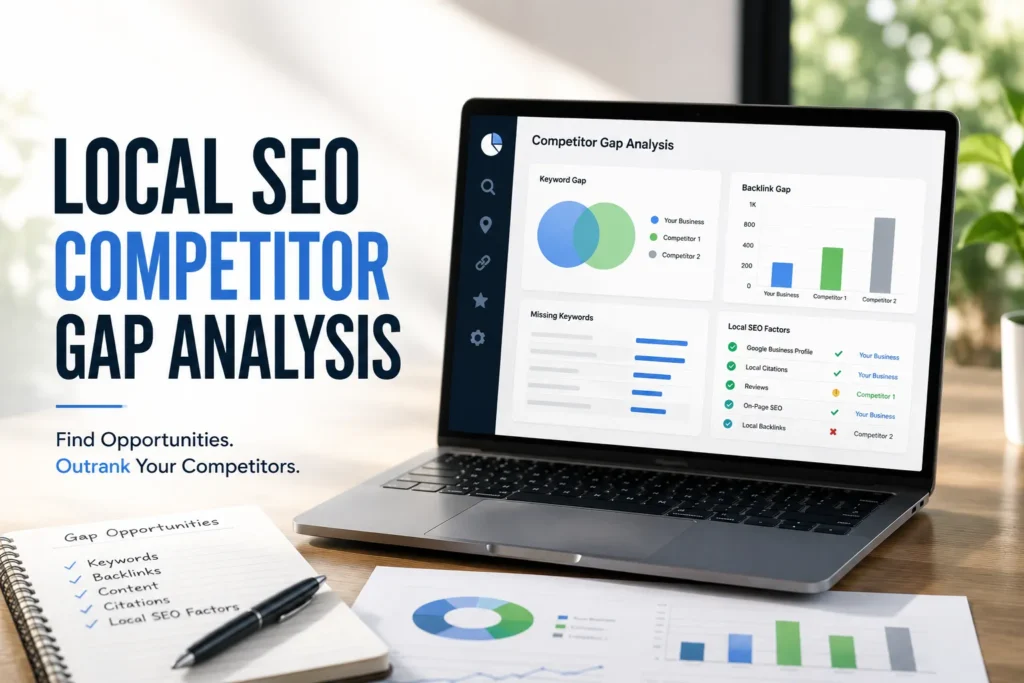
A business can have a solid website, a fully verified Google Business Profile, and a healthy stack of reviews, and still watch the same handful of competitors sit above it in local search results.
That’s what makes it frustrating: the obvious checks all look fine. Your business information is accurate, your website works, your rating is respectable, and you might even have more reviews than some of the businesses that consistently outrank you.
So the useful question isn’t “What are they doing?” It’s narrower than that: what are they doing that we aren’t, which of those differences actually matter, and what should we fix first? That’s the real job of a local SEO competitor gap analysis.
Done well, it isn’t a list of everything a competitor has going for it. It’s an evidence-to-decision process: you identify the businesses that genuinely compete with you in search, gather comparable evidence on each one, weigh the differences carefully, and turn whatever’s meaningful into a short action plan. That last step is the one most audits skip.
Knowing that one competitor has 300 reviews and you have 120 doesn’t tell you what to do about it. A useful analysis tells you whether that gap is worth chasing, why it might matter, what it can’t prove, and what to check next. This guide walks through that process from finding the right competitors to measuring whether your fixes actually moved anything.
Why Most Competitor “Analysis” Never Finds the Real Gap
Most competitor research starts and ends with a handful of visible numbers. Someone searches a keyword, opens the top few Google Business Profiles, compares review counts, glances at a competitor’s website, and decides that competitor is “stronger.”
Agencies make a more polished version of the same mistake. A 30- or 40-point audit can produce an impressive PDF covering categories, citations, backlinks, content, reviews, and technical SEO, producing dozens of data points, all collected correctly.
The problem was never the data collection. It’s what happens to the data afterward.
Say a competitor turns out to have more reviews, more backlinks, more photos, more service pages, more directory listings, and more Google Posts than you do. All of that is worth investigating, but none of it automatically explains why that competitor outranks you. Local rankings respond to multiple factors at once, and to the specifics of the search itself. Google describes local results in terms of relevance, distance, and prominence, which means a competitor’s apparent edge can shift depending on the query and where the search happens.
A competitor comparison is a snapshot. A gap analysis is a diagnosis, and the difference shows up in what you do with the information once you have it. A snapshot tells you “Competitor A has 14 location pages, we have 4.” A diagnosis tells you “our service-area page doesn’t clearly address the neighborhoods we actually serve, while the competitors we keep losing to have dedicated pages for each one, and that’s worth fixing because it maps directly to the queries we’re trying to rank for.” The first is just a fact. The second is something you can act on.
What “Local Search Competitor” Actually Means (It’s Not Who You Think)
The business down the road might be your biggest commercial rival and still barely register as a search competitor. That’s because local SEO runs on two separate ideas of competition at once: one based on the market, and one based on what Google actually shows.
Category Competitors vs. Real Search Competitors
A category competitor sells something similar to what you sell. A search competitor is a business that keeps showing up for the specific queries and locations you care about. Those two groups overlap, but they aren’t the same thing, and confusing them is where a lot of competitor analysis goes wrong from the start.
Google says local results are based primarily on relevance, distance, and prominence: how well a business matches the search, how far it is from wherever the search happened, and how well known it is based on the information Google has about it. That framework has a practical consequence: your competitor set isn’t fixed. Geography and what someone’s actually searching for shape it.
Picture two hypothetical HVAC companies. Business A is well established with a strong presence across the whole city. Business B is smaller but sits much closer to one particular neighborhood. Search “HVAC repair,” and Business A shows up across a wide area. Search “HVAC repair in [Neighborhood],” and Business B starts winning that same spot. Neither result makes one company universally stronger; it just means the search context changed.
Why Your Competitor Set Changes by Keyword and by Location
“Plumber near me,” “emergency plumber,” and “emergency plumber in [city]” can each surface a different set of competitors, and so can moving the search from one side of a city to the other. That’s the practical reason a single search from your own office won’t cut it: it audits one point on the map and can miss businesses that dominate elsewhere in your service area.
A geo-grid tool solves this by running the same search from many points across a defined area. Local Falcon, BrightLocal’s Search Grid, and Whitespark’s Local Ranking Grids are all built for this. You don’t need one to get started, though. Manually searching from a handful of locations will show you the basic pattern well enough for a small business; the tools earn their cost once the number of queries, locations, or clients makes checking by hand impractical.
Finding the Competitors That Actually Matter
Start From Queries, Not From Guesses
Don’t start by listing every business you can think of in your industry. Start with the searches that actually matter commercially, built around service, modifier, and geography. A hypothetical plumbing company, for instance, might build its list around:
- plumber [city]
- emergency plumber [city]
- drain cleaning [city]
- water heater repair [city]
- sewer line repair [city]
- plumber [neighborhood]
- emergency plumber [neighborhood]
The exact list should reflect the business’s real services and service area, and it doesn’t need to be huge; a focused set of 8 to 15 commercially meaningful searches is enough to get started.
Check the Map Pack and Organic Results From the Right Location
Search each query and record who shows up. For a manual audit, use an incognito window and search from multiple points within the service area, if possible. Incognito mode doesn’t make a search fully location-neutral. It mainly strips out your current browser session and personalization, so location still matters most. Check from at least three points across the service area: the center, one edge, and another area where customers actually live. A geo-grid tool can automate this across many more points for a larger audit.
Record both the map pack and organic results, since they answer different competitive questions. For each query and location, log the top three map-pack businesses, the top five organic results, the search location, the query, the date, and the position where each competitor showed up. Don’t worry about making the first spreadsheet tidy; you just need enough data to spot repetition.
Build a Competitor Frequency Map
Businesses that show up again and again are more worth analyzing than ones that appear once for a narrow search. A simple matrix can look like this (the positions below are illustrative only):
| Query | Location | Competitor A | Competitor B | Competitor C | Competitor D |
|---|---|---|---|---|---|
| Emergency plumber | Central | 1 | 3 | 2 | Not found |
| Emergency plumber | North | 2 | 1 | Not found | 3 |
| Drain cleaning | Central | 3 | 1 | 2 | Not found |
| Drain cleaning | South | Not found | 2 | 1 | 3 |
| Water heater repair | Central | 1 | Not found | 3 | 2 |
Once you’ve run enough searches, tally the appearances: a business that turns up across multiple queries and locations deserves more attention than one that appeared once for a highly specific search. That gives you a practical discovery workflow:
- Build 8 to 15 target queries.
- Search each one from at least three relevant locations, or run a geo-grid.
- Record the top three map-pack results and top five organic results.
- Tally competitor appearances.
- Shortlist roughly three to five recurring competitors.
What you end up with is a competitor set built on search evidence, not reputation or guesswork.
Map Each Keyword to Its Competitors
Don’t treat your three to five competitors as one interchangeable group. Build a query-to-competitor matrix instead.
| Target query | Business A | Business B | Business C | Main competitor to investigate |
|---|---|---|---|---|
| Emergency plumber | 1 | 3 | Not found | Business A |
| Drain cleaning | 3 | 1 | 2 | Business B |
| Water heater repair | 2 | Not found | 1 | Business C |
| Sewer repair | Not found | 2 | 1 | Business C |
That reframes the question from “Who’s beating us?” to “Who’s beating us, and for which search?” That’s the version worth answering.
Building the Evidence Base: What to Pull From Each Competitor
Once you’ve identified the real competitors, resist the urge to judge them yet. Collect the evidence first. The core categories to cover are Google Business Profile, reviews, website and local landing pages, citations, backlinks and local authority, local content, guideline compliance, and conversion and user experience.
The goal at this stage is a comparable evidence base; interpretation comes later, and keeping the two separate matters more than it sounds. Decide that “reviews are the problem” before you’ve collected everything else, and you’ll start noticing evidence that confirms it while glossing over evidence that doesn’t.
Comparing Google Business Profiles
Google Business Profile is one of the most visible parts of a local search presence, though not every useful field is exposed equally to ordinary searchers. To identify the steps to optimize the GBP, start with what you can legitimately observe: primary category, secondary categories (where a proper tool can surface them), business description, hours and special hours, attributes, structured services, photos and their recency, Google Posts, product listings or other relevant profile features, Q&A activity, review count, rating, review recency, and review responses.
The first useful comparison is simply completeness: is your profile missing information that competitors have properly filled in? That doesn’t make every extra field a ranking lever. It just means your profile may be less complete from a customer’s and a profile-management standpoint.
Categories Deserve Special Attention
The primary category is visible on any normal profile; secondary categories generally aren’t, so you may need a legitimate third-party category finder or GBP audit tool to see them. This matters because categories describe what a business is. Google’s own guidance tells businesses to pick the category that best completes “this business is a ___,” not whichever ones happen to contain attractive keywords. If a competitor’s category combination more accurately reflects what it actually does, that’s worth investigating. It still doesn’t prove the category caused a ranking difference, and you should keep that distinction through the rest of the audit.
Look at Structured Services, Not Just a Description
A business description and a structured services list aren’t the same thing. Check whether competitors have individual services entered in the proper GBP service fields, then compare those against what you actually offer. Don’t add services you don’t provide just because a competitor lists them; the goal is accurate representation, not imitation.
Photos and Posts
Photos reveal how actively a profile is maintained and what customers see before they ever make contact. Look at roughly how many there are, how recently they were added, what kind of photos they are, whether they’re owner-uploaded or customer-uploaded, and whether they genuinely represent the business. You can note whether competitors use Google Posts too, but resist turning either observation into a ranking formula. There’s no reliable basis for claiming a business ranks higher because of its photo count or posting frequency. The same goes for Q&A activity: a well-maintained profile is easier for customers to evaluate, but activity volume alone isn’t a confirmed ranking factor.
A Note on “Hidden” GBP Data
This is where competitor research gets a little frustrating. Some of the most useful profile information (especially secondary categories, and sometimes finer details in the services list) isn’t presented plainly on the public profile. A legitimate third-party tool can save time here. The point isn’t to uncover some secret ranking formula; it’s to get a fuller picture of how competitors have actually represented their businesses.
Comparing Reviews: Beyond the Star Count
Review count and rating are the easiest things to compare, which is exactly why most competitor analyses stop there. That leaves a lot of useful information sitting untouched. A review profile also reveals what customers actually buy, which services get mentioned repeatedly, what people value and complain about, how recently customers have been active, and how the business responds to feedback. The actual language customers use to describe the service.
Start With Volume and Rating
Record the total review count, average rating, and roughly how recent the latest reviews are, but don’t treat these as a score that predicts ranking outright. A competitor with 500 reviews doesn’t automatically outrank one with 80; search location, query relevance, prominence, website signals, and everything else in this audit can all play a part. The review gap is evidence, not a verdict.
Look at Recency and Review Patterns
Two businesses can land on similar totals with very different histories: one receiving reviews steadily, the other piling up a large number years ago and going quiet since. Local SEO practitioners, including Whitespark’s Darren Shaw, have written about review recency and velocity as a possible signal worth watching, but treat this carefully: Google hasn’t publicly confirmed a “review velocity” factor you can plug into a formula. Use it as something worth investigating, not something you can bank on.
The practical question is whether a competitor seems to have an ongoing flow of feedback while yours has gone stagnant. If so, the fix isn’t manufacturing reviews. It’s building a legitimate review-request process into how you actually serve customers.
Read the Reviews for Meaning
Pull the most recent 20 to 30 reviews from each shortlisted competitor and tag each one for the service mentioned, the positive or negative theme, what the customer seemed to expect, any repeated wording, specific complaints, and the outcome mentioned. A simple tracker might look like this (these are illustrative examples, not real reviews):
| Review | Service | Theme | Sentiment | Repeated language | Potential action |
|---|---|---|---|---|---|
| 1 | AC repair | Fast response | Positive | “same day” | Mention response options |
| 2 | AC repair | Technician quality | Positive | “explained everything” | Consider FAQ or service copy |
| 3 | Maintenance | Pricing clarity | Negative | “unexpected cost” | Improve pricing explanation |
| 4 | Installation | Clean work | Positive | “left everything clean” | Reinforce service expectations |
The goal is turning customer language into business intelligence. If several competitors’ customers keep mentioning emergency response, weekend availability, transparent pricing, or a specific service, check your own GBP, website, and FAQ: is the service clearly represented, easy to find, and backed by a genuine process worth improving? This is where review analysis starts paying off well beyond a star-count comparison.
Review Content Can Inform Your Website
Customers rarely describe your services in your own internal terms, and their wording can expose real gaps in service-page copy, FAQs, GBP services, and objection handling. That’s not a license to lift competitor reviews or stuff their phrases into your pages; treat the recurring language as research into what customers actually care about.
Owner Responses Matter for More Than Ranking
Google encourages businesses to respond to reviews, and says doing so shows customers their feedback is valued. Check a sample of competitor responses: do they respond at all, are the replies personalized, do they address complaints constructively, do they offer a next step, or is it the same canned reply every time? Response quality isn’t grounds for claiming a competitor has a specific ranking advantage. It’s a customer-experience and reputation signal, and a useful one.
Watch for Review-Policy Red Flags
Review patterns can also flag compliance concerns worth a second look: sudden unnatural spikes, highly repetitive language, large clusters around a promotion, or signs that only happy customers were asked to leave a review. Google’s policies specifically prohibit review gating and other manipulative review practices. An odd-looking pattern isn’t proof of anything on its own, though, so flag it for further review rather than treating it as an accusation.
Comparing Websites and Local Landing Pages
A competitor’s website isn’t worth studying just because it “looks better.” What matters is whether it actually addresses the searches and customer needs you’re trying to win, so look at the structure before you judge the design.
Service and Location Page Structure
For each competitor, note the core service pages, the location pages, any service-location combinations, whether important services and locations each get a dedicated page, and how those pages link to each other internally. A competitor with a dedicated page for a service has more room to actually explain it than one cramming everything onto a single general page, though that alone doesn’t prove the dedicated page is what’s driving rankings. Whitespark’s practitioner survey has consistently ranked dedicated service pages high among local-organic factors, which is useful industry evidence. Still, it’s survey data reflecting practitioner opinion, not a published Google formula, and that distinction matters.
Don’t Obsess Over Title Tag Length
One common trap is treating title tag length as a competitive edge. A competitor can have a perfectly formatted title sitting over thin local content, and another can have a slightly messy title over a genuinely strong page. Whitespark’s research has actually placed title-tag length near the bottom of its factor rankings, a good reminder not to confuse technical formatting details with real strategic gaps. Write descriptive, relevant titles and move on; don’t spend hours matching a competitor’s character count.
Look for Real Local Relevance
A good local page should read like it was written for that location: areas actually served, neighborhood names, local service conditions, property types, relevant regulations, service-area specifics, and the questions real customers ask there. Be skeptical of pages where the only thing that changes between locations is the city name; swapping “[City A]” for “[City B]” in a template isn’t a local resource, it’s a placeholder.
Internal Linking Reveals Site Structure
Look at how competitors connect location to service to related service to contact, or service to the locations it serves. Strong internal linking won’t guarantee rankings on its own. Still, it makes a site’s structure easier to follow and helps customers find what they need, which matters even more for a multi-location business.
Comparing Citations and Directory Presence
A citation is simply a listing that contains your business name, address, and phone number somewhere other than your own website. Citations get discussed alongside NAP consistency for a sensible reason: conflicting business information can confuse customers and cause problems across the data ecosystems that feed Google and other platforms. That’s a reasonable case for consistency on its own. It doesn’t require inventing a claim that Google applies some specific numerical penalty every time a phone number differs, because no published formula lets you calculate one.
Find the Citations Competitors Have That You Don’t
This is where a citation-gap workflow earns its keep. Tools like BrightLocal’s Citation Tracker and Whitespark’s citation tools can compare listing coverage: run your business through an audit, run each shortlisted competitor through the same one, export the citation lists, and compare them to see which directories list competitors but not you. Then filter for relevance. A citation report can easily surface dozens of directories, and that doesn’t mean dozens of new listings are worth pursuing. The real question is which of the missing listings are actually worth having.
Quality Over Quantity
Prioritize directories with a genuine reason to list your business: industry associations, local chambers of commerce, local business organizations, relevant professional directories, established local directories, and legitimate niche platforms. A relevant local listing is usually a better use of time than another generic directory that exists mainly to hold business listings; that’s strategic judgment, not a published Google weighting.
| Directory type | Competitor A | Competitor B | Your business | Priority | Action |
|---|---|---|---|---|---|
| Local chamber | Yes | Yes | No | High | Investigate membership/listing |
| Industry association | Yes | No | No | High | Check eligibility |
| Generic directory | Yes | Yes | No | Low | Usually deprioritize |
| Local business directory | Yes | Yes | Yes | None | Verify consistency |
Before building anything new, audit your existing citations and fix the inconsistencies first.
Comparing Backlinks and Local Authority
Backlink analysis is another spot where competitor research tends to oversimplify. You’ll hear that a competitor has a higher “Domain Authority” or a bigger backlink profile and must therefore rank better. That conclusion doesn’t hold up. Domain Authority and similar scores from tools like Moz, Ahrefs, and Semrush are third-party estimates. They’re not Google metrics, and Google has never published anything like a Domain Authority score. The number is useful for comparing sites within that tool’s own index; it isn’t Google’s ranking score.
Look at Referring Domains, Not Just Link Counts
Record the number of referring domains, overall link volume, and, more importantly, how many of those domains are locally relevant, industry-relevant, or tied to community relationships, local publications, associations, or partners and suppliers. A hundred irrelevant links aren’t automatically worth more than a handful of genuinely relevant ones, and the same logic applies to authority scores: a high third-party number doesn’t make a site worth pursuing as an outreach target if it has no real connection to your business.
Run a Backlink Gap
Ahrefs and Semrush both offer backlink comparison tools that can surface domains linking to competitors but not to you. A useful workflow is to compare your domain against two or three recurring competitors, pull the domains linking to multiple of them, filter for relevance, separate real opportunities from the noise, and build a shortlist of outreach or relationship targets. You don’t need to reproduce every competitor link; ask why the competitor got it in the first place. Local news coverage, a community event, a sponsorship, an industry association, a supplier relationship, a local publication, a useful resource, a partnership: the reason behind the link is usually more useful than the link itself.
| Referring domain type | Competitor links? | Locally relevant? | Realistic opportunity? | Possible action |
|---|---|---|---|---|
| Local publication | Yes | High | Yes | Develop newsworthy local angle |
| Chamber | Yes | High | Maybe | Check eligibility |
| Industry association | Yes | High | Yes | Explore membership |
| Generic directory | Yes | Low | Usually no | Deprioritize |
| Unrelated website | Yes | None | No | Ignore |
That keeps backlink analysis tied to business reality instead of a numbers chase.
What the Data Actually Means: Interpreting Gaps Instead of Just Listing Them
This is the point where a competitor audit either becomes useful or falls apart. Say you find that a competitor has 500 reviews and you have 80. That’s a real difference, but what does it actually mean? It could point to a stronger reputation, a longer operating history, better customer acquisition, or simply a more consistent review-request process. It doesn’t prove that Google ranks the competitor higher because it has exactly 420 more reviews than you. Local search doesn’t run on a public spreadsheet where every signal earns a known number of points, and the same logic applies to backlinks, photos, content, citations, and almost everything else you’ll compare.
A Three-Tier Evidence Model
For every finding, it helps to sort the evidence into one of three tiers.
Tier 1: Confirmed Google guidance. These are things Google has actually published: that local results are influenced by relevance, distance, and prominence; that businesses should represent themselves accurately; that business names should reflect the real-world name; that service-area businesses follow specific address rules; that categories should be chosen appropriately; and that Google encourages businesses to respond to reviews. These statements tell you what Google says. They don’t hand you a numerical formula.
Tier 2: Industry research and evidence. This covers named research, surveys, and documented observations. Whitespark’s annual local ranking factors survey is a good example, representing the collective opinion of local SEO practitioners rather than anything Google has confirmed. That’s genuinely useful, but it shouldn’t get rewritten as “Google says this is the second most important ranking factor.” Those are two different claims. Research into review recency falls into the same bucket: useful evidence for an audit, not proof of a causal mechanism.
Tier 3: Practitioner observation or hypothesis. Some ideas are plausible and worth testing, even if they aren’t confirmed anywhere. “The competitor seems to get reviews more consistently, so it’s probably worth tightening our own review-request process” is a sensible hypothesis. “Google rewards a certain review velocity” is a different, much stronger claim, one that isn’t publicly established.
The Sanity Check for Every Gap
Before turning a difference into an action item, ask four questions. Has Google explicitly said this matters? If so, you can be relatively confident. Is there credible third-party research or consistent industry evidence behind it? If so, note the source and its methodology. Is this mostly a practitioner observation or hypothesis? If so, test it carefully rather than building your whole strategy around it. And, easy to overlook, could the difference matter to customers even if it’s never confirmed as a ranking factor? A faster mobile site, a clearer phone number, a better service explanation, or stronger FAQs can all be worth doing on their own merits. Not every good change needs a ranking-factor justification.
When a Competitor’s Advantage Isn’t Actually SEO: Spotting Guideline Violations
Sometimes the competitor you’re trying to beat isn’t better optimized at all. Their profile just doesn’t follow Google’s Business Profile guidelines, which is a completely different problem to solve. Common examples include keyword-stuffed business names, ineligible or misleading addresses, fake listings, duplicate profiles, misleading business information, and service-area businesses that shouldn’t display an address but do.
Take a hypothetical business actually called Smith Plumbing, whose Google Business Profile is listed as “Smith Plumbing Emergency Water Heater Repair Dallas.” If those extra words aren’t part of the real business name, that profile likely violates Google’s naming guidelines. The right response isn’t to rename your own profile with a keyword string to match. It’s to document whether the competitor is genuinely violating the rules and, if the evidence holds up, use Google’s reporting process.
Why This Matters in Competitor Analysis
Imagine a legitimate business that’s spent months improving its website, reviews, citations, and customer experience, only to find a nearby competitor with an unusually strong map presence. During the audit, it turns out that competitor is using an address that doesn’t actually meet Google’s eligibility requirements. That’s not a conventional SEO gap, and trying to “beat” it by copying the same trick would just make your own profile less compliant. The right move instead is to document the evidence and report the suspected violation through Google’s proper channel.
Google’s guidelines directly cover business names, addresses, service-area businesses, and other profile requirements. Spam on Google Maps is also a well-documented industry problem: Sterling Sky has published research into spam listings, Google’s own research team has written about efforts to detect and remove fake ones, and Search Engine Land has reported on the broader impact. None of that means every suspicious-looking competitor is breaking the rules. It does mean guideline violations are a real category worth checking for, not a fringe concern.
What to Look For
| Potential issue | What to investigate | Appropriate response |
|---|---|---|
| Keyword-stuffed name | Does the profile name match the real-world business name? | Document evidence and investigate reporting |
| Suspicious address | Does the business appear eligible to display that address? | Compare against Google’s requirements |
| Duplicate profile | Do multiple listings appear to represent the same business? | Document the duplication |
| Fake or misleading listing | Is there evidence the business doesn’t genuinely exist at the represented location? | Gather evidence before reporting |
| Unusual review activity | Is there a pattern suggesting prohibited review practices? | Treat as a compliance concern, not proof. |
Don’t make public accusations off a screenshot or a profile that just looks odd; an unusual profile isn’t automatically a violation. Evidence is the standard.
Reporting and Outranking Are Different Strategies
These are two separate situations. Outranking a legitimate competitor means improving your own relevance, website, customer experience, and reputation: the normal work. Reporting a competitor that appears to violate Google’s guidelines means documenting the suspected issue and using the proper reporting mechanism. Don’t blend the two: a competitor’s prohibited tactic is not something to add to your own strategy.
Turning Findings Into a Prioritized Action Plan
By this point you may have dozens of findings, which is normal, and also the biggest risk in the whole process. It’s easy to end up with a 70-row spreadsheet and no idea what to do Monday morning. “Fix everything” isn’t a plan.
Think in Terms of Impact, Effort, and Confidence
For each finding, weigh three things: likely impact (how closely it relates to the actual search problem you’re investigating), effort (the time, money, development work, content production, or relationship-building it requires), and confidence (how strong the evidence behind it actually is). A high-confidence, low-effort issue deserves attention before a speculative project that could take months. Breadth also matters: a fix that touches every location or service page usually deserves more weight than one affecting a single low-value page.
| Finding | Confidence | Effort | Breadth | Priority |
|---|---|---|---|---|
| Missing accurate GBP hours | High | Low | One profile | High |
| Suspected guideline violation | High if evidence is strong | Low to moderate | One competitor | High |
| No dedicated core service page | Moderate to high | High | Multiple queries | High |
| Missing relevant local citation | Moderate | Low to moderate | One business | Medium |
| Review request process is inconsistent | Moderate | Moderate | Ongoing | Medium |
| Competitor has more photos | Low | Low | One profile | Low |
| Competitor has higher third-party authority score | Low | High | Sitewide | Low until investigated |
The exact labels matter less than the reasoning behind them.
A Sensible Sequence
A practical order often looks like this: fix compliance issues and obvious GBP gaps first (accurate information and legitimate completeness) while investigating any strong evidence of a competitor’s guideline violation separately. Then build a legitimate, sustainable review-request process rather than trying to manufacture volume. After that, build out core service and location content where genuine search demand and customer intent justify it, clean up citation consistency and pursue the listings actually worth having, and finally invest in relevant local relationships, community involvement, partnerships, and legitimate link opportunities.
That order isn’t fixed. A serious technical or conversion problem might jump the queue ahead of citation work, and a compliance issue may need action regardless of where it ranks. The principle is to sequence work by evidence, not by whichever competitor metric looks most impressive.
The Competitor Gap Scorecard
The scorecard below is a strategic benchmarking system, not a reproduction of Google’s ranking algorithm. Google has never published the weights you’d need to calculate an exact ranking probability, so don’t treat this score as proof you’re “73% likely to rank.” It can’t tell you that. What it can do is make your competitor comparisons consistent from one audit to the next.
Use a simple 0-to-3 scale: 0 for a major gap or something largely absent, 1 for weak or incomplete, 2 for competitive or reasonably developed, and 3 for a strong relative position. Always attach a note to the number.
| Signal area | What’s being rated | Data source | Your score | Competitor A | Competitor B | Notes |
|---|---|---|---|---|---|---|
| GBP completeness | Categories, attributes, services, hours, description | Profile review + category tools | 5 | 4 | 5 | Audit primary and secondary categories, add missing business attributes, and ensure business hours and photos are updated. |
| Review strength | Volume, rating, recency pattern | GBP + review analysis | 4 | 5 | 4 | Implement a review generation strategy to improve review count/recency, and set up a process to respond to all reviews. |
| Website/local pages | Service/location pages, relevance, structure | Manual site review | 4 | 5 | 4 | Create or optimize dedicated service and location landing pages with localized content and proper structure. |
| Citations | Consistency + relevant coverage | Citation audit | 5 | 3 | 2 | Fix NAP (Name, Address, Phone) inconsistencies across existing listings and submit to high-authority local directories. |
| Backlinks/local authority | Relevant referring domains and opportunities | Backlink gap analysis | 3 | 3 | 4 | Target local link opportunities such as local blogs, business associations, sponsorships, and regional news sites. |
| Local content depth | Local topics, FAQs, useful service information | Manual content audit | 4 | 3 | 4 | Develop detailed local service guides and add localized FAQs addressing common customer questions. |
| Guideline compliance | Profile issues and potential violations | Manual guideline review | 3 | 5 | 5 | Audit competitors for Google guidelines violations (such as keyword stuffing or spam) and report non-compliant profiles if necessary. |
| Conversion/UX | Mobile experience, contact visibility, page experience | Manual/site tools | 2 | 4 | 5 | Improve page layout, call-to-action (CTA) buttons, site navigation, and mobile user experience to convert visitors into leads. |
The notes column is doing the real work here. A “1” with no explanation isn’t useful. “Core service pages exist, but three high-priority services are only covered on the main services page” is something you can act on. “Competitor has a stronger website” is not.
A Mock Scorecard Row
Say a hypothetical HVAC business is comparing itself against Business A and Business B:
| Signal area | Your business | Business A | Business B | Interpretation |
|---|---|---|---|---|
| Website/local pages | 1 | 3 | 2 | Business A has dedicated pages for core services and key locations; worth checking whether those gaps map to target queries. |
That doesn’t mean Business A earned “three ranking points.” It means Business A currently has a more developed structure in that category.
Use the Score to Answer One Question
Don’t ask “Who has the highest score?” Ask “Where are we clearly behind on something relevant, backed by evidence, and realistic to improve?” That’s the whole point of the scorecard: narrowing dozens of data points down to a short list of three to five priorities.
Executing and Measuring the Gap Over Time
A competitor analysis shouldn’t be a document that gets filed away after the audit meeting. Local competitors keep changing: reviews accumulate, websites get redesigned, locations open and close, profiles get updated, new citations appear, links get earned, and visibility shifts across different parts of a city. Your measurement system should hold onto the same baseline you used to identify the competitors in the first place.
Recheck the Same Queries
Don’t swap out your keyword set every time you check performance. Keep the original target queries so you’re comparing like with like. If you started by tracking “emergency plumber,” “drain cleaning,” “water heater repair,” and “sewer repair,” keep tracking those same searches. Geo-grid tracking is especially useful here, since a business can gain visibility in one part of its service area while losing it elsewhere, and a single rank position checked from one location can hide that entirely.
Match Actions to Metrics
Each action deserves its own measurement. Fix GBP completeness (accurate structured services, corrected information) and watch profile performance and customer actions where that data is available. Add a citation and recheck it to confirm the information is accurate and consistent. Build a review-request process and track volume, rating trends, recency, and the themes in new feedback. Publish a new service page and track organic visibility for the relevant queries along with engagement on the page itself. Build a new local relationship or link and monitor referring domains and organic visibility over time, rather than assuming that one link caused a ranking shift.
Be careful with the wording here. If rankings improve after you publish a service page, you can say the improvement followed the change. You generally can’t prove the page was the sole cause; other things may have shifted at the same time.
A Practical Recheck Cadence
For many local businesses, a quarterly structured review is a reasonable starting point, with some signals worth checking more often if they matter especially to the business:
| Area | Suggested review rhythm | What to check |
|---|---|---|
| Rankings | Regularly | Same query set and locations |
| GBP | Quarterly or when changes occur | Categories, hours, services, profile changes |
| Reviews | Ongoing | Volume, rating, recency, themes |
| Citations | Quarterly or after major business changes | Accuracy and new gaps |
| Content | Quarterly | New competitor pages and uncovered topics |
| Backlinks | Less frequently | Relevant new referring domains |
| Guideline issues | When observed | Evidence and status of suspected violations |
None of this is a universal rule: a competitive market may call for more frequent monitoring, and a stable local business may need less. What matters is consistency.
A Repeatable Local SEO Competitor Gap Analysis Workflow
At this point, you can reduce the whole process to a repeatable system.
Discovery. Build 8 to 15 meaningful queries, search them from multiple relevant locations, and identify the businesses that show up repeatedly.
Evidence collection. For the three to five strongest recurring competitors, collect GBP information, categories, structured services, reviews, review themes, website pages, local content, citations, relevant backlinks, guideline concerns, and conversion/UX observations.
Comparison. Map each finding against your own business, not against some abstract ideal, but against the actual gaps affecting the searches you care about.
Interpretation. For every meaningful difference, ask what Google explicitly confirms, what’s backed by credible industry research, what’s only an observation or hypothesis, whether it could matter to customers regardless, and whether it actually relates to the query and location where you’re losing visibility.
Prioritization. Score each finding on confidence, effort, breadth, and likely strategic impact, then pick the three to five most sensible actions.
Execution. Turn each priority into an owner, a task, and an expected measurement. “Improve local SEO” isn’t executable. “Create a dedicated page for the core service identified in the competitor and query gap, add it to the service navigation and internal-link structure, and track the target query set for the next reporting cycle” is.
Measurement. Keep the original competitor set and query set, recheck the same evidence categories, record what changed, and update the scorecard.
Run through it once, and you have an audit. Run through it repeatedly, and it becomes a feedback loop instead of a one-time research project.
Choosing Tools Without Making the Audit Dependent on Them
You can do a surprising amount of this manually. A small business can search target queries, compare map-pack results, review GBP information, read reviews, inspect websites and internal links, spot obvious citation opportunities, and check for guideline problems without spending a cent on software. Paid tools earn their keep once scale makes doing this by hand impractical.
Geo-grid and local rank tracking. Local Falcon, BrightLocal’s Search Grid, and Whitespark’s Local Ranking Grids all analyze visibility across multiple geographic points, mainly saving you the manual searching needed to see how rankings vary across an area.
Citation analysis. BrightLocal’s Citation Tracker and Whitespark’s citation tools can identify coverage and gaps, but the strategic work still happens after the report. A tool can flag a missing directory, but it can’t decide whether that directory is worth pursuing for your business.
Backlink gap analysis. Ahrefs and Semrush can compare referring domains and surface ones linking to competitors but not you. Again, the report is a starting point; you still have to judge whether a given link is relevant, realistic, and worth pursuing.
Reviews. The Google Business Profile review interface gives you everything you need for manual analysis. Third-party review-management platforms make monitoring easier across multiple locations, but they’re not necessary for a single-location business willing to do the reading itself.
Structured data. Google’s Rich Results Test can check whether a supported structured-data implementation is working. Don’t add LocalBusiness markup just because a competitor has it; check first that it accurately represents your business and fits the page.
One rule matters more than any specific tool: interfaces change, feature names change, and coverage changes. Verify current vendor documentation before publishing an audit methodology that depends on a specific feature, and build the methodology to survive even if a tool renames a report.
What Not to Chase
A good competitor analysis should also tell you what to leave alone.
Raw review-count competition isn’t worth chasing for its own sake. More reviews can be useful evidence, but the goal is consistent, genuine customer feedback, not beating an arbitrary number. Not every competitor backlink is a good opportunity either; ask why it exists and whether the same relationship would make sense for your business before pursuing it. The same goes for citations: a directory gap isn’t automatically worth filling, so prioritize the legitimate, relevant listings and skip the rest.
More photos for the sake of volume won’t move rankings on their own, even though a well-presented profile helps customers. Google Posts can keep a profile useful and communicate updates, but posting frequency isn’t a confirmed ranking mechanism, so don’t treat it like one. Third-party authority scores are tool-generated estimates, not Google metrics: useful for comparative research, not something that should dictate strategy. And if a competitor appears to be benefiting from a keyword-stuffed business name, the answer isn’t to copy it. It’s to check whether it violates Google’s guidelines.
The Real Value of Competitor Gap Analysis
The best outcome of this work isn’t a bigger spreadsheet. It’s a better decision. You might find your GBP is already competitive, which means another month spent obsessing over profile completeness isn’t the best use of time. You might find your real weakness is a lack of dedicated service pages, or that competitors hold citations from local organizations genuinely relevant to your industry. You might discover your review count was never the problem, but that your review content reveals customer questions your website never answers. Or you might find something more fundamental: that the competitor who seemed unbeatable has a profile that appears to violate Google’s guidelines outright.
Each of those findings points to a different action, which is exactly why the interpretation layer matters. Competitor analysis earns its keep when it moves from “they have this” to “here’s what’s actually different, here’s what the evidence suggests, here’s what it doesn’t prove, and here’s what we should do next.”
Conclusion
A useful local SEO competitor analysis starts with the right competitors, not the biggest names in your market. Identify who repeatedly shows up for the queries and locations that matter, then collect comparable evidence across Google Business Profiles, reviews, websites, citations, backlinks, content, compliance, and user experience.
Then slow down before concluding. Separate what Google has actually confirmed from third-party research and practitioner hypotheses: a gap is evidence, not proof of causation. From there, prioritize the findings with strong evidence, reasonable effort, and genuine relevance to your search visibility. Fix what’s in your control, report real guideline violations instead of copying them, and keep measuring the same queries and signals over time.
The goal was never to know everything your competitors are doing. It’s knowing which differences are worth acting on.
FAQ
Start with three to five recurring search competitors for most local businesses: the ones that keep showing up across your target queries and locations, not just the biggest names in your industry. You can expand the set later if different competitors dominate different services or areas.
A quarterly review is a practical baseline. GBP information, reviews, and citations can shift fairly quickly, while content and backlink profiles tend to move more slowly. If you’re in a highly competitive market or making major changes yourself, check the important signals more often.
It is. Map-pack competitors matter most for GBP and local visibility, but organic-only competitors can reveal useful content ideas, site architecture, and link opportunities. A site that consistently outranks you organically for an important local service is worth a look even if it never appears in the map pack.
If you have credible evidence of a genuine violation, reporting it through Google’s proper process is reasonable. Don’t report a competitor just because they rank above you or their profile looks different from yours. Document the specific issue first and treat it as a compliance matter, not an excuse for unsupported accusations.
Not necessarily. A small business can manually discover competitors, compare profiles, read reviews, inspect websites, and catch plenty of obvious gaps without spending anything. Paid tools become genuinely useful for geo-grid tracking, large-scale citation comparison, backlink-gap analysis, and monitoring multiple locations, but they should reduce manual work, not replace judgment.
It doesn’t. Link count alone doesn’t establish superiority. Look at referring domains, relevance, local relationships, and why the links exist. Third-party authority metrics can help with comparative research. Still, they aren’t Google ranking scores, and a handful of genuinely relevant local relationships can be worth more strategically than a large pile of unrelated links.