
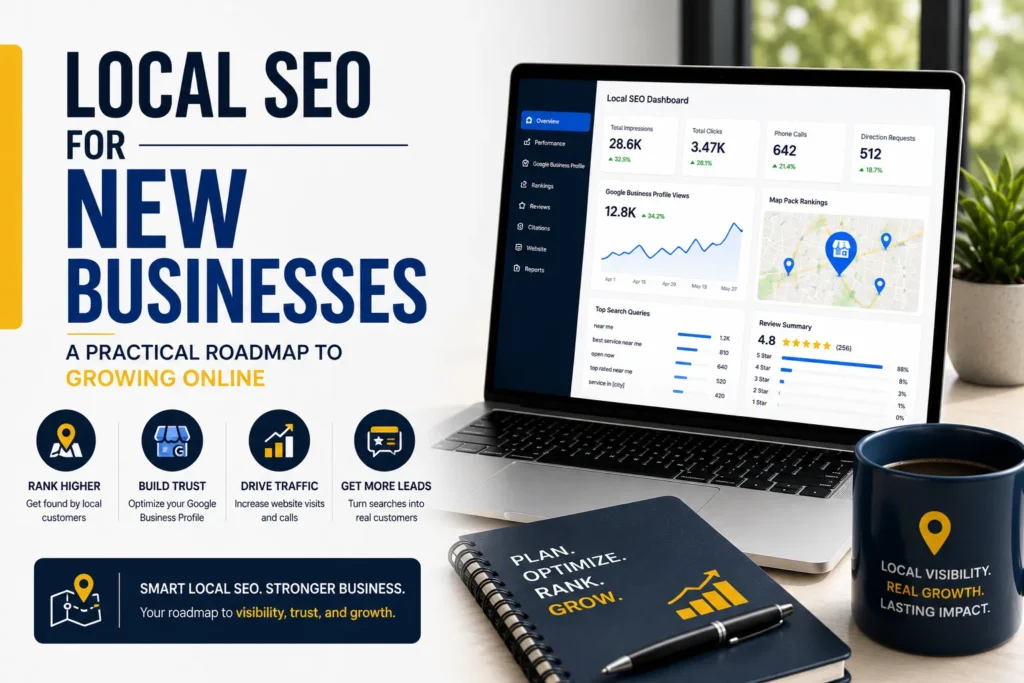
Starting a new business comes with one major challenge: getting noticed. Even if you offer excellent products or services, potential customers cannot choose your business if they cannot find it when searching online.
Established competitors often have years of customer reviews, backlinks, Google Business Profile activity, brand searches, and local authority working in their favor. A new business has to build these signals from the ground up while simultaneously generating leads and revenue.
This is where local SEO becomes essential.
Local SEO for new businesses focuses on helping newly established companies become visible when potential customers search for nearby products and services. A strong strategy can help your business appear across Google Search and Google Maps while gradually building the authority and trust required to compete with established local brands.
Successful new business local SEO combines Google Business Profile optimization, a well-structured website, accurate business listings, customer reviews, location-focused content, technical SEO, local backlinks, conversion optimization, and AI search visibility.
This guide explains how new businesses can build a strong local search foundation, attract their first customers, establish online credibility, and create sustainable organic growth.
Why Local SEO Matters for a New Business
New businesses typically begin with limited online visibility. Google may have little information about your company, customers may not recognize your brand, and your website may have little or no established authority.
Local SEO helps close this gap by creating clear signals about:
- Who your business is
- What products or services you provide
- Where your business operates
- Which communities you serve
- Why customers should trust you
- How people can contact your business
Consistently building these signals helps search engines understand your company and connect it with relevant local searches.
For new businesses, SEO should not be treated as a quick ranking tactic. The goal is to build a digital foundation that becomes stronger as your business earns reviews, backlinks, mentions, customer engagement, and brand recognition.
How Customers Discover New Local Businesses
Customers rarely search specifically for a newly established company they have never heard of. Instead, they search for the product, service, or solution they need.
Common searches include:
- [Service] near me
- Best [service] near me
- Local [service]
- [Service] in [city]
- [Product] near me
- Affordable [service]
- Emergency [service]
- [Service] company
- Local business for [service]
Your website and Google Business Profile should clearly connect your business with these relevant services and locations.
As your brand becomes more established, branded searches may also increase as customers discover your business through recommendations, social media, reviews, advertising, and word of mouth.
Start With a Clear Local SEO Strategy
New businesses should avoid trying to rank for hundreds of keywords immediately. Start by establishing relevance for your most important services and geographic market.
Identify:
- Your primary service or product
- Your highest-value services
- Your primary city or location
- Nearby areas you genuinely serve
- Your ideal customers
- Your strongest competitive advantages
- The actions you want website visitors to take
This creates a focused SEO foundation. You can expand into additional services, locations, and informational topics as your authority grows.
Google Business Profile Best Practices for New Businesses
Google Business Profile should be one of the priorities for any eligible new local business. It can help your company appear in Google Search and Google Maps when customers search for nearby services.
Your profile should accurately represent your real-world business and remain consistent with the information published on your website and other online platforms.
Choose the Right Business Categories
Select the primary category that most accurately represents your core business.
Add secondary categories only when they genuinely describe additional products or services you provide.
Choosing irrelevant categories simply to target more searches can create confusion and does not build meaningful relevance.
Add Complete Business Information
Provide accurate information for every applicable profile field, including:
- Business name
- Address where applicable
- Phone number
- Website
- Business hours
- Service areas where applicable
- Business description
- Products or services
- Appointment or booking links
Customers should be able to understand what your business offers and how to contact you without having to search elsewhere.
Upload Authentic Business Photos
A new business may not have years of brand recognition, so authentic photography can help establish credibility.
Upload relevant photos of:
- Business exterior
- Business interior
- Team members
- Products
- Equipment
- Completed work
- Office or storefront
- Customer-facing areas
Use real, professional-quality images whenever possible.
Add Your Core Products or Services
Clearly list the products or services your business actually provides.
Use accurate descriptions that help potential customers understand what they can expect. Avoid stuffing descriptions with repetitive keywords.
Configure Your Service Areas Correctly
If you operate as a service-area business, add the locations you genuinely serve.
Your website should reinforce this geographic relevance through naturally written service and location content.
Avoid claiming distant cities simply to increase your potential ranking area.
Publish Helpful Google Posts
Keep your profile active with relevant updates such as:
- New services
- Business announcements
- Helpful tips
- Educational resources
- Completed projects
- Seasonal updates
- Community involvement
- Special events
Google Posts can also give prospective customers additional reasons to engage with your business.
Maintain Consistent Business Information
Your business name, address where applicable, phone number, website, and hours should remain consistent across your website, Google Business Profile, social profiles, directories, and local citations.
For a new company, establishing accurate information from the beginning is much easier than correcting inconsistent listings later.
Complete Every Available Profile Section
Fill out every relevant section available for your business category.
A complete profile gives Google and potential customers more accurate information about your business while improving the overall user experience.
Use Gemini to Improve Google Business Profile Management
Gemini can help eligible businesses streamline parts of their Google Business Profile workflow, such as brainstorming Google Post topics, drafting review responses, improving service descriptions, and organizing profile information.
AI-generated suggestions should always be reviewed for accuracy before publishing. The priority is maintaining a complete, useful, and accurate profile rather than simply producing more content.
Google Business Profile Verification Challenges for New Businesses
Established businesses rarely think about GBP verification because theirs happened years ago. A brand-new business often hits a wall here first, and this guide jumps straight into optimization without addressing that some new listings simply don’t verify quickly or smoothly, which can delay getting found and trusted.
Expect Longer or More Complex Verification
New businesses sometimes face postcard verification delays, video verification requests, or additional scrutiny compared to established listings, particularly for service-area businesses without a public-facing storefront. Google flags many new profiles for extra review specifically because fraudulent listings are common. Don’t panic if verification takes longer than expected, and check your Business Profile dashboard regularly to keep moving toward a verified listing.
Prepare Documentation Before You Start
Have your business license, utility bill, or other proof of address ready before beginning verification, since incomplete documentation is one of the most common reasons new listings stall. If verification is repeatedly rejected, Google’s support team can escalate the case manually, but this only happens if you request it directly rather than resubmitting the same information repeatedly. Act quickly to avoid further delays.
Building Momentum in Your First 90 Days
“Start collecting reviews early” is good advice. Still, it skips the actual bootstrap problem: a business with zero reviews, zero photos, and zero search history looks meaningfully different to both customers and Google than one with even ten genuine reviews. The first 90 days need a deliberate plan, not just a general reminder to ask for feedback, because that early proof can shape how quickly trust builds.
Personally Ask Your First Ten Customers
Don’t rely on passive review requests for your earliest customers. A direct, personal ask, in person or a genuine follow-up message, converts far better than an automated email when you have no reputation yet to lend the request credibility. These first reviews matter disproportionately because they’re what every subsequent visitor sees when your listing has nothing else to show, making them the fastest way to strengthen your credibility.
Use the “New Business” Signal to Your Advantage
A newly verified Google Business Profile carries a “New” indicator in some categories, which can actually work in your favor since some customers specifically seek out and want to support new local businesses. Lean into this in your Google Posts and homepage messaging rather than trying to appear more established than you are. Authenticity about being new, paired with genuine early proof points, builds more trust than an empty About page that tries to sound experienced and helps you turn that newness into an asset.
Website Structure for New Businesses
Your website is one of the strongest foundations of your new business SEO strategy. A new company may not have established brand recognition, hundreds of reviews, or years of backlinks, so the website must clearly communicate what you offer, where you operate, and why customers should trust you.
A well-structured website also helps Google understand your services, products, location, and expertise, giving your new business a stronger foundation for competing in local search results.
Build a High-Converting Homepage
Your homepage should immediately explain what your business does, who you help, where you operate, and what makes your company different.
Include:
- Clear description of your business
- Primary products or services
- Main service area or location
- Click-to-call phone number
- Contact or inquiry forms
- Customer reviews as you earn them
- Certifications or credentials where applicable
- Clear calls to action
Visitors should understand your business within seconds of arriving on your website.
Create Dedicated Service Pages
Avoid placing every service on a single general services page. Create dedicated pages for your most important products or services.
Each service page should include:
- Clear service description
- Customer problems you solve
- How your service works
- Key benefits
- Frequently asked questions
- Relevant internal links
- Contact or booking options
- Clear calls to action
Dedicated pages help Google understand individual services while allowing you to target more specific, high-intent searches.
Create Local Service Area Pages
If your business genuinely serves multiple cities or communities, create unique location pages for your most important markets.
Each location page can include:
- Services available in the area
- Local customer needs
- Relevant neighborhood information
- Local project examples where available
- Customer testimonials as you earn them
- Nearby communities served
Avoid creating dozens of nearly identical city pages. Every location page should provide genuine local value.
Support Multi-Location Growth
If your new business operates from multiple legitimate locations, create a dedicated page for each branch.
Include:
- Business address
- Phone number
- Business hours
- Products or services available
- Team information where appropriate
- Directions
- Local reviews
- Contact information
Each eligible location should also have an accurate Google Business Profile that follows Google’s guidelines.
Create a Strong About Page
Trust is particularly important for a new business.
Your About page should introduce:
- Your company
- Founders or leadership
- Team members where appropriate
- Professional experience
- Qualifications
- Certifications
- Company values
- Your reason for starting the business
Real information about the people behind your company helps customers feel more confident about choosing an unfamiliar brand.
Build Proof as Your Business Grows
A new business may not have an extensive portfolio or hundreds of testimonials at launch. Build these trust signals naturally as you gain customers.
Depending on your industry, showcase:
- Completed projects
- Case studies
- Customer testimonials
- Before and after examples
- Client results
- Professional certifications
- Awards and recognition
Never fabricate reviews, experience, projects, or business history. Authentic proof becomes increasingly valuable as your company grows.
Expand Your Resource Center
Educational content can help a new business establish expertise even before it develops significant brand authority.
Publish helpful resources covering:
- Customer questions
- Buying guides
- Service comparisons
- Cost considerations
- Industry advice
- Maintenance tips
- Common mistakes
- Step-by-step guides
- Frequently asked questions
Focus on topics directly connected to your products, services, and customer needs.
Improve Lead Generation
Every important page should provide a clear next step.
Depending on your business model, include:
- Contact forms
- Click-to-call buttons
- Online booking
- Appointment scheduling
- Quote requests
- Free consultations
- Product inquiries
- Email contact options
Make these conversion points easy to find, particularly for mobile visitors.
Reviews and Reputation for New Businesses
One of the biggest challenges for a new business is building trust without an established reputation. Reviews can help potential customers feel more confident while also supporting your overall local search presence.
Your goal should be to build a steady, authentic review profile based on real customer reviews.
Start Collecting Reviews Early
Once you begin serving customers, create a simple process for requesting honest feedback.
Review requests can be shared through:
- Follow-up emails
- SMS messages
- Thank-you messages
- Receipts
- QR codes
- Customer satisfaction surveys
Ask consistently without pressuring customers or attempting to influence what they write.
Respond to Every Customer Review
Respond professionally to both positive and negative feedback.
Thank customers for positive reviews and address negative experiences constructively. Your responses are visible to future customers and can demonstrate how your business handles customer relationships.
Focus on Relevant Review Platforms
Google should typically be a priority for eligible local businesses because reviews are visible directly in Google Search and Google Maps.
Depending on your industry, you may also need profiles on relevant:
- Industry directories
- Professional platforms
- Local business directories
- Marketplace platforms
- Trusted review websites
Focus on platforms your actual customers use rather than creating profiles everywhere.
Build Consistent Review Growth
A new business does not need hundreds of reviews immediately.
A steady stream of authentic customer feedback builds a more sustainable reputation and provides valuable insights into what customers appreciate about your business.
Comprehensive Local SEO Checklist for New Businesses
A successful local SEO strategy for new businesses requires building the fundamentals correctly before expanding aggressively. Start with accurate business information, strong service pages, technical SEO, reviews, and local authority.
Target High-Intent Local Keywords
Focus first on keywords directly connected to your products or services and your geographic market.
Examples include:
- [Service] near me
- [Service] in [city]
- Local [service]
- [Product] near me
- [Service] company
- Best [service] in [city]
Naturally incorporate relevant terms throughout your homepage, service pages, location pages, Google Business Profile, FAQs, and educational content.
Optimize Every Important Page
Each important page should have a clear purpose.
Include:
- Unique title tag
- Optimized meta description
- One clear H1
- Logical H2 and H3 headings
- Helpful original content
- Relevant internal links
- Clear calls to action
Avoid creating pages solely to target keyword variations without additional value.
Publish Helpful Content Consistently
New businesses can use content to build topical authority gradually.
Useful content might include:
- Beginner guides
- Customer FAQs
- Service explanations
- Product comparisons
- Pricing factors
- Industry advice
- Local guides
- Common mistakes
- How-to resources
Quality matters more than publishing frequency. A smaller collection of genuinely useful resources is more valuable than hundreds of thin articles.
Strengthen Google Maps Visibility
For eligible local businesses, Google Maps can be an important channel for customer acquisition.
Keep your Google Business Profile accurate and useful by:
- Updating business information
- Adding authentic photos
- Publishing relevant updates
- Listing accurate products or services
- Collecting genuine customer reviews
- Responding to customer feedback
- Monitoring profile performance
Local visibility usually develops gradually as Google gains more information and trust signals about a new business.
Build Accurate Local Citations
Create accurate listings on relevant directories and business platforms.
Prioritize:
- Major business directories
- Industry-specific directories
- Local chambers of commerce
- Professional associations
- Trusted local platforms
- Relevant community organizations
Keep your core business information consistent across these sources.
Earn High-Quality Local Backlinks
Backlinks can help a new website establish authority, but quality and relevance matter more than volume.
Look for opportunities through:
- Local business partnerships
- Suppliers
- Professional associations
- Chambers of commerce
- Community organizations
- Local publications
- Industry websites
- Sponsorships
- Original research or useful resources
Avoid building large numbers of low-quality links simply to increase backlink counts.
Build Community Authority
Offline relationships can support online visibility.
Participate in relevant:
- Community events
- Local business groups
- Charity initiatives
- Professional associations
- Networking events
- Educational workshops
- Local sponsorships
These activities can generate referrals, brand searches, local mentions, and valuable relationships.
Implement Structured Data
Use structured data appropriate to your business, which may include:
- LocalBusiness
- Organization
- Service
- Product
- FAQ where eligible and appropriate
- Breadcrumb
- Website schema
Choose the most specific schema types that accurately describe your business and content.
Strengthen Entity Optimization
Clearly connect your business with its products, services, location, founders, team members, industry expertise, and other relevant entities throughout your website.
Keep these details consistent across your website and trusted third-party profiles.
Strong entity signals help Google and AI-powered platforms such as ChatGPT, Gemini, Claude, and Perplexity better understand who your business is, what it offers, and where it operates.
AI Search Optimization for New Businesses
AI-powered search is creating new opportunities for recently launched businesses to build visibility beyond traditional Google rankings. Platforms such as Google AI Overviews, ChatGPT, Gemini, Claude, and Perplexity help users research companies, compare services, and find answers before making purchasing decisions.
For a new business, the biggest challenge is establishing enough clear and trustworthy information for search engines and AI systems to understand who you are, what you offer, and where you operate.
New businesses with accurate Google Business Profiles, detailed service pages, consistent business information, helpful educational content, authentic customer reviews, and strong entity signals can gradually improve their visibility across both traditional and AI-powered search experiences.
Improve Visibility Across AI Search
Create content that clearly answers questions related to your products, services, industry, and customer needs. Your website should provide accurate information about your business, expertise, service areas, processes, pricing factors where appropriate, and frequently asked questions.
Avoid publishing generic AI-generated content that simply repeats information already available across hundreds of competing websites. Original insights, first-hand experience, real examples, and genuinely useful information give both users and AI systems stronger reasons to trust your business.
AI SEO Checklist for New Businesses
| AI SEO Element | Best Practice |
| Entity Optimization | Clearly define your business, products, services, location, founders, expertise, and relevant relationships. |
| Structured Content | Use descriptive headings and answer common customer questions directly. |
| Schema Markup | Implement Organization, LocalBusiness, Service, Product, Breadcrumb, Website, and other relevant structured data. |
| Google Business Profile | Keep all applicable profile information complete, accurate, and up to date. |
| Reviews | Build authentic customer reviews gradually and respond professionally. |
| Content Quality | Publish original, useful resources based on genuine customer needs and industry expertise. |
| Internal Linking | Connect service pages, location pages, blogs, FAQs, case studies, and contact pages naturally. |
| Brand Consistency | Maintain consistent business information across your website and trusted third-party platforms. |
Measure AI Search Visibility
Don’t rely solely on keyword rankings. As your new business grows, monitor branded searches, organic traffic, referral traffic, phone calls, inquiries, bookings, sales, Google Search Console performance, and Google Business Profile interactions.
These metrics provide a clearer picture of whether your overall search visibility is contributing to actual business growth.
Technical SEO Checklist for New Businesses
Technical SEO should be established correctly from the beginning. Fixing major website architecture, indexing, and URL problems becomes more difficult after a website grows to hundreds or thousands of pages.
| Technical SEO Element | What to Check |
| Crawlability | Ensure Google can access all important pages. |
| Indexing Status | Monitor indexed, excluded, duplicate, discovered, and crawled pages in Google Search Console. |
| XML Sitemap | Include valuable indexable pages while excluding unnecessary URLs. |
| Robots.txt | Confirm important pages and resources remain crawlable. |
| Index Bloat | Prevent unnecessary tag, filter, archive, search, and duplicate pages from creating index bloat. |
| Orphan Pages | Ensure every important page receives relevant internal links. |
| Crawl Depth | Keep important pages within a few clicks of the homepage. |
| URL Structure | Use clean, descriptive, and consistent URLs from the beginning. |
| Website Architecture | Organize services, products, locations, resources, and contact pages logically. |
| Internal Linking | Connect related pages naturally to improve discovery and topical relationships. |
| Breadcrumbs | Improve navigation and website hierarchy. |
| Title Tags | Create unique, descriptive titles for every important page. |
| Meta Descriptions | Write compelling descriptions that accurately represent each page. |
| Heading Structure | Maintain one clear H1 followed by logical H2 and H3 headings. |
| Duplicate Content | Avoid creating multiple pages targeting nearly identical topics. |
| Canonical Tags | Ensure duplicate or similar URLs reference the preferred version correctly. |
| Thin Pages | Avoid publishing pages with little original or useful information. |
| Site Speed | Optimize loading performance across desktop and mobile devices. |
| Core Web Vitals | Monitor LCP, INP, and CLS performance. |
| Mobile Experience | Ensure customers can easily browse your business and contact you from mobile devices. |
| Contact Forms | Regularly test forms, booking systems, and inquiry functionality. |
| Accessibility | Improve navigation, readability, forms, buttons, and image alt text. |
| Image Optimization | Compress images and use descriptive filenames and appropriate alt text. |
| Schema Markup | Validate structured data and ensure it accurately represents visible page content. |
| NAP Consistency | Keep core business information consistent across relevant online platforms. |
| Service Coverage | Create dedicated pages for your most important services. |
| Location Pages | Build unique pages only for locations you genuinely serve. |
| Broken Links | Regularly identify and repair broken internal and external links. |
| Redirects | Avoid unnecessary redirect chains and correctly redirect removed URLs. |
| HTTPS | Secure the entire website using HTTPS. |
| Security | Monitor for malware, spam, hacked pages, and unauthorized content. |
| GA4 | Configure analytics correctly from the beginning. |
| Google Search Console | Verify your website and monitor indexing, search performance, and technical issues. |
| Conversion Tracking | Track phone calls, forms, bookings, purchases, quote requests, and other meaningful actions. |
| GBP Tracking | Monitor website visits, calls, directions, bookings, and other Google Business Profile interactions where available. |
Local SEO Mistakes New Businesses Should Avoid
New businesses sometimes rush their SEO strategy because they want immediate rankings. This can lead to shortcuts that create long-term problems.
Avoid these common mistakes:
- Expecting top rankings immediately after launching a website.
- Creating dozens of low-quality location pages.
- Targeting every possible keyword instead of focusing on core services.
- Stuffing keywords into website content and Google Business Profile information.
- Creating inaccurate or inconsistent business listings.
- Buying large quantities of low-quality backlinks.
- Publishing generic content without demonstrating genuine expertise.
- Creating fake customer reviews.
- Ignoring technical SEO and indexing issues.
- Neglecting mobile user experience.
- Building multiple pages that target almost identical keywords.
- Measuring SEO success only through rankings instead of leads, customers, and revenue.
Building authority gradually creates a stronger foundation than attempting to manipulate rankings with aggressive shortcuts.
How LocalMighty Helps New Businesses Build Local Visibility
Starting SEO from the beginning allows a new business to build its online presence correctly instead of repairing years of technical problems, inconsistent listings, and weak website architecture later.
LocalMighty helps new businesses establish a strong digital foundation through Google Business Profile optimization, local SEO, service and location page strategy, technical SEO, citation building, reputation management, content development, entity optimization, AI search visibility, and conversion optimization. The goal is to help new businesses become easier to discover across Google Search, Google Maps, and modern AI search platforms while building the authority needed for sustainable long-term growth.
Recover Rankings and Leads After a Google Update
A new website may experience significant ranking fluctuations as Google discovers pages, evaluates content, and develops a better understanding of the business.
Not every ranking decline means an algorithm update has penalized your website.
If organic visibility declines:
- Review Google Search Console for indexing or crawling problems.
- Check whether important pages remain indexed.
- Compare performance across different services and queries.
- Review recent website changes.
- Audit technical SEO before rewriting large amounts of content.
- Improve thin or outdated pages.
- Strengthen internal linking.
- Continue building authentic reviews and local authority.
- Keep your Google Business Profile accurate and up to date.
- Monitor performance before making major reactive changes.
New businesses should focus on long-term trends rather than daily ranking movements. Building sustainable organic visibility takes time, particularly in competitive local markets.
Closing Notes
Successful new business SEO starts with getting the fundamentals right. Your website, Google Business Profile, service pages, local citations, customer reviews, technical SEO, content, backlinks, and business information should work together to help search engines and potential customers understand and trust your company.
You do not need to compete for every keyword immediately. Start with your core services and primary market, establish a strong local presence, earn genuine customer reviews, publish genuinely helpful content, and expand your SEO strategy as your authority grows.
As discovery continues evolving across Google Search, Google Maps, AI Overviews, ChatGPT, Gemini, Claude, Perplexity, and other AI-powered platforms, new businesses that invest early in accurate information, strong technical foundations, useful content, and authentic customer experiences will be better positioned to increase visibility, attract qualified customers, strengthen brand recognition, and achieve sustainable long-term growth.