
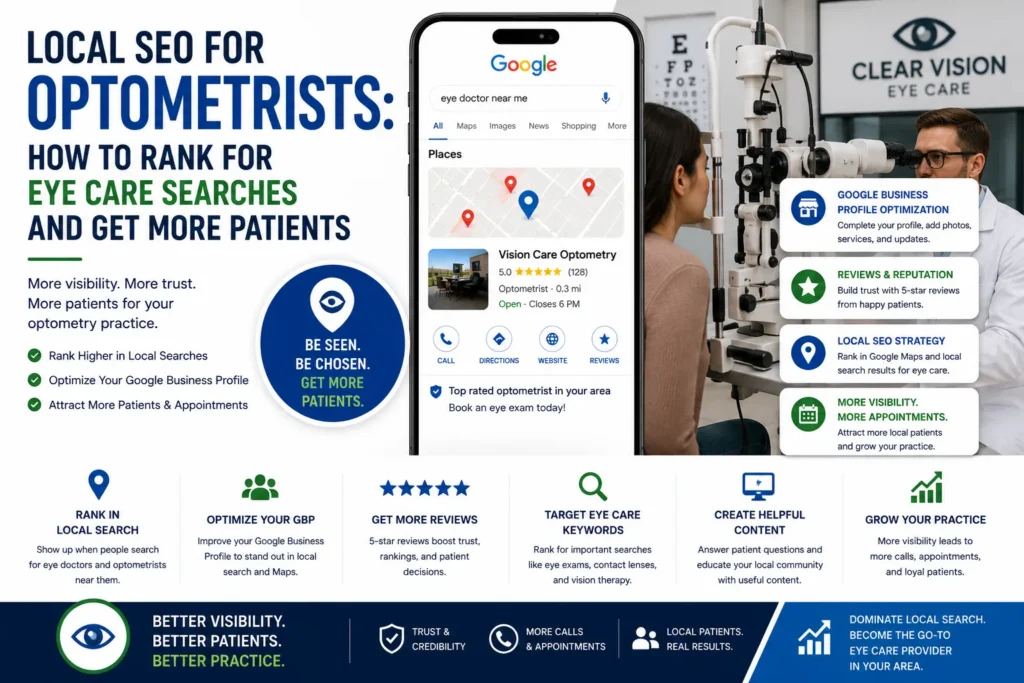
When someone needs an eye doctor, they reach for their phone, not a referral. They search for an eye doctor near me or an eye exam near me, glance at the map, scan a few star ratings, and call one of the first practices that looks close and trustworthy. That decision often takes under a minute. Your practice is either in those results or out of the running, and local SEO for optometrists determines which.
Local SEO for optometrists is the practice of making your practice show up, look credible, and convert in local and map-based eye care searches. It connects your Google Business Profile, your Google Maps presence, your website and service pages, your patient reviews, your listings across insurance and health directories, and your AI search signals into one system. Get it right, and nearby patients find you first, trust you quickly, and book without friction.
One thing most guides gloss over: ranking is only the start. A practice can sit at the top of the map and still stay quiet if the phone never rings. So everything below is built around outcomes, more calls, more booked exams, and more new patients, rather than a higher position for its own sake.
How Patients Search for an Eye Doctor Today
Most optometry searches fall into a few clear buckets, and each one signals a different level of urgency and intent. Reading the intent correctly is what lets you show up the right way for each searcher.
Routine and planned searches are initiated by people who know they need an exam. They type eye exam near me, optometrist in [city], or eye doctor accepting new patients. These patients are comparing, so reviews, location, and insurance clarity usually decide who wins.
Urgent and medical searches carry real pressure. Someone searching for a pink eye doctor near me, foreign object in eye, sudden vision changes, or an emergency eye doctor open now wants help fast. They call the first credible practice that looks open and closed. Speed and clarity beat everything else here.
Service-specific searches show a patient who already knows what they need, such as contact lens fitting near me, dry eye treatment [city], kids’ eye exam, or scleral lens specialist. These are some of the most valuable searches you can rank for, because intent is high and competition is often thinner than for the generic terms.
Insurance-driven searches are unique to eye care and healthcare. Patients regularly search for an optometrist who takes VSP or an eye doctor who accepts EyeMed. If your profile and site never mention the plans you take, you quietly lose these people before they reach you.
Patients Often Decide Before They Reach Your Website
Many practice owners assume the website creates the first impression. In reality, patients often decide whether to contact you directly from the search results before a single click.
Google shows trust signals right in the results: your star rating, review count, hours, photos, services, directions, and booking options. When those details are complete and accurate, a prospective patient immediately gains confidence. When they are missing or stale, that hesitation often sends the patient to a competitor whose listing answered the question first.
What Makes Optometry Local SEO Different
Optometry sits in an unusual spot. You are part healthcare provider and part retail business. One patient books a medical visit for blurry vision and headaches, while the next is shopping for designer frames. Your local SEO has to serve both without sounding confused.
A few traits set eye care apart from the way medical practices approach local search more broadly:
- You straddle vision plans and medical insurance. A diabetic eye exam may be billed through medical insurance, while a routine refraction runs through a vision plan, and patients care deeply about which you accept.
- Trust is non-negotiable. People are letting you near their eyes, so credentials, reviews, and a clean, modern presence carry more weight than in many local industries.
- Your services range from quick, transactional to clinical and recurring. Glasses today, glaucoma monitoring for years. That range deserves more than one catch-all page.
- Family decision-makers drive many bookings. A parent often books for the kids, a spouse, and an aging parent, so content that speaks to family eye care converts well.
Competing With Chains and Retail Optical
Independent practices now compete with national vision centers, retail optical chains, hospital-affiliated clinics, and multi-location groups. Those organizations often carry bigger brand recognition and larger ad budgets.
Local SEO is how an independent practice wins anyway. You compete on local relevance, genuine expertise, and patient trust rather than spending. The same playbook works whether you run a single office or several, though multiple locations bring their own structural challenges, much like those dental practices face as they add new sites.
How Google Decides Which Eye Care Practices Rank Locally
Google does not rank a practice simply because it has a website or a few good reviews. It blends signals from your site, your business profile, third-party directories, and patient behavior to decide who deserves visibility. Three forces sit at the center.
Relevance
Relevance measures how closely your practice matches a search. If someone searches for dry eye treatment, Google wants to show practices that clearly offer it. The common mistake is dumping every service onto one page, which blurs your expertise. Dedicated pages for each major service give Google far stronger context, the same principle that helps physical therapy clinics get found for specific treatments rather than one broad term.
Distance
Distance remains one of the strongest local ranking factors. Google weighs how close you are to the searcher or to the location in their query. You cannot move your building, but you can strengthen geographic relevance with accurate business information, location-aware service pages, local citations, and reviews from nearby patients.
Prominence
Prominence reflects how known and trusted your practice is. Review quality and quantity, fresh review activity, citations, brand mentions, local coverage, and overall site authority all feed it. This is where steady effort compounds, and it is often what separates two practices that sit the same distance from a searcher.
Your Optometrist Google Business Profile, the Front Door
For most practices, the Optometrist Google Business Profile is the single most important asset in local search. It fills the map, the local pack, and the knowledge panel, and many patients form their entire first impression here before they ever reach your site. For many practices, it generates more calls than the website does.
Get the fundamentals exactly right, then keep the profile active. Working through a full Google Business Profile optimization routine is worth the time because every complete field gives Google more confidence about who you are.
Set your primary category as Optometrist. Add accurate secondary categories such as Eye care center, Contact lenses supplier, or Optician only where they truly apply. The primary category strongly shapes which searches you appear for, so do not leave it generic.
Keep your name, address, and phone number identical everywhere, often called NAP consistency. Mismatched details across your site, profile, and directories erode both trust and rankings.
Fill every meaningful field: hours, including how you handle urgent visits, services listed individually rather than lumped together, a clear human description that names your specialties and area, accepted insurance where the field allows, and accurate attributes like wheelchair access and new patients welcome.
Then make the profile feel alive. Add real photos of your office, equipment, optical area, and team. Post regularly about services and seasonal reminders, such as back-to-school eye exams. Answer the Q and A section before random users do. Respond to every review. These are the same habits that drive Google Business Profile ranking factors for any local business, applied to eye care.
Google Maps SEO for Optometrists
Ranking in the map results is often the difference between a full calendar and patients lost to a nearby competitor. Many people never scroll past the local pack. They compare ratings, reviews, hours, and proximity, then contact one of the first practices they see. Strong Google Maps SEO for optometrists improves your odds of landing in that visible cluster.
Maps rankings lean heavily on local trust and engagement, so the levers differ slightly from those in standard organic work. If you want the deeper mechanics, this breakdown of how local businesses rank in Google Maps covers the underlying signals, and there is a separate playbook for earning a spot in the local three pack.
To strengthen Maps’ visibility:
- Keep a steady flow of new reviews rather than one big burst
- Use natural language across your profile and site
- Earn accurate listings and mentions on reputable health and local directories
- Embed a Google Map on your contact page and keep your address consistent
- Build genuine local relevance through community involvement and local content
If you serve several cities or neighborhoods, resist stuffing them into your business name. That violates Google’s guidelines and risks suspension. Build real relevance for each area instead, supported by a genuine presence and matching content.
Build an Eye Care Website That Turns Visitors Into Patients
A surprising number of optometry sites still rely on a single Services page that lists everything in a single paragraph. It looks tidy, but it tells Google almost nothing and gives patients little reason to trust your depth in any one area. Strong Optometrist SEO depends on a website where every important service is easy to find, understand, and book.
Create Dedicated Service Pages
Each primary service deserves its own page with unique, patient-focused content. A dedicated page can explain who the service is for, what to expect during the visit, common symptoms, how insurance usually applies, and the next step to book. Consider pages for:
- Comprehensive eye exams
- Contact lens exams and fittings
- Children’s and pediatric eye exams
- Dry eye evaluation and treatment
- Diabetic eye exams
- Glaucoma testing and monitoring
- Myopia management for kids
- Emergency and urgent eye care
- Eyewear and optical, including designer frames
- Specialty contact lenses, such as scleral or keratoconus fittings
- LASIK consultation and care before and after surgery
Each page should open by answering the searcher’s core question, then expand into detail only a real practitioner would know, like what a dry eye workup actually involves or why a contact lens fitting is billed separately from a standard exam. That practical depth is what makes a page feel expert instead of generic.
Build Location Pages Only When They Add Value
If your practice genuinely serves several nearby communities, location pages can extend your reach. But each one must offer something real: directions, parking, nearby landmarks, the services most requested in that area, and location-specific questions. Avoid spinning up dozens of near-identical pages that only swap a city name. Thin location content rarely ranks and can drag down the site’s overall quality.
Make Booking Effortless and Link Pages Together
Even a top-ranked site leaks patients when booking is clumsy. Every important page should make the next step obvious with a click-to-call number, easy online scheduling, clear hours, insurance details, and new-patient information. Match the path to the urgency behind the search. Someone with a painful red eye does not want a form promising a reply in two business days. They want a number they can tap.
Internal links tie the site together and guide patients deeper. Your comprehensive eye exam page can naturally point readers to contact lens fittings, pediatric care, and dry eye treatment, while blog articles route them to the most relevant service page. Done well, this is also how you turn local visibility into booked appointments rather than passive traffic.
Build Trust Across Every Page
Patients compare several providers before choosing one, and each is silently asking why they should trust you. Answer it with provider biographies, credentials, years of experience, modern diagnostic technology, real office photography, accepted insurance, and patient testimonials. These signals lift both conversion and visibility.
Reviews and Reputation for Eye Care Practices
In eye care, reviews are part of the decision, not an extra. A patient choosing who gets near their eyes reads what others experienced first, and Google treats consistent positive feedback as a signal of prominence.
Google reviews carry the most weight, though reputation also lives on Healthgrades, Yelp, and Vitals, depending on your market. The aim is a steady, recent, authentic stream, not an old pile collected years ago. Because review activity feeds rankings, it pays to understand how reviews and ratings influence local visibility before you build your system.
Build a simple, repeatable routine:
- Ask every satisfied patient at the right moment, usually right after a positive visit or a successful eyewear pickup
- Make it effortless with a short link or a QR code at the front desk, since a frictionless way to ask patients for a Google review lifts participation dramatically
- Train front desk staff to ask naturally, because they drive most reviews
- Respond to every review, thanking happy patients without copy-paste replies and addressing concerns calmly
Never buy reviews or post fake ones. Beyond the ethics, it risks your profile and damages the exact trust you are building. Handle criticism with composure and a genuine offer to make things right, since a thoughtful response often reassures future patients more than a wall of perfect ratings.
Content That Brings in More Eye Care Patients
Many practices publish a few posts, see little traffic, and give up. The problem is usually strategy, not effort. Broad articles like eye health tips rarely attract people ready to book. Content that answers the questions patients ask before choosing a provider does.
Answer the Questions Patients Actually Search
Useful, intent-matched topics introduce your expertise while guiding readers toward your services:
- How often should adults get an eye exam?
- What are the early signs of glaucoma?
- When should children have their first eye exam?
- Can diabetes affect eyesight?
- What causes dry eyes?
- What happens during a comprehensive eye exam?
Answer the question clearly first, then explain how professional care helps.
Build Topic Clusters Around Core Services
Instead of posting unrelated content, organize your content around your primary services. A comprehensive eye exam page can connect to articles on how to prepare for an exam and why annual exams matter even when vision feels fine. A dry eye treatment page can link to pieces on symptoms, screen time, and when to seek professional help. This structure strengthens topical authority and helps search engines see how your pages relate.
Cover Every Stage of the Patient Journey
Not everyone is ready to book today. A balanced plan serves each stage. Awareness content introduces concerns such as digital eye strain and signs that you need an eye exam. Consideration content compares options, such as glasses versus contacts or optometrist versus ophthalmologist. Decision content supports booking, like what to expect at a first visit, and which insurance you accept. Cover all three, and your site becomes a resource rather than a brochure.
Insurance Directories and Citations Optometrists Need
Citations are mentions of your practice across the web, ideally with consistent name, address, and phone details. For optometrists, the most valuable ones are often unique to eye care and healthcare. If you want the broader logic, here is a primer on how local citations build trust and consistency.
Make sure your practice appears accurately in:
- Vision plan provider directories, such as VSP, EyeMed, Davis Vision, Spectera, and Superior Vision, listing every location and provider
- Medical insurance directories for the plans you accept on the medical side
- Health-focused directories like Healthgrades and Vitals
- Core local platforms, including Google, Apple Maps, Bing Places, and Yelp
- Local chamber of commerce and reputable community listings
Insurance directories deserve special attention because patients search inside them. If a patient filters their vision plan’s find-a-doctor tool and your listing is missing or incorrect, you lose a ready-to-book patient who never even opened Google. The non-negotiable rule across all of these is consistency: one address format, one phone number, one practice name. Quality also beats volume. A handful of accurate listings on trusted sources outperforms hundreds of low-quality submissions.
Technical SEO That Supports Long-Term Growth
Strong technical foundations help search engines crawl and understand your site while delivering faster, smoother visits for patients. Patients rarely notice the work directly, but they feel it.
Prioritize Mobile and Page Experience
Most local eye care searches happen on phones, often while someone is at work or just got a recommendation. Your site should load quickly, display cleanly on small screens, keep navigation simple, and make phone numbers tappable. Google also weighs page experience through Core Web Vitals, so focus on fast loading, stable layouts, and responsive interactions. Compressing images, trimming unnecessary scripts, and improving hosting all help, and these mobile optimization fundamentals apply directly to eye care sites.
Implement Structured Data
Schema markup helps search engines and AI systems understand your practice with more confidence. Useful types for optometry include Local Business, Medical Business, Physician (where appropriate), FAQ, Breadcrumb, Review, and Service. It does not guarantee rankings, but it improves clarity, and this guide to adding local business schema markup walks through the setup.
Optimize Images and Site Structure
Eye care sites rely on visuals, so compress large images without sacrificing quality, use descriptive file names, and write meaningful alt text. Keep navigation logical so patients can reach any service in a few clicks, with a clear path through home, about, services, insurance, and locations, where relevant, and contact.
Getting Found in AI Search and Google AI Overviews
A growing share of patients get answers from AI-driven experiences before they click anything. Google AI Overviews summarize at the top of search results, and tools like ChatGPT, Gemini, Perplexity, and Claude answer questions such as who is a good optometrist for dry eye in [city] or whether I need a special exam if I have diabetes. To be recommended, your practice has to be understandable and citable. The habits that make content easy for a busy patient to skim are the same ones that make it easy for an AI system to summarize, which this overview of optimizing for AI-driven search expands on.
What helps you surface in these experiences:
- Clear, direct answers near the top of each page, before the longer explanation
- Consistent business information so systems can confidently identify who and where you are
- Well-structured content with descriptive headings and plain language
- Service pages that explain what you do in specific, factual terms
- Structured data that labels your practice, services, location, and hours
- An FAQ section that answers the real questions patients ask
Strong entity signals matter most here. Make it unmistakable who you are, what you do, where you practice, which communities you serve, and what makes you trustworthy. This is also where experience and trust signals, often called E E A T, carry real weight, since healthcare content is held to a high standard.
Tracking Results That Actually Matter
Rankings feel good, but they are a means, not the goal. The metrics that prove local SEO is working are tied to patients and revenue. Watch the numbers that reflect real demand:
- Calls from your Google Business Profile and website
- Online bookings and appointment requests
- Direction requests and profile views in your profile insights
- New patient volume month over month
- Which services and pages drive the most contacts
- Review count, rating, and recency over time
Use call tracking and your booking system to connect search activity to actual appointments. Keyword positions are worth monitoring as a secondary signal, but a practice that ranks third and books steadily is healthier than one that ranks first and converts poorly. Measure toward booked exams, not applause.
Local SEO Mistakes Optometrists Should Avoid
A handful of recurring mistakes hold eye care practices back, and most are quick to fix.
- Treating the Google Business Profile as set and forget instead of an active channel
- Choosing a vague primary category rather than Optometrist
- Cramming every service onto one page instead of building dedicated pages
- Marketing only glasses and optical products while ignoring medical eye care content
- Letting name, address, and phone details drift across insurance and health directories
- Having no system for collecting fresh reviews
- Publishing thin location pages that only swap a city name
- Hiding the phone number, booking link, or accepted insurance details
- Running a slow site that frustrates mobile patients before they convert
Order matters when you fix these. Before chasing more traffic, make your service pages and booking experience solid. Before scaling location pages, make sure each can stand on its own. Before adding more content, get your profile and listings accurate. Fixing the foundation first protects every dollar you later spend on growth.
How LocalMighty Helps Eye Care Practices Grow
Everything in this guide is doable in-house, but it takes steady time; most practice owners do not have time between patient schedules. LocalMighty runs this work as a proven SEO for healthcare systems tailored to optometry and eye care practices, with a focus on booked eye exams and long-term patient growth rather than vanity rankings.
For an eye care practice, the work usually covers:
- Optimizing your Optometrist Google Business Profile with the right categories, complete services, and an active posting and review response routine
- Building Google Maps visibility in the specific neighborhoods and cities you serve
- Structuring your website around real eye care searches, with dedicated pages for exams, contact lenses, pediatric care, dry eye, diabetic exams, and emergency visits
- Setting up a steady review system so patient feedback keeps arriving rather than coming in occasional bursts
- Correcting and maintaining listings across vision plan directories, health directories, and core local platforms so VSP, EyeMed, and similar searches find you
- Optimizing for AI search so your practice surfaces in AI Overviews, ChatGPT, Gemini, and Perplexity when patients ask for a nearby eye doctor
- Tightening the path from search to booking with click to call, simple scheduling, and clear insurance information
- Tracking calls, bookings, and new patient volume so you can see the work turn into revenue
The aim is straightforward. Turn local search into a fuller schedule, a steadier flow of new patients, and a practice that stays the trusted local choice as competition grows.
The Real Goal of Optometry Local SEO
Ranking a page is not the finish line. The finish line is being the practice a patient chooses the moment they are ready to book an exam, calm a worried parent, or finally fix the blurry vision they have ignored for months.
Everything here points to that outcome. A complete profile, a strong Maps presence, service pages that answer real questions, genuine reviews, helpful content, accurate listings, and a booking experience that respects the urgency behind the search. The practices that win lasting visibility are rarely the ones spending the most. They are the ones who consistently answer patient questions, show real expertise, and remove friction at every step. Get those right, and higher rankings become a byproduct of a better experience, one that turns local search into a full schedule.