
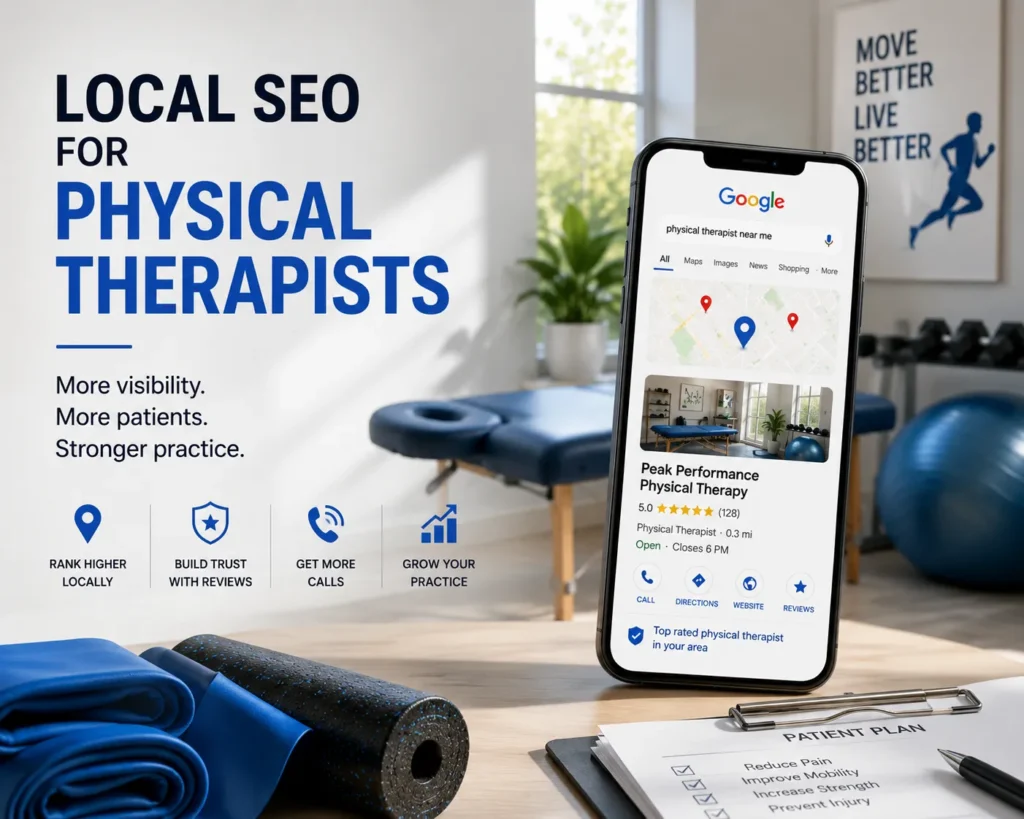
Someone wakes up with a shoulder that will not lift past their ear, or their surgeon just handed them a referral for post-operative rehab. What do they do next? They open Google, type “physical therapist near me” or “physical therapy clinic [city],” and choose from whatever shows up in the map results and the list underneath it.
That moment is where most new patient relationships with a physical therapy practice now begin. The clinic that shows up prominently, looks trustworthy, and makes it easy to take the next step has a structural advantage over every competitor the patient never sees.
Physical therapy is unusually location-bound. A patient cannot get a shoulder mobilized by a clinic three states away. They need someone within a realistic drive, with hours that fit, and enough reputation to book without a long vetting process. That constraint is exactly what local search and Google Maps are built to solve, and it is why local SEO matters disproportionately for physical therapy.
This guide treats local SEO as a system, not a ranking project:
Search visibility → Maps visibility → profile engagement → website visit, call, or direction request → appointment inquiry → new patient.
Ranking well with no reviews, blurry photos, and a wrong phone number does not produce new patients. Neither does a well-optimized profile that never shows up because your core business information is thin or inconsistent. The clinics that win consistently treat visibility and conversion as one connected problem, which is the lens this guide uses throughout.
This resource covers local SEO, Google Maps, and local patient acquisition for physical therapy practices. It does not cover paid advertising, social media, email marketing, or general digital marketing, and it does not offer clinical or treatment guidance.
What Local SEO Means for Physical Therapists
Local SEO for a physical therapy practice is the work of making your clinic easy for Google to understand, trust, and surface when someone nearby searches for physical therapy, and easy for that person to evaluate and contact once they find you. Several distinct systems get lumped together but behave differently:
- Organic Google rankings: the traditional blue-link results, based on content relevance, site authority, and technical quality.
- Google Maps rankings: built primarily around Google Business Profile (GBP) data rather than website content alone.
- The Local Pack / Local 3-Pack: the block of three listings with a map shown above or alongside organic results for local-intent searches.
- Google Business Profile visibility: how prominently your profile appears in Maps, the local finder, or your branded knowledge panel.
- “Near me” and location-based searches: queries where intent is explicitly geographic.
A clinic can rank very differently across these systems at once, because Maps and the Local Pack weight proximity and profile signals more heavily than a standard organic result does.
Underneath it all, Google matches a searcher’s location, a search query, and an index of candidate businesses using relevance (does this business match the intent), distance (how close is it), and prominence (how established and trusted does it appear). Google evaluates all of this relative to your local competition.
What makes this different for a physical therapy practice compared with a business that can serve customers remotely is that a physical therapist cannot treat a patient outside a realistic service radius. Google treats proximity as a first-class input for location-bound service businesses in a way it does not for purely online ones. That is why the accuracy of your address, the honesty of your service area, and the completeness of your Business Profile are not secondary details here: they are the foundation.
How Patients Search for Physical Therapists on Google
The patient search journey typically moves from broad discovery toward a specific, high-intent decision.
Broad discovery: “physical therapist near me,” “physical therapy near me,” “physical therapist [city],” “physical therapy [neighborhood].” Strong local intent, weak brand intent: Google shows the Business Profile first, not your homepage copy.
Specialty and condition-modified queries: “sports physical therapy near me,” “orthopedic physical therapy [city],” “[condition] physical therapist [city].” Here, service relevance matters as much as proximity.
Comparative and reputation queries: “best physical therapist [city],” “[clinic name] reviews.” The searcher has a short list and is evaluating trust signals.
Branded searches: “[clinic name] physical therapy.” The patient has already decided, often from a referral or insurance directory. Branded search volume is itself a prominence signal.
Before contacting a clinic, patients typically evaluate, in seconds, on a phone: location and distance, star rating and review volume, what recent reviews actually say, listed services, photos, hours, phone number, website quality, and insurance or appointment information.
The practical implication: local SEO is not only about being found. It is about being found and then giving that patient, in the ten to twenty seconds they’ll spend evaluating you, enough clear and credible information to act instead of clicking back to try a competitor.
How Google Maps Rankings Work for Physical Therapists
Google has documented that local ranking depends primarily on relevance, distance, and prominence.
Relevance is how well your Business Profile matches what the searcher wants. For a physical therapy clinic, this means your category, description, listed services, and website all consistently describe you as a physical therapy provider and, where applicable, as a specialist in areas like sports or orthopedic rehab. Relevance is not measured by keyword frequency; it is measured by how clearly and consistently your information describes what you actually do.
Distance measures how far your clinic is from the location Google associates with the search, whether the searcher’s real-time location or a named city. Because patients have to travel to you physically, distance carries more practical weight for physical therapy than for many other categories. Representing your service area honestly, rather than inflating it, helps Google match you to searches you can genuinely serve.
Prominence reflects how well known and trusted your practice appears, based on review volume, rating, and recency; profile completeness; citation quality; links from reputable local or industry sources; and general web presence. This is the factor most within a clinic’s long-term control, and the one most often neglected: a newer clinic with two reviews and a half-finished profile starts from a real disadvantage against an established competitor with hundreds of reviews.
These three factors interact rather than operate as a fixed formula. Local ranking is dynamic: it varies by query, exact searcher location, local competition density, and ongoing algorithm changes. A clinic ranking first from one street corner may rank fourth two blocks away simply because a competitor is now closer. No checklist guarantees a specific rank; only work that consistently improves your odds across the range of searches your real patients run.
Google Business Profile Optimization for Physical Therapists
If local SEO for a physical therapy practice has one center of gravity, it is the Google Business Profile. This is what controls how you appear in Maps, the Local Pack, and your branded knowledge panel.
Business name: your real, legal, or DBA name exactly as it appears elsewhere. Google prohibits adding keywords, locations, or services to this field. It’s a common shortcut (“Riverside PT – Sports Injury & Post-Surgical Rehab”) that risks suspension and misrepresents the business.
Primary category: the single most influential field on the profile. Choose the most accurate description of your core business, typically Physical therapist or Physical therapy clinic, based on what you actually are, not what you believe ranks better. A mismatched category weakens relevance rather than strengthening it.
Secondary categories: legitimate additional descriptors (Sports medicine clinic, Rehabilitation center, Occupational therapist) only if they genuinely describe services you provide.
Address and service area: your real, staffed location, formatted correctly. If you also offer in-home visits, define that service area honestly through GBP’s service-area settings. Still, a location with in-clinic care should always list its real storefront address as primary.
Phone and website: a local, direct number consistently answered, linked to the most relevant page, not always the homepage.
Hours and special hours: keep accurate, including holiday closures. Inaccurate hours are a common reason Maps visits fail to convert: a patient who drives to a “closed” clinic Google shows as open rarely tries again.
Appointment links: add your booking tool link if you have one, to shorten the path from profile to conversion.
Description: plain, accurate language about what you treat and what distinguishes your approach, without keyword stuffing or unsubstantiated claims.
Services: list what you actually provide (Orthopedic physical therapy, Sports rehabilitation, Post-operative rehabilitation, Manual therapy) matched to your website.
Attributes: accessibility features, languages spoken, or ownership attributes, only where genuinely true.
Photos and video: real, current, high-quality images, covered further in Section 18.
Completeness and maintenance: a filled, accurate, current profile signals a real, well-run business. This is not a one-time setup task: hours, services, staff, and photos all change.
Across every field, accuracy outperforms manipulation, and manipulation (stuffed names, fake categories, exaggerated attributes) is both detectable and damaging to patient trust.
Choosing the Right Google Business Profile Categories
Your primary category tells Google’s local algorithm what kind of business you fundamentally are, shaping which searches you’re even eligible to appear for before it weighs relevance, distance, or prominence. Choose Physical therapist or Physical therapy clinic, matched to how you actually operate.
Secondary categories should add legitimate texture: a clinic treating many athletes might reasonably add Sports medicine clinic if that reflects real, marketed services. Ask, for each one: would a patient searching this term find exactly what they expect here? If not, it doesn’t belong.
A recurring myth is that adding more categories, including loosely related ones, broadens visibility and improves rankings. In practice, categories that don’t reflect your real services dilute topical clarity and make it harder for Google to match you confidently. No reliable evidence shows that category volume alone improves rankings.
Keep category (what kind of business you are) separate from services (the specific offerings within that business). Using categories to represent every service is the wrong tool; the services section is for that.
Physical Therapy Services and Local Relevance
Your GBP services list, paired with your website’s service pages, translates “we are a physical therapy clinic” into “here is specifically what we treat.” This is a relevance signal, not a marketing showcase, and should carry the same accuracy standard as category selection.
Clinics can legitimately structure services around what they actually provide: general outpatient PT, orthopedic PT, sports rehabilitation, post-operative rehabilitation, manual therapy, and other genuine specialties (pelvic health, vestibular rehab, pediatric PT, work injury rehab, and so on). The point is not to educate on how treatments work clinically (that’s outside local SEO’s scope), but to represent honestly what a searcher can expect.
Consistency is the multiplier. A service listed on GBP should match, in substance, what appears on your website and citations. When a clinic lists “sports rehabilitation” on GBP but has no supporting website page and citations that describe it only as “general physical therapy,” Google has three inconsistent signals to reconcile instead of one clear one; that happens right at the moment it’s deciding whether to surface you for a specialty search. Before adding a GBP service, confirm it has a supporting website page, and vice versa.
How to Rank for “Physical Therapist Near Me”
The myth: repeating “near me” in your name, description, or copy helps you rank for it. Google infers geographic intent from query structure and the searcher’s actual location; it does not need the literal phrase anywhere in your content. Stuffing it in provides no meaningful benefit and, in a business name, violates Google’s guidelines.
What actually matters: physical location (near-me queries are proximity-weighted more than almost any other local query type), GBP completeness and accuracy, category and service relevance, reviews and rating, broader local prominence (citations, links, web presence), and website signals that reinforce the same identity found on your profile.
Ranking for “near me” is not a discrete tactic; it is the natural result of being a well-optimized, well-reviewed, accurately located practice. There is no separate playbook beyond doing the fundamentals in this guide well and consistently.
Physical Therapy Location Pages
For a multi-location practice, dedicated location pages can be genuinely useful, or one of the most damaging mistakes a practice makes, depending entirely on whether the page offers real value to a specific area or exists purely to target a city name.
When appropriate: a real, staffed clinic location, or in limited cases a clearly defined, genuinely served area with real local context to offer. Not appropriate as a way to rank for every city within an hour’s drive of one physical clinic (see “common local SEO mistakes physical therapists make” section below).
What a strong page should contain: full address and embedded map; accessibility and parking information (especially relevant given the population PT serves); areas genuinely served, described honestly; services actually available at that location; local context (referring surgeons, sports programs, when genuinely applicable); provider information specific to that site; internal links to service pages and other locations; and clear conversion elements: a visible phone number, a booking link, and a contact form.
A real page versus a doorway page: a doorway page swaps in a city name and offers nothing a patient couldn’t get from the homepage. Google can detect this easily at scale, and it’s unhelpful to the patient it’s nominally written for. If a page could be copy-pasted across five cities by changing only the name, it needs more substance or shouldn’t exist as a separate page.
Multi-location structure: one page per real location, each meaningfully distinct, linked from a central “our locations” page, and ideally paired with its own Business Profile (Section 19). Avoid a page per nearby city when there’s only one physical clinic.
Physical Therapy Service Pages and Local SEO
Service pages and location pages answer different questions. A service page answers service intent (“what does sports rehab involve, and does this clinic do it well”). A location page answers location intent (“is this clinic close enough, and what’s it like to visit”). Many real searches, like “sports physical therapy [city],” combine both.
The most sustainable approach, especially for single- or small multi-location practices, is building strong, genuinely informative pages of each type and connecting them with internal linking: a sports rehab service page linking to the location(s) offering it, and each location page linking back to services available there, rather than creating a separate page for every service-and-city combination, which produces the same thin-content problem as Section 9.
A locally effective service page should make clear what the service is (at a patient level, not a clinical one), who it’s typically for, which location(s) offer it with direct links, how to take the next step, and any genuinely relevant local context (common referral pathways, for instance).
Reviews and Local SEO for Physical Therapists
Reviews sit at the center of both visibility and patient decision-making.
As a ranking signal, Google weighs review volume, quality (substance and detail), recency, overall rating, relevance (mentions of specific services or conditions), and how well you respond. No specific count or rating guarantees a rank; this is a strong observed pattern, not a formula with a fixed threshold.
As a conversion signal, reviews are often the single biggest factor in whether a patient who finds you actually contacts you. A detailed recent review describing an actual recovery experience does more than a generic five-star rating with no comment.
Building an ethical process:
- Identify a consistent moment to ask, typically after a positive milestone like successful discharge.
- Ask directly and personally rather than relying on a passive sign.
- Use a direct link to your review page to minimize friction.
- Ask every eligible, satisfied patient consistently, not selectively.
- Track and respond to what comes in as an ongoing habit.
What to avoid: fake or incentivized reviews; review gating (selectively soliciting only patients expected to be positive, which Google explicitly prohibits); purchased reviews from third-party services; and asking patients to include specific keywords.
Privacy note: review requests should never pressure disclosure of a condition or diagnosis, or imply that leaving a review connects to the quality or continuation of care. Keep the ask simple, optional, and low-pressure.
How to Respond to Google Reviews
Responses are visible to every future prospective patient, which makes them part of your reputation, not a private customer-service function.
Positive reviews: a brief, specific, genuine response outperforms a generic “thank you.”
Neutral reviews: acknowledge the feedback specifically and invite further conversation offline if there’s a real issue.
Negative reviews: stay calm and professional. Acknowledge the concern, avoid arguing specifics publicly, and invite the reviewer to continue privately.
The critical rule: never confirm or reveal protected patient information in a public response, even if a review is inaccurate or the reviewer disclosed details first. Never confirm a treatment relationship, reference specific dates of service, diagnoses, or treatment details. A safe pattern: “We take all patient feedback seriously and would welcome the chance to discuss this directly; please reach out to us at [contact],” with no specifics referenced. Establish this as standing policy before a negative review ever appears, since the pressure to defend the clinic publicly can lead staff to overshare.
Local Citations for Physical Therapy Clinics
A citation is any online mention of your name, address, and phone number (NAP), typically on directories, healthcare listing sites, and industry platforms. Citations corroborate to Google that your business exists and is legitimate, feeding directly into prominence.
Consistency matters more than volume. Your NAP should read identically everywhere. Small inconsistencies (a missing suite number, an abbreviated street type in one place and spelled out in another) create ambiguity for Google’s systems and confuse real patients. Bulk-building hundreds of low-quality listings can actively create this problem rather than solve it.
Relevant sources: major general directories and data aggregators (which often feed information downstream); healthcare-specific directories including insurance provider directories and physician/health-system referral directories; local directories like your chamber of commerce; and professional associations your practice or clinicians genuinely belong to.
Outdated citations do more than dilute a ranking signal: a patient acting on an old address or disconnected number has a genuinely bad experience before they reach you, and it reflects on your practice regardless of where the error originated. Audit periodically, especially after a move, rebrand, or phone change.
Local Links and Authority for Physical Therapists
Link building for a physical therapy practice should not resemble generic link building. The goal is earning mentions that reflect genuine relationships within your actual local market and professional community: sponsorships of youth sports leagues or community events, health fairs and school athletic programs, hosting a free injury-screening day, membership in state or regional PT associations, referral relationships with local orthopedic practices or hospital systems, local press coverage, and contributing real expertise to community resources.
The distinction between this and buying backlinks is not subtle. A link earned through a genuine sponsorship or referral relationship carries weight because Google and real people can both verify the relationship exists. A purchased link from an unrelated site carries none of that, and increasingly carries downside risk (Section 22). The sustainable path is slower but builds real-world reputation independent of SEO.
Building Local Authority for a Physical Therapy Practice
Local authority is the cumulative effect of everything above, reinforcing rather than operating in isolation: a complete, accurate Business Profile establishes your identity; a matching website corroborates it independently; a steady stream of specific reviews validates real patient trust; consistent citations confirm your information is stable; local mentions and relevant links demonstrate genuine community standing; and consistency across all of it removes ambiguity for Google’s systems, eventually contributing to brand and entity recognition.
None of these signals substitutes for the others, and none produces meaningful results as a one-time optimization. A clinic that perfects its profile once and never touches citations, reviews, or its website again will plateau. This compounds over months and years, which is why starting early, before you feel competitive pressure, tends to produce a durable advantage.
Website Optimization for Physical Therapy Local Search
Your website’s job here is narrow: reinforce the same identity and location information on your Business Profile, and give a patient who clicks through enough confidence to take the next step.
Key elements: clear location information on every page, not just a contact page; contact information matching your GBP and citations exactly; location and service pages built to the standards in Sections 9 and 10; local relevance woven naturally throughout so the site reads as genuinely operating in its specific area; mobile usability (most local PT searches happen on a phone, often from someone dealing with pain); fast, obvious access to contact information (a phone number reachable within a tap or two from any page); clear booking pathways; an embedded map on location and contact pages; and internal linking connecting location and service content.
The overarching principle is alignment: every local signal on your website should tell Google and patients the same story your Business Profile tells. When they diverge, you introduce friction exactly when a patient is deciding whether to trust you.
Local Schema and Structured Data for Physical Therapy Clinics
Structured data (schema.org markup) labels your business and location information in a machine-readable format. It helps search engines parse this information with more confidence; it does not, on its own, improve rankings. This distinction matters because structured data is frequently oversold as a ranking lever, when its real function is closer to translation: marking up your address doesn’t make Google trust it more than the same address in plain text; it just removes ambiguity about which text on the page is the address.
Practical value: confirming identity and location information without guesswork; supporting rich-result eligibility (hours, ratings) when Google chooses to use the data, never guaranteed; and reinforcing consistency between what a page visually says and what its code says. Worthwhile and low-risk, especially for multi-location practices. It remains a supporting technical detail, though, never a substitute for the accuracy work in the rest of this guide.
Photos and Visual Signals on Google Business Profile
Photos are among the highest-engagement elements on a profile and one of the most under-invested-in by physical therapy practices. For a patient deciding whether to trust an unfamiliar clinic, photos often do more persuasive work in seconds than paragraphs of copy.
Useful categories: exterior (so patients recognize the building, especially in shared or strip-mall settings); entrance (particularly useful for patients managing mobility limitations); reception and waiting area; treatment environment; equipment (important for sports and post-surgical searches); staff, with consent; facility features like private treatment rooms; and accessibility information such as ramps or accessible parking.
Generic stock photos do little to build confidence and can undermine trust once a patient notices the mismatch. Authentic, current photography gives Google genuine business-specific content and gives patients an honest preview that reduces uncertainty. Refresh periodically: an outdated interior shot after a renovation creates a subtle but real mismatch.
Local SEO for Multi-Location Physical Therapy Practices
Google evaluates each physical location largely on its own local merits, not purely on brand strength.
Each eligible location needs its own Business Profile, meaning its own address, phone, hours, and services, never a single profile representing multiple clinics or duplicate profiles for one location; Google’s guidelines require this, and violating it both risks penalties and confuses ranking signals.
Each location also needs its own dedicated page with genuinely distinct content (Section 9), its own reviews and contact routing rather than everything centralized through a corporate profile, and content specific enough that it couldn’t be copy-pasted to a different address, which is the most common multi-location failure mode.
Every location page should link to the others through a central directory, while core brand information (name formatting, overall philosophy) stays consistent across the brand. Brand reputation helps, but it does not substitute for each location earning its own relevance, proximity advantage, and prominence.
Competing Against Established Physical Therapy Clinics
A newer or smaller practice is usually competing against a clinic with years of accumulated reviews, citations, and recognition: a real, structural prominence disadvantage worth being honest about.
What’s controllable: an accurate, fully completed profile built correctly from day one; strong differentiation around a specialty or niche where a generalist competitor may be vague; an excellent, consistent patient experience that generates reviews; a disciplined review process (gaps can close meaningfully within twelve to twenty-four months of consistent effort); genuinely useful location and service content an older practice may never have built; accurate, consistent citations; and deliberately built local relationships.
Set realistic expectations. A new clinic should not expect to outrank a well-established, well-reviewed competitor within weeks, and any plan promising that is overpromising. Realistic progress looks like meaningful visibility gains in the first few months as foundational issues are fixed, stronger positioning for less contested specialty and neighborhood searches within six to twelve months, and genuine competitiveness on the most contested broad searches over a longer horizon as review volume and authority accumulate.
Common Local SEO Mistakes Physical Therapists Make
| Mistake | Why it happens | What to do instead |
| Keyword stuffing generally | Overstated early-SEO advice about repetition | Write for the patient first, in natural language |
| Keyword-stuffed business names | Produces a short-term visibility bump | Use your real, accurate name only |
| Irrelevant GBP categories | Belief that more/broader categories capture more traffic | Choose only categories that precisely match your business |
| Fake locations | Wanting Maps visibility in a city with no real office | Represent only real, staffed locations; use service-area settings honestly |
| Thin, duplicated city pages | Trying to rank for every nearby city | Build pages only for real locations, with substantive, distinct content |
| Inconsistent NAP | Gradual drift through moves, rebrands, oversight | Audit citations periodically and correct promptly |
| Ignoring reviews | Treated as low priority versus clinical operations | Build the consistent process in Section 11 |
| Buying fake reviews | Pressure to catch up to better-reviewed competitors | Build genuine volume through ethical requests |
| Ignoring negative reviews | Discomfort with how to respond appropriately | Respond promptly and professionally (Section 12) |
| Stock photos only | No investment in real photography | Invest in current, authentic images |
| Neglecting profile updates | Treated as “done” after setup | Revisit on a regular schedule |
| Low-quality bulk citations | Bulk directory submission services | Prioritize accuracy and relevance over count |
| Spammy backlinks | Pressure to build authority quickly | Build real local links (Section 14) |
| Chasing rankings over conversions | Rankings are easier to check than outcomes | Track the full pathway in Section 23 |
| Not tracking calls/inquiries | No system connecting search activity to leads | Implement tracking in Section 24 |
| Expecting immediate results | Comparing to faster channels like paid ads | Set realistic timelines (Section 20) |
Local SEO Strategies That Can Backfire
| Tactic | Why it backfires | Safer alternative |
| Fake or virtual addresses | Violates guidelines, risks suspension, strands patients | Use honest service-area settings, or open a real location first |
| Virtual office abuse for multiple “locations” | Actively enforced against by Google | Represent only real, patient-accessible clinical locations |
| Keyword-stuffed names | Violates guidelines, frequently reported by competitors | Use your real, registered name |
| Fake or incentivized reviews | Violates policy, risks removal or suspension | Build genuine volume through ethical requests |
| Review gating | Explicitly prohibited, inflates reputation misleadingly | Ask every eligible patient consistently |
| Duplicate profiles for one location | Splits reviews, confuses ranking signals | One accurate profile per real location |
| Doorway location pages | Thin content that underperforms, looks manipulative | Build substantive pages only for real, served areas |
| Spam citations | Introduces NAP inconsistency | Prioritize a smaller set of accurate, relevant citations |
| Paid link schemes | Risk of algorithmic penalty | Build real local relationships and links |
| Misleading business information | Damages trust immediately once discovered | Represent your practice exactly as it operates |
The pattern is consistent: misrepresentation might produce a short-term bump, but the risk outweighs the benefit, especially in a healthcare-adjacent field where patient trust is the product.
Turning Google Maps Visibility Into More Patients
Ranking is the precondition for the objective, not the objective itself. The full pathway:
Impression → Profile view → Website visit, call, or direction request → Contact → Appointment inquiry → Scheduled appointment → New patient
Visibility work gets a patient to the first two or three steps. What happens next depends on conversion details that are easy to overlook once a practice has focused primarily on rankings.
From impression to profile action, what matters is what Section 3 covers: an accurate phone number, correct hours, a strong recent review profile, authentic photos, and clearly listed services.
From profile action to contact, friction is the enemy: a working appointment link converts more reliably than requiring navigation to a website and a generic form; a header phone number converts more reliably than one buried on a separate page.
From contact to appointment inquiry, a helpful website that answers basic questions (insurance, what to expect, how to get there) reduces hesitation, and prompt follow-up converts a meaningfully higher share of inquiries than delayed response.
Beyond local SEO, front-desk responsiveness and scheduling process determine whether an inquiry becomes a scheduled visit. Local SEO can get the phone to ring; it can’t make someone answer it.
No one can promise a specific conversion rate, and you should treat any figure claiming a guaranteed lift from a single tactic with skepticism. What is consistently true: two clinics with identical Maps visibility can produce very different patient volumes depending on how well they handle this second half of the pathway.
Tracking Local SEO Performance for Physical Therapists
Rankings are the most visible metric and the least complete one. Local rankings vary by the exact location of the searcher, so a single manual search, especially one run from your own office, gives a distorted, overly optimistic picture. This isn’t inconsistency; it’s the proximity factor from Section 4 working as designed.
Visibility metrics (from GBP performance data and, ideally, rank tracking across multiple points in your service area): Maps/Local Pack presence, search impressions, and branded versus non-branded visibility.
Engagement metrics (from GBP insights): profile views, website clicks, calls, direction requests.
Website metrics (from analytics): organic local traffic to location/service pages, and on-site conversion actions.
Outcome metrics (from your practice management system): appointment-related conversions traceable to local search, review growth in volume and rating, and new patient volume attributable to organic local search versus other channels.
Track visibility and outcomes together. A practice can improve Maps visibility meaningfully and see no patient growth if conversion friction is the actual bottleneck, or see strong growth from modest ranking gains if reviews and contact pathways are unusually strong. Tracking both is what lets you correctly diagnose where your investment is working.
A Practical Local SEO Audit for a Physical Therapy Clinic
Google Business Profile: Is the name exactly your real name, no added keywords? Is the primary category the most accurate available? Is the address current and correctly formatted? Are hours (including special hours) accurate right now? Is the phone consistently answered? Is there a booking link? Are services accurate and complete? Do you have authentic, current photos? When did you last update the profile?
Website: Does your homepage clearly state your location and service area? Is your phone number visible on every page? Does the site work well on mobile? Is it easy to book from any page? Is a map embedded on your contact page?
Location pages: Does each real location have its own distinct page? Does it include an accurate address, services, and local context? Is it free of thin, city-swapped content? Is it internally linked to service pages and other locations?
Service relevance: Do your website’s service pages match your GBP services list? Are services described accurately? Would a patient searching a specific specialty find clear confirmation you offer it?
Reviews: Do you have a consistent, ethical request process? Are new reviews accumulating steadily, not in bursts? Are you responding to all reviews, including negative ones, professionally? Do responses avoid disclosing any protected patient information?
Citations: Is your NAP consistent across major listings? Have you checked for outdated information after any move or rebrand? Are citations concentrated on relevant, reputable platforms?
Local authority: Do you have genuine local links or mentions from community involvement or professional relationships?
Patient conversion: Is the path from profile to contact short and clear? Are photos authentic and current? Does your website answer basic pre-visit questions?
Tracking: Are you monitoring GBP performance regularly? Can you trace inquiries back to local search as a source? Are you evaluating visibility from multiple points in your service area, not one manual search?
A 2026 Local SEO Strategy for Physical Therapists
Rather than speculating about specific future algorithm changes, the more durable approach is focusing on principles that have consistently mattered and are, if anything, becoming more important as Google’s systems, including AI-powered ones, get better at evaluating businesses holistically:
Strong, accurate business information remains foundational: every system, from traditional Maps ranking to AI-generated answers, depends on confidently establishing who you are, where you are, and what you do. Clear relevance matters more as competition grows. Genuine local presence continues to outperform manufactured signals, and Google’s ability to detect manipulation has generally improved, not weakened. Strong reputation, built ethically, remains one of the most direct levers a practice controls. Helpful patient-facing content separates practices that convert visibility into patients from those that don’t. Consistency across every representation of your business reduces ambiguity for every system evaluating you. Local authority, built as Sections 14 and 15 describe, compounds and is hard for competitors to replicate quickly. Better user experience, particularly around the friction points in Section 23, remains an underexploited advantage. Accurate measurement, using the full framework in Section 24, lets a practice keep improving instead of guessing. Sustainable optimization protects the practice from the downside risk that comes with shortcuts.
None of this requires predicting Google’s next algorithm update. It requires building a practice that is genuinely easy to find, trust, and contact. That has been the underlying goal of local search since the Local Pack existed, regardless of how the technology evaluating it continues to evolve.
AI Search and Physical Therapy Local SEO
Google’s AI-powered search experiences, including AI Overviews and conversational answer features, increasingly synthesize information about local businesses directly into a generated response rather than presenting only a list of links. For a physical therapy practice, this changes the presentation layer of local discovery without changing the underlying inputs those systems rely on.
Machine-generated answers about local businesses draw on the same categories of information this guide has focused on throughout: who the business is (a clearly, consistently described identity); where it’s located (precise, consistent address and service area information everywhere); what services it provides (matching across GBP, website, and citations); which patients it serves (specialties represented honestly); reputation (review volume, substance, recency, rating); local relevance; and consistency across every source mentioning your practice.
An AI-generated answer summarizing “physical therapy options near me” is, in effect, doing an accelerated version of the same evaluation a human patient does. A business with fragmented, inconsistent, or thin information gives these systems less confident material than one represented clearly and consistently everywhere. This is exactly why the consistency principle emphasized throughout this guide has become more important, not less.
Google and other AI search providers have not published a detailed, specific formula for how their generative answer systems select and rank local businesses, and any claim to know that mechanism precisely should be treated skeptically. This guide does not assert a distinct “AI ranking algorithm” for physical therapy practices, or suggest AI-generated answers require a fundamentally different strategy. The most reasonable, evidence-supported interpretation is that being an accurate, well-reviewed, clearly and consistently represented local business remains the right foundation, whether the resulting visibility surfaces through a Local Pack, a Maps result, or a generated answer.
Local SEO Priority Framework for Physical Therapists
Highest priority (first one to two months): claim and fully complete your GBP (name, category, address, hours, phone, services); correct any guideline violations (keyword-stuffed names, fake categories, fake locations); fix glaring NAP inconsistencies; ensure your website prominently displays contact information and a clear booking path; begin a consistent, ethical review request process.
Medium priority (months two through six): build or refine service pages; build or improve location pages for each real location; audit and correct your citation profile; add structured data; invest in authentic photography; establish a review response routine, including a privacy policy.
Ongoing maintenance: keep hours, services, and photos current; continue requesting reviews consistently; respond to new reviews promptly; re-audit citations periodically; monitor performance data regularly.
Advanced opportunities (once the foundation is solid): pursue local links and mentions through community involvement; expand location/service page depth; refine multi-location structure as the practice grows; build more sophisticated rank tracking; layer in conversion tracking connecting search activity to scheduled appointments.
Foundational accuracy improves relevance, trust, and prominence at the same time. Advanced tactics built on a weak foundation tend to underperform regardless of execution.
How LocalMighty Helps Physical Therapists With Local SEO
LocalMighty helps physical therapy practices turn Google visibility into scheduled patients by handling the research heavy, healthcare SEO work that most clinics never have the time or in house expertise to do well. The team builds and audits Google Business Profiles for accuracy, corrects category and service mismatches, and produces location and service pages written with genuinely unique local wording per market rather than swapped city names, so a clinic with several locations gets pages that read as if someone who knows that specific neighborhood wrote them.
LocalMighty also manages the citations, internal linking, and ongoing content production that keep a clinic’s information consistent everywhere it appears online, which is one of the clearest signals Google and AI powered search systems use to decide whether a business is trustworthy enough to surface prominently. For a practice competing against clinics with years of built up reviews and reputation, this kind of sustained, detail focused work is what closes the gap over time, without shortcuts that put a clinic’s Google presence at risk.
Final Action Plan
Local SEO for a physical therapy practice is not a project with a finish line; it’s an ongoing discipline that compounds into a durable advantage. If you’re starting fresh or resetting after neglect, this sequence produces the most reliable results:
- Establish accurate business information: name, address, phone, and category, correct everywhere.
- Fully optimize the Google Business Profile, correcting any past shortcuts that put it at risk.
- Strengthen service and location relevance with genuinely useful, distinct pages.
- Improve the website’s local experience: make location, contact, and booking paths obvious, especially on mobile.
- Build a consistent review process by asking every satisfied patient and responding to every review, with privacy safeguards in place.
- Clean up citations for NAP consistency.
- Build legitimate local authority through real community and professional relationships.
- Improve local conversion pathways, reducing friction from profile view to scheduled appointment.
- Track local visibility and patient actions together, not rank position alone.
- Continuously improve based on actual performance, revisiting your audit periodically.
The goal is not simply to rank higher on Google Maps. Ranking is a means, not an end. The actual goal is to become one of the most relevant, trustworthy, visible, and genuinely useful physical therapy options for the people searching for care in your area right now, and to make it as easy as possible for that visibility to turn into a real patient who gets the care they came looking for.
Frequently Asked Questions
Optimizing your Google Business Profile, website, reviews, citations, and local reputation so your clinic appears prominently for nearby physical therapy searches, and converting that visibility into patient inquiries. It differs from general SEO because it focuses on proximity and location-specific trust rather than broad content strategy.
Primarily through relevance, distance, and prominence, evaluated dynamically per search rather than through a fixed formula so that position can vary by searcher location and exact query.
There’s no guaranteed path, but practices that consistently appear share the same traits: a complete, accurate profile with the right category, strong recent reviews, consistent information across the web, genuine local relevance, and a well-positioned location. Strengthening these improves your odds; no single tactic guarantees placement.
Start with accuracy: real name, precise category, correct address, accurate hours, working local number, and matching services. Then add a clear description, authentic photos, and a booking link if applicable. See “Google business profile optimization for physical therapists” section above.
Yes, volume, rating, recency, and substance all appear to contribute to prominence. No specific number or rating guarantees a rank, but stronger, more current review profiles consistently show stronger visibility.
Very. More so than for many other categories, since patients must physically travel to you. Distance is one of Google’s three core ranking factors.
No. With one physical location, city-by-city pages typically produce thin, near-duplicate content that underperforms and can look manipulative. Reserve location pages for real, staffed locations or genuinely, demonstrably served areas.
There’s no separate tactic; it’s resolved by the same fundamentals as everywhere else: accurate location, a complete profile, service relevance, and local prominence. Repeating “near me” in content or your name provides no benefit and can violate naming guidelines.
No fixed number guarantees an outcome. What matters is an ongoing, steady pattern of recent, substantive reviews relative to your direct local competitors, not a target total.
Yes, when genuinely useful rather than thin; they support relevance for specialty and condition-specific searches, especially paired with internal links to relevant location pages.
Accurate, consistent listings on major directories and aggregators, relevant healthcare and insurance directories, local directories, and genuine professional associations. Consistency matters more than count.
Foundational fixes can show visibility improvement within a few months. Building genuine competitive prominence, especially review volume and authority, more commonly takes six months to two years depending on market competitiveness. It’s an ongoing, compounding process, not a project with a fixed end date.
Yes, over a realistic timeline, through an accurate profile from day one, clear specialty differentiation, an excellent patient experience driving reviews, and useful location/service content. Don’t expect to outrank a well-established competitor within weeks; expect meaningful, compounding progress within the first year.
Keyword-stuffed names, manipulative category selection, fake locations, thin duplicate city pages, inconsistent business information, fake or gated reviews, and chasing rankings while ignoring conversion.
Track visibility and outcome metrics together rather than a single manual search: Maps presence across multiple points in your service area, profile views, website clicks, calls, direction requests, and, most importantly, appointment inquiries your intake process can trace back to local search.