
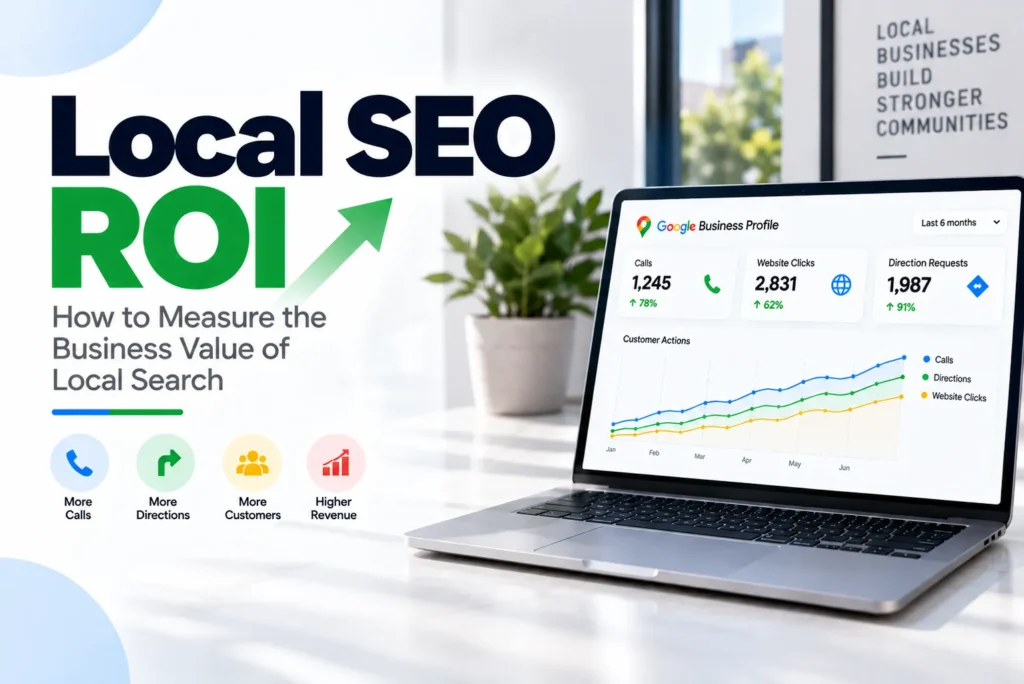
Local SEO ROI comes down to one thing: how much profitable business local search generates compared with what you spend to earn it. To measure it properly, track calls, visits, leads, booked jobs, customers, revenue, and profit instead of relying on rankings alone.
That sounds simple until you try to prove it for a real business. A local customer might find a company through Google, call three days later, visit the location, and buy something without ever mentioning Google to the owner. That gap between the search and the sale is where most local SEO reporting breaks down.
Take two campaigns running at the same time. One pushes a company’s rankings from position eight to position three, and the owner is thrilled, but the phone barely rings differently than before. Another barely moves rankings yet quietly adds a dozen extra calls a month that turn into real jobs. Rank movement alone would say the first campaign won. Revenue says the second one did.
Should You Invest in Local SEO?
Before spending money on local SEO, start with the economics of the business itself, not the marketing plan.
Say you run a residential electrician business. Your average completed job brings in $580, and after materials and labor you keep about $230 in gross profit. If local SEO produces 15 extra qualified jobs a month, that campaign has a measurable value you can defend in a budget meeting. Now picture a different company ranking in the top three for dozens of keywords but getting very few calls. Its visibility looks impressive in a screenshot, but the commercial value behind it could be thin.
Rankings and revenue are related, but they are not the same thing. Revenue and customer behavior make a better starting point.
Start With Your Customer Value
You need three numbers before calculating local search ROI with any confidence. Track average revenue per customer, average profit per customer, and the average number of leads needed to acquire one customer.
A home service company might make $800 from an average customer and keep $320 after direct job costs. If five qualified leads produce two customers, the business needs roughly 2.5 leads per sale. A campaign producing 50 additional profile interactions sounds useful on paper. But if those interactions generate three customers worth $960 in gross profit, you have a number worth comparing against the campaign cost.
These numbers look different for every business. A dentist, a restaurant, a family law attorney, a roofer, and a boutique retail shop should never be measured against the same ROI assumptions. Their customer value and buying cycles are nothing alike.
Why Local SEO Has a Different ROI Problem
Traditional SEO reporting leans on organic traffic, rankings, impressions, and website conversions. Those metrics still matter, but for local businesses, they miss most of the actual buying journey.
Someone searches emergency electrician near me, scans a few Google Business Profiles, reads the reviews, and calls one company directly without ever opening the website. Someone else searches for a bakery, taps directions, drives over, and buys a cake in person, leaving no digital trace beyond that one search. If your reporting only counts website form submissions, you miss both customers. Measuring local SEO ROI needs a wider net than a typical SEO report is built to catch.
Why Standard SEO ROI Formulas Often Fail Locally
A common SEO ROI formula looks something like this:
ROI = Organic Revenue Generated ÷ SEO Cost
The formula is not wrong. The problem is almost always how you calculate the revenue number. Count only website transactions as organic revenue, and you will badly underestimate what local search is worth. So much of the value never touches the website.
Rankings Are Not Revenue
A ranking is an opportunity to be seen. It is not a sale. A roofing company ranking first for roofing company in its city sounds impressive. That keyword might generate less commercial activity than a smaller phrase like roof leak repair near me. Fewer people search the second phrase, but the ones who do have a clearer, more urgent need, and they convert at a higher rate. Track rankings because they explain why visibility is changing. Do not treat a ranking report as the final scoreboard for the business.
Traffic Can Mislead You Too
An SEO campaign can push organic sessions up 70 percent while producing almost no additional customers. This often happens when the growth comes from informational searches with little buying intent. The reverse also happens. A campaign might bring in fewer visitors but attract people actively searching for a specific paid service, and those visitors convert at a far higher rate. For a local business, 100 highly relevant visitors usually beat 1,000 people who were never going to buy anything.
Which Local SEO Metrics Actually Matter?
The metrics that matter sit close to the moment someone decides to buy. Group them into four layers.
Visibility metrics cover local rankings, Google Business Profile views, branded searches, and organic impressions, and tell you whether people can find you. Engagement metrics cover website visits, profile interactions, calls, direction requests, and booking clicks, and tell you whether people act once they find you. Lead metrics include qualified calls, booked appointments, quote requests, and anything that lands in your CRM as an actual prospect. Revenue metrics sit at the top: closed customers, sales value, gross profit, customer acquisition cost, and revenue you can reasonably attribute to local search.
Calls Deserve Special Attention
For most service businesses, calls are one of the cleanest local SEO conversions. Someone searching for a locksmith at 11 pm rarely fills out a contact form; they call the number on your Google Business Profile.
Your tracking setup needs to identify where calls come from. A call tracking number assigned to your website and profile listings lets you record the source, the call duration, and whether the call turned into a qualified lead. Duration matters too. A 12-second call that lands in voicemail is not worth the same as a six-minute call that ends in a booked $1,800 job. Both still show up as one call in a basic report.
Direction Requests Can Signal Offline Revenue
Direction requests matter most for businesses with a physical location. A furniture store, bakery, dental office, or auto repair shop can bring in customers who never fill out a web form. Google Business Profile insights show how often people view your profile and tap for directions, but a direction request is still a signal, not confirmed revenue. Ask new customers how they found you, and add a simple source field to your point of sale system or CRM. Over a few months, you can compare reported Google discovery against your actual sales records.
Profile Views and Reviews Need Context
A profile view represents visibility, not automatically a customer. One view might lead to a call, another to a website visit, and a third person might just compare you against competitors and leave. Never report profile views as revenue. Follow the full chain instead: profile views lead to actions, actions lead to leads, leads lead to customers, and customers lead to revenue.
Reviews shape that chain more than most reports admit. Two businesses can rank in the same local pack with similar visibility and still see very different call volumes. One might have 140 recent five-star reviews while the other has 22 reviews from three years ago. When a well-ranked business still gets weak call volume, check the reviews before assuming the SEO work failed.
How to Measure Local SEO ROI With a Simple Formula
Once tracking is working, use a revenue-based formula that reflects how the business really makes money.
Local SEO ROI = (Attributed Gross Profit − Local SEO Cost) ÷ Local SEO Cost × 100
Gross profit works better than total revenue, because revenue alone can make an expensive campaign look far better than it is. Generating $20,000 in sales sounds great until the business keeps only $3,000 after direct costs.
The Four Numbers You Need
Calculate the revenue you can reasonably attribute to local search, then estimate the gross profit from those customers. Add up the actual SEO cost, subtract it from the attributed gross profit, and divide by the cost. Keep the calculation method consistent every month, since changing it midyear makes periods impossible to compare.
A Full Local SEO ROI Example
Consider a fictional residential pest control company. The company pays an agency $2,200 a month for local SEO, covering Google Business Profile optimization, service area pages, technical fixes, citation cleanup, and reporting. The owner wants a straight answer: is this producing profitable business or just prettier rankings?
During one month, tracking shows 74 calls attributed to organic local search, 28 qualified calls, 16 booked jobs, and 13 completed jobs. Average revenue per completed job was $340, with average gross profit per job at $145. The business also picked up 6 additional customers from tracked organic form submissions, worth an average of $110 in gross profit each.
Gross profit from completed jobs: 13 × $145 = $1,885. Gross profit from the additional customers: 6 × $110 = $660—total attributed gross profit: $2,545.
Local SEO ROI = ($2,545 − $2,200) ÷ $2,200 × 100 = 15.7%
That is a real return, but a thin one for a $2,200 monthly investment. Fifteen percent might be acceptable for a newer campaign, but it should trigger a closer look at the conversion path rather than getting filed away as working.
What If Attribution Is Uncertain?
Real-world attribution is rarely this clean. Suppose the pest control company suspects a few of those customers actually came from referrals rather than organic search. A conservative model might count only 70 percent of that uncertain value, roughly $462, bringing total attributed gross profit to $2,347 and ROI down to 6.7 percent. The exact percentage matters less than the discipline behind it. A conservative model applied consistently is more useful than an inflated one that shifts depending on how good the report needs to look.
How Do You Separate Local SEO From Paid Ads?
A customer might search your business name after seeing a Google ad. Another might click an organic result after seeing a social post, and a third might find your profile because a neighbor mentioned you. If every one of these gets credited to Google, your local search ROI becomes meaningless.
UTM parameters help identify where tracked website traffic comes from. Use clear parameters for paid campaigns that name the ad source, and use them sparingly for organic initiatives so you do not build tracking structures nobody can explain later.
Your CRM should answer a short list of questions, starting with how the lead first contacted you and which source generated it. Was it qualified, did it become a customer, and how much revenue did it produce? This is where local search ROI becomes reliable instead of guessed at. Analytics can tell you someone arrived, and your CRM tells you whether that person became a paying customer.
Call tracking earns its keep when a business runs Google Ads and local SEO at the same time. Use source-level tracking to separate paid calls from organic calls, then report the two separately. A useful report might show organic local search producing 38 qualified leads, paid search 24, referral 11, and direct and unknown making up the remaining 15. That gives the owner a far clearer picture than one combined number labeled Google leads.
The Tracking Setup I Recommend
You do not need an enormous analytics stack. For most small and mid-size businesses, four systems cover the basics.
Google Business Profile Insights show views, searches, calls, and direction requests. Track these monthly rather than reacting to daily swings, since local search behavior shifts with seasonality and demand.
Google Analytics shows what happens after someone reaches the website. Track landing pages, contact actions, and phone clicks, and focus on revenue-connected actions rather than tracking everything the platform allows.
Call tracking should record the source, duration, and lead outcome of every call. Connect it to the CRM so customer value does not disappear between the phone system and the sales team.
Your CRM is the closest thing you have to a source of truth for revenue. The SEO side knows rankings improved, while the sales side knows which leads bought something.
What Should Your Local SEO KPIs Be?
Your KPIs should shift based on the business model, not sit on a template reused for every client. A service area business leans on qualified calls, booked appointments, and completed jobs. A physical retail business cares more about direction requests, store visits, and in-store purchases. A professional service firm focuses on consultation requests and signed clients. The common mistake is giving every business the same dashboard, regardless of how it actually makes money.
A Practical KPI Hierarchy
Build the reporting in layers. Level one covers visibility: rankings, profile visibility, and organic impressions. Level two covers actions: calls, website clicks, and direction requests. Level three covers leads: qualified calls, forms, and appointments. Level four covers business results: new customers, sales, gross profit, and local SEO ROI. The higher you move through this hierarchy, the closer you get to what the business actually cares about.
Common Mistakes That Distort Local SEO ROI
The first mistake is treating rankings as revenue, when a ranking report shows progress, not whether that progress produced a paying customer. The second is counting every phone call as a lead, when some calls are spam, wrong numbers, or existing customers. The third is treating every form submission as a closed sale, when a form is only a lead signal.
The fourth is ignoring offline conversions, common with businesses where customers call, visit, or buy in person without touching a form. The fifth is changing attribution rules every month, since mixing first-touch and last-touch attribution makes numbers impossible to compare. The sixth is ignoring seasonality. A landscaping company generates far more leads in spring than winter, and an HVAC company can swing wildly based on the week’s weather. Compare like periods instead of assuming every month should perform the same.
When Does Local SEO ROI Become Measurable?
There is no universal month when local SEO turns profitable. A business with an established profile, decent authority, and strong reviews can see meaningful movement within a few months, while newer businesses usually need longer.
A practical window is three to six months for early signals, followed by six to twelve months for a stronger trend. That does not mean waiting six months before checking anything. Track the campaign every month, and avoid making major decisions off one unusually good or bad one.
During month one, set the baseline by recording existing rankings, profile actions, calls, leads, and sales data before anything changes. By months four through six, you should have enough data to spot real trends, assuming the business gets enough search demand. A company getting 200 local leads a month will show patterns far faster than one getting 15.
How Should You Report Local SEO Value to a Business Owner?
Do not make the owner dig through a 30-page report to figure out whether the campaign worked. Lead with business outcomes. A useful monthly report might open with an SEO investment of $2,200, 28 qualified leads, and 13 new customers. It would also show attributed revenue of $4,420, gross profit of $2,545, and a local SEO ROI of 15.7 percent.
Then explain what changed. Maybe a service page started pulling more organic calls, or the profile picked up more phone actions. Rankings still belong in the report because they explain why lead volume shifted, but they should not replace the financial story. The owner needs to understand what the investment produced, not where the business sits on a keyword list.
What If the ROI Looks Poor?
Do not assume local SEO failed the moment a number looks weak. Check the conversion path first. Service pages may have a weak call to action; calls may be coming in, but someone is missing them, or the sales team responds too slowly.
An attribution problem often hides beneath a bad-looking number. If customers call straight from the Google Business Profile but your tracking records those calls as direct, the campaign will look weaker than it actually is. Rule out measurement problems before making strategic changes, then look at the raw economics.
The Real Goal Is Better Business Decisions
The purpose of local SEO tracking is not a prettier monthly report. It is better decisions about where to put the next dollar.
If calls are rising but close rates are falling, the sales process probably needs attention rather than the SEO strategy. If rankings are climbing but qualified leads stay flat, the keyword targeting or landing pages likely need work.
Local SEO ROI gets easier to understand once you connect the entire chain. Search visibility leads to a customer action, which leads to a qualified lead, which leads to a sale, which leads to gross profit. The closer your reporting sits to that chain, the less you depend on vanity metrics.
A strong local SEO campaign should answer three practical questions. What did we spend? What business did local search generate? Was the profit worth the investment? If your tracking system can answer those consistently, month after month, you have a solid foundation for measuring what local search is actually worth to the business.
Frequently Asked Questions
Calculate the gross profit attributed to local SEO, subtract the SEO cost, divide by the SEO cost, then multiply by 100. Gross profit gives a more accurate picture than total revenue.
Qualified calls, booked appointments, leads, customers, revenue, and gross profit matter more than rankings alone. Rankings and traffic help explain where those results came from.
Early signals can appear within three to six months, depending on competition, authority, and demand. A six to twelve-month window gives a stronger picture of the overall trend.
Use call tracking that records the marketing source and connects qualified calls to your CRM. This separates organic local search calls from paid ads, referrals, and repeat customers.
Profile activity is one piece of local search performance and can be measured on its own. Track profile-driven calls, visits, direction requests, and resulting customers rather than treating views as revenue.
The core principle stays the same even as AI assistants start answering local search queries directly. Ask new customers how they found the business, include AI as an option, and connect that source back to calls, visits, and sales like any other channel.