
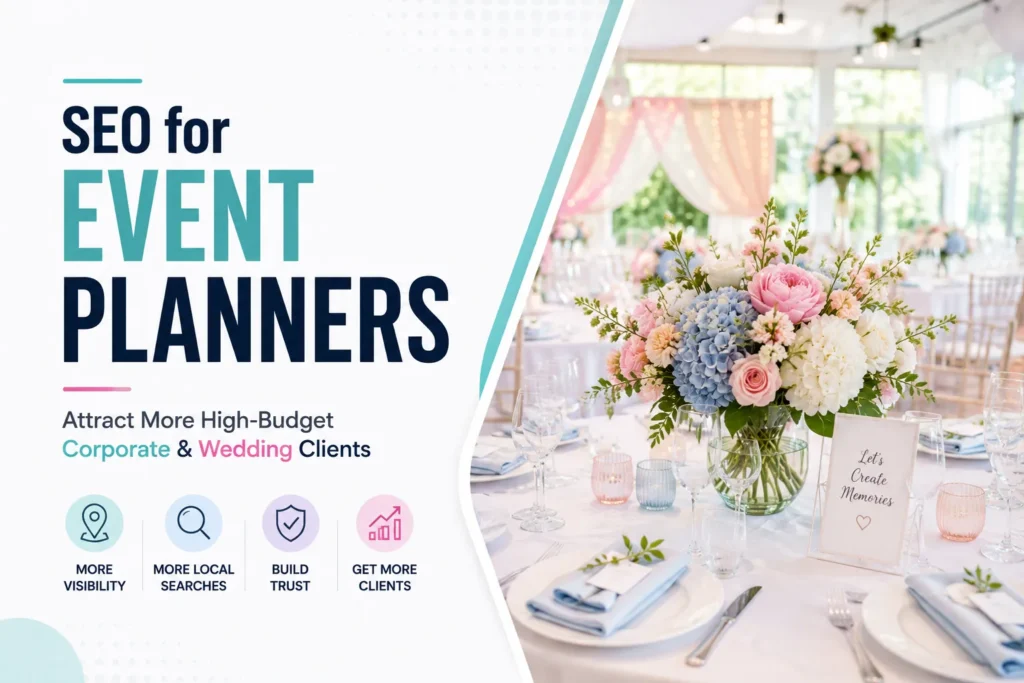
What Is Event Planner SEO and Why High-Budget Clients Search Differently
A couple planning a $50,000 wedding may visit an event planner’s website five or six times before sending an inquiry. A corporate team planning a 600-person conference may compare planners, venues, production companies, portfolios, reviews, and RFP requirements for months before selecting a vendor.
That buying process makes event planner SEO different from SEO for a business where customers search, choose, and buy within minutes.
A search like “event planner near me“ can start a long research process. The person may be checking whether you plan weddings, corporate events, private parties, or destination events. They may want to know your minimum budget, guest capacity, style, packages, service area, past venues, or experience level before they consider contacting you.
For corporate clients, the process can be even more involved. A company may need to issue an RFP, compare several proposals, obtain internal approval, and coordinate with procurement. The planner’s website therefore needs to answer questions that arise long before the final booking.
This is where generic local SEO advice falls short. Getting a business into the local results matters, but an event planner also needs a portfolio that sells, case studies that demonstrate capability, pricing signals that qualify inquiries, reviews that establish trust, and content that helps prospects while they are still researching.
SEO for event planners should therefore connect several systems:
Search visibility → useful information → portfolio proof → trust → consultation → qualified proposal → booking
This guide covers event planner website SEO, wedding planner SEO, corporate event planner SEO, technical SEO, off-page SEO, local SEO, Google Business Profile, directories, vendor relationships, and social channel SEO.
The objective is not to generate the largest possible number of inquiries.
It is to attract more of the inquiries that fit the events, budgets, locations, and services your business actually wants.
How Corporate and Wedding Clients Search for an Event Planner
The same planner can serve several markets, but search behavior can differ widely by market.
Understanding those differences should determine the pages you build.
Corporate Event Planner SEO Starts With Scope and Procurement
A corporate client may search:
- Corporate event planner in Dallas
- Corporate event planning company
- Conference planner near me
- Corporate gala planner
- Corporate holiday party planner
- Event production company
- Conference management services
- Event planner for 500 people
- Corporate event RFP
- Corporate meeting planner
Some of these searches show a general need. Others reveal the event’s scale or type.
A company planning a 40-person executive dinner does not need the same information as a company planning an 800-person conference.
Your corporate pages should therefore explain the work you actually handle.
Useful details may include:
- Conference planning
- Corporate galas
- Product launches
- Executive events
- Employee celebrations
- Holiday parties
- Awards ceremonies
- Attendee management
- Registration
- Venue sourcing
- Vendor management
- Production
- Audio and visual coordination
- Guest counts
- Budget management
If your team has managed conferences with 500 or more attendees, that experience should appear in relevant content and case studies when you can substantiate it.
“Creating memorable corporate experiences” does not tell a procurement manager whether you can handle a 600-person conference.
Wedding Planner SEO Follows a Longer Research Journey
Wedding searches often start months before the event.
A couple may search:
- Wedding planner near me
- Luxury wedding planner Dallas
- Full-service wedding planner
- Wedding day coordinator
- Destination wedding planner
- Wedding planner at [venue]
- Wedding planner for large wedding
- Modern wedding planner
- Wedding planner pricing
The portfolio matters heavily here.
A couple may have already chosen a venue before searching for a planner. They may look at previous weddings at that venue, compare design styles, read reviews, and check whether the planner works within their budget.
That creates opportunities for venue-specific case studies, wedding galleries, planning guides, and service pages.
Social and Milestone Events Need Their Own Search Paths
Private events can include:
- Milestone birthdays
- Anniversary parties
- Galas
- Fundraisers
- Graduation events
- Private dinners
- Holiday celebrations
- Cultural celebrations
A planner that regularly produces 100-person milestone birthdays should not bury that service inside a generic “Events” page.
The page should show the event type, planning scope, design capabilities, guest management, vendor coordination, and examples of actual work.
One Generic Services Page Cannot Sell Every Event Type.
Consider a page that says:
Event Planning Services
“We plan weddings, corporate events, birthday parties, conferences, galas, and private celebrations.”
The page technically covers the services.
It does not help a bride determine whether the planner handles full-service weddings.
It does not tell a corporate buyer whether the team can manage a conference.
It doesn’t show a private-event client what types of celebrations the planner specializes in.
Important services should have their own search destinations.
A practical architecture might include:
- Wedding Planning
- Full-Service Wedding Planning
- Wedding Day Coordination
- Corporate Event Planning
- Conference Planning
- Corporate Galas
- Private Event Planning
- Event Design
- Event Production
- Destination Event Planning
- Event Portfolio
- Wedding Case Studies
- Corporate Case Studies
Do not create pages simply because a keyword exists. Build them where the service is commercially meaningful, and you have enough real information to make the page useful.
Event Planner Google Business Profile SEO: Turn the Listing Into a Sales Asset
For high-budget clients, your optimized Google Business Profile can function as a first-stage portfolio.
Someone may discover the listing before visiting your website.
What they see can influence whether they continue researching.
Choose Categories That Match Your Actual Work
Your primary category should accurately represent the main business.
Use secondary categories to reflect genuine services, where available.
Do not select categories only because they contain valuable keywords.
A planner specializing in weddings should make that focus clear.
A corporate event company should accurately represent corporate services.
Use Photos to Show the Level of Work You Want to Sell
Do not upload random event photographs.
Organize the visual story.
Show:
- Luxury wedding receptions
- Ceremony designs
- Corporate conferences
- Galas
- Private events
- Event installations
- Tablescapes
- Production
- Behind-the-scenes work
- Team photographs
If you want more $30,000 weddings, your strongest wedding work should be easy to find.
List Planning Services Clearly
Where available, list services such as:
- Full-service wedding planning
- Wedding coordination
- Corporate event planning
- Conference planning
- Event design
- Destination planning
- Event production
Use accurate descriptions.
If your minimum investment is important for qualification, make that information available on the website and appropriate profile channels.
Use GBP Posts Around Real Booking Windows
Event planning has seasonal booking periods.
Wedding inquiries may rise during engagement season.
Corporate event planning can depend heavily on annual budgets and conference calendars.
Posts can highlight:
- Recent events
- New case studies
- Seasonal availability
- Wedding booking windows
- Corporate planning availability
- Venue partnerships
- Awards
- Event design projects
Avoid posting generic promotional copy every week.
Answer High-Value Questions
Potential clients may want to know:
What is your minimum wedding budget?
How far in advance should we book?
Do you travel?
Do you plan destination weddings?
How many guests can your team handle?
Do you work with corporate RFPs?
Do you provide event-day coordination?
Answer these questions honestly on the website and use appropriate Business Profile features where available.
Event Planner Website SEO: Build Pages Around Event Types and Budget Tiers
Your website should help a potential client answer three questions quickly:
Can you handle my type of event?
Can you handle its size and complexity?
Are we likely to be a financial fit?
Those questions should influence the site’s structure.
Separate Full-Service Weddings From Wedding Day Coordination
Full-service wedding planning and day-of coordination solve different problems.
A full-service client may need help with:
- Budget development
- Venue selection
- Vendor sourcing
- Contract management
- Design
- Guest logistics
- Timeline development
- Rehearsal
- Vendor communication
- Event-day management
A coordination client may already have the venue and vendors and just needs someone to handle the final details and manage execution.
If both services share one short page, visitors may not understand what they are actually buying.
Separate pages also allow you to target searches with different intent.
Give Corporate Conferences Their Own Search Destination
A corporate conference page should sound like a conference page.
Discuss:
- Venue sourcing
- Registration
- Speaker coordination
- Breakout rooms
- Catering
- Audio and visual requirements
- Signage
- Attendee communications
- Production schedules
- Vendor management
- On-site coordination
If you handled a 600-person conference across two hotel ballrooms, turn that experience into a case study.
That is useful to another corporate buyer because it demonstrates scale.
Use Investment Pages to Qualify Serious Prospects
Many event planners hesitate to mention pricing.
There is a good reason. Event scope changes dramatically.
A wedding with 75 guests and a wedding with 300 guests may require very different staffing, design, logistics, and planning time.
You do not necessarily need to publish a complete price list.
A starting investment can be enough.
For example:
Full-service wedding planning begins at $8,000.
Or:
Corporate event planning projects generally begin at $15,000 depending on guest count, production requirements, and scope.
Use real figures.
A starting investment helps a $25,000 client see you as a fit while discouraging inquiries from people looking for a $2,000 planning package.
The purpose is qualification, not exclusion.
Turn Event Galleries Into Searchable Case Studies
A portfolio gallery answers:
What does your work look like?
A case study can answer:
What did you actually manage?
Consider:
180-Guest Wedding at The Grand Ballroom
Guest count: 180
Planning period: 12 months
Service: Full-service planning
Venue: The Grand Ballroom
Style: Modern romantic
Main challenge: A restricted four-hour venue setup window
Scope: Planning, vendor management, design coordination, rehearsal, event-day execution
Then explain what the planner did.
Perhaps vendors were assigned staggered load-in windows. The design team completed the ceremony setup before moving to reception spaces. The planner coordinated the final timeline with catering, entertainment, photography, and venue staff.
Now the page demonstrates capability.
It is no longer just a collection of attractive photographs.
Show the Planning Process Before the First Consultation
A high-budget client is also buying confidence.
Explain what happens after the inquiry.
For example:
Initial inquiry
The client provides event date, location, guest count, event type, and planning needs.
Discovery consultation
You discuss priorities, budget, venue, event scope, and expectations.
Proposal
You prepare a service scope and investment based on the actual event.
Planning
You coordinate the agreed services, vendors, design, logistics, and timeline.
Event execution
Your team manages the final details and event-day coordination.
This information can remove uncertainty before someone fills out your form.
Write Titles for Research-Stage Searchers
Your title tag should identify the service and market without sounding like an advertisement.
Weak:
Best Event Planning Services | ABC Events
Better:
Corporate Event Planner in Dallas | ABC Events
For a wedding service:
Luxury Wedding Planner in Dallas | ABC Events
For a planning guide:
How Much Does Wedding Planning Cost in Dallas?
The title should match the page’s actual purpose.
A person researching wedding planning costs should land on an article that discusses costs, not a generic homepage.
Technical SEO for Event Planner Websites: Speed, Schema, and Portfolio Performance
Event planner websites often contain some of the largest image collections among local service businesses.
That creates a technical challenge.
You need beautiful photography without making the website painfully slow.
Compress Wedding and Corporate Event Photography
A professional wedding photograph can be several megabytes straight from a camera.
Sending the original file to every visitor is unnecessary.
Resize images to the dimensions they will actually occupy on the page. Compress them without visibly damaging quality. Use modern image formats where the website platform supports them.
A portfolio image displayed at 1,000 pixels wide does not need to be downloaded at its original camera resolution.
Lazy-Load Large Portfolio Galleries
A page with 50 wedding photographs should not load all 50 images before the visitor can see the first section.
Load important above-the-fold content first.
Lazy-load images lower on the page where appropriate.
This is especially important for visitors browsing on mobile connections.
Do Not Let Hero Videos Slow the Homepage
A full-screen wedding video can look impressive.
It can also become the largest element on the page and delay the useful content.
If you use background or hero video:
- Compress the file
- Use an appropriate poster image
- Avoid unnecessary autoplay
- Keep the initial page light
- Make the service information available as normal text
- Consider external video hosting for larger content
A visitor should understand that you are a wedding and corporate event planner even if the video takes longer to load.
Monitor Core Web Vitals
Watch the three main Core Web Vitals:
LCP: How quickly the main content loads.
INP: How quickly the page responds to interaction.
CLS: How much the layout moves unexpectedly.
For an event planner, these issues can appear in practical ways.
A mobile visitor taps the portfolio menu, but the page is still loading.
A large image pushes the inquiry button down after the visitor tries to tap it.
A video loads late and shifts the entire hero section.
Those are user experience problems before they become SEO problems.
Keep Mobile Portfolio Browsing Easy
Keep mobile portfolio browsing easy and ensure seamless mobile optimization for local SEO so local users can browse photos quickly on smartphones.
Test:
- Image galleries
- Swipe controls
- Navigation
- Inquiry forms
- Pricing sections
- Video
- Testimonials
- Case studies
- Contact buttons
If a client cannot easily move between photographs and project details on mobile, the portfolio loses some of its sales value.
Build a Site Structure That Can Grow
A growing event planning company may eventually have dozens of pages.
For example:
Wedding Planning
→ Full-Service Wedding Planning
→ Wedding Coordination
→ Wedding Portfolio
→ Venue Case Studies
Corporate Events
→ Conference Planning
→ Corporate Galas
→ Corporate Event Portfolio
→ Conference Case Studies
Private Events
→ Milestone Birthdays
→ Private Parties
→ Gala Events
This structure gives each page a clear purpose.
Use Event, Service, LocalBusiness, Review, and FAQ Schema Carefully
Relevant structured data may include:
- LocalBusiness
- Service
- Event
- Review
- FAQPage
- BreadcrumbList
Using local business schema markup that accurately describes the content actually shown on your page helps search engines read your data better.
For example, a real upcoming event that meets the requirements for event markup may be eligible for Event structured data.
A service page can describe event planning services.
A local business page can describe the planner’s business information.
Represent customer reviews where appropriate and where the markup requirements are met.
Do not use schema to add claims that visitors cannot see.
Structured data supports understanding. It does not replace the quality of the underlying page.
Off-Page SEO for Event Planners: Earn Authority Through Venues, Vendors, and Press
Event planning creates natural opportunities for authority because every successful event involves other organizations.
A wedding may involve a venue, florist, photographer, caterer, rental company, DJ, bridal boutique, and transportation provider.
A corporate conference may involve a hotel, convention center, AV company, caterer, entertainment company, and production team.
These relationships can become valuable referral sources and legitimate online mentions.
Build Venue Relationships Through Real Events
Suppose you planned four weddings at the same Dallas venue.
That venue may publish real wedding features, preferred vendor pages, or event galleries.
A genuine feature can link to your website.
The stronger opportunity is the relationship itself.
A venue that trusts your team may recommend you to another couple.
Don’t approach every venue with a generic backlink request.
Build a relationship through actual work.
Partner With Photographers, Florists, Caterers, and Rental Companies
A real wedding project gives vendors a reason to collaborate.
You could create a styled shoot with:
- Event planner
- Photographer
- Florist
- Venue
- Rental company
- Stationery designer
- Bridal boutique
Each participant can document the project.
The planner can publish a case study.
The photographer can publish the photographs.
The venue can feature the event.
That creates genuine connections rather than manufactured link exchanges.
Use ILEA, MPI, and Other Industry Organizations
Professional organizations can provide more than a directory listing.
Relevant organizations may include ILEA, MPI, and other event-industry associations or local chapters.
If you belong to one, keep your profile accurate.
Make sure it includes the correct:
- Business name
- Website
- Location
- Professional role
- Specialties
Membership, certifications, awards, and professional recognition can also support trust when they are real and current.
Turn Awards Into Website Content
If your company wins an event-planning award, create a page about it.
Include:
- Award name
- Category
- Year
- Event involved
- Client or project context where permitted
- Photographs
- Why the event was recognized
An “Awards” page with only logos is less useful than pages that explain the actual work behind the recognition.
Use Event PR as a Link-Earning Strategy
Event planning has many possible news angles.
For example:
- A 1,000-person charity gala
- A major local conference
- A unique venue transformation
- A large fundraising event
- A wedding with unusual design requirements
- A new event trend based on real client work
- Expert commentary on local event planning
A local publication may be interested in the event itself.
That coverage can produce both brand exposure and a relevant website mention.
Event Planner Directory SEO: The Knot, WeddingWire, Cvent, and PartySlate
Directory profiles can introduce planners to people who may never discover them through a normal Google search.
Treat them as sales channels, not just citation listings.
How Directory Citations Strengthen Your Local Pack Rankings
Directory profiles do more than generate direct inquiries.
Google’s local ranking system relies partly on prominence, how established and trustworthy a business appears based on signals collected from across the web, not just from your own website.
One of the clearest prominence signals is citation consistency: the same business name, category, service area, and website address appearing accurately across trusted external platforms such as The Knot, WeddingWire, Cvent, PartySlate, chamber of commerce listings, and industry association directories.
When that information matches everywhere, it reinforces confidence in your Google Business Profile and can support stronger local pack visibility. When it doesn’t match, Google gets conflicting signals about which version of your business information is correct, which can quietly weaken local rankings even if your website is well optimized.
Treat directory accuracy as a local SEO task, not only a lead-generation task.
Optimize Wedding Planner Profiles on The Knot, WeddingWire, and Zola
For wedding planners, platforms such as The Knot, WeddingWire, and Zola can influence how couples discover and compare vendors.
Your profile should contain:
- Current portfolio images
- Accurate services
- Wedding specialties
- Planning packages
- Starting investment
- Service area
- Reviews
- Contact details
- Recent work
Do not upload a profile once and forget it for three years.
If your website now focuses on luxury weddings and your directory profile still presents you as a general party planner, you are sending mixed signals.
Use Corporate Marketplaces Based on Your Actual Work
Corporate event planners may explore channels such as:
- Cvent
- PartySlate
- Eventective
- Relevant corporate event marketplaces
The right platform depends on the market and event type.
A conference planner should emphasize capabilities such as guest count, event size, production, registration, and corporate experience.
A private-event planner may prioritize different channels.
Track leads by source.
If a directory produces 30 inquiries but zero qualified opportunities after a year, question its value.
Keep Pricing and Portfolio Signals Consistent
Imagine your website says:
Corporate events begin at $15,000.
Your directory says:
Packages from $5,000.
A prospective client may not know which number to trust.
The same applies to portfolio quality.
Your website may showcase luxury corporate galas while your directory profile uses old birthday-party photographs.
Update the external profile.
Keep Your Website as the Conversion Hub
Directories help people discover you.
Your website should provide the deeper information:
- Full portfolio
- Case studies
- Service pages
- Process
- Investment information
- FAQs
- Team
- Testimonials
- Inquiry process
Don’t make the directory profile the only place your best information lives.
Local SEO for Event Planners: NAP, Service Area, and the Local 3-Pack
Local SEO for event planners has one important complication.
Many planners do not work from a storefront where every client visits.
They may operate from an office and travel to venues.
That affects how you describe the service area.
Keep NAP Consistent Across Event Directories
Your business name, address, and phone should be accurate across:
- Website
- Google Business Profile
- Wedding directories
- Corporate directories
- Chamber listings
- Industry profiles
- Social profiles
- Venue partner pages
Do not create different business names to target different cities.
If your official business name is:
ABC Event Planning
do not create:
ABC Luxury Dallas Wedding Planner
for one directory and another variation elsewhere.
Separate Local Service From Destination Planning
Suppose your business is based in Dallas but has planned weddings in Austin and Miami.
Do not imply that you maintain physical offices in those cities.
Instead, explain:
Based in Dallas, serving North Texas and available for destination weddings and corporate events throughout the United States.
If Austin becomes a major market with substantial project history, you may eventually have enough information to build a dedicated Austin service page.
Understand the Local 3-Pack Through an Event Planner Example.
Local ranking factors influence Google’s local results.
For an event planner, relevance means your profile and website clearly match the search.
Distance can matter when someone searches for an event planner near a particular location.
Prominence reflects how established and trusted the business appears, based on factors such as reviews, links, and mentions.
Imagine two planners.
Planner A has a complete profile, 150 relevant reviews, strong local mentions, and detailed wedding pages.
Planner B has a website but a weak profile and almost no reviews.
Both may provide excellent events.
Planner A has more local evidence supporting its presence.
Capture “Event Planner Near Me” Without Creating Thin City Pages
You do not need 50 pages called:
Event Planner in [City]
with the same paragraph.
If you genuinely serve multiple markets, create useful location pages.
A strong Dallas page might include:
- Dallas office or service information
- Local venues you have worked at
- Actual Dallas event case studies
- Guest-size ranges
- Wedding and corporate specialties
- Local vendor relationships
- Travel information
A city name swap is not local expertise.
Event Planner Reviews and Trust Signals: Build Proof for Expensive Decisions
When a customer chooses an event planner, they’re entrusting an important date to that business.
A wedding cannot be repeated.
A corporate conference may involve hundreds of attendees and senior executives.
A fundraising gala may affect an organization’s reputation.
That makes trust a major part of the buying decision.
Separate Wedding and Corporate Testimonials
A wedding testimonial may say:
“They kept us calm throughout the final month and handled every vendor on the wedding day.”
A corporate testimonial may say:
“Their team coordinated 600 attendees, 18 vendors, and the production schedule without disrupting our conference.”
Both are valuable.
They simply prove different things.
Place testimonials near the service they support.
Use Real Case Study Numbers
Specific numbers make an event planner easier to evaluate.
For example:
Corporate conference
- 620 attendees
- 2 hotel ballrooms
- 18 vendors
- 3-day production
- 9 months of planning
Wedding
- 180 guests
- 12-month planning period
- 14 vendors
- Full-service planning
- Ceremony and reception production
Only publish real or client-approved information.
Do not exaggerate event size to appear more established.
Add Video Testimonials When Available
A 45-second client video can demonstrate emotion, communication, and confidence in ways written text cannot.
For corporate clients, a short testimonial from an executive or event manager can answer a question another buyer may have:
Could this team actually manage our event?
For weddings, a couple can explain what happened when something unexpected changed on the wedding day.
That kind of evidence is difficult to create through generic marketing copy.
Ask for Reviews After the Event
Knowing how to ask for a Google review properly allows you to build the request seamlessly into your post-event process.
For weddings, ask after the couple has experienced the final result.
For corporate events, request feedback while the event experience is still fresh, as high ratings directly boost your search ranking performance.
For corporate clients with confidentiality concerns, ask whether they can provide a public testimonial and what information they are comfortable sharing.
Never fabricate reviews.
Respond to Reviews Like a Professional
A response should sound like the planner, not a keyword generator.
If a client says:
“They solved a venue problem two hours before our reception.”
You can acknowledge the situation naturally.
Do not reply:
“Thank you for choosing the best Dallas wedding planner for your luxury wedding planning needs.”
The first response builds trust.
The second sounds like advertising.
Social Channel SEO for Event Planners: How Instagram, Pinterest, and YouTube Support Search Visibility
Social channels are not a replacement for a website, but they influence event planner SEO in specific, measurable ways. For example, they generate branded searches from people who first saw your work on social, give Google additional indexed content to associate with your business name and service area, and let prospects validate your portfolio before they land on your site.
Connect Instagram to Website Case Studies
An Instagram post can show 10 wedding photos.
The website can explain:
- Venue
- Guest count
- Design direction
- Planning scope
- Challenges
- Services
- Client feedback
Use Instagram to create interest and the website to provide depth.
Use Pinterest for Long-Term Wedding Discovery
Pinterest content can include:
- Wedding color palettes
- Reception tables
- Ceremony designs
- Luxury wedding inspiration
- Seasonal wedding ideas
- Floral installations
- Venue inspiration
Link the visual content to relevant portfolio and planning pages when appropriate.
Use YouTube for Process and Venue Content
Useful videos include:
- Venue walkthroughs
- Behind-the-scenes setup
- Corporate conference production
- Wedding setup
- Event design transformations
- Planning process explanations
- Client case studies
A video showing how your team transformed a ballroom for 600 attendees provides useful evidence of capability.
Track Social Search Performance With Google Search Console Platform Properties
Google Search Console now includes a feature called Platform Properties, which lets you connect Instagram, TikTok, YouTube, and X accounts directly to Search Console and see how that content performs in Google Search itself. Facebook and LinkedIn are not supported at this time.
Once connected, the Performance report shows total clicks, impressions, average click-through rate, and average search position for your social content, filterable by individual post and by the exact search query that produced the impression.
This is useful for an event planner in a specific way. If a Reel from a Dallas ballroom wedding is generating impressions for a query such as “Dallas ballroom wedding reception ideas,” and your website does not rank for that term yet, that is documented evidence of real search demand. It tells you exactly which case study or service page to build next.
Check this report alongside your website’s Performance report regularly, and treat matching queries as content and page-building priorities rather than one-off social wins.
Event Planner SEO Metrics That Predict High-Budget Client Acquisition
Ranking number one for a broad keyword can look impressive.
That doesn’t automatically mean you are attracting the right clients.
Track the full lead path.
Measure Consultations and RFPs
Track:
- Organic visits
- Consultation requests
- Wedding inquiries
- Corporate RFPs
- Qualified inquiries
- Proposal requests
- Booked events
- Revenue
A corporate planner may receive only 20 inquiries in a month but close several large contracts.
That can be more valuable than receiving 200 low-budget inquiries.
Compare Organic With Referral and Directory Leads
Track whether high-value clients come from:
- Google organic
- Google Business Profile
- The Knot
- WeddingWire
- Cvent
- PartySlate
- Venue referrals
- Vendor referrals
- Direct traffic
- Paid campaigns
A venue referral may generate fewer inquiries than Google but produce much larger contracts.
Your reporting should reveal that.
Common Event Planner SEO Mistakes That Cost High-Budget Clients
Using One Generic Page for Weddings and Corporate Events
A planner lists every service on one page.
A bride cannot find wedding-specific information.
A corporate buyer cannot determine whether the team has conference experience.
Build pages around commercially important event types.
Showing Old Portfolio Work
A planner’s website still features weddings from five years ago.
The work may be excellent, but the prospect cannot tell what the current team produces.
Update the portfolio regularly.
Hiding Every Pricing Signal
The website says:
“Contact us for pricing.”
Nothing else.
A $30,000 prospect may be interested, but a $3,000 prospect may also submit an inquiry.
A starting investment can reduce that mismatch.
Using Different Business Information Across Directories
The website says one phone number.
A wedding directory shows another.
The Google Business Profile uses an outdated address.
Fixing these inconsistencies helps search engines better understand your key search signals.
Ignoring the Research Stage
The website targets only:
“Wedding planner Dallas.”
It does not answer:
- How much does wedding planning cost?
- When should I hire a planner?
- What does full-service planning include?
- What questions should I ask?
- How do I compare planners?
That creates a large gap between discovery and consultation.
Publishing Generic Portfolio Copy
“Elegant. Timeless. Unforgettable.”
Those words don’t show what happened.
Add guest counts, venue, scope, challenge, planning timeline, and actual project details where clients permit disclosure.
Treating Social Media as the Entire Portfolio
Instagram may quickly disappear from a searcher’s attention.
Your website should hold the permanent case study, service information, and inquiry path.
Creating Thin Location Pages
A planner creates:
/event-planner-dallas/
/event-planner-austin/
/event-planner-houston/
with identical copy and different city names, which is one of the top local SEO mistakes killing your rankings.
If you genuinely serve those markets, implementing strategic SEO for multi-location businesses helps you build useful local pages based on actual projects, vendors, and service information.
If you don’t, don’t manufacture local expertise.
Final Takeaway: Your Event Planner SEO Action Plan
A strong event planner SEO strategy connects the entire decision process: the right client finds you, the website explains the service, the portfolio proves your ability, reviews build trust, directories expand discovery, local signals reinforce your market, and case studies show that you can handle the type and scale of event the client is planning.
Start with the event types and budget ranges you want more of. Then make sure your website, Google Business Profile, directories, portfolio, content, and reporting all communicate those priorities consistently.
If your current SEO brings traffic but too few high-value consultations, audit the path from search result to inquiry before creating more content. The biggest opportunity may already be sitting inside the pages and profiles you have.
Event Planner SEO FAQ
Create dedicated corporate event pages that explain your event types, guest capacity, planning scope, production capabilities, and previous corporate work. Support those pages with real conference case studies, relevant industry profiles, venue relationships, and useful RFP planning content.
A starting investment or realistic budget range can help qualify prospects without requiring you to publish a fixed package price. If your minimum wedding planning investment is $8,000, for example, stating that clearly can prevent many inquiries from prospects with budgets far below your normal project size.
They can be important discovery and reputation channels for wedding planners, especially when the profiles contain current photographs, reviews, services, pricing signals, and accurate contact information. They should support your website rather than replace your own portfolio and case-study system.
Make review requests part of the post-event process and ask when the client has had an opportunity to assess the completed event. If confidentiality limits what they can disclose, ask for feedback about communication, planning, coordination, or execution without requesting sensitive information.
Wedding planner SEO often relies heavily on visual portfolios, venue-specific searches, engagement-season demand, planning guides, and emotional trust. Corporate event planner SEO tends to emphasize capabilities, guest counts, RFPs, procurement requirements, production experience, and case studies that demonstrate scale.
Only when there is enough genuine local experience or service information to make the page useful. A planner who has completed five weddings in Austin can build a strong Austin page around those projects, while a planner who has never worked there should not create a thin page simply because “event planner Austin” has search volume.
Add new work whenever you have projects that represent the type of clients you want more of. If your goal is to attract luxury weddings, feature recent luxury weddings prominently rather than relying entirely on older work.
AI can help organize research, RFP information, reviews, content ideas, and reporting, but it should not invent event budgets, guest counts, testimonials, awards, venue relationships, or project results. Keep those details tied to real business records and client-approved information.