
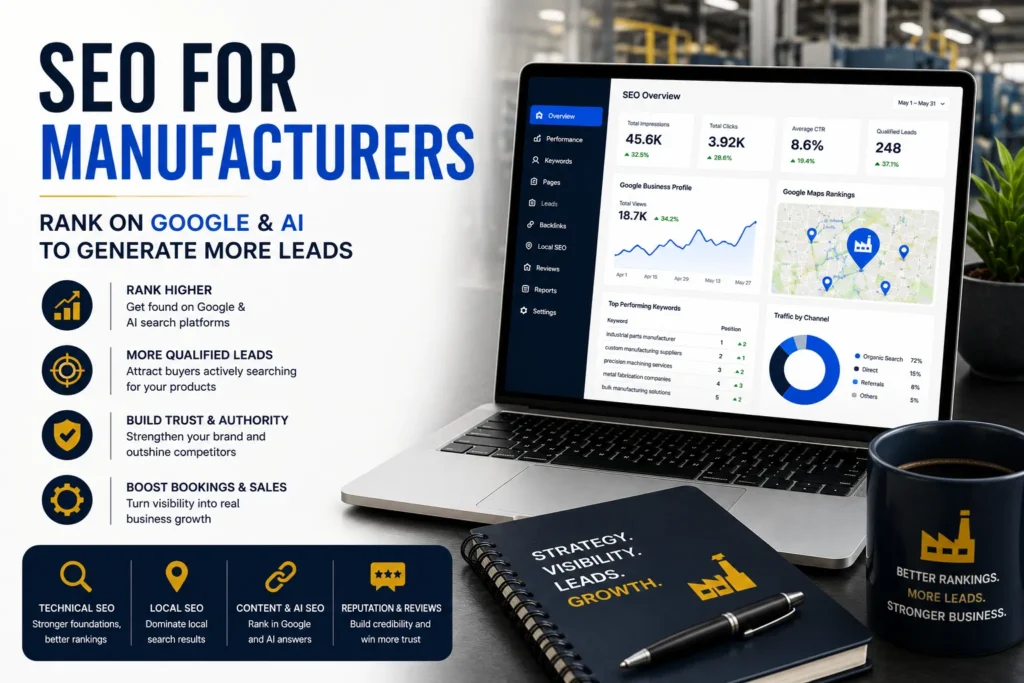
Manufacturing buyers rarely make quick purchasing decisions. Engineers, procurement teams, distributors, contractors, and business owners often spend weeks or months researching suppliers, comparing capabilities, reviewing certifications, evaluating technical specifications, and requesting quotes before choosing a manufacturing partner.
Much of this research now begins online.
If your manufacturing company does not appear when potential buyers search for your products, capabilities, materials, or manufacturing services, those opportunities may go directly to competitors with stronger visibility across Google Search and AI-powered platforms.
SEO for Manufacturers helps manufacturing companies improve their visibility for the technical, commercial, and industry-specific searches that influence purchasing decisions. Unlike consumer-focused SEO, an effective manufacturing SEO strategy must address complex B2B buying journeys, specialized terminology, long sales cycles, multiple decision-makers, and highly specific search intent.
A comprehensive strategy combines technical SEO, product and capability pages, industry content, local SEO, Google Business Profile optimization where relevant, topical authority, structured data, digital PR, conversion optimization, and AI search optimization.
This guide explains how manufacturers can improve visibility across Google Search, Google Maps, Google AI Overviews, ChatGPT, Gemini, Claude, Perplexity, and other emerging discovery platforms, and turn qualified searches into RFQs, sales inquiries, distributor opportunities, and long-term business relationships.
How B2B Buyers Search for Manufacturers
Manufacturing search behavior is often more technical than traditional local or consumer search.
A homeowner might search for a service using a simple phrase, but an engineer or procurement professional may search using exact materials, manufacturing processes, tolerances, production capabilities, certifications, or applications.
Common searches include:
- Manufacturer near me
- Custom manufacturer
- Contract manufacturing company
- Industrial manufacturer
- OEM manufacturer
- Private label manufacturer
- Custom fabrication company
- CNC machining manufacturer
- Metal fabrication company
- Prototype manufacturing
- High volume manufacturing
- Manufacturing company in [location]
Other searches can be significantly more specific, combining:
- Product type
- Material
- Manufacturing process
- Industry
- Application
- Certification
- Production volume
- Geographic location
Your website should be structured around these different search intents rather than relying on one general products or capabilities page.
Why Manufacturer SEO Is Different
Manufacturing SEO requires a different approach because the customer journey is often longer and more complex.
Potential buyers may visit your website several times before making contact. Different stakeholders may also evaluate your company at different stages of the purchasing process.
An engineer may review technical capabilities.
A procurement manager may evaluate production capacity and certifications.
A business owner may assess reliability and the company’s experience.
A distributor may research product availability and partnership opportunities.
Your SEO strategy must provide useful information for each of these audiences while making it easy for qualified prospects to request a quote or contact your sales team.
Focus on Qualified Traffic, Not Just Traffic Volume
A manufacturing website does not necessarily need hundreds of thousands of monthly visitors.
One highly qualified visitor seeking specialized manufacturing capabilities could lead to a substantial long-term contract.
Success should therefore be measured through:
- RFQ submissions
- Sales inquiries
- Qualified leads
- Distributor inquiries
- Product inquiries
- Sample requests
- Technical document downloads
- Phone calls
- New customer acquisition
- Revenue generated from organic search
Traffic and rankings remain useful metrics, but they should support actual business outcomes.
Google Business Profile Best Practices for Manufacturers
Google Business Profile can boost visibility for manufacturers with eligible physical locations, particularly when customers, suppliers, partners, or B2B buyers search for the company by name or for manufacturers in a specific geographic market.
A complete profile also reinforces important business information across Google’s ecosystem.
Choose the Right Business Categories
Select the category that most accurately describes your primary manufacturing activity.
Depending on your business, relevant categories may include categories related to:
- Manufacturer
- Machine shop
- Metal fabricator
- Plastic fabrication
- Food manufacturing
- Electronics manufacturing
- Industrial equipment
Choose the most specific available category that accurately represents your business and use secondary categories only for genuine additional activities.
Upload Professional Facility Photos
Manufacturing buyers want to understand your capabilities and operational scale.
Where appropriate, upload authentic photos of:
- Manufacturing facilities
- Production lines
- Machinery
- Equipment
- Warehouses
- Quality control processes
- Finished products
- Team members
- Office and facility exterior
Professional facility photography provides tangible evidence that supports trust and credibility.
Showcase Your Manufacturing Capabilities
Clearly describe the products and manufacturing services you provide.
Depending on your company, these may include:
- Contract manufacturing
- Custom manufacturing
- CNC machining
- Metal fabrication
- Injection molding
- Assembly
- Prototyping
- Private label manufacturing
- OEM production
- High-volume production
- Packaging
- Quality control
Only include capabilities your company genuinely provides.
Keep Business Information Accurate
Your company name, address, phone number, website, and operating hours should remain consistent across your Google Business Profile, website, industry directories, professional associations, and other trusted business listings.
Accurate information strengthens entity consistency and makes it easier for potential buyers to contact your company.
Publish Relevant Google Posts
Where useful, share updates related to:
- New manufacturing capabilities
- Equipment investments
- Facility expansions
- Certifications
- Trade show participation
- Company announcements
- New product lines
- Industry insights
- Community involvement
Keep posts factual and relevant to customers and business partners.
Complete Every Relevant Profile Section
Complete all applicable sections of your profile, including:
- Business description
- Website
- Contact details
- Business hours
- Products or services
- Photos
- Social profiles
- Opening date
The goal is to provide accurate information rather than filling fields solely for SEO purposes.
Use Gemini to Support Google Business Profile Management
Gemini can assist eligible businesses with tasks such as brainstorming profile updates, drafting review responses, organizing service descriptions, and creating ideas for Google Posts.
Always review AI-generated content before publishing to ensure technical accuracy. For manufacturers, incorrect claims about materials, capabilities, certifications, or production processes can create significant credibility problems.
Website Structure for Manufacturing Companies
Your website should do more than provide a basic overview of your company. It should clearly communicate your manufacturing capabilities, technical expertise, production processes, industries served, quality standards, and reasons buyers should choose your company.
A well-structured manufacturing website also helps Google understand the relationship between your products, capabilities, materials, industries, and applications, improving your ability to rank for high-value B2B searches.
Build a High-Converting Homepage
Your homepage should immediately explain what your company manufactures, the industries you serve, your primary capabilities, and what differentiates your operation from competitors.
Include:
- Core manufacturing capabilities
- Products or components manufactured
- Industries served
- Certifications where applicable
- Production capabilities
- Facility information
- Quality standards
- RFQ forms
- Click-to-call contact information
- Clear calls to action
A prospective buyer should understand your core manufacturing capabilities within seconds of arriving on your website.
Create Dedicated Manufacturing Capability Pages
Every major manufacturing capability should have its own optimized page rather than being grouped into one generic services section.
Depending on your operation, create pages for:
- CNC machining
- Precision machining
- Metal fabrication
- Injection molding
- Contract manufacturing
- Custom manufacturing
- Prototyping
- Assembly services
- OEM manufacturing
- Private label manufacturing
- High-volume production
- Packaging and fulfillment
Each capability page should explain your processes, equipment, materials, production capacity, tolerances where relevant, quality standards, applications, and industries served.
Create Detailed Product Pages
If your company manufactures specific products, components, or equipment, create dedicated pages for important product categories.
Each product page should include:
- Product description
- Technical specifications
- Materials
- Applications
- Available options
- Manufacturing standards
- Certifications where applicable
- Images
- Technical documents
- RFQ or inquiry options
Avoid using manufacturer descriptions copied from catalogs or suppliers. Original technical information provides more value to both buyers and search engines.
Build Dedicated Industry Pages
Manufacturers often serve multiple industries with very different requirements.
Create dedicated pages for industries such as:
- Automotive
- Aerospace
- Medical
- Construction
- Electronics
- Energy
- Food and beverage
- Agriculture
- Defense where applicable
- Industrial equipment
Each industry page should explain your relevant capabilities, materials, quality standards, certifications, and experience serving that market.
This structure helps you target industry-specific searches without creating repetitive content.
Create Material-Specific Content
Buyers and engineers frequently search by material rather than manufacturing process alone.
Depending on your capabilities, create useful resources covering materials such as:
- Aluminum
- Stainless steel
- Carbon steel
- Titanium
- Copper
- Brass
- Plastics
- Composites
Explain relevant material properties, manufacturing considerations, applications, and the processes your company supports.
Create Location Pages Where Relevant
Manufacturers serving specific geographic markets can create dedicated location pages when there is genuine business relevance.
Each page should include:
- Manufacturing capabilities available
- Industries served
- Regional shipping or distribution information
- Local facility information where applicable
- Nearby markets served
- Contact or RFQ information
Avoid creating dozens of nearly identical city pages if your manufacturing operation lacks meaningful local relevance in those locations.
Showcase Your Manufacturing Facility
B2B buyers often want evidence that your company has the equipment and capacity required to handle their projects.
Create facility and capabilities content showcasing:
- Production equipment
- Machinery
- Manufacturing processes
- Warehouse capacity
- Quality control systems
- Testing equipment
- Production lines
- Automation technology
- Shipping capabilities
Professional photography and video can help buyers understand the scale and sophistication of your operation.
Expand Your Manufacturing Resource Center
Manufacturing buyers often perform extensive research before submitting an RFQ. A comprehensive resource center can attract prospects during these early research stages.
Publish resources covering:
- Material comparisons
- Manufacturing process guides
- Design considerations
- Production tolerances
- Quality control
- Prototyping
- Cost factors
- Lead times
- Supply chain considerations
- Industry standards
- Frequently asked technical questions
Educational resources strengthen topical authority while demonstrating technical expertise.
Improve RFQ and Lead Generation
Every important commercial page should provide a clear path toward contacting your sales team.
Include:
- Request for Quote forms
- Contact sales options
- File upload functionality for drawings where appropriate
- Sample requests
- Technical consultation requests
- Phone numbers
- Email contact
- Specification downloads
- Clear calls to action
Keep RFQ forms detailed enough to qualify prospects without unnecessarily complicating the initial inquiry.
Certification and Compliance Standards Pages for Manufacturers
“Certifications where applicable” tells a procurement team nothing they can act on. In B2B manufacturing, a missing ISO 9001 or AS9100 certification often isn’t a minor gap; it’s an automatic disqualifier from an RFP before a single conversation happens.
Name Your Actual Certifications and What They Cover
State exactly which certifications your facility holds: ISO 9001, ISO 13485 for medical devices, AS9100 for aerospace, ITAR registration for defense work, or FDA registration for food and pharmaceutical manufacturing. Explain what each certification actually verifies instead of just listing the acronym. A procurement team screening suppliers filters by these specifics before they ever read your capabilities page, and a vague mention gets your site filtered out before it’s even properly evaluated.
Publish Your Quality Management Documentation
If you can share audit summaries, quality control processes, or a general overview of your quality management system without disclosing proprietary information, do so. Give engineers and procurement teams evidence beyond a certification logo, and invite them to see how your process works. A company willing to explain its actual quality process looks more credible than one that just displays badges.
Minimum Order Quantity and Lead Time Transparency Pages for Manufacturers
“Lead time considerations” appears once as a resource topic idea but is never addressed as content, and MOQ and lead time are two of the first practical questions a buyer needs answered before they’ll invest time in an RFQ.
State Your Typical MOQ by Service Type
If your MOQ varies significantly between prototyping, low-volume production, and high-volume manufacturing, explain that range directly. A startup or small business searching “low MOQ manufacturer” needs this answered before they’ll bother submitting an RFQ, and a company that states its MOQ policy plainly captures buyers who would otherwise assume they’re too small to work with a larger manufacturer.
Publish Realistic Lead Time Ranges by Order Type
Give a real lead time range for prototyping versus standard production runs versus rush orders, and explain what factors extend it (material availability, order complexity, current capacity). A procurement team comparing your company against two other manufacturers often uses lead time as a tiebreaker, and vague language like “contact us for lead times” loses that comparison before your capabilities are even considered.
Reviews and Reputation for Manufacturers
Reputation management for manufacturers differs from consumer-facing businesses. B2B buyers may place greater emphasis on reliability, quality control, communication, delivery performance, technical capabilities, and long-term supplier relationships.
Your online reputation should reinforce these qualities.
Respond Professionally to Reviews
When customers leave public reviews, respond professionally to both positive and negative feedback.
Avoid discussing confidential customer projects, proprietary manufacturing processes, pricing agreements, or sensitive business information.
Your responses should demonstrate professionalism and commitment to quality.
Focus on Relevant Industry Platforms
Google can support branded and local visibility, but manufacturers should also establish credible profiles across relevant:
- Industry directories
- Manufacturing associations
- Supplier directories
- Chambers of commerce
- Professional organizations
- Trade associations
- B2B marketplaces where appropriate
Prioritize reputable platforms that actual buyers and industry professionals use.
Build Trust Beyond Reviews
For manufacturers, trust signals extend beyond star ratings.
Strengthen your reputation through:
- Certifications
- Quality standards
- Industry memberships
- Case studies
- Customer testimonials
- Facility information
- Years of experience
- Quality control processes
- Technical expertise
- Awards and recognition
These signals help procurement teams evaluate whether your company is a credible potential supplier.
Comprehensive SEO Checklist for Manufacturers
A successful manufacturing SEO strategy combines technical optimization, detailed capability content, product information, industry expertise, authority building, and conversion optimization.
Target High-Intent Manufacturing Keywords
Focus on searches that indicate genuine commercial or technical intent.
Examples include:
- Custom manufacturer
- Contract manufacturing company
- OEM manufacturer
- CNC machining company
- Metal fabrication manufacturer
- Prototype manufacturer
- Private label manufacturer
- Industrial equipment manufacturer
- High-volume manufacturing
Combine these terms naturally with relevant:
- Materials
- Products
- Industries
- Applications
- Certifications
- Locations
- Manufacturing processes
Long-tail technical keywords may generate lower search volume but significantly more qualified leads.
Optimize Every Capability Page
Each manufacturing capability page should target a clearly defined process or service.
Include:
- Unique title tag
- Optimized meta description
- Clear headings
- Technical capabilities
- Equipment
- Materials supported
- Applications
- Quality standards
- Relevant certifications
- Internal links
- RFQ calls to action
Provide enough technical information for engineers and procurement teams to evaluate whether your company can meet their requirements.
Publish Helpful Manufacturing Content
Educational content can attract buyers throughout long B2B research cycles.
Useful topics include:
- Manufacturing process comparisons
- Material selection guides
- Design for manufacturability
- Prototype versus production manufacturing
- Production cost factors
- Quality assurance
- Supply chain management
- Lead time considerations
- Industry standards
- Common manufacturing challenges
Helpful technical content strengthens topical authority while creating opportunities to rank for informational searches that influence future purchasing decisions.
Strengthen Local SEO Where Relevant
Not every manufacturer depends heavily on local customers, but local SEO for manufacturers can still be valuable for companies serving regional buyers or operating facilities that customers, suppliers, and partners may visit.
Maintain:
- Accurate Google Business Profile information
- Consistent business listings
- Facility location pages
- Regional manufacturing content where relevant
- Local industry memberships
- Chamber of commerce profiles
- Regional business citations
Local optimization should support genuine business operations rather than artificially targeting unrelated geographic markets.
Build Accurate Industry Citations
Maintain consistent company information across trusted industry platforms.
Prioritize:
- Manufacturing directories
- Supplier databases
- Trade associations
- Industry organizations
- Chambers of commerce
- Relevant B2B platforms
- Professional memberships
Industry citations can strengthen both discoverability and entity authority.
Earn High-Quality Industry Backlinks
Manufacturing companies can earn valuable backlinks through:
- Trade associations
- Supplier partnerships
- Distributor relationships
- Industry publications
- Engineering resources
- Original research
- Technical white papers
- Trade shows
- Universities
- Local economic development organizations
- Digital PR
Links from authoritative industry sources can be significantly more valuable than large quantities of unrelated backlinks.
Build Industry Authority
Strengthen your company’s reputation by participating in:
- Trade shows
- Industry conferences
- Manufacturing associations
- Technical webinars
- Engineering events
- Business organizations
- Educational partnerships
- Industry research
These activities can generate valuable mentions, links, partnerships, and referral opportunities.
Implement Structured Data
Use structured data appropriate to your website, which may include:
- Organization
- LocalBusiness where appropriate
- Product
- Service
- Article
- Breadcrumb
- Website
- FAQ where eligible and appropriate
Ensure all structured data accurately represents information visible on the page.
Strengthen Entity Optimization
Clearly connect your manufacturing company to its products, manufacturing processes, materials, facilities, served industries, certifications, leadership, locations, and technical expertise.
Maintain consistent company information across your website and authoritative third-party sources.
Strong entity optimization helps Google and AI-powered platforms such as ChatGPT, Gemini, Claude, and Perplexity better understand your manufacturing capabilities and determine when your company may be relevant to a buyer’s search.
AI Search Optimization for Manufacturers
Manufacturing buyers are increasingly using AI-powered search platforms to research suppliers, compare production capabilities, understand technical processes, and identify potential manufacturing partners. Google AI Overviews, ChatGPT, Gemini, Claude, and Perplexity are becoming additional discovery channels throughout the B2B buying journey.
For manufacturers, AI search visibility depends heavily on whether these systems can clearly understand your company, capabilities, products, materials, industries served, certifications, and technical expertise.
Manufacturers with comprehensive capability pages, detailed product information, authoritative technical content, consistent company information, and strong industry credibility are better positioned to gain visibility across AI-powered search experiences.
Improve Visibility Across AI Search
Create technically accurate content that directly answers the questions engineers, procurement teams, distributors, and business decision-makers ask.
Clearly explain:
- Manufacturing capabilities
- Production processes
- Materials supported
- Equipment and technology
- Production volumes
- Tolerances where relevant
- Quality control processes
- Certifications
- Industries served
- Typical applications
- Lead time considerations
- Frequently asked technical questions
Avoid vague marketing claims. Specific, factual information makes it easier for both buyers and AI systems to understand whether your company is relevant to a particular manufacturing requirement.
AI SEO Checklist for Manufacturers
| AI SEO Element | Best Practice |
| Entity Optimization | Clearly define your company, products, capabilities, facilities, materials, industries, certifications, and technical expertise. |
| Structured Content | Organize technical information with descriptive headings, specifications, tables, FAQs, and direct explanations. |
| Schema Markup | Implement Organization, Product, Service, Article, Breadcrumb, Website, and other relevant structured data. |
| Technical Expertise | Demonstrate genuine manufacturing knowledge through detailed capability pages, technical guides, and expert insights. |
| Original Information | Publish proprietary research, case studies, manufacturing data, testing results, and original technical resources where appropriate. |
| Content Quality | Provide accurate, useful information that helps engineers and procurement teams evaluate manufacturing options. |
| Internal Linking | Connect products, capabilities, materials, industries, case studies, technical resources, and RFQ pages naturally. |
| Brand Consistency | Maintain consistent company and capability information across your website and authoritative industry platforms. |
Measure AI Search Visibility
Don’t rely solely on keyword rankings. Track whether improved search visibility contributes to meaningful B2B outcomes.
Monitor:
- Branded searches
- AI referral traffic where identifiable
- RFQ submissions
- Sales inquiries
- Technical document downloads
- Product inquiries
- Distributor inquiries
- Phone calls
- Organic conversions
- Qualified pipeline generated from search
The ultimate goal of manufacturer SEO is not simply more visibility. It is attracting the right buyers and generating commercially valuable opportunities.
Technical SEO Checklist for Manufacturers
Manufacturing websites can become technically complex, particularly when they contain hundreds or thousands of products, specifications, PDFs, technical documents, filters, categories, and international pages.
Strong technical SEO ensures search engines can efficiently discover, crawl, understand, and index your most valuable content.
| Technical SEO Element | What to Check |
| Crawlability | Ensure Google can crawl important product, capability, industry, material, and technical resource pages. |
| Indexing Status | Monitor indexed, excluded, duplicate, discovered, and crawled pages in Google Search Console. |
| XML Sitemap | Include valuable indexable URLs while excluding unnecessary pages. |
| Robots.txt | Confirm important content and resources remain accessible to appropriate crawlers. |
| Index Bloat | Control duplicate product variations, filters, parameters, internal search results, and low-value archive pages. |
| Orphan Pages | Ensure important products, capabilities, and technical resources receive internal links. |
| Crawl Depth | Keep commercially valuable pages within a few clicks of the homepage. |
| URL Structure | Use clean, descriptive URLs for products, capabilities, industries, materials, and resources. |
| Website Architecture | Organize products, manufacturing processes, industries, materials, case studies, and resources logically. |
| Internal Linking | Connect related products, capabilities, applications, industries, materials, and technical resources. |
| Breadcrumbs | Improve navigation and communicate website hierarchy. |
| Title Tags | Create unique, descriptive titles for important pages. |
| Meta Descriptions | Write accurate descriptions that encourage qualified searchers to visit. |
| Heading Structure | Maintain one clear H1 followed by logical H2 and H3 headings. |
| Duplicate Content | Prevent unnecessary duplication across similar products and manufacturing pages. |
| Canonical Tags | Consolidate duplicate or near-duplicate URLs correctly. |
| Thin Pages | Improve pages that provide little technical or commercial value. |
| Product Variations | Manage similar specifications and product variants without creating unnecessary indexable URLs. |
| Faceted Navigation | Control crawlable filters and parameters on large manufacturing catalogs. |
| PDF Optimization | Make technical PDFs discoverable while ensuring important information is also available in crawlable HTML where appropriate. |
| Site Speed | Optimize loading performance across desktop and mobile devices. |
| Core Web Vitals | Monitor LCP, INP, and CLS performance. |
| Mobile Experience | Ensure buyers can research products and contact sales teams from mobile devices. |
| RFQ Forms | Test quote forms and file upload functionality regularly. |
| Accessibility | Improve navigation, readability, semantic HTML, forms, and image alt text. |
| Image Optimization | Compress product and facility images, use descriptive filenames, and include appropriate alt text. |
| Schema Markup | Validate structured data implementation. |
| International SEO | Implement appropriate language, regional URLs, and hreflang where relevant. |
| HTTPS | Secure the entire website using HTTPS. |
| Security | Monitor for malware, spam, hacked pages, and unauthorized content. |
| Broken Links | Repair broken internal links and outdated external references. |
| Redirects | Eliminate unnecessary redirect chains and correctly manage discontinued products. |
| GA4 | Verify analytics tracking across important pages and conversions. |
| Google Search Console | Monitor crawl health, indexing, impressions, clicks, and technical issues. |
| Conversion Tracking | Track RFQs, sales inquiries, calls, downloads, sample requests, and other valuable actions. |
SEO Mistakes Manufacturers Should Avoid
Manufacturing companies often have highly valuable expertise but fail to communicate it effectively online.
Avoid these common mistakes:
- Using one generic page for every manufacturing capability.
- Providing minimal technical information about products and processes.
- Publishing duplicate manufacturer or supplier descriptions.
- Hiding important technical information exclusively inside PDFs.
- Creating product pages with only a name, image, and specification number.
- Ignoring long-tail searches related to materials, applications, processes, and industries.
- Creating unnecessary location pages for markets with no genuine business relevance.
- Neglecting technical SEO on large product catalogs.
- Allowing filters and URL parameters to create index bloat.
- Weak internal linking between products, capabilities, industries, and resources.
- Publishing generic content without demonstrating manufacturing expertise.
- Building large quantities of irrelevant backlinks.
- Failing to clearly display certifications and quality standards.
- Measuring SEO success only through traffic rather than RFQs, qualified leads, sales opportunities, and revenue.
How LocalMighty Helps Manufacturers Generate More Qualified Leads
Manufacturing SEO requires more than ranking for broad industry keywords. LocalMighty helps manufacturers improve technical SEO, strengthen product and capability pages, build industry-specific topical authority, optimize local visibility through strategic Local SEO Services where relevant, and create content that connects manufacturing expertise with the searches engineers, procurement teams, distributors, and business decision-makers use throughout the buying journey. We also support AI Search Optimization to help manufacturers increase their visibility across AI-powered search platforms and answer engines.
Our strategies combine traditional SEO, local SEO, AI search optimization, entity optimization, technical SEO, content strategy, digital authority, and conversion optimization to help manufacturers improve visibility across Google Search and modern AI platforms while generating more RFQs, qualified sales inquiries, distributor opportunities, and long-term B2B growth.
Recover Rankings and Leads After a Google Update
Google updates can affect manufacturing websites differently depending on their content quality, technical structure, authority, and competitive landscape.
If your organic visibility declines:
- Review Google Search Console to identify affected queries and pages.
- Determine whether specific products, capabilities, or informational resources lost visibility.
- Check indexing and crawlability.
- Audit technical SEO before making large-scale content changes.
- Review thin or duplicate product pages.
- Improve outdated capability content.
- Strengthen technical information and first-hand expertise.
- Review internal linking between related manufacturing topics.
- Update outdated statistics, specifications, and industry information.
- Evaluate backlink quality.
- Continue building credible industry mentions and authority.
- Monitor performance before making significant reactive changes.
Manufacturers should focus on improving genuine technical value rather than rewriting pages simply to recover individual keyword positions.
Final Notes
Successful SEO for manufacturers is built around technical expertise, authority, discoverability, and commercial relevance. Your website should make it easy for search engines and potential buyers to understand exactly what you manufacture, which processes you support, what materials you work with, which industries you serve, and why your company is a credible manufacturing partner.
Strong product pages, detailed capability content, industry resources, technical SEO, entity optimization, authoritative backlinks, and a streamlined RFQ process work together to attract qualified buyers throughout complex B2B purchasing journeys.
As product and supplier discovery expands across Google Search, Google AI Overviews, ChatGPT, Gemini, Claude, Perplexity, and other AI-powered platforms, manufacturers that invest in accurate technical information, strong digital authority, helpful industry content, and an excellent buyer experience will be better positioned to increase visibility, generate qualified leads, win new contracts, and achieve sustainable long-term growth.