
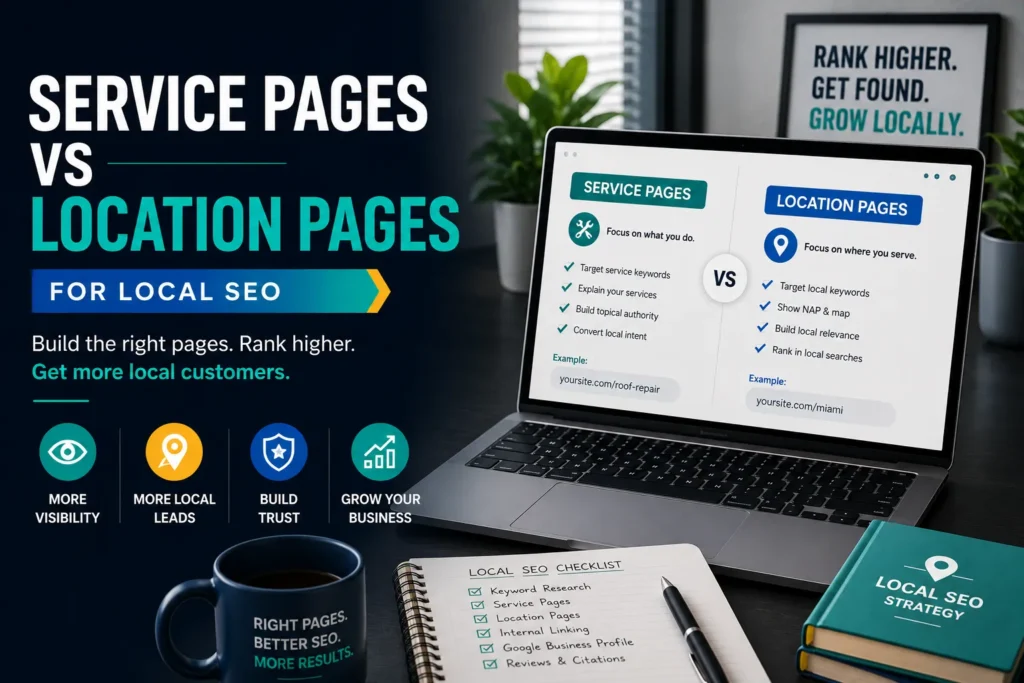
Many local businesses do not have a content problem.
They have a page purpose problem.
A plumbing company builds one page called “Services” and expects it to rank for water heater repair, drain cleaning, leak detection, and emergency plumbing across ten cities.
Another company creates 100 city pages that repeat the same content with a different location inserted into the heading.
A third company publishes separate service pages, location pages, and service location pages without deciding which one should rank for each search. Several pages begin competing against one another, while customers struggle to understand where the company operates and what it actually provides.
The solution is not automatically more content.
The solution is giving every page one clear job.
An SEO service page explains what a business provides. An SEO location page explains where the business provides its services. A service location page targets one specific service in one specific market when that combination has distinct search demand, business value, and enough unique information to justify a standalone page.
The correct structure depends on search intent, market coverage, business operations, competition, and the amount of useful information available.
This guide uses a page architecture decision tree built around ten questions:
- What job should each page perform?
- What does the search result reveal about intent?
- When does a service deserve its own page?
- When does a location deserve its own page?
- When should a service and location have a combined page?
- How should all page types connect?
- What makes each page genuinely unique?
- How can a business prevent cannibalization and doorway content?
- How should pages support Search, Google Maps, and AI visibility?
- How should performance be measured and maintained?
Answer these questions before writing dozens of pages.
The architecture becomes much easier once every URL has a defined purpose.
The Basic Difference Between Service Pages and Location Pages
The clearest way to understand the difference is to identify the primary question each page answers.
| Page type | Primary question | Example intent | Example URL |
|---|---|---|---|
| Service page | What does the company provide? | drain cleaning services | /drain-cleaning/ |
| Location page | Where does the company operate? | plumber in Dallas | /locations/dallas/ |
| Service location page | Who provides this service in this market? | drain cleaning in Dallas | /locations/dallas/drain-cleaning/ |
| Service hub | Which services are available? | plumbing services | /services/ |
| Location hub | Which markets are served? | plumbing service areas | /locations/ |
A service page should establish depth around one service.
A location page should establish relevance and trust within one market.
A combined page must do both without simply copying the parent service and location pages.
Not every business needs all five page types.
A small company serving one city may only need a strong homepage and individual service pages.
A regional contractor may need service pages, a location hub, and several city pages.
A multi location healthcare practice may need detailed branch pages, service pages, and selected service location combinations.
Page count should follow genuine customer demand and business operations.
It should not follow a template sold as a universal local SEO formula.
Decision 1: What Job Should Each Page Perform?
Every indexable page should own a distinct search and conversion role.
Before writing the page, complete this sentence:
This page exists to help a person searching for __________ in __________ understand __________ and take __________ as the next step.
Examples:
This page exists to help a homeowner searching for water heater repair understand the repair process, cost factors, warning signs, and how to schedule service.
This page exists to help a business owner searching for an accountant in Dallas understand which accounting services are available locally and how to request a consultation.
This page exists to help a property owner searching for emergency roof repair in Phoenix confirm local availability and call for urgent assistance.
If two proposed pages produce almost identical answers, they may not need to exist separately.
The Role of a Service Page
A service page should explain:
- The problem the service solves
- Who needs it
- What is included
- How the process works
- What affects cost
- What qualifications matter
- What risks or limitations exist
- Why the company is equipped to provide it
- What the customer should do next
A service page usually targets the service across the company’s broader market rather than one individual city.
The Role of a Location Page
A location page should explain:
- Whether the company genuinely serves the market
- Which services are available there
- How service is delivered locally
- Whether the business has an office or operates as a service area business
- Which local proof supports the claim
- Which neighborhoods or nearby communities are realistically served
- What local customers should expect
- How to contact the correct team
A location page is not simply a service page with a city added to the title.
The Role of a Service Location Page
A service location page should explain:
- Whether the exact service is available in the market
- How the service applies to local customers
- What local conditions may affect the work
- Which local projects, professionals, or facilities provide proof
- Whether pricing, timing, regulations, or availability differ
- What the customer should do next
This page type should only exist when the combination deserves independent treatment.
Decision 2: What Does the Search Result Reveal About Intent?
Do not decide the page type from keyword volume alone.
Search the target query and study what Google currently rewards.
For example, compare:
- drain cleaning
- drain cleaning services
- drain cleaning Dallas
- plumber Dallas
- plumbing company Dallas
The results may contain different page types:
- Service pages
- Homepages
- Location pages
- Service location pages
- Directories
- Google Maps results
- Informational articles
- Local company profiles
The result pattern reveals how Google interprets the search.
When Service Pages Dominate
If most results are detailed pages about one service, the search probably requires service depth.
A broad city page may not satisfy the intent.
Example:
hardwood floor refinishing
The customer wants information about refinishing, not a general overview of every flooring service.
When Location Pages Dominate
If results primarily feature local company homepages, office pages, or broad city landing pages, the query likely has strong provider and geographic intent.
Example:
accountant in Dallas
The customer may want a local provider rather than a detailed explanation of one accounting service.
When Combined Pages Dominate
If results repeatedly feature pages dedicated to the exact service and city, the market may support a service location page.
Example:
emergency plumber in Dallas
The customer needs a particular service in a particular location.
Look Beyond the First Keyword
Google’s AI Overviews and AI Mode may use query fan out, which involves running related searches across several subtopics and sources before generating an answer. A strong page should therefore satisfy the central query and the follow-up questions naturally connected to it.
A service page might need to answer:
- What is the service?
- When is it needed?
- How much does it cost?
- How long does it take?
- Which company provides it locally?
A location page might need to answer:
- Does the company serve the city?
- Which services are offered?
- Is there a real office?
- What proof exists in the market?
- How can someone book?
Use LocalMighty’s local keyword research guide to map these different intent layers before deciding which pages to build.
Decision 3: When Does a Service Deserve Its Own Page?
A service deserves a standalone page when it represents a distinct customer need, process, buying decision, or revenue opportunity.
Strong Reasons to Build a Service Page
Create a dedicated service page when:
- Customers search for the service directly
- The service solves a distinct problem
- The process differs from other services
- Pricing factors differ
- Required expertise or credentials differ
- The customer asks unique questions
- The company wants more leads for the service
- Enough useful information exists to create a complete page
Examples include:
- Emergency roof repair
- Hardwood floor refinishing
- Estate planning
- Dental implants
- Commercial landscaping
- Tree risk assessment
- Water heater replacement
- Google Business Profile optimization
These services should not be reduced to one paragraph on a generic services page.
When a Service Does Not Need a Separate Page
Do not create a standalone page merely because a phrase appears in a keyword tool.
A separate page may not be necessary when:
- The service is a small step within a larger service
- Search intent is effectively identical
- The company rarely provides it
- The page would repeat another page
- There is not enough information to help a customer
- The business does not want more inquiries for it
For example, a cleaning company may not need separate pages for wiping baseboards, dusting shelves, and cleaning light switches when these tasks form part of one standard home cleaning service.
Build the Service Hierarchy First
For many local businesses, service pages should be built before expanding city content.
A practical order is:
- Define the profitable services
- Build a services hub
- Create the primary service pages
- Improve calls to action and conversion tracking
- Add strategic location pages
- Add selected service location pages only when justified
This prevents a common mistake.
Businesses often create 30 city pages while the website still has one weak page describing every service.
Before scaling geography, establish what the company wants to rank and generate leads for.
LocalMighty’s local on-page SEO guide explains how titles, headings, content, internal links, and local context should work together on priority pages.
Decision 4: When Does a Location Deserve Its Own Page?
A location deserves a page when the business genuinely operates in or serves the market and can provide useful information specific to that area.
Strong Reasons to Build a Location Page
Create a location page when:
- The business has a real office, clinic, store, or branch
- The business consistently serves customers in the market
- The location produces meaningful search demand
- The company has local staff, projects, reviews, or experience
- Services or availability differ by location
- The page can help a local customer make a decision
- The market supports business growth
Actual Branch Pages
A branch page should contain genuine operational information:
- Business name
- Address
- Phone number
- Hours
- Team members
- Services
- Appointment information
- Directions
- Parking or access information
- Local reviews
- Photographs
- Location specific calls to action
Each legitimate office should have a dedicated page.
Multi-location businesses can review LocalMighty’s local SEO guide for multi-location companies for a deeper branch strategy.
Service Area Pages
A service area business may create pages for cities where it regularly works even without a public office in each city.
The page must clearly explain the operating model.
Do not imply that the company has a local office when it does not.
Google requires businesses to represent locations accurately and prohibits using virtual offices, remote mailboxes, or locations where the company does not maintain a genuine customer-facing presence.
A service area page may include:
- Services available
- Response or scheduling information
- Local project examples
- Real photographs
- Local testimonials
- Nearby areas served
- Market-specific challenges
- Relevant permits or regulations when verified
- A clear quote or booking path
Does Every City Need a Page?
No.
Do not create a page for every city within driving distance.
Prioritize locations based on:
- Customer demand
- Revenue potential
- Operational capacity
- Existing proof
- Competitive opportunity
- Ability to produce useful local information
A city name in a heading does not create local authority by itself.
The Homepage May Already Serve the Primary City
A single location business often uses its homepage to target the primary service category and home market.
For example:
Family Dentist in Austin, TX
Creating a second page called “Austin Dentist” may duplicate the homepage’s role.
In that situation, use the homepage for the primary market and create location pages only for genuine additional markets or branches.
Decision 5: When Should a Service and Location Have a Combined Page?
A service location page targets one service in one market.
Examples include:
- /locations/dallas/drain-cleaning/
- /locations/phoenix/emergency-roof-repair/
- /locations/miami/dental-implants/
These pages can capture specific commercial intent.
They can also create the greatest duplication and doorway risk when scaled carelessly.
Build a Combined Page When Both Dimensions Matter
A service location page is more likely to be useful when:
- People search for the exact service in the market
- The service has high business value
- Competition requires deeper relevance
- The company genuinely provides the service there
- Local proof exists
- Local conditions affect the service
- The page can stand alone
- The customer benefits from the added specificity
Example of a Strong Combined Page
An emergency roof repair page for Dallas could include:
- Direct emergency availability information
- Storm types common to the market
- Local response boundaries
- Dallas project examples
- City-specific photographs
- Applicable permit or inspection information
- Reviews from Dallas customers
- Service-specific pricing factors
- Local contact process
This is meaningfully different from:
- A general roof repair page
- A broad Dallas roofing page
Example of a Weak Combined Page
A weak page changes only:
- City name
- County name
- Neighborhood list
- Meta title
- One introductory sentence
The rest of the content remains identical to every other city page.
That page does not deserve a separate URL.
Use a Go or No Go Test
Before creating a combined page, ask:
- Is the search intent distinct?
- Is the service profitable in this market?
- Can the company provide it reliably?
- Is there unique local proof?
- Can the page answer location-specific questions?
- Will another page already satisfy the same search?
- Can the page receive useful internal links?
- Can the company maintain it?
When several answers are no, do not build the page yet.
Strengthen the parent service and location pages first.
Decision 6: How Should All Page Types Connect?
Good architecture helps customers and search engines understand the relationship between services and markets.
Google uses links to discover pages and understand their relevance. Google recommends crawlable HTML links with concise, descriptive anchor text and advises that every important page should receive at least one contextual internal link.
Build Two Clear Hubs
A scalable local business website often needs:
Services hub
/services/
This page introduces the company’s main services and links to individual service pages.
Locations hub
/locations/
This page introduces the geographic coverage and links to individual location pages.
Connect Parent and Child Pages
A service page should link to:
- Closely related services
- Relevant service location pages
- Important location pages
- Supporting educational content
- The contact or booking page
A location page should link to:
- Services available in the market
- Relevant service location pages
- Nearby location pages when useful
- Local project examples
- The correct contact path
A service location page should link to:
- Its parent service page
- Its parent location page
- Related services in the same market
- Relevant guides
- Conversion pages
Use Descriptive Anchor Text
Weak anchor:
Learn more
Stronger anchor:
Explore our drain cleaning services
Weak anchor:
Click here
Stronger anchor:
View plumbing services available in Dallas
The anchor should tell users what they will find next.
Choose One URL Pattern
Several structures can work.
Service-focused structure
- /services/drain-cleaning/
- /services/drain-cleaning/dallas/
Location focused structure
- /locations/dallas/
- /locations/dallas/drain-cleaning/
Short structure
- /drain-cleaning/
- /dallas/
- /dallas/drain-cleaning/
The best structure is the one that:
- Reflects the site hierarchy
- Can scale cleanly
- Avoids duplicate URLs
- Remains understandable
- Is used consistently
- Can remain stable
Do not create both:
- /dallas/drain-cleaning/
- /drain-cleaning/dallas/
for the same page intent.
Choose one preferred URL and redirect obsolete duplicates.
Add Breadcrumbs
Breadcrumbs help visitors understand:
- Where they are
- Which parent section owns the page
- How to return to broader services or locations
Example:
Home > Locations > Dallas > Drain Cleaning
Breadcrumbs also reinforce the intended hierarchy when implemented consistently.
Decision 7: What Makes Each Page Genuinely Unique?
Unique content does not mean rewriting the same sentence with synonyms.
It means giving each page information required by its specific audience.
What an SEO Service Page Should Contain
A strong service page may include:
- Clear definition
- Problems or needs addressed
- Who the service is for
- Service options
- Process
- Pricing factors
- Timeline
- Qualifications
- Risks and limitations
- Real examples
- Frequently asked questions
- Service areas
- Clear conversion path
The main focus remains the service.
What an SEO Location Page Should Contain
A strong location page may include:
- Clear statement of local availability
- Services available in the market
- Real office information when applicable
- Local team members
- Local projects
- Market-specific photographs
- Customer reviews from the area
- Scheduling or response information
- Nearby communities served
- Local regulations when verified
- Relevant local conditions
- Clear conversion path
The main focus remains the market.
What a Service Location Page Should Contain
A strong combined page may include:
- Direct answer confirming service availability
- Local service process
- Market-specific issues
- Local pricing factors
- Service-specific local proof
- Relevant local professionals
- Project examples
- Reviews
- City-specific questions
- Local booking instructions
The page must provide something the parent pages do not.
Local Information That Usually Adds Little Value
Avoid filling pages with:
- Generic city history
- Population facts unrelated to the service
- Long lists of landmarks
- Repeated neighborhood names
- Local sports references
- Claims that the company “loves serving the community”
- Weather commentary with no service connection
Local information should improve the customer’s decision.
For example, soil conditions can matter to a foundation contractor. State filing rules can matter to a lawyer. Seasonal storm patterns can matter to a roofer.
A city’s founding date usually does not matter.
Add Firsthand Proof
Google’s people first content guidance encourages original information, clear expertise, useful depth, trustworthy sourcing, and evidence that the creator understands the subject.
Useful page proof includes:
- Real project photographs
- Named team members
- Local credentials
- Process details
- Verified customer feedback
- Original pricing observations
- Local case examples when genuine
- Specific service limitations
- Clear business experience
Do not invent local projects or testimonials.
Decision 8: How Can a Business Prevent Cannibalization and Doorway Content?
Service and location strategies fail when several pages pursue the same intent without offering meaningful differences.
What Keyword Cannibalization Looks Like
Cannibalization may occur when:
- The homepage and city page target the same primary query
- Two service pages explain the same service
- Several city pages appear for one city query
- A service page and service location page are nearly identical
- Google repeatedly switches the ranking URL
- Internal links send conflicting relevance signals
Cannibalization is not simply two pages mentioning the same keyword.
The problem occurs when multiple pages compete for the same search purpose.
How to Diagnose Cannibalization
Use Google Search Console to compare:
- Query
- Landing page
- Impressions
- Clicks
- Average position
- Conversion performance
Look for:
- Several URLs receiving impressions for the same query
- Frequent changes in the ranking page
- A weaker page replacing the intended page
- Several pages with low visibility instead of one strong page
Also review:
- Page titles
- H1 headings
- Internal anchor text
- Canonical tags
- Content overlap
- Backlinks
- Conversion intent
LocalMighty’s local SEO audit checklist can help identify these structural problems.
How to Fix Cannibalization
Choose the action based on page intent.
Merge
Combine two pages when they answer the same question.
Redirect
Send an obsolete or weaker URL to the preferred page.
Reposition
Rewrite the pages when they should serve different intents.
Improve internal links
Link to the correct page with clear anchor text.
Remove from the index
Use noindex for a thin utility page that users still need, but Search does not.
Keep separate
Maintain both pages when each has distinct value, intent, and content.
Do not use canonical tags to avoid making a real architecture decision.
Canonicals are designed to identify a preferred version among duplicate or highly similar URLs. They are not a substitute for differentiating pages that should each rank independently.
Duplicate Content Is Not Automatically a Penalty
Google says duplicate content is not inherently a violation of its spam policies. However, duplicate pages can create a poor user experience, waste crawling resources, and cause Google to choose one canonical version instead of indexing every variation.
The larger concern with mass-produced city pages is often not duplication alone.
It is the purpose and value of the pages.
Understand Doorway Abuse
Google defines doorway abuse as creating pages for similar searches that funnel users toward the same destination or provide less value than a clear browsable hierarchy. Its examples include substantially similar pages targeting different cities or regions.
Warning signs include:
- Every city page sends users to one generic form
- Pages have no meaningful local information
- The business does not genuinely operate in the market
- Hundreds of pages differ only by location name
- The pages are difficult to find through normal navigation
- The architecture exists mainly to occupy more search results
Understand Scaled Content Abuse
Google defines scaled content abuse as producing many pages primarily to manipulate rankings rather than help users, regardless of whether automation, people, or a combination created them.
AI can help with research, outlines, editing, and quality control.
It should not be used to publish hundreds of city pages without real local evidence, editorial review, or customer value.
LocalMighty’s guide to common local SEO mistakes covers additional structural risks.
Decision 9: How Should Pages Support Search, Google Maps, and AI Visibility?
Service pages, location pages, Google Business Profiles, and AI search results work together, but they do not perform the same role.
Service Pages Support Service Relevance
A detailed service page helps search systems understand:
- What the company provides
- Which problems it solves
- Which entities and terms relate to the service
- Which qualifications matter
- What customers should expect
The Google Business Profile website link and services can connect with these pages, but the website content must stand on its own.
Location Pages Support Geographic Context
A location page helps clarify:
- Where the company operates
- Whether it has an office
- Which services are available in the market
- Which local team or evidence supports the claim
- How customers in the area can convert
A location page does not create a new Google Maps location.
It does not change the business’s physical proximity to a searcher.
Google states that local results are mainly influenced by relevance, distance, and prominence. A website page may strengthen relevance and organic visibility, but it cannot remove the distance component of Google Maps.
Review LocalMighty’s guide to ranking in Google Maps for a complete local pack strategy.
Service Location Pages Support Precise Commercial Queries
A combined page can become useful for searches such as:
- emergency electrician in Phoenix
- immigration lawyer in Arlington
- commercial landscaper in Mesa
- hardwood refinishing in Dallas
The page must clearly connect:
- Company
- Service
- Location
- Customer need
- Local proof
- Conversion action
Write for AI Extraction Without Creating Robotic Pages
Google says the same foundational SEO practices apply to AI Overviews and AI Mode. Pages must be indexed, crawlable, useful, internally linked, and available in textual form. Google does not require a special AI page type or unique schema for generative search.
Improve AI visibility through:
- Clear question-based headings
- Direct answers
- Consistent entity names
- Specific service and location information
- Original evidence
- Local proof
- Current details
- Descriptive internal links
- Useful comparisons
- Accurate structured data
A service page can support questions about the service.
A location page can support questions about providers in a market.
A service location page can support detailed recommendations combining both.
LocalMighty’s generative engine optimization guide explains how discoverability, citation quality, entity clarity, and third-party authority influence AI visibility.
You can also review the best AI search optimization techniques for practical citation-focused improvements.
Use Structured Data Accurately
Potential structured data may include:
- Organization
- LocalBusiness
- Service
- WebPage
- BreadcrumbList
- Person
- Article
Use LocalBusiness markup for a genuine business location or appropriate primary business entity.
Do not mark every service area page as a separate business location when no branch exists there.
Structured data should match visible page content and real business operations. It clarifies information but does not guarantee rankings or AI citations.
LocalMighty’s local business schema markup guide covers appropriate implementation in more detail.
Decision 10: How Should Performance Be Measured and Maintained?
A page should not remain online simply because someone created it years ago.
Measure whether it performs its intended role.
Measure Service Pages
Track:
- Nonbranded service queries
- Organic impressions
- Organic clicks
- Calls
- Forms
- Bookings
- Assisted conversions
- Revenue by service
- Internal link traffic
- AI citations or referrals
Measure Location Pages
Track:
- City and regional queries
- Local organic visibility
- Leads by market
- Calls by location
- Form submissions
- Qualified lead rate
- Revenue by city
- Branded searches
- Local backlinks
- AI mentions
Measure Service Location Pages
Track:
- Exact service and city queries
- Search impressions
- Organic clicks
- Qualified leads
- Cost per lead from supporting channels
- Revenue from the combination
- Cannibalization with parent pages
- AI citation frequency
Use a Query and Page Matrix
Build a simple worksheet with:
| Target intent | Preferred page | Current ranking page | Leads | Required action |
|---|---|---|---|---|
| drain cleaning | service page | service page | strong | maintain |
| plumber Dallas | location page | homepage | moderate | clarify page roles |
| drain cleaning Dallas | combined page | location page | weak | evaluate combined page |
| emergency plumber Dallas | combined page | no page | none | create if justified |
This makes architecture decisions easier to defend.
Audit Pages Regularly
Review:
- Search intent
- Rankings
- Leads
- Conversion rates
- Content accuracy
- Local proof
- Internal links
- Duplicate sections
- Cannibalization
- Broken links
- Outdated services
- Closed locations
- Schema
- Calls to action
Possible actions include:
- Improve
- Expand
- Merge
- Redirect
- Reposition
- Remove
- Noindex
Do not keep every page forever.
The website should become clearer as it grows.
LocalMighty’s guide to generating leads with local SEO explains how rankings, service relevance, trust, and conversion tracking should connect to business outcomes.
Service Pages vs Location Pages Decision Checklist
Build a Service Page When
- The service has distinct intent
- Customers search for it
- The process is different
- The service is profitable
- Unique information is available
- A clear conversion action exists
Build a Location Page When
- The market is genuinely served
- The location matters commercially
- Local proof exists
- The page can help a local customer
- The company can maintain accurate information
- The page differs from the homepage
Build a Service Location Page When
- The exact combination has meaningful intent
- The service is offered in the market
- The combination has business value
- Unique local evidence exists
- Parent pages do not fully satisfy the query
- The page can stand alone
Do Not Build the Page When
- Only the keyword changes
- The business does not serve the market
- No local proof exists
- Another page already owns the intent
- The page would repeat existing content
- The company cannot maintain it
- The page exists only to manipulate rankings
How LocalMighty Helps Businesses Build the Right Page Architecture
Building more pages does not automatically create more local visibility. LocalMighty helps businesses determine which services and markets deserve dedicated pages, map each keyword to the correct search intent, create scalable service and location structures, prevent cannibalization, strengthen internal linking, and remove weak or repetitive content before it becomes a larger technical problem.
Our strategies connect local keyword research, service page optimization, location architecture, technical SEO, Google Maps visibility, generative engine optimization, entity clarity, conversion tracking, and content quality. The goal is to build fewer pages with clearer purpose, stronger local relevance, better AI visibility, and a greater ability to generate qualified calls, appointments, and customers.
The Best Page Is the One That Owns One Clear Job
Service pages and location pages should not compete for attention.
They should support one another.
The service page proves that the company understands and provides the work.
The location page proves that the company operates in the market.
The service location page connects both only when the combination deserves its own answer.
A strong local website does not need a page for every keyword variation.
It needs a clear architecture that reflects:
- What the business sells
- Where it operates
- What customers search
- Which pages provide the strongest answer
- How each visit can become a lead
Build the service foundation first.
Expand geography where the business has real demand and proof.
Create combined pages selectively.
Then measure every page by the calls, appointments, customers, and revenue it helps produce.
That is the difference between a website filled with local landing pages and a website built to own a local market.
Frequently Asked Questions About Service Pages and Location Pages
Neither page type is universally better. Service pages target what the business provides, while location pages target where the business operates. Most growing local businesses need both, but every page should serve a distinct search and conversion intent.
No. A service needs its own page when customers search for it, the process or decision is distinct, and the business wants more leads for it. Small tasks included within a larger service may not justify standalone pages.
No. Create pages for genuine markets that the company can provide and can support with useful local information. Avoid building pages for every nearby city simply because the company is willing to travel there.
A service area page is a website page explaining that a business serves a particular city, county, or region. It is commonly a type of location page for companies that travel to customers rather than operating a public office in every market.
No. A website page does not create a Google Business Profile or change the company’s physical proximity. Separate profiles require genuine eligible business locations that follow Google’s guidelines.
A single-location business can often use its homepage to target its primary service category and main city. Creating a second page with the same intent may cause unnecessary overlap.
City pages are not automatically doorway pages. They become risky when substantially similar pages target many locations, offer little unique value, and funnel every visitor toward the same destination.
There is no required word count. The page should contain enough useful information to answer local customer questions, establish real service availability, provide proof, and support conversion without filler.
No. Some shared business information is natural, but the main content should reflect the page’s distinct purpose. A service page needs service depth. A location page needs market relevance. A combined page must connect both.
A short, logical, and consistent structure is best. Both service-focused and location-focused folders can work. Choose one hierarchy, use it consistently, and avoid publishing duplicate URL variations.
Yes, particularly when the company has strong authority, and the cities are within its real market. However, competitive city queries may require useful location pages or combined pages when the intent and available local evidence justify them.
They can. Clear location pages help AI systems understand where a company operates, which services are available, and what local proof supports the business. The page still needs to be accessible, accurate, specific, and trustworthy.
AI can support research, planning, and editing. It should not invent projects, testimonials, offices, local conditions, or business experience. Publishing large numbers of repetitive AI-generated pages can create quality and spam risks.
Identify the preferred page for each intent, compare page content and internal links, then merge, redirect, reposition, or remove weaker pages. The correct fix depends on whether the pages should serve the same or different searches.