
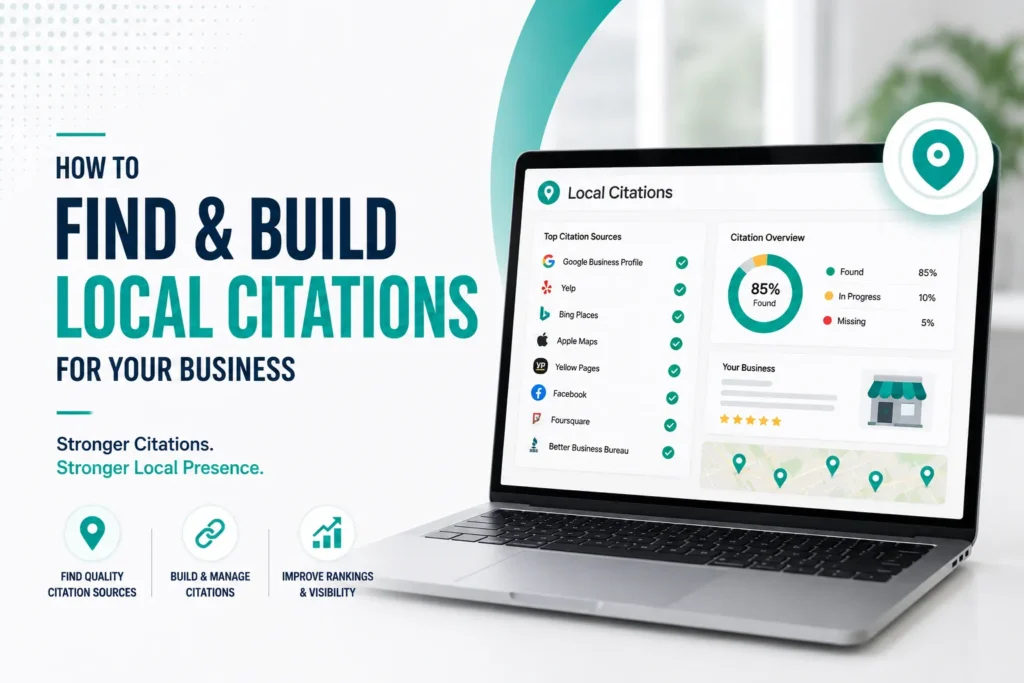
Local SEO is no longer just about getting your Google Business Profile into the local pack. A well-optimized Google Business Profile, consistent business information across search engines, map platforms, directories, and apps, and accurate local signals all help search engines and increasingly AI-powered search systems understand who your business is, where it operates, and how customers can contact you.
That is where local citations come in.
A local citation is an online mention of your business’s core information, typically its Name, Address, and Phone number (NAP). Some citations include a website link, business category, opening hours, reviews, photos, or other details. Others may simply mention the business name and location.
Citations aren’t a magic ranking shortcut, and having thousands of directory listings doesn’t automatically make a business rank higher. Google’s own documentation says local results are primarily influenced by relevance, distance, and prominence, with prominence including information Google finds about a business across the web.
That makes citation work less about collecting the largest possible number of listings and more about building a consistent, credible, relevant local entity across the web.
This guide shows you exactly how to research citation opportunities, uncover competitor citations, choose directories, submit listings, clean up incorrect information, and maintain your citation profile over time.
Quick-start checklist
Before starting, have your Google Business Profile access, website, finalized NAP information, business description, categories, logo, photos, business hours, social profiles, and a tracking spreadsheet ready. For a single-location business, you can organize the initial research and submission process into a focused working session rather than treating it as an endless directory-building campaign.
What Is a Local Citation?
A local citation is a reference to a business’s information on another website, directory, platform, app, publication, or online resource.
The simplest citation contains:
- Business name
- Physical address
- Phone number
A more complete citation might also contain:
- Website
- Business category
- Opening hours
- Description
- Photos
- Reviews
- Social profiles
- Service areas
- Products or services
Examples include a Yelp business profile, an industry directory listing, a chamber of commerce member page, a local newspaper article, or a “best businesses in [city]” roundup.
The key point is that a citation doesn’t have to be a backlink.
A directory profile containing your business name, address, and phone number is a citation even if the website does not give you a followed link.
Citation vs. Backlink
These concepts overlap, but they are not identical.
| Asset | What it is | Must contain NAP? | Must contain a link? |
| Local citation | Online business reference | Usually | No |
| Backlink | Link from another website to yours | No | Yes |
| Directory listing | Structured business profile | Usually | Often |
| Unstructured citation | Business mention in editorial content | Sometimes partially | Not necessarily |
A directory page that lists your business name, address, phone number, and website can therefore provide both a citation and a backlink.
A newspaper article that mentions your company by name without linking to your website can still function as an unstructured citation.
Why Local Citations Matter for Local SEO
Citations help establish a local business’s broader web presence.
Google says complete and accurate Business Profile information can improve the likelihood that a business appears for relevant local searches. At the same time, prominence is influenced by information about a business across the web.
Citations also have practical value outside of rankings.
Customers may discover businesses through:
- Google Maps
- Apple Maps
- Yelp
- Bing
- Industry directories
- Local chambers
- Travel platforms
- Review websites
- Mobile apps
- AI-powered search experiences
So the objective is not simply “build citations for Google.”
The objective is to make sure that when a customer, search engine, map platform, directory, or AI system encounters your business elsewhere, it finds the same trustworthy business information.
Structured vs. Unstructured Citations
Not all citations look the same.
Structured Citations
Structured citations appear in standardized business-directory formats.
Typical fields include:
- Business name
- Address
- Phone
- Website
- Category
- Hours
- Description
Examples include Yelp, Yellow Pages, industry directories, local directories, and chamber listings.
Because the information is presented in defined fields, structured citations are relatively easy to audit.
Unstructured Citations
Unstructured citations occur naturally inside editorial or community content.
Examples include:
- A local newspaper article
- A blog mentioning a business
- A podcast show-notes page
- A local event sponsor page
- A “best of” roundup
- A neighborhood resource page
- A journalist’s article
- A community organization page
For example:
“ABC Plumbing has served homeowners throughout Dallas for more than 15 years.”
That sentence is an unstructured business mention, even if it doesn’t use a formal directory template.
Unstructured citations are harder to build systematically, but they can be valuable because they place the business inside a relevant local or topical context.
For advanced local SEO campaigns, look beyond directory submissions and find opportunities to earn contextual mentions from genuinely relevant websites.
What Is NAP and Why Does Consistency Matter?
NAP stands for:
- Name
- Address
- Phone
NAP consistency means your core business information appears accurately and consistently across key sources.
For example:
| Inconsistent | Consistent |
| ABC Plumbing Co. | ABC Plumbing Co. |
| 123 Main St | 123 Main Street |
| (214) 555-0188 | (214) 555-0188 |
| Suite 4 | Suite 4 |
However, there is an important nuance: consistency does not mean obsessively forcing every punctuation mark to be identical.
The priority is that the information represents the same real-world business and location.
For example, “123 Main St.” and “123 Main Street” are normally recognizable as the same address. A missing suite number, wrong phone number, old address, or different business name is much more serious.
You may also encounter:
- NAP+W – Name, Address, Phone + Website
- NAPC – Name, Address, Phone + Category
For practical citation management, NAP+W is a useful working model because the website and category reinforce the business’s identity.
Why Bad NAP Data Creates Problems
Imagine a business has:
- One phone number on Yelp
- Another number on Yellow Pages
- An old address on a local directory
- A different business name on an industry site
- Two duplicate listings on another platform
The problem is not simply that the listings “look messy.”
It creates ambiguity.
Search engines and users need to determine whether these records represent the same business.
That is why citation cleanup can sometimes be more valuable than creating another 50 new directory listings.
What Information You Need Before Building Local Citations
Citation building becomes much easier when you prepare a golden record before creating a single listing.
Think of this as the master business record from which every submission is copied.
Core Business Details
Prepare:
- Official real-world business name
- Physical address
- Suite/unit number where applicable
- Local business phone
- Website URL
- Business email
- Primary business category
- Secondary categories
- Service areas, if applicable
One correction to a common citation-building recommendation: do not automatically force a legal entity name into every public listing.
Your public business name should accurately represent the business customers know. Google requires businesses to represent themselves accurately and does not permit adding marketing keywords to the business name simply to manipulate rankings.
Business Description and Positioning
Create at least two descriptions.
Short description: approximately 25–50 words.
Long description: approximately 150–300 words.
Your descriptions should explain:
- What the company does
- Who it serves
- Where it operates
- Main services
- Important specialties
- Genuine differentiators
Do not turn the description into a keyword dump.
Instead of:
“Best Dallas plumber Dallas plumbing emergency plumber Dallas TX plumbing services…”
Write naturally:
“ABC Plumbing provides residential and commercial plumbing services throughout Dallas, including emergency repairs, drain cleaning, water heater service, and fixture installation.”
The second version is easier for customers to understand and easier to reuse across directories.
Business Categories
Prepare:
- Primary category
- Secondary categories
- Industry classifications
Use categories that genuinely describe the business.
Don’t select an unrelated category just because it has higher search volume.
For Google Business Profile, follow Google’s available taxonomy and reflect the business’s actual primary service.
Visual and Trust Assets
Prepare:
- Logo
- Storefront photograph
- Team photographs
- Product/service photographs
- Interior photographs, where relevant
- Business hours
- Holiday hours
- Payment methods
- Social profile URLs
Keep the images organized in a dedicated folder.
A useful naming system is:
business-name-storefront.jpg
business-name-team.jpg
business-name-service-01.jpg
This makes large citation campaigns much easier to manage.
Verification and Compliance Information
Some industries require additional information.
Depending on the business, you may need:
- License number
- Professional registration
- NPI
- Business registration information
- Owner or manager information
- Service-area information
- Insurance details
- Accreditation information
This is especially important for regulated industries such as healthcare, legal, financial, and professional services.
Set Up a Citation Tracking Sheet
Do not build citations without tracking them.
Create a spreadsheet with columns such as:
| Directory | URL | Username/Email | Submitted | Status | Live URL | NAP Correct | Category | Duplicate | Notes |
| Directory A | URL | Date | Live | URL | Yes | Correct | No | Verified | |
| Directory B | URL | Date | Pending | – | Yes | Correct | No | Awaiting email | |
| Directory C | URL | Date | Rejected | – | Yes | – | – | Needs review |
For agencies, add:
- Client
- Location
- Priority
- Citation type
- Verification method
- Login owner
- Last audited
- Next audit date
This spreadsheet becomes your single source of truth.
How to Find Local Citation Opportunities
This is where most citation strategies either become useful or waste time.
Do not start by submitting to random lists of “500 business directories.”
Start with research.
Your goal is to discover the sources that are:
- Relevant to your industry.
- Relevant to your city or region.
- Used by your competitors.
- Trusted by customers.
- Capable of generating a legitimate business listing.
- Worth maintaining.
Method 1 – Search Google Yourself With Operators
Google itself is one of the best free citation research tools.
Start with:
“[city]” “[business category]” directory
Example:
“Dallas” “plumber” directory
Look for actual directories rather than generic SEO listicles.
Next:
“add your business” “[city].”
“submit your business” “[industry].”
“add a listing” “[city.]”
You can also search for directory pages:
intitle: “business directory” “[city.].”
For industry-specific opportunities:
“[industry]” directory “[city]”
For local organizations:
“[city]” chamber of commerce business directory
For government and educational opportunities:
site:.gov “[industry]” directory
site:.edu “[industry]” directory
These searches will not always produce a citation opportunity. That is why every result should go through a qualification process.
A Five-Second Qualification Test
When you discover a website, ask:
Is this actually relevant?
Then ask:
- Does it accept legitimate businesses?
- Is it relevant to my industry?
- Is it relevant to my location?
- Does it have real users?
- Does it contain genuine businesses?
- Does the site appear maintained?
- Is there a clear business listing process?
If you answered no to most of these, move on.
Method 2 – Competitor Citation Scraping
Competitor research is one of the highest-value free citation discovery methods.
Start by identifying three to five competitors that rank well for your target local searches.
Do not choose competitors solely because they are famous.
Prioritize businesses that actually compete with you in the same local market.
Then search:
“[Competitor Name]” “[Competitor Phone]”
and:
“[Competitor Name]” “[Competitor Address]”
You can also search:
“[Competitor Name]” -site:competitordomain.com
The goal is to find third-party pages that mention the competitor.
For each useful result, record:
- Directory name
- URL
- Listing URL
- Industry relevance
- Local relevance
- Competitor found
- Submission method
- Priority
Repeat this for three to five competitors.
Then combine the results.
The Multiple-Competitor Rule
If a directory contains:
- Competitor A
- Competitor B
- Competitor C
that directory deserves more attention than one with only one competitor.
Why?
Because repeated competitor presence shows the source is already used in your market.
This doesn’t prove the directory itself is a ranking factor.
It simply makes the directory a stronger prospecting signal.
Method 3 – Use Citation Research Tools
Manual research works, but specialized tools can dramatically reduce the workload.
Whitespark Local Citation Finder is designed specifically for citation discovery and competitive citation research. Its current plans include campaign-based citation research, with pricing beginning at $39/month on monthly billing or $33/month when billed annually for the Small Business plan.
BrightLocal Citation Tracker can audit existing citations and identify competitor citation opportunities. BrightLocal currently includes Citation Tracker in its Track, Manage, and Grow plans.
A practical workflow is:
- Enter your business.
- Enter the target location.
- Identify competitors.
- Run the citation comparison.
- Export or record the opportunity list.
- Remove irrelevant directories.
- Group the remaining opportunities by priority.
- Submit only to worthwhile sources.
BrightLocal explains that its Citation Tracker audits a business’s existing citations and also identifies competitor citations as new opportunities.
Ahrefs and Semrush for Citation Discovery
Citation-specific tools are not the only option.
If you already use Ahrefs or Semrush, backlink intersection can reveal websites linking to several competitors.
The workflow is:
- Enter your domain.
- Add two or three competing domains.
- Find referring domains shared by competitors.
- Filter out irrelevant sites.
- Inspect the remaining domains manually.
- Identify directory, association, local, editorial, and industry opportunities.
- Add qualified prospects to your citation sheet.
This method is especially useful because some opportunities can provide both a business mention and a backlink.
Semrush’s current Local Pro plan includes Listing Management, which distributes and manages business information across 70+ directories. The current listed price is $60/month per location when billed annually.
Method 4 – Data Aggregators and Distribution Networks
Data aggregators distribute business information to multiple downstream services.
The basic idea is:
One authoritative business record → distribution network → multiple downstream platforms
This can save substantial manual work.
However, the ecosystem has changed over time, so avoid publishing old aggregator lists without checking current availability and coverage.
For example, BrightLocal currently identifies Data Axle, Neustar, Foursquare, GPS Network, and YP Network among the aggregator networks available through its Citation Builder service, with coverage varying by country.
The practical advantages are:
- Less repetitive manual work
- Centralized business data
- Broader distribution
- Easier updates
The disadvantages include:
- Propagation delays
- Coverage differences by country
- Less control over every downstream display
- Recurring fees for some synchronization services
- Potential overwriting if another source supplies conflicting information
The Best Order for Aggregator Work
A useful sequence is:
- Finalize the golden record
- Correct major data sources
- Submit to appropriate aggregators/distribution networks
- Claim important first-party platforms
- Build niche directories
- Build local/community citations
- Pursue unstructured mentions
This reduces the chance that you spend hours manually correcting directories that later receive conflicting data from another source.
Method 5 – Citation Tools and Services Compared
| Tool | Best for | Discovery | Building | Ongoing management | Approx. current pricing |
| BrightLocal | Citation auditing + building | Excellent | Excellent | Excellent | Plans vary; Citation Builder is pay-as-you-go |
| Whitespark | Citation discovery + competitive gaps | Excellent | Via services | Good | From $39/mo for Citation Finder |
| Moz Local | Distribution + local listing management | Good | Good | Good | Historically around $99/location/year; verify current offer |
| Yext | Enterprise listings distribution | Good | Excellent | Excellent | Primarily sales/demo-based |
| Semrush Local | Listing management + broader SEO | Good | Excellent | Excellent | Local Base from $30/location/mo; Pro from $60/location/mo annually |
| Manual DIY | Maximum control + low cost | Excellent | Excellent | Manual | Free apart from staff time |
Pricing changes frequently. Verify the vendor’s current pricing page before publication or purchase.
BrightLocal currently lists its Track, Manage, and Grow plans by location and also offers Citation Builder separately on a pay-as-you-go basis. Citation Builder starts at $3.20 per site, with bulk credits reducing the effective price to as little as $2 per citation.
Whitespark currently lists Local Citation Finder at $39/month on monthly billing or $33/month when billed annually for its Small Business plan.
Semrush currently lists Local Base at $30/month per location when billed annually and Local Pro at $60/month per location when billed annually. Listing Management is included in Pro.
Yext’s current listings platform emphasizes direct integrations with 200+ publishers. It doesn’t list a simple, universal public price on its listings page, so a sales quote is often the more appropriate comparison for many businesses.
The key lesson is that the cheapest tool isn’t necessarily the cheapest workflow.
If you manage one business with 20 high-value directories, DIY may be ideal.
If you manage 100 locations, manually maintaining every listing can become far more expensive than a distribution platform.
Method 6 – Find Niche and Industry-Specific Directories
Generic directories are only one layer of citation building.
Industry-specific sources can be more useful because they place the business in a relevant topical environment.
Examples include:
| Industry | Potential platforms |
| Healthcare | Healthgrades, Zocdoc |
| Legal | Avvo, FindLaw |
| Home services | Houzz |
| Hospitality | Tripadvisor, OpenTable |
| Weddings | WeddingWire, The Knot |
| Agencies/B2B | Clutch, GoodFirms |
Always check these examples for current availability, geographic coverage, and eligibility.
Search operators are simple:
“[industry]” directory
“[industry]” “[city]” directory
“best [industry] in [city].”
“[industry] near me” “[city]”
The final search is particularly useful for finding editorial lists and roundup pages rather than traditional directories.
Method 7 – Local and Community Sources
Local citations can come from organizations that are not traditional SEO directories.
Look for:
- Chamber of commerce listings
- City business directories
- Local business associations
- Trade associations
- Local newspapers
- Community organizations
- Networking groups
- BNI chapters
- Sponsorship pages
- Local events
- Charity organizations
- School or university partnerships
- Neighborhood organizations
For example:
“[city]” chamber member directory
“[city]” business association
“[city]” business directory
“[city]” local business spotlight
“[city]” sponsor businesses
These opportunities can be particularly valuable because they combine local relevance with genuine business context.
Method 8 – Unstructured Citation Opportunities
This is where citation strategy becomes more sophisticated.
Instead of asking:
“Where can I submit my business?”
ask:
“Where can my business legitimately be mentioned?”
Potential sources include:
- Local journalism
- Expert quotes
- Podcasts
- Community interviews
- Guest contributions
- Local roundups
- Industry articles
- Event pages
- Sponsorship pages
- Association articles
Journalist-request platforms such as Qwoted and Connectively can be useful when they are active in your market, although availability and publisher participation change over time.
For local roundups, search:
“best [service] in [city].”
“top [service providers] in [city]”
“[city] business guide [industry]”
For podcasts:
“[city]” “[industry]” podcast
For local publications:
“[city]” “[industry]” news
The objective is not to manufacture mentions.
The objective is to earn real references from relevant sources.
How to Build a Local Citation: Step-by-Step
Finding opportunities is only half the process.
Now you need to build them correctly.
Step 1 – Finalize Your Golden Record NAP
Before submitting anything, create a master block of information.
For example:
Business Name:
ABC Plumbing
Address:
123 Main Street, Suite 400
Dallas, TX 75201
Phone:
(214) 555-0188
Website:
https://example.com
Primary Category:
Plumber
Keep this record unchanged unless the real business information changes.
Copy and paste from it.
Do not manually type the information into every form.
Step 2 – Prioritize the Directory List
Do not treat every directory equally.
A practical priority model is:
Tier 1 – Essential
Major search, map, review, and consumer platforms.
Tier 2 – Industry
Directories specifically relevant to your profession.
Tier 3 – Local
Chambers, associations, local publications, community organizations.
Tier 4 – Secondary
Legitimate general directories with useful local or industry relevance.
Tier 5 – Unstructured
Editorial mentions, roundups, podcasts, sponsorships, and PR.
You can also score prospects:
| Factor | Score |
| Competitor presence | 0 – 3 |
| Industry relevance | 0 – 3 |
| Local relevance | 0 – 3 |
| Customer usefulness | 0 – 3 |
| Website quality | 0 – 3 |
| Listing availability | 0 – 2 |
Review a directory scoring 14/17 before one scoring 5/17.
This creates a quality-first citation strategy.
Step 3 – Create Submission Accounts
Use a dedicated business email.
For example:
listings@businessdomain.com
or:
marketing@businessdomain.com
Do not create dozens of directory accounts using random personal emails.
Store credentials securely in a password manager.
Your spreadsheet should track account ownership, but passwords themselves should ideally remain in a password manager rather than a plain spreadsheet.
Step 4 – Submit Consistent Information
When completing a listing, fill in:
- Business name
- Address
- Phone
- Website
- Category
- Description
- Hours
- Photos
- Services
- Social profiles
Use the golden record.
For fields not part of the golden record, decide based on the platform’s requirements.
Do not create keyword-stuffed variations.
For example, if the actual business is:
ABC Roofing
do not submit:
Best Affordable Emergency Roofing Contractor Dallas TX
simply because you want to rank for those terms.
The listing should accurately represent the real business.
Step 5 – Verify the Listing
Directories may use:
- Email verification
- Phone verification
- SMS verification
- Manual moderation
- Business-document verification
- Address verification
Check your business email after submission.
If a platform requests verification, complete it promptly.
Do not create fake information to bypass verification.
Step 6 – Record the Submission
Update your spreadsheet immediately.
Change:
Not Started → Submitted
Then:
Submitted → Pending
Then:
Pending → Live
When live, record the exact listing URL.
This matters because six months later you do not want to wonder:
“Did we ever build this listing?”
Step 7 – Check Indexation
Once the listing has been published, search Google for it.
Try:
site:directory.com “Business Name”
You can also search:
“Business Name” “Phone Number”
and:
“Business Name” “Address”
Indexation isn’t guaranteed, and an unindexed directory page isn’t automatically useless. The listing can still have direct customer value or be consumed by another platform.
The check simply confirms that the listing exists and is publicly accessible.
How to Audit and Clean Up Existing Citations
For established businesses, citation cleanup should usually happen before aggressive citation expansion.
You may discover that the business already has:
- Old addresses
- Duplicate profiles
- Incorrect phone numbers
- Former business names
- Wrong categories
- Closed locations
- Incorrect websites
- Missing suite numbers
Find Existing Citations
Start with Google.
Search:
“Business Name”
Then:
“Business Name” “Phone”
Then:
“Business Name” “Address”
If the business has moved, search the old information too:
“Business Name” “Old Phone”
“Business Name” “Old Address”
This can uncover forgotten listings that a basic business-name search misses.
Use Citation Tools for Larger Audits
For larger businesses or agencies, use tools such as BrightLocal Citation Tracker or Whitespark.
BrightLocal’s Citation Tracker can audit existing citations and compare competitor citation profiles.
Categorize the output rather than treating it as one giant list.
Common Citation Errors
Duplicate Listings
Two listings represent the same business location.
Action: claim, merge, suppress, or request removal depending on the platform.
Old Address
The business moved, but the old listing remains.
Action: update it or request closure/merger where appropriate.
Wrong Phone
The listing contains a disconnected or unrelated number.
Action: correct it immediately.
Inconsistent Address
The listing omits a suite number or uses incorrect location information.
Action: correct the listing.
Wrong Category
The directory categorizes the business incorrectly.
Action: change it to the most accurate available category.
Closed Business
A listing still represents a location that no longer operates.
Action: follow the platform’s process for closure or merger.
How to Fix or Remove Bad Citations
Use this order:
1. Claim the listing
If you can, claim it.
2. Correct the information
Update NAP and other important fields.
3. Merge duplicates
If the platform supports merging, use its official process.
4. Contact support
For unclaimed or problematic listings, contact the directory.
5. Use distribution networks where appropriate
For larger campaigns, listing-management platforms can distribute updated information and monitor duplicates.
Semrush Listing Management, for example, allows businesses to distribute information across directories and manage duplicates and user suggestions from one location.
How to Track and Maintain Citations Long-Term
Citation work is not a one-time SEO task.
Business information changes.
A company might:
- Move offices
- Change phone numbers
- Rebrand
- Add locations
- Close a location
- Change business hours
- Change categories
- Update its website
Any major NAP change should trigger a citation review.
Recommended Audit Schedule
For a stable single-location business:
Every 6-12 months: run a citation audit.
For a business that frequently changes information:
Audit immediately after major changes.
For multi-location businesses:
Use ongoing listing management rather than relying entirely on annual manual audits.
Maintain the Master Spreadsheet
The spreadsheet should remain active.
Add:
- Last checked date
- Last updated date
- Current listing URL
- Status
- Problems
- Duplicate information
- Verification status
- Next action
This turns citation building from a one-off task into a repeatable system.
Common Local Citation Mistakes to Avoid
Building Quantity Instead of Quality
You do not need hundreds of questionable directories.
A smaller portfolio of legitimate, relevant citations can be more useful than a huge collection of low-quality listings.
Using Keyword-Stuffed Business Names
Do not turn the business name into a list of keywords.
This can violate platform guidelines and create inconsistent entity information.
Use the real-world business name.
Using Different NAP Information
Do not intentionally create variations just to target different keywords.
Consistency starts with a reliable golden record.
Using a Tracking Number Everywhere
Call tracking can be useful, but replacing the primary business number across every citation creates unnecessary inconsistency.
A better strategy is to preserve the primary business number and use tracking numbers where the platform and measurement strategy support them without compromising the core business record.
Ignoring Niche Directories
A plumber should not spend the entire citation budget on generic directories while ignoring legitimate home-service or trade-specific platforms.
Industry relevance matters.
Ignoring Local Organizations
Chambers, trade associations, local publications, events, and community organizations can produce highly relevant business mentions.
Paying for Spammy Directory Packages
Be cautious with services promising:
“5,000 citations for $49.”
Ask:
- Where will they be submitted?
- Can I see the sites first?
- Are they relevant?
- Are they legitimate?
- Will I own the listings?
- Can duplicates be removed?
- What happens after the service ends?
The goal is not to maximize the number of URLs containing your business name.
The goal is to improve the accuracy, coverage, and credibility of your local presence.
Building Citations and Forgetting Them
A listing that was correct three years ago may now contain:
- An old phone
- Old hours
- Old website
- Old address
- Incorrect categories
Maintenance is part of citation SEO.
Local Citation Checklist
Use this as the working checklist for a citation campaign.
Before Building
- Finalize business name
- Finalize physical address
- Finalize phone number
- Confirm website URL
- Confirm primary category
- Prepare secondary categories
- Write short description
- Write long description
- Prepare logo
- Prepare business photos
- Confirm business hours
- Prepare social URLs
- Prepare verification information
- Create dedicated business email
- Create citation tracking spreadsheet
Research
- Search general directories
- Search industry directories
- Search local directories
- Research three to five competitors
- Search competitor names + phone numbers
- Search competitor names + addresses
- Run citation-gap research
- Check aggregator/distribution options
- Identify local associations
- Identify chamber opportunities
- Identify editorial opportunities
- Identify unstructured citation opportunities
Build
- Prioritize opportunities
- Create accounts
- Submit golden-record information
- Add correct category
- Add business description
- Add photos
- Complete verification
- Record submission date
- Record status
- Record live URL
Cleanup
- Search old business information
- Find duplicate listings
- Correct old phone numbers
- Correct old addresses
- Correct categories
- Remove/merge duplicates
- Close obsolete listings
- Recheck major platforms
Maintenance
- Re-audit every 6–12 months
- Audit after NAP changes
- Monitor new duplicates
- Update holiday hours
- Update business descriptions
- Keep tracking sheet current
- Review competitor citation gaps periodically
How Many Local Citations Does a Business Need?
There is no universal number.
A business does not need to reach an arbitrary target such as 50, 100, or 500 citations.
The appropriate number depends on:
- Industry
- Location
- Competition
- Business type
- Number of locations
- Existing citation coverage
- Important local platforms
- Industry directories
- Community sources
A better question is:
Have we covered the important, legitimate sources that customers and competitors in this market actually use?
For one local business, that might mean a few dozen high-quality listings and mentions.
For a large multi-location company, the citation ecosystem can involve hundreds or thousands of publisher relationships.
The number itself is not the strategy.
Coverage, accuracy, relevance, and maintenance are the strategy.
Do Local Citations Still Matter in 2026?
Yes, but the way you should think about them has changed.
Local SEO has expanded beyond traditional Google search results.
Google’s local ranking documentation still identifies relevance, distance, and prominence as the main factors behind local results. It also explains that prominence can reflect information Google has about a business across the web, including links, articles, and directories.
At the same time, search behavior increasingly includes AI-generated answers and conversational discovery.
That makes consistent business information useful beyond conventional directory rankings.
If different sources tell different stories about your business, any system attempting to understand that business has more conflicting information to reconcile.
The modern citation strategy is therefore:
Accurate entity data + authoritative platforms + relevant directories + local mentions + reviews + website consistency.
Do not treat citations as an isolated ranking trick.
Treat them as part of your digital entity infrastructure.
What Is the Difference Between a Citation and a Backlink?
A citation is a business reference.
A backlink is a hyperlink.
A citation can exist without a link.
A backlink can exist without NAP.
For example:
Citation only:
ABC Roofing, Dallas, TX, (214) 555-0188
Backlink only:
Visit our partner at example.com.
Both:
ABC Roofing – example.com
The strongest opportunities can sometimes provide both a legitimate business citation and a useful backlink.
How Long Do Local Citations Take to Impact Rankings?
There is no guaranteed timeline.
A directory can publish your listing quickly, but that does not mean Google immediately changes your local rankings.
Several processes can occur independently:
- The directory receives your submission.
- The listing is reviewed.
- The listing becomes publicly available.
- Search engines discover the page.
- The page may be indexed.
- Business information can be incorporated into broader systems.
- Your overall local presence changes over time.
Therefore, do not promise clients:
“Your rankings will improve in 14 days because we built 50 citations.”
That is not a defensible SEO claim.
Measure the work through:
- Citation accuracy
- Duplicate reduction
- Listing coverage
- Local ranking visibility
- GBP performance
- Organic traffic
- Calls
- Directions
- Leads
- Brand discovery
Can I Build Local Citations Myself?
Absolutely.
DIY citation building makes sense when:
- You manage one business
- You have limited citation needs
- You want maximum control
- You can dedicate time to research and verification
A tool becomes more attractive when:
- You manage multiple locations
- You manage multiple clients
- You need recurring audits
- You need automated distribution
- You need reporting
- You frequently change business information
The best workflow is often hybrid:
Manual research + specialized software + selective automation.
Automation should reduce repetitive work, not replace judgment.
What Happens If My NAP Is Inconsistent?
Not every minor formatting difference will destroy local rankings.
However, serious inconsistencies can create problems.
Examples include:
- Wrong phone number
- Old address
- Wrong business name
- Duplicate locations
- Missing suite information
- Closed location still appearing as active
Start by fixing the most important and authoritative sources.
Then work outward toward secondary directories.
Don’t spend three hours changing punctuation from “St.” to “Street” while an old phone number still appears across major platforms.
Prioritize meaningful accuracy issues first.
How to Build Citations for a New Business
New businesses should build their citation profile from a clean starting point.
Use this sequence:
1. Establish the real-world business information
2. Create and verify the Google Business Profile where eligible
Google describes the Business Profile as the local storefront businesses use across Google Search and Maps.
3. Create the golden record
4. Secure major consumer and map platforms
5. Submit appropriate data-distribution sources
6. Build industry directories
7. Build local/community citations
8. Earn editorial mentions
9. Monitor duplicates
10. Re-audit
Starting clean is considerably easier than cleaning up years of contradictory information.
How to Build Citations for a Business That Moved
A business move requires a different approach.
Do not simply create new listings with the new address.
First, identify the old address footprint.
Search:
“Business Name” “Old Address”
Then:
“Business Name” “Old Phone”
Build a list of every important old listing.
For each one:
- Update the address
- Update the phone
- Change the location status where necessary
- Merge duplicates
- Remove obsolete profiles where appropriate
- Update major aggregators/distribution systems
- Check Google Business Profile
- Check Apple Maps and other important platforms
Then run another citation search after the changes propagate.
How Agencies Should Manage Citation Campaigns
Agencies should treat citations as a data-management workflow, not a one-time link-building task.
Create a standard operating procedure containing:
Client Intake
Collect:
- Business name
- Address
- Phone
- Website
- Categories
- Hours
- Description
- Photos
- Social profiles
- Existing listings
- Previous addresses
- Previous business names
Discovery
Run:
- Manual Google searches
- Competitor searches
- Citation tool audits
- Backlink intersections
- Industry research
- Local research
Prioritization
Score each opportunity based on:
- Relevance
- Competitor presence
- Customer usefulness
- Local authority
- Listing quality
- Submission difficulty
Building
Submit in batches.
For every listing, record:
- Submission date
- Login
- Status
- Verification
- Live URL
- Notes
Quality Assurance
Before marking a listing complete, verify:
- Business name
- Address
- Phone
- Website
- Category
- Hours
- Description
- Photos
This QA step prevents a citation campaign from creating new inconsistencies while fixing old ones.
A Better Citation Strategy for 2026
The old approach was:
Build as many citations as possible.
The better approach is:
Build the right citations, keep the data accurate, and expand the business’s legitimate presence across relevant local and topical sources.
A modern citation campaign can be organized into five layers.
Layer 1: Core Platforms
The major search, maps, and consumer destinations relevant to your market.
Layer 2: Industry Platforms
Directories and marketplaces specific to the business category.
Layer 3: Local Platforms
Chambers, associations, local organizations, publications, and community websites.
Layer 4: Data Distribution
Appropriate aggregators and listing-management platforms.
Layer 5: Earned Mentions
News, podcasts, events, roundups, sponsorships, interviews, and other editorial opportunities.
This creates a much stronger profile than submitting the same business to hundreds of low-value directories.
The Citation Gap Method: A Practical Competitive Framework
One of the most useful ways to operationalize citation research is to create a citation gap.
Suppose you analyze four businesses:
| Source | You | Competitor A | Competitor B | Competitor C |
| Industry Directory 1 | No | Yes | Yes | Yes |
| Local Chamber | No | Yes | No | Yes |
| General Directory | Yes | Yes | Yes | Yes |
| Local Newspaper | No | No | Yes | Yes |
| Industry Association | No | Yes | Yes | No |
The obvious opportunities are not simply “everything you don’t have.”
Prioritize sources where:
- Multiple competitors are present.
- The source is legitimate.
- The source is relevant.
- The business is eligible.
- Customers could realistically use it.
That produces a qualified citation gap, not a massive list of URLs.
Original EEAT Elements to Add Before Publishing
A strong article on citation building should demonstrate experience rather than simply repeat industry definitions.
There are several ways to do this.
Add Real Screenshots
Capture your own examples of:
- Google search operators
- Citation research
- Competitor citation analysis
- BrightLocal Citation Tracker
- Whitespark Local Citation Finder
- A real citation submission
- A finished live citation
- A citation tracking spreadsheet
Do not use competitor screenshots unless you have permission.
Do not claim that a screenshot represents a test you did if you did not actually run it.
Add Your Own Audit Data
If your agency audits 20 businesses, record something measurable.
For example:
“In our 2026 audit of 20 local business profiles, 13 had at least one duplicate listing, and 11 had outdated business information on at least one important directory.”
Only publish a statement like this if you actually performed the audit.
Do not manufacture a statistic to make an article look authoritative.
A small genuine dataset is more valuable than a dramatic invented number.
Add a Before-and-After Case Study
A strong case study can show:
Before
- 42 known citations
- 8 incorrect
- 3 duplicates
- 5 important industry directories missing
Work performed
- Corrected major NAP errors
- Removed duplicates
- Added industry citations
- Added local citations
- Earned local mentions
After
- 49 qualified citations
- 0 major NAP errors
- 0 known duplicates
- Expanded industry coverage
Again, use real numbers from an actual campaign.
Add the Author’s Credentials
The author bio should explain relevant experience.
For example:
About the Author: [Name] is a local SEO specialist with [X] years of experience working on citation management, Google Business Profile optimization, local search visibility, and competitive local SEO campaigns.
Replace the placeholders with real credentials.
Tools and Resources
For current workflows, these are useful starting points:
- Google Business Profile Help – Google’s official documentation for Business Profiles and local visibility.
- BrightLocal Citation Tracker – citation auditing and competitor citation discovery.
- BrightLocal Citation Builder – pay-as-you-go citation building and data distribution.
- Whitespark Local Citation Finder – citation discovery and competitive citation research.
- Semrush Local – listing management, local rankings, and broader local SEO workflows.
- Yext Listings – large-scale listings distribution and publisher management.
Key Takeaways
Local citation building works best when it is treated as structured business-data management, not mass directory submission.
The process is straightforward:
- Create a definitive business record.
- Standardize the important NAP information.
- Audit what already exists.
- Research competitors.
- Find citation gaps.
- Prioritize legitimate opportunities.
- Submit accurate information.
- Verify listings.
- Track every submission.
- Fix duplicates and outdated information.
- Build niche and local citations.
- Earn relevant unstructured mentions.
- Re-audit periodically.
Most importantly, do not chase citation quantity for its own sake.
Google’s current local-ranking documentation emphasizes relevance, distance, and prominence rather than a specific citation-count threshold.
A strong citation profile is therefore not the business with the most directory listings.
It is the business whose information is accurate, consistent, relevant, discoverable, and supported by credible sources across the local web.
As local search continues to expand into maps, marketplaces, apps, and AI-assisted discovery, that underlying data quality becomes increasingly important.
The best citation strategy for 2026 is simple:
Find where your customers and competitors are already represented. Build the legitimate gaps. Keep the information accurate. And maintain the entire footprint as the business changes.