
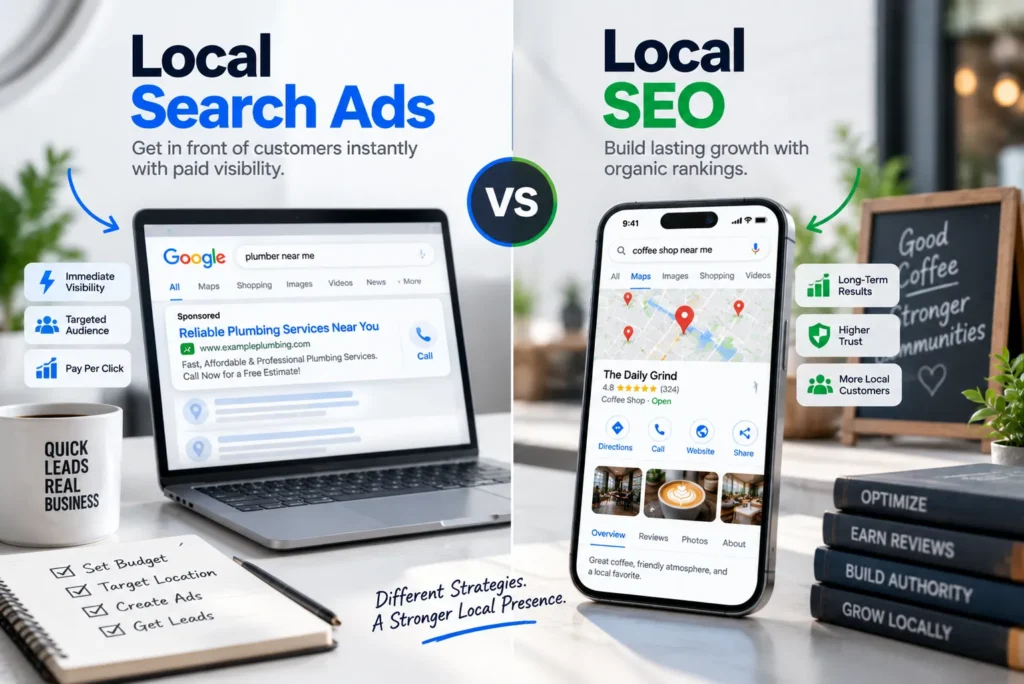
You have a set amount of money to spend on marketing this month. You can put it into Google Ads and start showing up at the top of local search results this week, or you can put it into SEO work that might not pay off for months but keeps paying off long after you stop actively working on it.
That’s the real decision most local business owners are facing when they ask about Local Search Ads vs Local SEO. It’s not really an either/or question about which one is “better.” It’s a question about timing, cash flow, patience, and what kind of business you run.
This article breaks down what each option actually does, where each one wins, and how to think through the decision for your specific situation. No hype, no guaranteed results, just a straight comparison based on how these two channels actually behave for local businesses.
Local Search Ads vs. Local SEO: The Quick Answer
If you need customers now and can afford to pay for them, Local Search Ads win on speed. If you want visibility that keeps working without an ongoing ad spend, Local SEO wins on long-term value.
Most established local businesses eventually use both, just not always at the same time or in the same amount. A new business with no reviews and a bare-bones Google Business Profile often needs ads just to get in the game while SEO work builds up in the background. A business that already ranks well organically might only need ads for specific services or slow seasons.
The honest answer is that neither one replaces the other. They solve different problems.
What Are Local Search Ads?
Local Search Ads are paid listings that show up above or alongside organic results when someone searches for a service in their area. This usually includes Google Ads search campaigns, Local Services Ads, and the paid results that appear near the Local Pack on Google Maps.
You pay when someone clicks your ad (or, for Local Services Ads, when you get a qualified lead). You set a budget, choose your targeting radius, and your ad stops showing the moment your budget runs out or you turn the campaign off.
This is the core trade-off with paid search: visibility is rented, not owned. Stop paying, and you disappear from that spot immediately.
The upside is control. You decide exactly which searches trigger your ad, which neighborhoods you target, and how much you’re willing to pay per lead. You can launch a campaign on a Monday and get calls by Wednesday.
What Is Local SEO?
Local SEO is the work you do to earn visibility in organic search results and the Google Maps Local Pack without paying for each click. This includes optimizing your Google Business Profile, building local citations, earning reviews, creating location and service pages on your website, getting local backlinks, and making sure your site is technically sound.
Nobody pays Google for an organic ranking. You earn it by having a website and business profile that Google and searchers both find genuinely useful and trustworthy.
The trade-off here runs the opposite direction from ads. Local SEO usually takes weeks or months to show real movement, especially in competitive markets. But once you’re ranking, that visibility doesn’t disappear the moment you stop spending money. It requires maintenance, not a monthly toll.
Local Search Ads vs. Local SEO: Key Differences
Here’s a side-by-side look at how the two compare on the factors that matter most to a business owner making this decision.
| Factor | Local Search Ads | Local SEO |
| Speed to results | Days | Weeks to months |
| Cost model | Pay per click or per lead | Time and ongoing effort, no per-click cost |
| Long-term value | Stops when spending stops | Keeps producing after the work is done |
| Visibility | Paid slots, Local Services Ads, top of search | Local Pack, organic results, Maps |
| Control | Full control over targeting and budget | Less direct control, depends on algorithm |
| Competition | Can outbid competitors for the top spot | Harder to out-earn competitors quickly |
| Lead intent | Often high, especially for urgent needs | Varies, but often strong for research-stage buyers |
| Tracking | Very precise (clicks, calls, conversions) | Good, but attribution is less exact |
| Scalability | Scale up or down instantly with budget | Grows slowly, harder to accelerate on demand |
| Maintenance | Needs ongoing bid and budget management | Needs periodic content and technical upkeep |
Which One Gets Results Faster?
Local Search Ads get results faster. That’s the clearest, least debatable difference between the two.
Set up a campaign correctly, and you can be getting calls within a day or two. There’s no waiting for Google to trust your website or for your Google Business Profile to build up review volume. You’re simply paying for placement.
Local SEO takes time because it depends on things Google can’t verify instantly: whether your business is legitimate, whether customers are actually satisfied, whether your website answers real questions well. Building that kind of trust signal takes months in most competitive local markets, sometimes longer if you’re in a crowded city or a competitive trade like law or dentistry.
If your business just opened, or if you’re heading into your busy season next month and have nothing built up yet, ads are the only realistic way to get visibility in that window.
Which One Costs Less?
This depends entirely on your time horizon.
In month one, Local SEO is usually cheaper if you’re doing the basic work yourself: claiming and optimizing your Google Business Profile, asking happy customers for reviews, fixing obvious website issues. Ads cost money from day one, and in competitive industries like plumbing, roofing, or personal injury law, cost per click can get expensive fast.
Stretch the timeline to a year or more, and the math tends to flip. A well-optimized local business that shows up in the Local Pack and organic results is generating leads without paying for each click. Meanwhile, an ad campaign still costs money for every lead, month after month, for as long as you want the visibility to continue.
The honest caveat: SEO isn’t free. You’re paying in time, or you’re paying someone to do the work, or both. It’s less predictable than an ad spend because results aren’t guaranteed on any particular timeline. Some businesses invest in SEO for six months and see limited movement because of heavy local competition or a weak starting point.
Which One Produces Better Leads?
Neither one is automatically better here. It depends on the type of search that’s driving the click.
Someone searching “emergency plumber near me” at 11 PM is ready to hire whoever answers the phone first, whether that’s an ad or an organic listing. That’s high urgency, high intent, and both channels can capture it well.
Someone searching “best dentist for kids in [city]” is often further from booking. They might be comparing three or four practices, reading reviews, checking the website. This kind of research-heavy search tends to reward businesses with strong organic presence, because people trust an organic listing with lots of reviews more than they trust an ad, especially for decisions that involve more money or more personal trust.
Lead quality from ads also depends heavily on how tightly you can target your campaign. Broad, poorly targeted ads bring in tire-kickers and price shoppers. Well-built campaigns with tight geographic targeting and strong ad copy bring in people who are ready to buy.
When Local Search Ads Make More Sense
Ads make the most sense when:
- You need customers within the next few weeks, not months.
- Your service has clear, immediate commercial intent, like an emergency repair or a same-day service call.
- You have the budget to sustain a campaign long enough to learn what works, not just a single week’s spend.
- Your website and booking process are ready to convert clicks into actual customers.
A roofer dealing with the aftermath of a hailstorm doesn’t have time to wait for organic rankings to catch up. Ads let them capture demand that exists right now, in a specific neighborhood, this week.
An HVAC company heading into the first heat wave of summer is in a similar spot. Demand spikes suddenly, and ads can be turned on and scaled up exactly when call volume matters most.
When Local SEO Makes More Sense
SEO makes more sense when:
- You’re building a business you plan to run for years, not months.
- Your services involve longer decision cycles, like choosing a lawyer, a dentist, or a landscaping company for a big project.
- You want visibility that keeps generating leads without a recurring cost per click.
- You’re willing to invest consistently, even when results aren’t immediate.
A local law firm handling estate planning or family law is playing a longer game. Clients research these decisions carefully, read reviews, and often find firms through organic search over weeks, not minutes. Ranking well organically builds a steady flow of leads that doesn’t disappear if the ad budget gets cut during a slow quarter.
A landscaping company that wants steady, repeat residential work benefits from ranking for service and location pages (“landscaping services in [city],” “lawn care in [neighborhood]”) because those searches keep coming in year after year, and the pages keep working without extra spend once they’re built and ranking.
Why Your Business Type Changes the Answer
There’s no single right answer for “local business” as a category because local businesses are not all the same.
An emergency plumber or locksmith deals with urgent, high-intent searches where speed matters more than brand loyalty. Ads often make sense as a permanent part of their marketing, not just a temporary boost.
A restaurant competes on a completely different set of factors: photos, menu, reviews, and Google Maps visibility for casual, low-commitment searches like “restaurants near me.” SEO and a strong Google Business Profile tend to carry more weight here than paid ads, since people rarely click a restaurant ad the way they click a service ad.
A dentist or auto repair shop sits somewhere in between. These are trust-based decisions with moderate urgency. Reviews, local content, and organic visibility build long-term trust, while ads can fill in gaps for specific procedures or promotions.
A real estate agent or high-ticket home improvement business (think full kitchen remodels or solar installation) usually deals with a long sales cycle and a high customer lifetime value. That combination often justifies spending more on both ads and SEO, because a single client can be worth thousands of dollars in commission or contract value.
An electrician doing small residential jobs might get by with lighter marketing altogether if their Google Business Profile and reviews are strong, since repeat business and referrals cover a lot of ground.
The point isn’t that one type of business should always choose ads, and another should always choose SEO. It’s that the urgency of the search, the value of the customer, and the length of the buying decision should shape where your money goes.
Should You Use Local Search Ads and Local SEO Together?
For most businesses with any real marketing budget, yes.
Running both gives you two separate things: instant visibility through ads while your organic presence is still developing, and long-term visibility through SEO that keeps working even during months when you scale ad spend down.
There’s also a practical bonus that gets overlooked. When a business shows up in both a paid ad and an organic or Local Pack listing for the same search, it signals credibility to the searcher. Showing up twice looks more established than showing up once, even if that’s not the “real” reason it works.
The businesses that shouldn’t run both yet are the ones without the foundation to support it: no functioning website, a Google Business Profile that’s barely filled out, or no consistent way to track which leads are converting. Fix the foundation first. Spending on ads when your website can’t convert visitors, or investing in SEO content when your Google Business Profile is incomplete, wastes money both ways.
How to Decide Based on Your Budget and Goals
If your budget is small (under a few hundred dollars a month), focus on the free and low-cost SEO fundamentals first: a fully optimized Google Business Profile, a steady flow of reviews, and basic on-page fixes to your website. These cost time more than money and build a foundation that makes future ad spend more effective.
If your budget is moderate, split it. Put a portion into a tightly targeted ad campaign for your highest-value service, and put the rest into ongoing SEO work like service pages, location pages, and review generation.
If your budget is larger and your business can absorb short-term losses while things ramp up, run both aggressively. Use ads to generate immediate revenue and data (which keywords convert, which services get the most calls) and feed that data into your SEO content strategy, so you’re building organic pages around proven demand instead of guesses.
A Practical Decision Framework for Local Businesses
Choose Local Search Ads first if:
- You need leads within days or weeks, not months.
- Your service has strong, immediate commercial intent (emergency repairs, urgent replacements, same-day bookings).
- You can sustain the ad budget long enough to gather real data, generally at least a few weeks.
- Your website and booking process can already convert a click into a customer.
Prioritize Local SEO if:
- You’re building for the next several years, not the next few weeks.
- Your service involves a longer research and decision process.
- You want visibility that doesn’t disappear the moment you stop spending.
- You can commit to consistent work over time, even without instant results.
Consider both if:
- You want immediate leads and long-term visibility at the same time.
- Your budget realistically supports both without starving either one.
- Your website and Google Business Profile are already in solid shape.
Fix your foundation first if:
- Your website doesn’t load well on mobile or doesn’t clearly show what you do and how to contact you.
- Your Google Business Profile is incomplete, unverified, or has very few reviews.
- You have no way to track which calls or form submissions actually turn into paying customers.
Spending on ads or SEO before fixing these issues is the fastest way to waste a marketing budget.
Common Mistakes Local Businesses Make
The most common mistake is expecting SEO to work like ads: fast, predictable, and easy to turn off and on. SEO builds slowly, and rushing it with shortcuts like fake reviews or spammy backlinks often backfires.
The second most common mistake is running ads with no real targeting, then giving up after a week because “ads don’t work.” A campaign needs a real budget and time to gather enough data to optimize.
Another mistake is treating Google Business Profile as a “set it and forget it” listing. It needs regular updates, photos, responses to reviews, and accurate hours and service areas. A neglected profile hurts both organic Local Pack rankings and how trustworthy your ads look to someone comparing options.
Finally, many businesses skip conversion tracking entirely. Without call tracking or basic form tracking, you can’t actually tell which channel, ad or organic, is bringing in paying customers. That makes every future budget decision a guess instead of an informed choice.
Final Verdict
If you need revenue in the next few weeks and your website can convert visitors, put your first dollars into Local Search Ads. If you’re building a business for the long haul and can be patient for a few months, put your first real effort into Local SEO fundamentals, starting with your Google Business Profile and reviews.
Most businesses that grow steadily end up doing both, just not in equal measure at every stage. In the first three months, lean on ads if you need leads now, while starting the SEO groundwork in the background: profile optimization, review requests, basic website fixes. By six months, your SEO work should be showing early signs of traction, letting you start shifting some ad budget toward the services or areas where organic isn’t covering enough ground yet. By twelve months and beyond, a business that’s invested consistently in both usually has a mix of low-cost organic leads and a smaller, more targeted ad spend filling in the gaps.
Businesses that struggle are the ones that pick one channel and expect it to solve every problem, or the ones that spend on either channel before fixing a website or profile that can’t convert the traffic they’re paying for. Fix the foundation, then decide where your next dollar and your next hour of work will do the most good.
Frequently Asked Questions
They can be, especially if your service has urgent demand and your website is ready to convert visitors. The risk is spending without tracking results, so start with a modest budget and measure calls and conversions before scaling up.
Yes, but it requires either your own consistent effort or hiring someone to handle it, since the results depend on ongoing work like reviews, content, and profile maintenance. It’s not a one-time project.
No fixed number fits every business. A reasonable approach is to start with what you can afford to test for at least two to three months, then adjust based on what’s actually converting.
Ads usually make more sense early on, since new businesses often can’t rank organically yet. Use that time to build reviews and content in the background so SEO has something to grow from.
You can, though many businesses keep a smaller ad budget running for competitive keywords or slow periods, even after ranking well organically.
No, running ads does not directly improve organic rankings. They operate as separate systems, though the data from ad campaigns (which keywords convert, which services get clicked) can inform your SEO content strategy.
Start with your website’s mobile experience, your Google Business Profile completeness, and basic tracking so you know what’s working. Spending on visibility that can’t convert is money wasted.
It depends on your time and comfort level with the technical side. Managing your own Google Business Profile and basic on-page fixes is realistic for many owners. Running paid campaigns and building out a full SEO content strategy usually benefits from experienced help, since mistakes there can be expensive.