
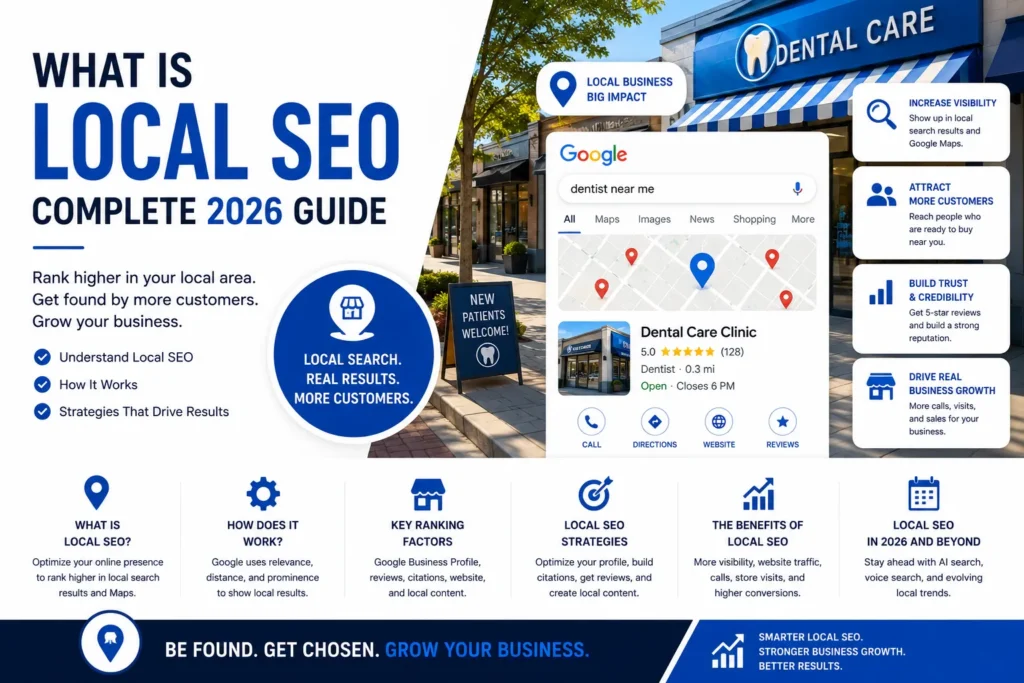
Local SEO is how your business shows up when someone nearby searches for what you sell. Type “coffee shop near me” or “plumber in [city]” and something decides whether you appear in the map, the local results, and increasingly the AI-generated answer, or whether the customer picks a competitor down the street. That something is local SEO.
For any business serving a local area, this is where most new customers now come from. People no longer flip through a directory or drive around comparing options. They search, glance at the map and the reviews, and call or book within seconds. Local SEO is how you make sure your business is the one they find and trust in that moment.
This guide explains local SEO in plain language: what it is, how it works, where you appear, how it differs from regular SEO, the parts that make it work, who needs it, why it pays off, how it ties into AI search, how to start, and how to measure results. By the end, you will have both the concept and the practical steps.
What Is Local SEO?
Local SEO, sometimes called local search optimization, is the work of improving your visibility for location-based searches. The idea is simple. When a nearby customer searches for your product or service, your business should appear prominently, with the information and trust signals that make them choose you.
It plays out across the places people actually search locally: Google Search, Google Maps, and the AI-powered answers now sitting at the top of many results. Where broad SEO tries to reach everyone everywhere, local SEO focuses on the people most likely to become customers, the ones close enough to walk in, call, or book. That focus is what makes it so valuable. You are not chasing traffic for its own sake; you are getting found by people ready to act.
How Local SEO Works
Google chooses which local businesses to show using three main factors. Grasp these, and the rest of local SEO falls into place.
| Factor | What it means |
| Relevance | How well your business matches what the person searched |
| Distance | How close your business is to the searcher |
| Prominence | How well known and trusted your business is |
Relevance comes from clearly describing what you do through your profile, categories, services, and website. Distance is determined by your location relative to the searcher and cannot be changed, though you can define the areas you serve. Prominence grows from reviews, mentions across the web, links, and an active, complete presence. These local ranking factors work together, and a business that steadily strengthens relevance and prominence climbs the local results, even past closer competitors who have let theirs slide.
Where Your Business Shows Up
Local SEO touches several places at once, and knowing them shows you what you are optimizing for.
The most visible is the local pack, the box of three businesses with a map that sits at the top of local searches. Earning a spot in the local pack is the prize for most local businesses, because it drives the most calls and visits. Around it sit the standard organic results, where your website can rank for local queries. Your business also appears in Google Maps when people search or browse the map directly, often on the move. And more and more, AI-generated overviews summarize and recommend local options, pulling from the same trusted, consistent information your local SEO builds. Strong local SEO lifts you across all of these at once.
Local SEO vs Traditional SEO
People often ask how local SEO differs from regular SEO. They share a foundation but aim at different goals.
| Features | Traditional SEO | Local SEO |
| Goal | Rank pages broadly | Get found by nearby customers |
| Focus | Keywords, content, links | Profile, reviews, location signals |
| Results | Organic listings | Map pack, Maps, and local results |
Traditional SEO ranks a website for searches, regardless of where the searcher is, which suits online businesses and publishers. Local SEO adds a layer built on geography and trust, centered on your Google Business Profile, your reviews, and consistent business information. A local business benefits from both, but the local signals are what put you on the map, literally, the moment someone nearby is ready to buy.
The Building Blocks of Local SEO
Local SEO consists of several interconnected parts. Each strengthens your visibility, and together they form a complete presence.
Google Business Profile
Your Google Business Profile is the free listing that powers your place on the map and in the local pack. It holds your hours, photos, services, reviews, and contact details. A complete, active profile is the single most important asset in local SEO, which is why thorough Google Business Profile optimization is usually the first thing to get right.
Business Information and Citations
Your name, address, and phone number should be consistent everywhere they appear, from your website to directories. These mentions, called local citations, build trust with search engines. When your details match across the web, Google is more confident your business is real, which supports your ranking.
Reviews
Reviews shape both rankings and customer decisions. A steady stream of recent, positive ones marks you as trusted, and reviews directly influence local rankings. Asking happy customers consistently and replying to every review, good or bad, is one of the highest return habits in local SEO.
Local Content and On-Page SEO
Your website should spell out what you do, where you do it, and who you serve. Pages for each service and location, written for real local searches, help you rank and convert. Good on-page SEO means clear titles, helpful content, and genuinely local pages rather than thin, generic ones. Helpful local content, like service guides, neighborhood pages, and answers to common local questions, also reaches customers earlier in their journey, while they are still comparing rather than only at the moment they buy.
Local Links
Links from other local, relevant sites, like community groups, local press, and partners, build prominence. They signal that you are an established part of your area, and they tend to come naturally from real local involvement and marketing.
Technical SEO and Schema
Behind the scenes, your site has to load fast, work on mobile, and be easy for search engines to read. Adding local business schema helps search engines and AI systems accurately understand your name, location, hours, and services, which supports both rankings and how you appear in AI answers.
Which Businesses Need Local SEO
Local SEO matters for any business serving customers in a specific place, whether they come to you or you go to them. That covers a lot of ground, including:
- Restaurants, cafes, and shops with a storefront
- Home service providers like plumbers, electricians, and HVAC companies
- Medical, dental, and other healthcare practices
- Law firms, accountants, and professional services
- Salons, gyms, and fitness studios
- Any business serving customers in a defined area
If your customers are local, local SEO is not optional. It is the line between being found by nearby people ready to buy and being invisible to them. Even businesses without a storefront, such as mobile and service-area providers, depend on it to reach the neighborhoods they serve.
Why Local SEO Is Worth It
It helps to be clear about why this work pays off. Buying habits have shifted: before choosing almost anything local, people search, compare the map listings, read reviews, check hours, and glance at photos, all before they ever make contact. If you are not visible during that quick research, the customer simply picks a competitor who is. Local searches also carry unusually high intent, because someone searching for a nearby business is often ready to act soon. A person typing “emergency electrician near me” is not browsing; they want to call someone now. Showing up at that moment turns a search into a customer, which is much of why local SEO is so critical for small businesses competing against larger or online rivals.
This is also why ranking alone is not the real goal. Rankings only count when they produce outcomes: more calls, more booked jobs, more consultations, more revenue. The point is not to sit pretty in the results; it is to become the trusted local choice people pick when they are ready to spend. Build your local presence around real results, not vanity metrics.
Local SEO and AI Search in 2026
Search is changing, and local SEO is changing with it. More people now ask AI tools like ChatGPT, Gemini, and Perplexity for recommendations, and Google often answers with an AI-generated overview before any links appear. These systems summarize and recommend local businesses, and they draw on the same foundation as local SEO: accurate profiles, consistent information, strong reviews, and clear content.
The good news is the work overlaps. A business with a complete profile, consistent details, genuine reviews, and well-structured content is exactly what AI systems trust and surface. Paying attention to AI-driven local search is now part of a complete strategy, because being named inside an AI answer is becoming as valuable as ranking in the map pack. The fundamentals that have always driven local SEO are what position you to win here, too.
Common Local SEO Mistakes
Most businesses that struggle locally are tripping over the same avoidable errors. Watch for these:
- An incomplete Google Business Profile, with missing categories, services, or hours
- Inconsistent name, address, and phone details across directories
- Rarely asking for reviews, or leaving them unanswered
- Thin, generic service pages instead of genuinely local ones
- A slow site that frustrates visitors and loses conversions
- A poor mobile experience, even though most local searches happen on phones
- Treating local SEO as a one-time task rather than ongoing upkeep
None of these is hard to fix. Catching them early is often the fastest way to pull ahead of nearby competitors who have not done so.
Getting Started With Local SEO
If you are new to this, the path is straightforward. You do not have to do everything at once, and order matters. Begin with the steps that deliver the most visibility for the least effort.
- Claim and fully complete your Google Business Profile.
- Make your name, address, and phone number identical across all online platforms.
- Start asking happy customers for reviews, and reply to every one.
- Build clear, locally relevant pages for your services and areas.
- Make sure your site loads fast and works well on mobile.
- Track your calls, bookings, and rankings to see what works.
Following a simple local SEO checklist keeps things organized and ensures you do not skip a foundational step. Each item builds on the last, and together they create a presence that brings in real customers.
Measuring Local SEO Results
Measure local SEO by the things that actually grow a business, not by rankings alone. The numbers that matter are calls, form submissions, bookings, direction requests, and new customers, as well as how often your profile appears and is clicked.
You do not need heavy-duty tooling to get started. Your Google Business Profile shows how people find and interact with your listing, while call tracking and basic website analytics show which pages and searches drive traffic. Reviewing these regularly tells you whether your visibility is turning into customers or stalling, and points you to the next improvement to make.
The Bottom Line on Local SEO
Local SEO is how a business earns its place when a nearby customer is ready to act. It is built on a complete Google Business Profile, consistent business information, genuine reviews, clear local pages, and a fast, trustworthy website, and now extends to the AI answers people increasingly rely on.
You do not have to master all of it overnight. Start with your profile, stay consistent, focus on real customers rather than vanity rankings, and build from there. Done well, local SEO stops being a mystery and becomes the steady engine that keeps new customers coming through your door.