
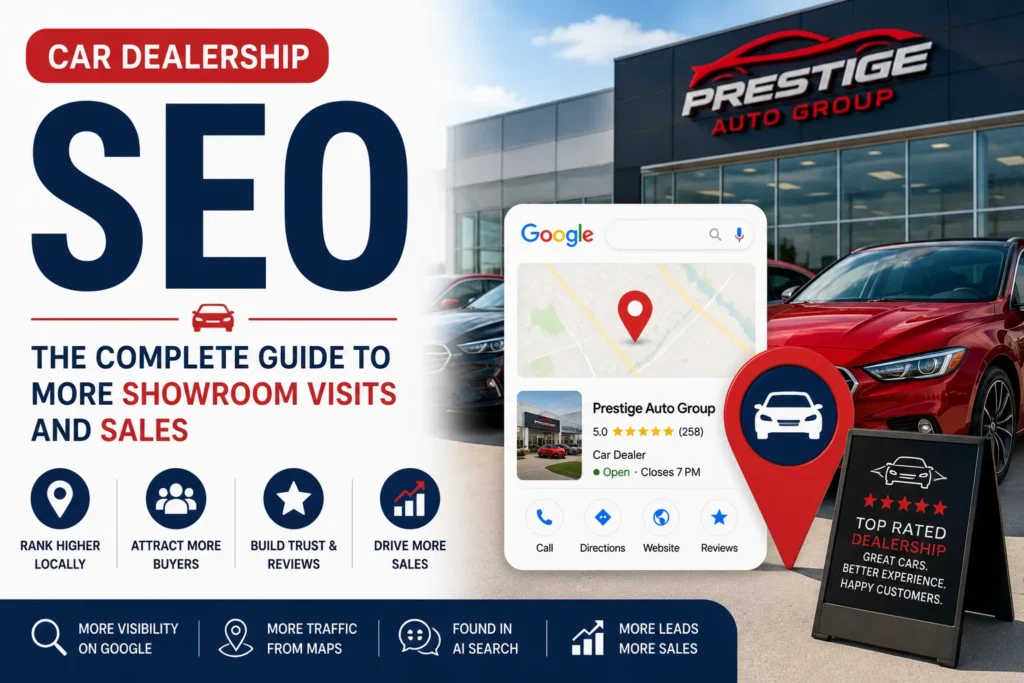
Buying a vehicle is one of the biggest purchasing decisions most people make. Before visiting a dealership, shoppers typically spend days or even weeks researching vehicles, comparing dealerships, reading reviews, checking inventory, exploring financing options, and evaluating customer experiences online.
If your dealership isn’t visible during this research process, potential buyers may never visit your showroom, no matter how competitive your pricing or inventory may be.
According to Google, automotive shoppers complete multiple online searches before contacting a dealership, and local search plays a significant role in helping buyers compare nearby dealers. A strong presence in Google Search and Google Maps helps dealerships attract more qualified shoppers throughout every stage of the buying journey.
Local SEO for car dealerships helps dealerships improve visibility across Google Search, Google Maps, and AI-powered search platforms. A successful strategy combines Google Business Profile optimization, inventory-focused website optimization, reputation management, technical SEO, local SEO, and AI search optimization to consistently generate qualified leads, showroom visits, and vehicle sales.
This guide explains how car dealerships can strengthen their online presence, build buyer trust, and convert more local searches into test drives and completed sales.
How Car Buyers Search for Dealerships Online
Vehicle shoppers search differently depending on the type of vehicle, budget, financing needs, brand preference, and location. Some are looking for a specific model, while others are comparing dealerships before making a purchase.
Common searches include:
- Car dealership near me
- Used cars in Los Angeles
- New car dealer nearby
- Certified pre-owned vehicles
- Toyota dealership
- Ford dealer near me
- Auto financing dealership
- Truck dealership nearby
Your website should address these different search intents by creating dedicated pages for every vehicle category, manufacturer, financing option, certified pre-owned inventory, service department, parts department, trade-in program, and dealership location. This helps Google better understand your dealership while improving visibility for highly qualified automotive searches. The way proximity, relevance, and prominence interact in local rankings is especially important for dealerships, where a buyer five miles away often beats a better-ranked dealership twenty miles out.
Google Business Profile Best Practices for Car Dealerships
Google Business Profile is often the first place potential buyers evaluate your dealership. Before visiting your showroom, many compare reviews, inventory photos, operating hours, directions, and dealership information directly within Google Search and Google Maps.
A complete, professionally managed profile improves local visibility and encourages more shoppers to visit your dealership.
Choose the Right Business Categories
Select Car Dealer as your primary category or choose a manufacturer-specific category where appropriate. Add secondary categories only when they accurately represent additional services such as Used Car Dealer, Auto Repair Shop, Auto Parts Store, Oil Change Service, or Tire Shop.
Upload Professional Dealership Photos
Buyers want to see your dealership before visiting. Upload high-quality photos of your showroom, vehicle inventory, service department, waiting area, financing office, staff, dealership exterior, customer lounge, charging stations where applicable, and dealership events. Fresh photos help build confidence and improve engagement.
Showcase Every Department and Service
List each major service individually rather than relying on a single general description. Include new vehicle sales, used vehicle sales, certified pre-owned vehicles, financing, leasing, trade-ins, service and maintenance, collision repair where applicable, parts department, tire services, and warranty programs.
Configure Your Dealership Information
Maintain accurate business hours, holiday schedules, contact information, financing appointment links, service scheduling links, website URLs, and dealership location details. Multi-location dealerships should maintain separate Google Business Profiles for every showroom.
Publish Regular Google Posts
Share new inventory arrivals, seasonal promotions, financing offers, manufacturer incentives, dealership events, maintenance tips, community involvement, customer success stories, and educational buying guides. Consistent posting keeps your dealership active while providing value to shoppers.
Maintain Consistent Business Information
Keep your dealership name, address, phone number, website, operating hours, service hours, and appointment information consistent across your website, Google Business Profile, automotive directories, and local citations. Consistency strengthens local trust signals and improves search visibility.
Complete Every Profile Section
Complete every available profile field, including your business description, appointment links, accessibility information, amenities, service options, social profiles, opening date, dealership highlights, and business attributes. A complete profile improves both customer experience and local SEO performance. Going through the full Google Business Profile optimization checklist ensures no fields that influence ranking and visibility are left incomplete.
Use Gemini to Improve Google Business Profile Management
Gemini can help eligible Google Business Profile users manage their profile more efficiently by assisting with review response drafts, profile improvement suggestions, Google Post ideas, inventory descriptions, performance summaries, and profile management recommendations.
While Gemini does not directly improve rankings, it helps maintain a complete, accurate, and active Google Business Profile that supports stronger local visibility and provides a better experience for prospective vehicle buyers.
Website Structure for Car Dealerships
Your website should do more than display inventory. It should build trust, answer buyer questions, and make it easy for shoppers to schedule a test drive, value their trade, apply for financing, or contact your sales team. Whether someone is purchasing their first vehicle or replacing an existing one, your website should guide them confidently through every step of the buying journey.
A well-organized website also helps Google understand your inventory, dealership services, brands, and locations, improving your ability to rank for high-intent automotive searches.
Build a Buyer-Focused Homepage
Your homepage should clearly highlight the vehicle brands you sell, new and used inventory, financing options, service department, current promotions, and what makes your dealership different. Include prominent calls to action to schedule test drives, browse inventory, apply for financing, value trade-ins, and contact your sales team. Showcase customer reviews, manufacturer certifications, awards, and trust signals throughout the page.
Create Dedicated Inventory and Service Pages
Every major vehicle category and dealership service should have its own optimized page. Separate pages for new vehicles, used vehicles, certified pre-owned inventory, SUVs, trucks, electric vehicles, financing, leasing, trade-ins, service and maintenance, collision repair where applicable, genuine parts, and warranty programs help target highly relevant searches while strengthening topical authority.
Create Local Dealership Pages
If your dealership operates multiple locations, create unique pages for each showroom. Include location-specific inventory, contact information, sales staff, service hours, directions, nearby landmarks, financing availability, customer reviews, and community involvement. Avoid duplicating content across different locations.
Support Multi-Location Growth
Dealer groups with multiple franchises should organize each dealership with dedicated landing pages featuring inventory, brands, departments, promotions, reviews, and location-specific information. Managing multiple dealership locations effectively ensures each showroom ranks in its own market, rather than locations competing against each other in search results.
Expand Automotive Resources
As your dealership grows, continue adding pages for vehicle buying guides, financing education, maintenance tips, EV ownership resources, warranty information, model comparisons, trade-in advice, fleet sales, and seasonal promotions. A comprehensive content structure helps search engines understand your expertise while supporting buyers throughout their research journey.
Improve Lead Generation
Most buyers compare several dealerships before making a decision, so every page should make it effortless to take the next step. Display test drive booking forms, financing applications, trade-in valuation tools, live chat, click-to-call phone numbers, inventory search, payment calculators, customer testimonials, FAQs, and clear calls to action throughout your website.
Individual Vehicle Listing and Pricing Transparency Pages for Car Dealerships
When someone searches for “2023 Toyota Camry near me” or a specific VIN, they are not interested in your general category page. They want to see that exact car, with real photos, accurate mileage, and a clear price, instead of scrolling through a generic inventory grid.
Build a Dedicated Page for Every Vehicle in Stock
Give every vehicle its own page that shows the VIN, mileage, trim, features, real photos (not just manufacturer images), and a clear price. Add Vehicle schema to each listing, not just your category pages, so Google and AI shopping tools can find the exact car people want. When buyers see the car they are looking for on your site, they are much more likely to visit than if they only find a general “used SUVs” page and have to keep searching. This level of detail also supports the kind of structured entity signals that help Google and AI systems understand exactly what your inventory contains.
Show Pricing Upfront, Not “Call for Price”
When buyers compare dealerships online, they often skip listings that make them call for the price. Show the actual price, dealer fees, and any incentives right on the vehicle page. This simple change can be the reason a shopper chooses your site over a competitor’s, since price transparency is one of the main things buyers look for when deciding where to start a conversation.
Certified Pre-Owned and Vehicle History Trust Pages for Car Dealerships
Just listing “certified pre-owned vehicles” doesn’t reassure a nervous used-car buyer. What really matters are the details: what the certification includes, what the warranty covers, and whether the car has a clean history. Dealerships that answer these questions up front are much more likely to earn a buyer’s trust and a visit than those that rely on a vague label.
Explain What Your CPO Program Actually Covers
Create a dedicated CPO page that explains your inspection process, including how many points are checked, what the extended warranty covers, and how long the coverage lasts. Buyers who are weighing a certified car against a cheaper non-certified one want to know what they’re getting for the extra money. Laying out these details clearly helps them make a confident decision.
Include Vehicle History Reports on Every Used Listing
Add a Carfax or AutoCheck report link right on each used vehicle’s page so buyers don’t have to ask for it. When a dealership shares the car’s history, including accidents, previous owners, and service records, up front, it builds trust. This openness also removes one of the biggest worries buyers have before they even need to ask.
Reviews and Reputation for Car Dealerships
Reputation has a direct impact on both local rankings and vehicle sales. Before visiting a dealership, many buyers compare ratings, customer experiences, and dealership responses to reviews. Positive reviews build confidence while helping your dealership stand out in highly competitive markets.
Respond to Every Customer Review
Respond professionally to both positive and negative reviews. Thank customers for sharing their experience, address concerns respectfully, and demonstrate your commitment to excellent customer service before, during, and after the sale.
Focus on Trusted Review Platforms
Google should remain your highest priority because it directly supports Google Maps visibility and local rankings. Maintain complete profiles on respected automotive marketplaces, manufacturer directories, and local business platforms to strengthen your online reputation. Understanding how review recency and response patterns influence local rankings helps dealerships treat review management as an ongoing process rather than a one-time push.
Build a Consistent Review Strategy
Encourage satisfied buyers and service customers to leave honest reviews after purchasing a vehicle or completing a service appointment. Following up with a direct review request via CRM or text after delivery keeps the flow consistent across sales and service rather than depending on customers to volunteer feedback unprompted.
Maintain Steady Review Growth
A steady stream of authentic reviews is more valuable than receiving a large number over a short period. Consistent feedback demonstrates ongoing customer satisfaction while strengthening your dealership’s local authority.
Comprehensive Local SEO Checklist for Car Dealerships
A successful automotive SEO strategy combines local optimization, technical SEO, inventory optimization, reputation management, and helpful content. Dealerships that optimize every part of their online presence consistently generate more qualified showroom visits and vehicle inquiries.
Target High-Intent Automotive Keywords
Focus on searches that indicate buyers are actively looking for a dealership or specific vehicle.
Examples include:
- Car dealership near me
- Used cars in Dallas
- Toyota dealership
- Certified pre-owned vehicles
- Truck dealership nearby
- Car financing near me
- Electric vehicle dealer
Use these naturally throughout your inventory pages, manufacturer pages, financing pages, Google Business Profile, FAQs, and educational content. Proper local keyword research for an automotive business surfaces vehicle-specific and finance-specific queries that most dealership websites never target, including VIN-level and model-year searches that carry extremely high buyer intent.
Optimize Every Inventory and Service Page
Each inventory category and dealership service should have its own optimized page with unique headings, title tags, meta descriptions, internal links, frequently asked questions, and helpful content. Explain available models, financing options, warranty coverage, vehicle features, and what buyers can expect during the purchasing process.
Publish Helpful Automotive Content
Educational content builds trust while helping buyers make informed decisions. Publish articles covering vehicle comparisons, maintenance schedules, financing advice, trade-in tips, EV ownership, buying guides, seasonal driving tips, warranty information, and ownership costs.
Strengthen Google Maps Visibility
Google Maps remains one of the largest lead sources for car dealerships. Keep your Google Business Profile fully optimized, upload fresh inventory and dealership photos, publish Google Posts regularly, answer customer questions, and continue collecting authentic reviews from both sales and service customers. Ranking in the local map pack is often the first visible touchpoint for a buyer who has narrowed their search to dealers in a specific area.
Build Accurate Local Citations
Maintain consistent dealership information across Google, automotive directories, manufacturer websites, local business listings, chambers of commerce, and reputable citation platforms. Inconsistent NAP details across automotive directories and manufacturer sites are a common but fixable reason dealerships underperform in local search relative to their inventory size.
Earn High-Quality Local Backlinks
Build relationships with local businesses, community organizations, sponsorships, charities, automotive clubs, schools, chambers of commerce, and local media. These community partnerships and local involvement generate valuable backlinks while strengthening your dealership’s authority within the market.
Strengthen Community Presence
Sponsor local events, charity drives, youth sports teams, vehicle safety programs, community fundraisers, and educational workshops. Community involvement increases brand awareness while generating valuable local mentions and referrals.
Implement Structured Data
Use Organization, AutoDealer, LocalBusiness, Vehicle, Product, Service, FAQ, Review, Breadcrumb, and Website schema where appropriate. Structured data helps search engines better understand your dealership, inventory, and services, improving your eligibility for better search results.
Strengthen Entity Optimization
Clearly connect your dealership with the vehicle brands you sell, inventory categories, financing options, departments, certified technicians, service areas, promotions, and customer services throughout your website. Strong entity optimization helps both search engines and AI platforms accurately understand your dealership and expertise.
AI Search Optimization for Automotive
Car buyers increasingly use AI-powered search to compare vehicles, research dealerships, understand financing options, and narrow their choices before visiting a showroom. Google AI Overviews, ChatGPT, Gemini, Claude, and Perplexity are becoming influential discovery channels by recommending dealerships with trustworthy information, comprehensive inventory, and strong local authority.
Dealerships with complete Google Business Profiles, well-organized inventory pages, authentic customer reviews, and consistent business information are better positioned to appear in these AI-generated search experiences.
Improve Visibility Across AI Search
Create content that answers common buyer questions while clearly explaining your inventory, financing options, trade-in process, warranties, certified pre-owned programs, service department, dealership locations, and frequently asked questions. Well-structured information helps both shoppers and AI systems understand your dealership and confidently recommend your business. The core principles of generative engine optimization matter for dealerships because AI systems are increasingly being asked to compare specific vehicle availability across local dealers, which rewards those with the clearest, most structured inventory information.
AI SEO Checklist for Car Dealerships
| AI SEO Element | Best Practice |
| Entity Optimization | Clearly define your dealership, vehicle brands, inventory categories, financing options, departments, and service areas. |
| Structured Content | Use descriptive headings and answer common buyer questions directly. |
| Schema Markup | Implement AutoDealer, Vehicle, LocalBusiness, Product, Service, FAQ, Review, Organization, Breadcrumb, and Website schema where appropriate. |
| Google Business Profile | Keep every profile section complete, accurate, and regularly updated. |
| Reviews | Build authentic customer reviews from both sales and service and respond professionally. |
| Content Quality | Publish comprehensive buying guides, vehicle comparisons, and financing resources. |
| Internal Linking | Connect inventory pages, financing pages, service department, buying guides, and location pages naturally. |
| Brand Consistency | Maintain identical dealership information across your website, GBP, automotive directories, and manufacturer sites. |
Measure AI Search Visibility
Look beyond keyword rankings to measure SEO success. Track branded searches, test-drive requests, financing applications, phone calls, showroom visits, Google Search Console performance, Google Business Profile insights, referral traffic, and qualified vehicle inquiries to understand how your dealership performs across both traditional and AI-powered search channels.
Technical SEO Checklist for Car Dealerships
Technical SEO ensures search engines can efficiently crawl, index, and understand your dealership website while providing shoppers with a fast and reliable browsing experience. A technically optimized website also improves lead generation by making it easier for buyers to browse inventory and contact your sales team.
| Technical SEO Element | What to Check |
| Crawlability | Ensure Google can crawl your homepage, inventory pages, manufacturer pages, service pages, location pages, blog posts, and contact page. |
| Indexing Status | Review indexed, excluded, duplicate, discovered, and crawled pages in Google Search Console. |
| XML Sitemap | Include all important inventory, service, location, and educational pages, and exclude unnecessary or dynamically generated URLs. |
| Robots.txt | Confirm important pages and resources remain crawlable. |
| Index Bloat | Remove or noindex thin, duplicate, outdated, and low-value inventory and promotional pages. |
| Orphan Pages | Ensure important inventory, financing, and service pages receive internal links. |
| Crawl Depth | Keep important pages within two or three clicks from the homepage. |
| URL Structure | Use clean, descriptive URLs for vehicle categories, manufacturers, and services. |
| Website Architecture | Organize inventory, financing, service, locations, and educational resources logically. |
| Internal Linking | Connect related inventory pages, financing options, service pages, buying guides, and location pages naturally. |
| Breadcrumbs | Improve navigation and crawl efficiency. |
| Title Tags | Create unique, keyword-focused titles for every important page. |
| Meta Descriptions | Write compelling descriptions that encourage test drive bookings and inventory browsing. |
| Heading Structure | Maintain one H1 with logical H2 and H3 hierarchy. |
| Duplicate Content | Avoid repeating content across manufacturer pages and inventory categories. |
| Canonical Tags | Point duplicate URLs to the preferred version. |
| Thin Pages | Expand weak pages with valuable buyer information and inventory detail. |
| Site Speed | Optimize loading speed across desktop and mobile devices, especially inventory browsing pages. |
| Core Web Vitals | Monitor LCP, INP, and CLS performance. |
| Mobile Experience | Ensure buyers can browse inventory, compare vehicles, and request test drives on mobile devices, where most early automotive research now happens. |
| Click to Call | Make phone numbers clickable across every page. |
| Accessibility | Improve readability, forms, navigation, image alt text, and button visibility. |
| Image Optimization | Compress vehicle and dealership images, and use descriptive file names and alt text. |
| Vehicle Photos | Showcase real inventory, showroom, service department, staff, and customer delivery photos. |
| Schema Markup | Validate all structured data, including the Vehicle, AutoDealer, and Service schemas. |
| NAP Consistency | Keep dealership information consistent across all online platforms and manufacturer directories. |
| Inventory Coverage | Create optimized pages for every major vehicle category and brand. |
| Location Pages | Build unique pages for every dealership location. |
| Broken Links | Repair broken internal and external links, especially on inventory pages. |
| Redirects | Review redirect chains, outdated vehicle URLs, and unnecessary redirects. |
| HTTPS | Secure every page using HTTPS. |
| Security | Monitor for malware, spam, hacked pages, and indexing issues. |
| Contact Forms | Regularly test drive booking forms, financing applications, trade-in forms, and contact forms. |
| GA4 | Verify analytics tracking is working correctly. |
| Google Search Console | Monitor indexing, impressions, clicks, and search performance. |
| Conversion Tracking | Track test drive bookings, financing applications, phone calls, and inventory inquiries. |
| GBP Tracking | Measure calls, website visits, direction requests, and profile interactions from Google Business Profile. |
Local SEO Mistakes Car Dealerships Should Avoid
Many dealerships lose qualified buyers because they overlook essential local SEO opportunities. Avoiding these mistakes can improve visibility, increase showroom traffic, and generate more vehicle sales.
- Using one generic page for every vehicle category.
- Leaving Google Business Profile incomplete or outdated.
- Publishing duplicate inventory or dealership location pages.
- Ignoring customer reviews.
- Not optimizing financing and service department pages.
- Publishing thin vehicle category content.
- Neglecting technical SEO.
- Weak internal linking between inventory, financing, service, and buying guide pages.
- Inconsistent dealership information across automotive directories.
- Measuring rankings instead of test drives, vehicle inquiries, and completed sales.
How LocalMighty Helps Car Dealerships Increase Showroom Traffic
Growing a successful dealership requires more than increasing website traffic. LocalMighty helps car dealerships improve Google Maps visibility, optimize Google Business Profiles, build inventory-focused website structures, strengthen local authority, and create automotive content that supports buyers throughout every stage of the purchasing journey. Our local SEO services combine technical SEO, AI search optimization, reputation management, entity optimization, and conversion optimization to help dealerships generate more qualified vehicle inquiries, test drive bookings, financing applications, showroom visits, and long-term organic growth across Google Search, Google Maps, and modern AI search platforms.
Recover Rankings and Leads After a Google Update
Google updates can affect automotive websites, especially in highly competitive local markets. Rather than reacting immediately, focus on improving overall website quality, inventory content, and buyer experience.
If your rankings decline:
- Review Google Search Console to identify affected pages.
- Compare traffic changes with recent Google updates.
- Audit technical SEO before modifying content.
- Refresh outdated inventory category pages, financing resources, and buying guides.
- Improve vehicle descriptions, dealership trust signals, and customer resources.
- Strengthen internal linking across inventory, financing, service, and educational content.
- Continue earning authentic customer reviews.
- Keep your Google Business Profile complete and regularly updated.
- Monitor performance over several weeks before making significant SEO changes.
Dealerships that consistently improve content quality, technical performance, inventory organization, and customer experience generally recover more successfully than businesses that make reactive SEO changes after each algorithm update.
Closing Notes
Successful SEO for car dealerships is built on visibility, trust, and an exceptional buying experience. Your website, Google Business Profile, inventory pages, customer reviews, technical SEO, and local authority all work together to influence whether shoppers visit your dealership or choose a competitor.
As search continues evolving through Google Search, Google Maps, AI Overviews, ChatGPT, Gemini, Claude, Perplexity, and future AI search platforms, dealerships that invest in accurate business information, well-organized inventory, helpful buying resources, strong local SEO, and an outstanding online experience will continue generating more qualified leads, increasing showroom visits, and driving long-term vehicle sales.