
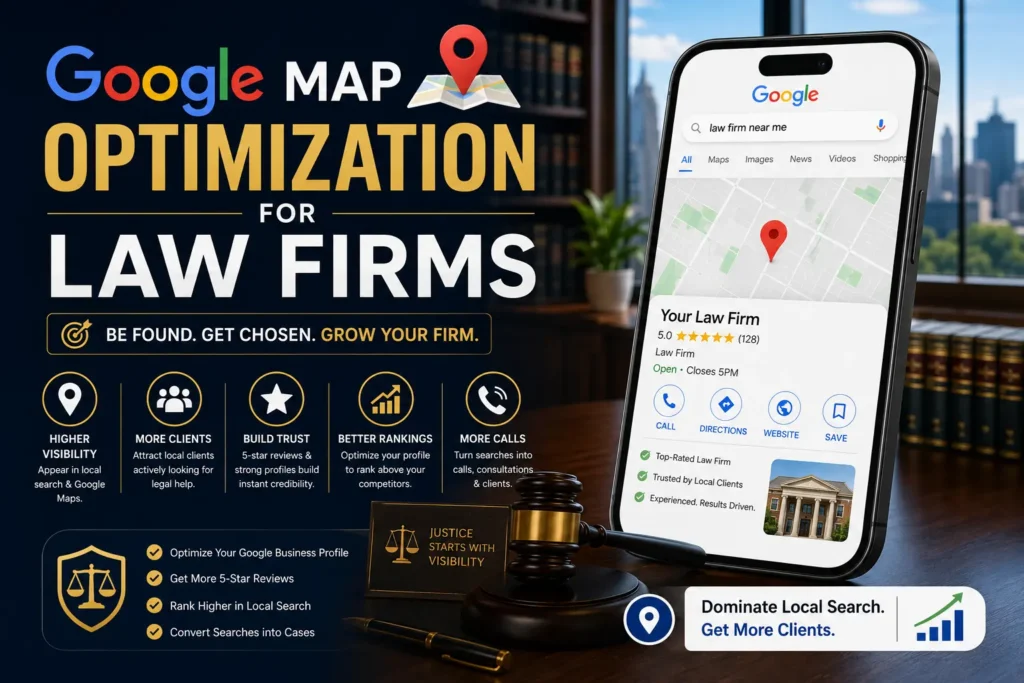
Google Map optimization for law firms improves how Google understands a law firm’s Google Business Profile and website signals. This helps the firm appear in the Google Maps 3-Pack, the Local Finder, and map-based search results for the practice areas and locations it serves. It sits alongside traditional SEO but runs on a different set of inputs: profile accuracy, category selection, proximity, reviews, and local prominence, rather than website rankings alone.
For law firms, this matters more than in most industries. Legal services are high-value, high-trust, and almost always searched with local intent. Someone searching “divorce lawyer near me” or “car accident attorney Dallas” is rarely browsing. They are usually dealing with a real problem and comparing a short list of options within minutes. If a firm isn’t visible in the Map Pack for those searches, it competes for a shrinking pool of clients who scroll past it, regardless of how strong its website or reputation is.
This guide covers what determines Google Maps visibility for law firms, how to structure and maintain a Google Business Profile, how reviews and citations function as trust signals, how to handle multi-location and multi-attorney firms, and how to build a repeatable process to audit, prioritize, and measure Maps performance. The approach here is deliberately narrow. Generic local SEO advice doesn’t account for the categories, eligibility questions, and ethical constraints specific to law firms, so this guide stays in that lane.
Why Google Maps Visibility Matters for Law Firms
Most local legal searches end at the Map Pack, not the organic results below it. When someone searches for a practice area plus a city or “near me,” Google typically shows three map listings above traditional blue links, and on mobile those three listings can occupy the entire first screen. A firm with a strong website but a weak or incomplete Google Business Profile can lose that visibility entirely to a smaller competitor with a better-optimized profile.
Legal search also tends to be comparison-heavy. Prospective clients often check a firm’s rating, review count, and photos directly inside the Map Pack before ever clicking through to a website. That means the Google Business Profile is frequently the first, and sometimes the only, impression a firm makes. A profile with an inaccurate category, a handful of old reviews, and no photos signals less credibility than a profile that looks current, complete, and actively managed, independent of how good the firm’s actual legal work is.
The stakes are higher in competitive markets. In practice areas like personal injury, family law, and criminal defense, firms in mid-sized and large cities are often competing against dozens of other offices for the same handful of Map Pack positions. Winning that competition requires understanding the specific inputs Google uses to decide which businesses to show, and applying them correctly to a law firm’s particular structure, whether that is a solo practitioner, a regional firm with satellite offices, or a large multi-practice firm with dozens of attorneys.
How Google Maps Ranking Works
Google has publicly stated that local ranking is based on three main factors: relevance, distance, and prominence. Understanding how these apply specifically to law firms is the foundation for everything else in this guide.
Relevance is how well a Business Profile matches what someone is searching for. For a law firm, this depends heavily on category selection, the practice areas listed in the profile, the business description, and how consistently the website and directory listings reinforce the same practice areas. A firm that handles only family law but lists itself under a generic “Lawyer” category with no supporting detail gives Google less to work with than a firm that selects an accurate category and clearly represents its services.
Distance measures how far a potential client is, or how far the search location is, from the business address. Google calculates this using the location set in the profile, or the location implied by the search query when the searcher includes a city or neighborhood name. Law firms cannot manipulate distance by inflating their service area, and attempts to do so through fake addresses or virtual offices create real eligibility risk, which this guide covers later.
Prominence reflects how well known and how well regarded a business is, both online and offline. For law firms, this includes review volume and quality, citations from legal directories, mentions from local publications, links from other reputable sites, and general offline reputation that Google can detect through web signals. Prominence is the factor most within a firm’s long-term control, and it usually separates firms competing for the same Map Pack positions in a crowded market.
These three factors interact. A firm with excellent prominence but a poorly optimized profile may still lose to a closer, better-categorized competitor with fewer reviews. A firm with a highly relevant, complete profile in a less competitive suburb may outrank a much larger downtown firm simply because it is closer to more searchers. No single tactic overrides the combination, and treating any one of these three as the entire strategy is a common reason optimization efforts stall.
It is worth separating what Google has stated directly from what local SEO practitioners have observed through testing and pattern recognition. Relevance, distance, and prominence are Google’s own stated framework. Specific tactics like posting frequency, photo count, or exact review response timing are practitioner observations built on top of that framework, not confirmed ranking rules. This guide flags that distinction throughout rather than presenting every recommendation as a fact.
What Makes Law Firm Google Maps Optimization Different
A generic local SEO playbook built for restaurants or retail stores does not map cleanly onto law firms. Several factors are specific to legal practices and change how you should approach optimization.
Practice-area relevance functions differently than product relevance. A restaurant’s menu items are usually singular and simple. A law firm may practice family law, personal injury, and estate planning, sometimes from the same office, sometimes through different attorneys. Google’s category and services fields need to represent this accurately without turning the profile into a list of every legal service the firm has ever handled.
Legal markets are often disproportionately competitive relative to firm size. A single metro area can have hundreds of personal injury or immigration attorneys competing for the same handful of high-value keywords. This raises the bar on prominence and review signals well above what a typical local business needs.
Attorney identity and firm identity frequently overlap. Solo practitioners and small partnerships often tie the attorney’s name and the firm’s name closely, which affects business naming, category selection, and whether an individual practitioner profile should exist alongside the firm profile.
Location eligibility carries more scrutiny. Many law firms use co-working spaces, virtual offices, or by-appointment-only arrangements, especially newer or smaller firms. Google’s guidelines are specific about what qualifies as an eligible business location, and law firms are more likely than typical local businesses to run into ambiguity here.
Multi-office and multi-attorney structures are common. A single firm might have three physical offices, twelve attorneys, and profiles that need to be differentiated by location without creating duplicate or misleading listings.
Ethical and professional responsibility constraints apply to review solicitation and response. Bar association rules in many jurisdictions restrict how attorneys can request reviews, offer incentives, or discuss client matters publicly, which limits which generic reputation-management tactics are appropriate.
Rebranding, mergers, and name changes happen regularly in the legal industry. Firms change names after a partner leaves, merge with another practice, or rebrand entirely. Each of these events has specific implications for the Business Profile that a static retail business rarely faces.
These differences are why you need a specialized approach, not a repurposed general local SEO checklist.
Google Business Profile Optimization for Law Firms
The Google Business Profile is the foundation of visibility on Maps. Every other tactic in this guide, from reviews to citations to local links, either reinforces or undermines what the profile itself communicates. Getting the profile right first makes everything downstream more effective.
Business Name
The business name field should reflect the firm’s real-world legal name, exactly as it appears on the office door, letterhead, and state bar registration. Google requires this, and enforcement has become stricter over time. Adding descriptors like “Best Divorce Lawyer” or a city name that isn’t part of the actual firm name violates the guidelines, and profiles found doing this risk suspension.
This does not mean firms cannot brand themselves clearly. “Smith & Associates Family Law” is a legitimate business name if that is genuinely how the firm operates and markets itself elsewhere. The distinction is between a name the firm actually uses in the real world, including on its own website, signage, and legal filings, and a name modified specifically to include search terms that are not part of its actual brand.
Firms with attorney names in their business name should keep that structure consistent everywhere the firm is listed, including legal directories and the website footer. Inconsistent naming between the Business Profile and other citations is one of the more common reasons firms see fluctuating or suppressed visibility.
After a rebrand, name change, or merger, update the Business Profile name promptly, and reflect the change across the website and major directories at roughly the same time. A name change on Google Maps that is not matched elsewhere creates a temporary inconsistency that can affect prominence until the rest of the web catches up.
Primary Category
The primary category is one of the strongest relevance signals available on a Business Profile, and it deserves more attention than most firms give it. Google offers categories like “Personal Injury Attorney,” “Family Law Attorney,” “Criminal Justice Attorney,” “Divorce Lawyer,” and dozens of other specific legal categories, in addition to the generic “Law Firm” or “Attorney” options.
A firm should select the most accurate available category based on what it actually practices, not the category with the most perceived search volume or the one a competitor uses. A firm that primarily handles personal injury cases but selects “Law Firm” as its primary category is giving Google a weaker relevance signal than a firm that selects “Personal Injury Attorney,” even though both are technically accurate.
Copying a competitor’s category without checking whether it reflects the firm’s own services is a common mistake. Category selection should always start with what the business actually does, since an inaccurate category can create relevance mismatches that hurt visibility for the searches that matter and, in some cases, raise eligibility questions if the mismatch is significant.
Secondary Categories
Secondary categories can help represent legitimate additional services a firm offers, such as a family law firm that also handles estate planning. Use them to reflect genuine practice areas, not to broaden reach by adding every category that seems tangentially related to “law.”
Adding a long list of secondary categories that don’t reflect the firm’s real services dilutes relevance rather than strengthening it. Google’s systems are built to match specific searches to specific categories, and a profile crowded with unrelated categories makes it harder, not easier, for Google to understand what the firm actually specializes in. A firm with three genuine practice areas should generally use three well-chosen categories, not ten loosely related ones.
Business Description
The business description allows a firm to describe its practice areas, geographic focus, and approach in plain language for potential clients. It should read naturally, mention the practice areas and general service area the firm covers, and give a prospective client a reason to choose the firm, without turning into a keyword list.
A useful description answers three questions naturally: what kind of legal help does this firm provide, who does it help, and where. “Smith & Associates represents individuals and families across the Denver metro area in divorce, custody, and property division matters” communicates more, and reads better, than a description stuffed with every keyword variation of “divorce lawyer Denver.”
Descriptions should avoid guarantees about case outcomes, unsubstantiated superlative claims (“the best,” “the top-rated”), and language that could raise advertising compliance concerns under state bar rules. This is also not the place for calls to action stacked with phone numbers and urgency language; the description should read like an accurate summary, not an ad.
Services
The services section lets a firm list specific offerings under its category, such as “Divorce Filing,” “Child Custody,” or “Prenuptial Agreements” under a family law category. This section helps clarify practice-area relevance beyond what the category alone can communicate, and it gives Google more specific text to match against detailed searches.
Each service listed should be something the firm genuinely handles, described in language a prospective client would actually search for or recognize, with a short, useful description rather than a repeated string of keywords. A firm listing fifteen near-identical services with slightly different keyword phrasing isn’t adding relevance; it is adding clutter that looks manipulative on close inspection.
Hours
Hours should reflect when the firm is genuinely available, including whether it operates by appointment only. Many law firms don’t keep traditional retail hours, and Google lets firms indicate that. Accuracy matters: if a firm lists 9-to-5 hours but the office is regularly unstaffed or requires appointments, that mismatch creates a poor experience for users relying on “open now” filters. Over time, it can signal inconsistency.
Update special hours for holidays and firm closures, and update any permanent changes to the operating schedule promptly rather than leaving them stale. An outdated hours profile is small on its own, but it is one of several completeness signals that, together, shape how Google and prospective clients judge the profile’s reliability.
Address
Address accuracy is one of the more sensitive parts of a law firm’s profile because it ties directly into eligibility. The address must reflect a real, staffed location where the firm conducts business and match what appears consistently across the website, letterhead, and directories.
When a firm moves offices, update the address on the Business Profile as soon as the move is finalized, not weeks later. An outdated address risks sending prospective clients to the wrong location and can create a temporary mismatch between Google’s understanding of the business and its actual location, which affects both relevance and trust.
Firms with multiple locations need a separate, accurate profile for each genuinely staffed office, a topic covered in more detail in the multi-location section below. A single firm attempting to represent multiple cities through one profile, rather than through separate eligible profiles, misrepresents its actual footprint and creates the kind of inconsistency that can trigger suspension.
Phone
The primary phone number listed on the profile should be the number that actually rings to the firm, ideally a local number tied to the office rather than a generic national tracking number that changes based on ad campaigns. Google’s guidelines prefer a local, business-specific number over a call-tracking number that isn’t tied to the physical business.
Firms that use call tracking for marketing attribution should be careful about which number populates the primary field on the Business Profile itself. Using a tracking number that doesn’t match what’s listed elsewhere, including the website and directories, creates the kind of inconsistency that erodes the trust signals Google is trying to evaluate. If tracking is important, a static number specific to Google listings, consistently used everywhere else the firm is cited, is safer than a rotating pool of numbers.
Website
The connected website should be the firm’s actual domain. For multi-location firms, it should point to the specific location page relevant to that profile rather than always defaulting to the homepage. A location page that reinforces the same name, address, phone number, and practice-area information shown on the Business Profile strengthens the consistency Google is checking for.
The website doesn’t need a full SEO re-optimization to support Maps visibility. Still, the core local information, name, address, phone, practice areas, and city references, should match what’s on the profile. A website that lists a different phone number or an outdated address than the one on the Business Profile is a common, avoidable source of local ranking inconsistency.
Google Map Pack Optimization: What Law Firms Are Actually Competing For
“Ranking on Google Maps” isn’t a single outcome. Law firms are typically competing across a few distinct surfaces that behave somewhat differently.
The Local Pack, sometimes called the 3-Pack, is the set of three map listings shown at the top of search results for local queries. This is the highest-visibility placement and the one most firms mean when they talk about “ranking on Maps.”
The Local Finder is the expanded map view a searcher reaches by clicking “More places” below the 3-Pack. A firm that doesn’t make the top three can still appear here, and for less competitive practice areas or smaller markets, Local Finder traffic can still be meaningful.
Search behavior also splits into different intent types that firms should think about separately. Branded searches, someone searching for the firm by name, are largely a function of the firm already being known, and a well-optimized profile mostly needs to show up accurately and completely when this happens. Non-branded searches, like “personal injury lawyer Austin” or “immigration attorney near me,” drive most new client acquisition through Maps, where relevance, distance, and prominence do the real competitive work.
Ranking for a firm’s own brand name and ranking for a generic practice-area-plus-location search are different problems. Almost any firm with an accurate profile will show up for its own name. Ranking for “car accident lawyer” without the firm’s name attached requires genuine relevance and prominence strength relative to every other firm competing for that same non-branded search, which is a much harder and more valuable position to earn.
Practice Area and Keyword Relevance
Relevance for a law firm’s Google Maps presence comes from several sources that reinforce each other: the GBP category, the services listed, the website’s practice-area pages, the language used in reviews, and any local directory listings that describe the same specialties. When these sources tell a consistent story, a firm’s relevance for a given practice area and location is much stronger than when only one of them, like the website, mentions it.
This means building relevance isn’t a single keyword research exercise. It’s making sure a firm that wants to rank for “estate planning attorney” in a specific city has that practice area reflected in its GBP category or services, its website content, and ideally in some of its reviews and citations, rather than relying on the website alone to carry the entire signal.
Firms sometimes try to force relevance for practice areas they don’t meaningfully handle, hoping to capture more search volume. This usually backfires. A criminal defense firm that adds “personal injury” as a secondary category to capture more searches, without building the case volume, reviews, and website content to support it, dilutes its stronger criminal defense signals without gaining real traction in personal injury. Relevance should track what the firm can genuinely support with case history, content, and reviews, not what looks appealing on paper.
Google Reviews for Law Firms
Reviews carry unusual weight for law firms because legal services are a high-stakes, trust-dependent purchase. A prospective client choosing between a divorce attorney and a general contractor is making a very different kind of decision, and reviews function as one of the only ways to gauge quality and trustworthiness before the first consultation.
Reviews also signal local visibility, though not in isolation. Review count, recency, and the presence of location or practice-area language inside review text all appear to correlate with stronger Map Pack performance in practitioner observation. However, Google has not published an exact formula connecting review metrics to ranking position. What’s clear is that a stagnant review profile, one with a handful of reviews from years ago and nothing recent, signals lower ongoing activity than a profile that continues to accumulate reviews steadily.
Review quantity matters less as an absolute number and more relative to direct competitors in the same market and practice area. A firm with 40 reviews in a market where competitors average 15 is in a strong position. The same 40 reviews in a market where competitors average 300 is a gap worth closing.
Review recency signals an active, currently operating practice. A steady pattern of reviews over time looks more credible to both Google’s systems and prospective clients than a burst of reviews from a single month followed by silence.
Review quality, meaning detailed, specific, genuine client experiences rather than one-line ratings, appears to carry more weight than volume alone. A review that mentions the specific type of case, the attorney by name, or the outcome the client experienced provides more useful signal, both to Google’s relevance matching and to future readers, than a generic five-star rating with no text.
Review velocity, the rate at which new reviews arrive, should stay reasonably steady rather than spiking dramatically and then stopping. A sudden burst of dozens of reviews in a short window, especially if they read similarly, can draw scrutiny and, in the worst cases, trigger review removal or a profile review by Google.
Building a Legitimate Review Process
The safest and most sustainable review strategy is a consistent process built into the firm’s regular workflow: asking satisfied clients for a review at a natural point in the relationship, such as after a case resolves, through a simple, direct request rather than a high-pressure ask.
Firms should avoid offering any incentives for reviews, avoid asking staff or family members to post reviews unrelated to actual client experience, and avoid “review gating,” the practice of privately routing unhappy clients away from the public review flow while directing only satisfied clients to leave a review. Google’s guidelines prohibit incentivized and fake reviews. In the legal industry, many state bar associations have their own advertising and solicitation rules that can apply to how firms request reviews. Firms should check their jurisdiction’s specific rules rather than assume a general marketing tactic is automatically compliant.
Fake or purchased reviews are a serious risk for law firms because bar associations already scrutinize legal marketing closely, and a firm caught manipulating reviews faces both a Google penalty and a potential ethics complaint. The downside risk outweighs any short-term visibility boost, which is why this guide treats review manipulation as something to avoid entirely rather than a gray area to lean into.
Responding to Reviews
How a law firm responds to reviews is being read by two audiences at once: the reviewer and every future prospective client who reads that exchange later. Professionalism matters more here than in almost any other industry, because a defensive or careless response to a negative review can do more damage than the review itself.
Positive reviews deserve a genuine, specific thank-you response rather than a copy-pasted line repeated across every review. Referencing the general nature of the matter, without confirming specific case details, keeps the response warm without creating a confidentiality problem.
Respond to negative reviews calmly and professionally, without arguing the client’s account point by point in public. A short response that acknowledges the concern and invites the person to contact the firm directly to discuss it is almost always more effective than a lengthy public rebuttal, which tends to make the firm look defensive to anyone reading it later.
Reviews that reference specific legal matters or confidential details require particular care. An attorney should never confirm, deny, or discuss the specifics of an attorney-client relationship in a public review response, even if the reviewer has already disclosed details themselves. A safe standard response acknowledges the reviewer’s experience in general terms and directs further conversation offline, without validating or expanding on any of the specific case details mentioned. This is both an ethical obligation in most jurisdictions and a matter of basic client trust.
Photos and Visual Optimization
Photos on a Business Profile build trust and legitimacy more than they directly influence ranking. There’s no strong evidence that photo count alone is a major ranking factor, but photos shape whether a prospective client trusts what they’re seeing enough to call. They contribute to a profile’s overall sense of completeness and authenticity.
A well-rounded set of photos for a law firm typically includes the office exterior so clients can recognize the building, interior shots of the reception and meeting areas, attorney headshots that match what’s used on the website and directories, and, where appropriate, team photos that convey the size and character of the firm. Signage photos help confirm the business is a real, identifiable location, supporting the legitimacy signals Google evaluates alongside the address itself.
Photos should be current. An office that has been renovated, or an attorney who has left the firm but still appears in outdated photos, creates a small but real inconsistency between what’s presented online and what a client actually encounters. Refreshing photos periodically, rather than uploading a batch once and never returning, also keeps the profile looking actively maintained.
Image quality matters for the same reason presentation matters anywhere: a blurry, poorly lit photo of a law office reads as neglect, while a clean, well-lit, professional set of photos reads as a firm that takes its public presentation seriously. Specific technical tactics like keyword-stuffed file names or embedded metadata offer no verified benefit; the practical value of photos comes from what they show, not how the file is labeled.
Google Posts for Law Firms
Google Posts allow a firm to share short updates directly on its Business Profile: practice-area announcements, community involvement, educational content about legal processes, office updates, or notice of a new attorney joining the firm. These posts appear directly in the Business Profile and let a firm show ongoing activity to anyone viewing the listing.
Useful post types for a law firm include short explainers on common legal questions relevant to the firm’s practice areas; updates on community involvement or sponsorships; firm news like a new office opening or an attorney recognition; and seasonal reminders relevant to certain practice areas, such as estate planning around year-end.
Posts should include a clear, appropriate call to action, such as “Learn more” linking to a relevant page or “Call now” for the office number, without slipping into promotional claims about outcomes or guarantees that would raise the same compliance concerns as an ad.
No verified evidence shows that posting frequency alone is a significant, direct ranking factor, and firms should not treat Google Posts as a substitute for the deeper work of reviews, citations, and profile accuracy. Posts reliably signal an actively managed profile and give prospective clients another reason to trust that the firm they’re looking at is currently operating and engaged.
Local Citations and Legal Directories
Citations, meaning mentions of a firm’s name, address, and phone number across the web, function as a corroboration signal. When Google finds the same business information repeated consistently across legal directories, local directories, and other relevant sites, it reinforces confidence in the accuracy of what’s shown on the Business Profile.
For law firms, the most relevant citation sources are legal-specific directories such as Avvo, FindLaw, Justia, and state or local bar association directories, along with general local business directories. A listing on a well-established legal directory tends to carry more relevance for a law firm than a generic directory built for restaurants and retail, because it reinforces the correct business category alongside the NAP data.
NAP consistency, meaning the business name, address, and phone number matching exactly across every listing, is more important than the sheer number of citations a firm has. A firm with fifty accurate, consistent citations is in a stronger position than a firm with two hundred citations that include a mix of old addresses, former firm names, and outdated phone numbers.
Firms that have moved offices, changed their name, or gone through a merger need to audit existing citations for outdated information, not just add new listings. An old address still showing up on a handful of directories, even after the Business Profile itself has been updated, creates exactly the kind of inconsistency that undermines prominence and can confuse prospective clients who find the outdated listing first.
Quality matters more than quantity here. Building citations on dozens of low-relevance, low-authority directories purely to increase citation count does little for a law firm and can sometimes introduce more inconsistent or incorrect data than it resolves. A focused effort on the handful of legal-specific and reputable local directories that matter in a given market is more effective than a mass citation-building campaign.
Local Links and Prominence
Prominence is built partly through legitimate local recognition: mentions from local news outlets, links from community organizations, sponsorships, and involvement with professional and bar association groups. These signals help Google understand that a firm has a genuine presence and reputation in its community, beyond what it states on its own website and profile.
For a law firm, credible local prominence sources include coverage from local news outlets covering a case or community event the firm was involved in, membership and recognition from state and local bar associations, sponsorships of local events or organizations the firm genuinely supports, and mentions from community groups or nonprofits the firm is actively involved with.
This is not a call to pursue a general link-building campaign. The relevance and legitimacy of the source matter far more than the raw number of links or mentions a firm accumulates. A single mention from a respected local news outlet or a recognized legal association carries more weight for local prominence than a stack of low-quality, unrelated backlinks acquired specifically for SEO purposes. Firms should think of this as an extension of genuine community and professional involvement, not a separate, isolated SEO task.
How the Website Supports Google Maps Optimization
The website’s role in Maps optimization is to reinforce, not replace, what the Business Profile communicates. A location page for each office should clearly state the address, phone number, and practice areas served at that location, matching the Business Profile exactly, along with content specific enough to demonstrate that location genuinely serves the surrounding area.
Practice-area pages that clearly describe each service the firm offers help reinforce the relevance signals tied to the categories and services selected on the profile. Keep contact information consistent sitewide, ideally reinforced with structured data (schema markup) that explicitly tells search engines the firm’s name, address, phone number, and organization type, when a developer can implement it correctly.
Internal linking between the homepage, practice-area pages, and location pages helps establish a clear entity structure for a multi-location or multi-practice firm, making it easier for Google to understand which pages relate to which office and which services. This is a supporting role, not a replacement for a full technical SEO effort; the website only needs to reliably reinforce the same information the Business Profile already states and accurately reflect the firm’s actual geographic and practice-area footprint.
Multi-Location Law Firms
As a multi-location firm, operating more than one physical office involves different decisions than a single-location practice. Each genuinely staffed, distinct office location is generally eligible for its own Business Profile, provided it meets Google’s guidelines: a real address, defined hours, and staff or an attorney reasonably available there during posted hours.
Each location’s profile should have unique content where possible: a distinct business description reflecting that office specifically, its own set of photos, and its own accumulating reviews. Duplicating the same description word-for-word across every location profile is a missed opportunity. It can look less authentic than a description tailored to that specific office and the attorneys based there.
The website should mirror this structure with a dedicated location page per office, each with unique, locally relevant content rather than a single generic page repeated with only the address swapped out. Thin, templated location pages that add little genuine information provide limited support to the Business Profile they’re meant to reinforce.
Fake or non-functional locations are one of the more serious risks in this category. Some firms create a Business Profile at an address that isn’t a genuinely staffed office, hoping to rank in a nearby market without a real presence there. Google’s guidelines explicitly prohibit this, and profiles found violating them are subject to suspension. The safer, more durable path to expanding into a new market is a real, staffed office, even a smaller satellite location, rather than a nominal address created solely for visibility.
Reviews, phone numbers, and contact details should be specific to each location rather than funneled entirely through one central number that obscures which office a client actually interacted with. This also matters for accurately building each location’s own reputation over time, rather than one office effectively borrowing prominence from another.
Attorney Profiles vs. Law Firm Profiles
Whether individual attorneys should have their own Business Profile separate from the firm’s main profile is one of the more nuanced questions in this space, and the right answer depends on how the practice is actually structured.
A firm-level profile represents the practice as a business entity: the office location, the firm’s overall services, and its collective reputation. This is the primary profile for almost every law firm, regardless of size.
Individual practitioner profiles may be appropriate in specific circumstances, generally when an attorney operates in a way that functions as its own distinct, publicly recognized professional practice within the firm, such as a named partner with significant independent public recognition, or a solo practitioner where the attorney and the firm are effectively the same entity. Google’s guidelines for professional listings determine eligibility, and the rules can depend on the practice’s specific structure, so firms should not assume a practitioner profile is automatically appropriate just because an attorney is well known.
Firms should avoid creating practitioner profiles purely to occupy additional Map Pack positions for the same searches the firm profile is already competing for. Multiple profiles representing what is functionally the same business and same location, without a genuine, distinct reason for each to exist, risk being flagged as duplicate or misleading listings, which can result in suspension of one or both profiles.
When individual attorney profiles are genuinely appropriate, they should reflect real differentiation, a different specialty, a separate consultation process, clearly connected back to the firm rather than presented as a wholly separate competing business. The goal is to accurately represent how the practice operates, not to maximize the number of listings associated with the firm.
Duplicate Profiles and Suspended Listings
Duplicate Business Profiles are one of the more common technical problems law firms encounter, often as an unintended byproduct of a rebrand, an office move, or multiple people at the firm creating listings independently without realizing one already existed. Duplicates dilute reviews and prominence signals across two listings instead of consolidating them into one, and they can also trigger Google’s spam detection systems.
Firms should periodically search their own business name and address to check for old or duplicate listings, particularly after a move, rebrand, or merger, and request merging or removal through Google’s official process rather than leaving it to resolve on its own.
Suspended or disabled profiles are a distinct and more serious problem, usually resulting from a guideline violation such as an ineligible address, a manipulated business name, review manipulation, or an unverified ownership dispute. A suspended profile effectively removes a firm from Maps visibility entirely until it is resolved. Reinstatement requires identifying the violated guideline, correcting the underlying issue, and submitting an appeal through Google’s official reinstatement process. Firms should treat suspension prevention, meaning strict adherence to the naming, category, address, and review guidelines covered throughout this guide, as far more valuable than hoping a suspension can be quickly reversed after the fact, since reinstatement timelines can vary and are not guaranteed.
Common Google Maps Optimization Mistakes Law Firms Make
1. Keyword-stuffed business names. Adding practice areas or locations into the business name field that aren’t part of the firm’s real name. This violates Google’s guidelines and can lead to suspension. Use the firm’s actual legal name everywhere, and build relevance through the category and services fields instead.
2. Wrong or overly generic primary category. Selecting “Law Firm” when a more specific category like “Personal Injury Attorney” accurately fits. This weakens relevance for the searches that matter most. Choose the most specific category that genuinely reflects the firm’s primary practice.
3. Excessive secondary categories. Adding every loosely related legal category to capture more search volume. This dilutes relevance rather than strengthening it. Limit secondary categories to genuine, actively practiced services.
4. Fake or non-staffed office locations. Creating a profile at an address without a real, staffed presence to expand into a new market. This directly violates the guidelines and can lead to suspension. Expand only into markets where the firm has an actual office.
5. Virtual-office manipulation. Using a co-working or mailbox address as if it were a full office to gain eligibility. This creates the same suspension risk as a fake location. Confirm the address meets Google’s eligibility standards before creating a profile there.
6. Duplicate profiles. Multiple listings for the same office, often from a rebrand or independent listing creation by different staff. This splits reviews and prominence across listings. Search for and merge duplicates through Google’s official process.
7. Incorrect NAP information. Name, address, or phone number that doesn’t match across the website, citations, and the profile itself. This undermines the consistency signals tied to prominence. Audit and correct NAP data across all major listings after any change.
8. Ignoring old listings after a move or rebrand. Leaving outdated citations and directory listings unchanged after the firm’s information has changed. This leaves conflicting data live across the web. Update citations proactively any time firm information changes.
9. Buying fake reviews. Paying for or incentivizing reviews from people who aren’t real clients. This violates Google’s policies and creates serious bar association exposure for attorneys. Build reviews through a consistent, ethical request process instead.
10. Review gating. Selectively directing only satisfied clients toward the public review flow while diverting unhappy clients elsewhere. This is a prohibited practice under Google’s guidelines. Ask every client the same way, and let the outcome be genuine.
11. Poor or defensive review responses. Arguing publicly with a negative reviewer or ignoring reviews entirely. This damages credibility with everyone who reads the exchange later, not just the original reviewer. Respond professionally and briefly, then move the conversation offline.
12. Ignoring negative reputation signals. Letting a pattern of unresolved complaints sit unaddressed. This compounds over time and affects both prominence and client trust. Address recurring issues operationally, not just in review responses.
13. Weak business descriptions. A description that either says nothing specific or reads as a keyword list. This wastes an opportunity to build relevance and trust. Write a clear, natural description of what the firm does and who it serves.
14. Incomplete services section. Leaving the services field mostly or entirely blank. This leaves relevance signals underdeveloped. List the specific, genuine services the firm offers under its category.
15. Poor-quality or outdated photos. Blurry images, or photos showing an office that no longer looks the way it’s pictured. This undercuts the trust and legitimacy photos are meant to build. Keep a current, well-lit set of photos and refresh them periodically.
16. Ignoring the profile after initial setup. Treating the Business Profile as a one-time task rather than an ongoing asset. This leaves the profile looking inactive over time. Build a recurring schedule for reviews, posts, and photo updates.
17. Creating irrelevant citations and building listings on low-quality, unrelated directories purely to increase citation count. This adds noise without adding meaningful prominence. Focus citation efforts on reputable legal and local directories.
18. Building irrelevant links and pursuing generic backlinks unrelated to the firm’s community or practice area. This does little for local prominence and can look unnatural. Prioritize genuine local and legal-community recognition instead.
19. Creating thin, low-value location pages. Publishing a templated location page with the address swapped but no real local content. This weakly reinforces the corresponding Business Profile. Write unique, genuinely useful content for each location page.
20. Measuring only organic website rankings and tracking blog or keyword rankings while ignoring Maps-specific visibility and engagement metrics entirely. This misses the metrics that actually reflect Maps performance. Track Map Pack visibility, calls, and direction requests directly.
21. Expecting instant results. Assuming a profile fix or a batch of new reviews will change rankings within days. This leads to abandoning a sound strategy before it has time to work. Set realistic timelines and monitor trends over months, not days.
22. Making changes without tracking impact. Adjusting categories, descriptions, or other profile elements without recording what changed and when. This makes it impossible to know what actually worked. Log changes and correlate them with performance data over time.
Google Maps Optimization Audit Framework for Law Firms
A structured audit gives a firm a clear starting point, not a vague sense that “something should be improved.” The following framework organizes the audit into five areas, plus measurement.
Profile Foundation: Check that the business name matches the firm’s real-world legal name exactly, the primary category is the most accurate option available, the address is current and eligible, the phone number is accurate and consistent, the website link points to the correct page, and hours reflect actual availability, including appointment-only status.
Relevance: Confirm the practice areas in the category and services fields match what the firm actually handles, and that the business description accurately and naturally reflects the firm’s services and location. The website’s practice-area and location content aligns with what’s stated on the profile.
Trust: Review the current review count and rating relative to direct competitors, check how recently reviews have come in, assess whether negative reviews have been responded to professionally, and confirm photos are current, high quality, and represent the actual office and attorneys.
Local Authority Audit: Check citations across major legal and local directories for NAP consistency, check for outdated addresses, former firm names, or old phone numbers still live anywhere, and note any legitimate local or legal-community recognition the firm has, or could reasonably pursue.
Technical and Structural Issues: Search for duplicate profiles tied to the firm’s name or address, confirm each office location has an eligible, distinct profile if the firm operates multiple locations, verify any individual attorney profiles are genuinely warranted and properly connected to the firm, and check whether any past information changes were fully propagated everywhere they needed to be.
Measurement: Establish a baseline for Map Pack visibility across the firm’s core practice-area and location searches, and track calls, website clicks, direction requests, and other profile interactions available through the Business Profile’s performance data, along with the quality of leads those interactions eventually produce.
Step-by-Step 2026 Google Maps Optimization Process
Step 1: Establish eligibility and ownership. Confirm the firm has verified ownership of its Business Profile, or claim and verify it if it doesn’t. Watch for: unauthorized past claims by a former employee or agency. Measure: verification status and confirmed account access.
Step 2: Audit the existing profile. Run through the audit framework above to document every gap between the current profile and an accurate, complete one. Watch for: assuming the profile is fine without actually checking each field. Measure: a documented list of specific issues found.
Step 3: Correct foundational information. Fix the business name, category, address, phone, hours, and website link to be fully accurate. Watch for: making changes that don’t match the firm’s real-world branding, which can trigger review. Measure: each field confirmed accurate against the firm’s actual operations.
Step 4: Optimize categories. Select the most accurate primary category and add only genuinely relevant secondary categories. Watch for: copying a competitor’s category list without verifying it fits the firm. Measure: category selection reviewed and confirmed against actual services.
Step 5: Improve service relevance. Build out the services section and business description to clearly and naturally reflect the firm’s real practice areas. Watch for: keyword-stuffed phrasing that reads unnaturally. Measure: services listed match what the firm can genuinely support with case history and content.
Step 6: Strengthen website-location alignment. Confirm location pages, contact information, and practice-area content on the website match the Business Profile exactly. Watch for: a generic homepage standing in for a proper location page on a multi-office site. Measure: NAP and practice-area consistency between website and profile.
Step 7: Clean citations and legal directory data. Audit and correct NAP information across major legal and local directories, removing or updating outdated listings. Watch for: chasing citation volume instead of accuracy. Measure: consistent NAP data confirmed across the firm’s top directory listings.
Step 8: Build legitimate local prominence. Pursue genuine local and legal-community recognition: bar association involvement, sponsorships, local press, and community organization ties. Watch for: generic link-building unrelated to the firm’s actual community presence. Measure: new, relevant mentions or citations gained over time.
Step 9: Develop a compliant review process. Build a consistent, ethical review request workflow that fits the firm’s intake and case-closing process. Watch for: incentivized reviews or review gating. Measure: steady review growth and improving average rating over time.
Step 10: Improve photos and profile completeness. Add and periodically refresh a full set of current, high-quality photos, and fill in every available profile field. Watch for: outdated photos left in place after an office change or staffing change measure: profile completeness score and photo recency.
Step 11: Manage ongoing profile activity. Establish a regular cadence for Google Posts, review monitoring and responses, and profile updates. Watch for: treating this as a one-time project rather than an ongoing responsibility. Measure: consistency of activity over successive months.
Step 12: Measure results and iterate. Track Map Pack visibility, engagement metrics, and lead quality over time, and adjust the plan based on the data. Watch for: judging results too early or relying on a single metric. Measure: trend lines across visibility, engagement, and business outcomes over a multi-month period.
Competitive Google Maps Analysis for Law Firms
Understanding what firms currently ranking in the Map Pack do well helps identify where a firm’s optimization efforts should focus first. A competitive review should look at the categories competitors have selected, their proximity to the searcher or search location, how complete and active their profiles appear, their review count, rating, and recency, how well their services align with the specific searches being analyzed, and any visible local authority signals like directory presence or community mentions.
The goal of this analysis is to find gaps, not to copy what a competitor is doing. If every firm ranking in a market has 150-plus reviews and a firm being audited has 20, that’s a clear, specific gap to close. If competitors are all using a generic “Law Firm” category while the firm in question could legitimately claim a more specific category that better matches search intent, that’s an opportunity rather than something to imitate away.
Revisit competitive analysis periodically rather than treating it as a one-time snapshot, since Map Pack composition in competitive legal markets can shift as other firms improve their profiles.
Measuring Google Maps Optimization Success
Ranking position alone is an incomplete measure of success, partly because Maps rankings are not fixed. They vary by the searcher’s exact location, the device used, the specific query typed, current competition, and general personalization factors, meaning two people searching the same term from different phones can see somewhat different results. A firm chasing a single, fixed “we’re ranked #1” outcome is chasing something that doesn’t exist in a stable, permanent form.
Visibility metrics include how often the firm appears in the Map Pack and Local Finder for its core practice-area and location searches, and the split between branded and non-branded visibility, since non-branded visibility is generally the harder, more valuable signal to build.
Engagement metrics include the calls, website clicks, and direction requests generated directly from the Business Profile, which the profile’s own performance data reports. These numbers show whether a firm’s visibility is converting into contact from prospective clients.
Business metrics are ultimately what matter most: qualified inquiries, consultation requests, and new client matters that can reasonably be traced back to Maps visibility. A firm generating strong call volume from its profile but very few qualified consultations likely has a relevance or messaging problem worth investigating separately from the Maps optimization itself.
Firms should expect some natural variability in all of these numbers and look for sustained trends across weeks and months rather than reacting to single-day or single-week fluctuations, which are common and usually not meaningful on their own.
How Long Does Google Maps Optimization Take?
There is no fixed, universal timeline, and you should treat any promise of a specific ranking position within a specific number of days skeptically. How long meaningful change takes depends on several factors: how strong the firm’s existing profile and prominence already are, how competitive the specific practice area and market are, how much correction the profile needed at the outset, the pace at which reviews are genuinely being added, and how consistently the ongoing process from Step 11 above is actually followed.
Foundational fixes, correcting the category, name, address, and description, can take effect relatively quickly once Google reprocesses the updated information, though the exact timing isn’t guaranteed or instant. Prominence-based improvements, like a growing review base or new local citations and mentions, tend to compound gradually over months rather than producing a sudden jump.
In the first several weeks after starting an optimization effort, firms should monitor whether profile views and search impressions are trending upward, whether new reviews are steadily accumulating, and whether technical issues like duplicate listings have been resolved, rather than expecting Map Pack position to have shifted meaningfully. Over the following months, Map Pack visibility for the firm’s priority searches, along with call and direction-request volume, become the more meaningful markers of progress.
Google Maps Optimization Priority Framework for Law Firms
Not every task in this guide deserves equal attention at the same time. The following framework helps a firm sequence its efforts by impact.
High Impact / High Priority: Business name, address, and phone accuracy; correct primary category; genuine, eligible office location; resolving duplicate or suspended profiles; and an active, ethical review process. These are foundational. Getting any of them wrong undermines everything built on top.
High Impact / Medium Priority: Business description and services optimization, website-location alignment, and citation cleanup across major legal directories. These strengthen relevance and consistency but build on a foundation that needs to be correct first.
Medium Impact: Photo refresh and completeness, Google Posts cadence, and legitimate local authority building through community and bar association involvement. These reinforce trust and prominence over time but move more slowly and depend somewhat on the foundational work already being solid.
Low Priority: Secondary category expansion beyond genuinely practiced services, minor formatting adjustments to existing content, and low-authority directory listings unrelated to the legal industry. These generally offer limited additional value and shouldn’t take time away from the higher-priority items above.
A firm working through this guide for the first time should generally move top to bottom through this framework rather than starting with whatever task feels easiest or most interesting.
The 2026 Search Landscape for Law Firms
Local search in 2026 increasingly blends traditional Map Pack results with AI-generated overviews and conversational answers that pull from many of the same underlying signals: business information accuracy, reviews, and web-wide consistency. Search journeys for legal services now routinely move between Google Maps, standard search results, a firm’s website, and increasingly, AI-driven summaries that synthesize information from multiple sources before a person ever clicks through to a specific listing.
This shift raises the value of the same fundamentals already covered in this guide, rather than replacing them with something new. A business entity that is consistently and accurately represented, correct name, address, category, services, and a steady stream of genuine reviews, gives both traditional local search and AI-driven discovery systems a clearer, more trustworthy foundation to draw from. Google Maps has not been replaced by AI search, and no single tactic in this space guarantees visibility inside an AI-generated answer. What firms can reasonably do is make sure the underlying data about their business is accurate, current, and consistent everywhere it appears, since that consistency is what both systems are ultimately built to reward.
Firms should be cautious about chasing speculative “AI SEO” tactics that promise guaranteed placement inside AI overviews or generative answers. The specific mechanics of how these systems select and cite sources are not fully public, and any claim of a guaranteed tactic here should be treated with the same skepticism as a guaranteed Map Pack ranking claim. The reliable path is the same discipline covered throughout this guide: an accurate, complete, well-reviewed, and consistently represented business.
Final Thoughts
Google Maps optimization for law firms comes down to a small number of things done consistently well: an accurate, complete Google Business Profile; a category and service list that genuinely reflects the firm’s practice; a steady, ethical flow of real client reviews; consistent business information across the website and every directory that mentions the firm; and legitimate local and legal-community recognition built over time.
Relevance, distance, and prominence work together, and no single tactic, whether it’s a keyword-optimized business name or a burst of reviews, substitutes for getting the fundamentals right across all three. Firms operating in competitive markets should expect this to be an ongoing discipline rather than a project with a defined end date, since competitors are making the same improvements, and a profile that isn’t actively maintained tends to fall behind one that is.
For firms with the internal bandwidth to manage this consistently, this guide’s framework and audit process provide a complete starting point. For firms without that bandwidth, or operating in especially competitive practice areas, working with an agency or consultant experienced specifically in legal local search can accelerate the process. However, the same fundamentals covered here should still be the basis of whatever that partnership delivers.
Frequently Asked Questions
Google Map optimization for law firms is the process of improving a firm’s Google Business Profile and related local search signals, including reviews, citations, and website consistency, so it appears prominently in Google Maps and the Local Pack for relevant practice-area and location searches. It combines profile accuracy, category selection, and prominence-building tailored to how people search for and evaluate legal services.
Higher Maps rankings come from strengthening relevance, distance, and prominence together: an accurate, specific GBP category; a complete, honest profile; a steady base of genuine reviews; consistent NAP data across the web; and legitimate local and legal-community recognition. No single tactic produces a ranking change on its own; these factors work in combination.
It’s typically the first thing a prospective client sees for a local legal search, often before they ever visit the website. An incomplete or inaccurate profile can cause a firm to lose visibility and credibility to a smaller competitor with a stronger, more complete profile, regardless of the underlying quality of the firm’s legal work.
The most accurate, specific category available that reflects the firm’s actual primary practice area, such as “Personal Injury Attorney” or “Family Law Attorney,” rather than a generic “Law Firm” or “Attorney” category. Firms with multiple genuine practice areas can add accurate secondary categories, but the primary category should match the firm’s core specialty.
Local SEO practitioners widely observe that review volume, recency, and quality correlate with stronger Map Pack visibility, though Google has not published an exact formula. Reviews also directly influence whether a prospective client trusts and contacts the firm, making them valuable even without a ranking effect.
There’s no universal number. What matters more is how a firm’s review count and recency compare to direct competitors in the same market and practice area. A firm should aim to consistently add reviews over time rather than target a single fixed number and stop.
Only when there’s a genuine, distinct reason, such as a named partner with independent public recognition or a solo practitioner structure; creating attorney profiles solely to occupy more Map Pack space for the same searches the firm profile already targets risks being flagged as duplicate or misleading.
Yes, but only through genuinely staffed, eligible office locations in each city, each with its own Business Profile and supporting location page. A single profile cannot legitimately represent multiple cities, and creating a profile at a non-staffed address to appear in another market violates Google’s guidelines.
This depends on whether the address meets Google’s eligibility requirements for a real, staffed business location during posted hours. A mailbox or nominal address used only to appear in a market without genuine staffing does not meet this standard and creates suspension risk.
There’s no fixed timeline. Foundational profile corrections can take effect within weeks once Google reprocesses the changes, while prominence-based growth, like reviews and citations, tends to build gradually over several months. Track results as trends over time rather than expecting overnight results.
Common causes include an unclaimed or unverified profile, a suspended listing due to a guideline violation, an ineligible or inaccurate address, a mismatched or inconsistent business name, or simply being outcompeted on relevance and prominence by other firms in a competitive market. An audit against this guide’s framework is the fastest way to identify the specific cause.
Start with foundational accuracy: business name, category, address, and phone. Then build genuine relevance through services and description, grow reviews through a consistent ethical process, clean up citations for consistency, and build legitimate local prominence through community and legal-industry recognition.
The most damaging mistakes are keyword-stuffed business names, ineligible or fake office locations, duplicate profiles, and fake or manipulated reviews, since each of these can trigger suspension or a policy violation. Beyond that, incomplete profiles and inconsistent NAP data across the web are the most common, more gradual drags on visibility.
Each genuinely staffed office should have its own eligible Business Profile with unique content, its own accumulating reviews, and a dedicated, locally relevant website page. Avoid templated, duplicate content across locations and never create a profile at an address without real staffing.
Respond to positive reviews with a genuine, specific thank-you. Respond to negative reviews calmly and professionally without arguing the details publicly. Never confirm or discuss specific case details in a public response, even if the reviewer has shared them, to protect client confidentiality and attorney ethics obligations.
Legal-specific directories such as Avvo, FindLaw, Justia, and state or local bar association listings are particularly relevant, alongside general local business directories. Consistency of name, address, and phone number across these listings matters more than the total number of citations a firm accumulates.
Track Map Pack and Local Finder visibility for core searches, engagement metrics like calls, website clicks, and direction requests from the Business Profile’s own performance data, and ultimately the quality and volume of consultation requests and new client matters that can be traced back to that visibility.