
Most construction projects don’t begin with a phone call anymore. Whether someone is planning a custom home, a commercial building, an office renovation, or a large remodeling project, they typically begin by researching contractors online. They compare portfolios, read reviews, evaluate experience, explore completed projects, and visit multiple company websites before requesting a quote.
If your construction company isn’t visible during this research phase, you’re losing valuable projects to competitors with stronger online visibility.
According to Google, local search continues to influence how customers discover nearby businesses, while high-value services like construction often involve multiple online touchpoints before a decision is made. A strong presence in Google Search and Google Maps helps construction companies build credibility long before the first consultation.
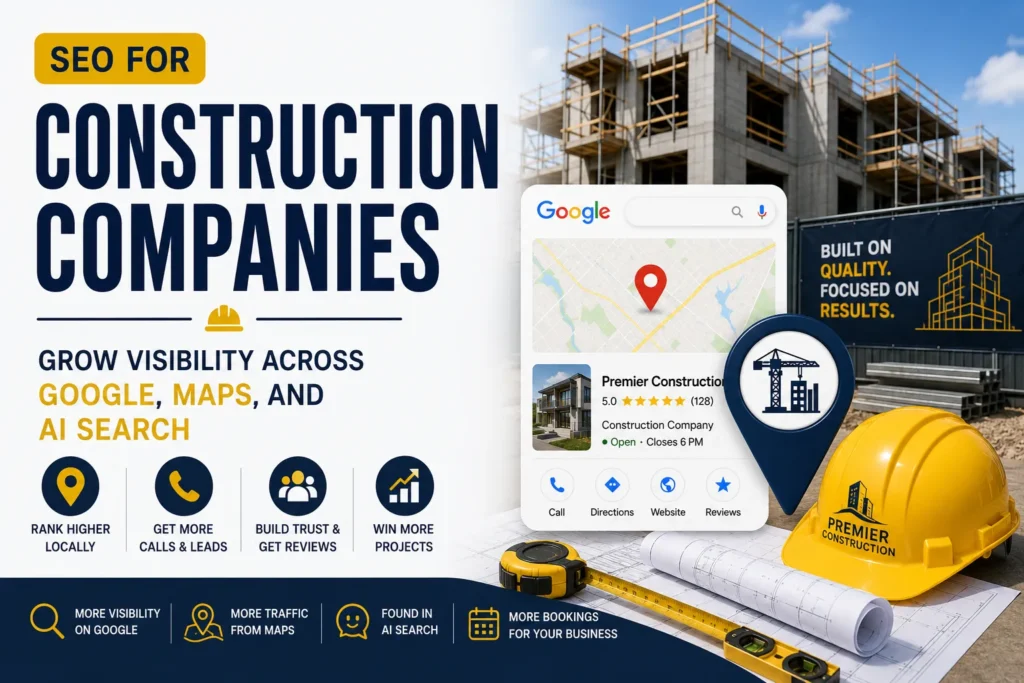
SEO for Construction Companies helps contractors improve visibility across Google Search, Google Maps, and AI-powered search platforms. A successful strategy combines Google Business Profile optimization, a project-focused website, reputation management, technical SEO, local SEO, and AI search optimization to consistently generate qualified project inquiries.
This guide explains how construction companies can improve their online presence, build trust, and convert more searches into consultations and completed projects.
How Customers Search for Construction Companies
Construction clients search differently depending on the project type, budget, timeline, and location. Some are looking for residential contractors, while others need commercial construction specialists or renovation experts.
Common searches include:
- Construction company near me
- General contractor in Dallas
- Commercial construction company
- Home builder nearby
- Office renovation contractor
- Custom home builder
- Industrial construction company
- Construction contractor for remodeling
Your website should address these different search intents by creating dedicated pages for every major construction service. Separate pages for custom home construction, commercial construction, office renovations, tenant improvements, remodeling, design-build services, project management, concrete work, roofing, and specialty construction services help Google better understand your expertise while improving visibility for highly qualified searches. Understanding how local ranking factors like relevance and prominence interact helps construction companies prioritize where to invest their SEO effort first.
Google Business Profile Best Practices for Construction Companies
Google Business Profile is often one of the first places potential clients evaluate your business. Before requesting a consultation, many compare reviews, completed projects, business information, photos, and service areas directly within Google Search and Google Maps.
A complete, professionally managed profile improves local visibility and builds confidence before prospects visit your website.
Choose the Right Business Categories
Select General Contractor or the category that best represents your primary business. Add secondary categories only when they accurately represent additional services such as Home Builder, Commercial Builder, Remodeler, Concrete Contractor, or Roofing Contractor where applicable.
Upload Real Project Photos
Construction clients want proof of quality workmanship. Upload high-quality photos of completed residential projects, commercial buildings, renovations, project progress, finished interiors and exteriors, job sites, equipment, team members, and before-and-after transformations, where appropriate.
Showcase Every Construction Service
List each major construction service individually rather than relying on a single general description. Include custom home construction, commercial construction, remodeling, renovations, tenant improvements, office build-outs, design-build services, concrete work, framing, additions, and project management where applicable.
Configure Your Service Areas
Most construction companies operate across multiple cities and service areas. Clearly define every location you actively serve, and ensure your Google Business Profile aligns with your location pages and service coverage.
Publish Helpful Google Posts
Share completed projects, construction tips, company updates, safety practices, industry insights, project milestones, awards, community involvement, and educational content. Consistent posting demonstrates expertise while keeping your profile active.
Maintain Consistent Business Information
Keep your business name, address, phone number, website, office hours, consultation information, and service descriptions consistent across your website, Google Business Profile, contractor directories, and local citations. Consistency strengthens local trust while improving search visibility.
Complete Every Profile Section
Complete every available profile field, including your business description, consultation links, service options, opening date, accessibility information, highlights, social profiles, and business attributes. A complete profile provides prospects with valuable information while supporting stronger local SEO. The Google Business Profile optimization best practices cover every field worth filling in, including the sections most construction companies skip.
Use Gemini to Improve Google Business Profile Management
Gemini can help eligible Google Business Profile users manage their profile more efficiently by assisting with review response drafts, profile improvement suggestions, Google Post ideas, project description updates, performance summaries, and profile management recommendations.
While Gemini does not directly improve rankings, it helps maintain a complete, accurate, and active Google Business Profile that supports stronger local visibility and provides a better experience for prospective clients.
Website Structure for Construction Companies
Your website should do more than showcase completed projects. It should demonstrate expertise, establish credibility, and help potential clients understand why your company is the right choice for their construction project. Whether someone is planning a residential build, a commercial development, or a major renovation, your website should answer key questions and make it easy to request a consultation.
A well-structured website also helps Google understand your services, project types, service areas, and industry expertise, improving your ability to rank for valuable construction-related searches.
Build a Trust-Focused Homepage
Your homepage should clearly explain your construction services, the industries you serve, years of experience, certifications and licenses, service areas, and what differentiates your company. Include prominent consultation request forms, click-to-call phone numbers, completed project highlights, client testimonials, certifications, and trust signals throughout the page.
Create Dedicated Service Pages
Every major construction service should have its own optimized page. Separate pages for custom home construction, commercial construction, office renovations, tenant improvements, remodeling, design-build services, project management, concrete construction, additions, steel buildings, and specialty contracting services help target highly relevant searches while strengthening topical authority.
Create Local Service Area Pages
If your company serves multiple cities or regions, create unique location pages for each area. Include locally relevant content, completed projects, service availability, nearby landmarks, permits or regional expertise where appropriate, and customer testimonials, rather than duplicating content across locations.
Support Multi-Office Growth
Construction companies with multiple offices should create dedicated pages for every branch. Include office-specific contact information, project portfolios, service coverage, business hours, local team members, and location-specific case studies to improve both local rankings and client confidence.
Expand Your Project Coverage
As your business grows, continue adding pages for new construction specialties, commercial sectors, industrial projects, sustainable construction, pre-construction planning, value engineering, infrastructure projects, maintenance services, and design consulting. A comprehensive website structure helps search engines understand the full scope of your expertise while increasing opportunities to rank.
Improve Lead Generation
Construction projects often involve significant investment, so every page should make it easy for prospects to evaluate your company and request a consultation. Display quote request forms, click-to-call phone numbers, project galleries, case studies, licenses, certifications, warranties where applicable, client testimonials, safety credentials, and frequently asked questions throughout your website.
Licensing, Bonding, and Safety Credential Pages for Construction Companies
If a client is about to sign a contract for a large amount, they want to see proof that you are licensed and insured. Simply listing “licenses and certifications” on your homepage is not enough. Showing your actual license number and bonding details makes your company appear to be the safer choice, even before the first call.
Publish Your License Number and Bonding Details
List your contractor license number, the state or city that issued it, and your bonding and general liability coverage in clear language. Clients comparing several contractors for a big project often check license status themselves. If you make this information easy to find, your company will seem more established than those who hide or skip it. Publishing real credentials is one of the strongest signals of experience and authority a contractor website can display, especially when competing for high-value commercial projects.
Build a Safety Record and OSHA Compliance Page
Commercial and industrial clients often look at your safety record before your project portfolio. If you track your EMR, OSHA compliance history, or jobsite safety rules, share these details. Being able to show a strong safety record provides a concrete answer to “why should we trust you on our site,” rather than just saying you are “safety focused.”
Detailed Project Case Study Pages for Construction Companies
A photo gallery highlights what you built, but it doesn’t explain how you solved the client’s real problem. Prospective clients comparing contractors want to know this before they decide to invest in a project.
Structure Case Studies Around the Client’s Problem
Every major project should have a real case study, not just a set of photos. Include what the client needed, the budget or size, the timeline, any challenges you faced and how you solved them, and the final outcome. When prospects see these details, they can picture themselves in a similar project something a photo gallery alone can’t offer.
Organize Case Studies by Project Type and Industry
Organize your case studies by the categories clients look for, like custom homes, office renovations, or industrial builds, instead of keeping everything on one long portfolio page. If someone is searching for an office renovation contractor, they want to see examples of office renovations right away, not sift through unrelated projects. This approach also lets you link back to the matching service page, which helps both pages perform better.
Reviews and Reputation for Construction Companies
Trust is one of the biggest factors when choosing a construction company. Before requesting a proposal, many clients compare reviews, completed projects, company experience, and customer satisfaction to determine which contractor they can rely on.
A strong online reputation improves both Google Maps visibility and your ability to convert prospects into qualified leads.
Respond to Every Client Review
Respond professionally to both positive and negative reviews. Thank clients for their feedback, acknowledge concerns respectfully, and demonstrate your commitment to quality workmanship, communication, and project management.
Focus on Trusted Review Platforms
Google should remain your primary review platform because it directly supports local SEO and Google Maps visibility. Maintain complete profiles on reputable contractor directories, construction associations, local business directories, and industry platforms that are relevant to your market.
Build a Consistent Review Strategy
Encourage satisfied clients to leave honest reviews after major project milestones or successful project completion. A systematic approach to requesting client reviews tied to project handoffs and completion milestones keeps the flow consistent rather than relying on the team to remember.
Maintain Steady Review Growth
Consistent, authentic reviews are more valuable than receiving a large batch over a short period. Regular feedback demonstrates ongoing project success while strengthening both customer trust and local search performance.
Comprehensive Local SEO Checklist for Construction Companies
A successful construction company SEO strategy combines local optimization, technical SEO, authoritative content, reputation management, and project-focused landing pages. Companies that consistently optimize every area typically generate more qualified inquiries than competitors relying on rankings alone.
Target High-Intent Construction Keywords
Focus on searches that indicate potential clients are actively planning or hiring for a construction project.
Examples include:
- Construction company near me
- General contractor in Dallas
- Commercial construction company
- Home builder nearby
- Office renovation contractor
- Custom home builder
- Industrial construction contractor
Naturally include these throughout your service pages, project pages, location pages, Google Business Profile, FAQs, and educational content. Thorough keyword research for your specific market reveals the project types and regional terms your ideal clients actually search, including commercial-sector and specialty-trade terms that broad tools often miss.
Optimize Every Service Page
Each service page should focus on a single primary construction service, with unique headings, title tags, meta descriptions, internal links, frequently asked questions, and comprehensive project information. Explain your construction process, project timelines, planning stages, materials, quality standards, and what clients can expect throughout the project.
Publish Helpful Construction Content
Educational content helps establish your expertise while answering common client questions. Publish articles about budgeting for construction projects, selecting contractors, permit requirements, construction timelines, sustainable building practices, renovation planning, commercial construction trends, and project management best practices.
Strengthen Google Maps Visibility
Google Maps remains one of the strongest lead sources for local construction companies. Keep your Google Business Profile fully optimized, publish Google Posts regularly, upload photos of completed projects, answer customer questions, and continue collecting authentic client reviews. The local map pack is often where high-value commercial and residential clients make their first shortlist.
Build Accurate Local Citations
Maintain consistent business information across Google, contractor directories, construction associations, chambers of commerce, local business listings, and reputable citation websites. Consistent NAP details across every platform strengthen local authority while preventing the ranking erosion that inconsistent listings cause over time.
Earn High-Quality Local Backlinks
Build relationships with architects, engineers, developers, real estate firms, suppliers, subcontractors, chambers of commerce, and local business organizations. These partnerships can generate valuable backlinks while strengthening your authority within your market. The most durable local link-building opportunities for construction companies come from genuine project partnerships, trade associations, and community development involvement rather than generic directory submissions.
Build Community Authority
Participate in community development projects, sponsor local events, support charitable construction initiatives, join trade associations, and contribute to local business organizations. These activities increase brand recognition while generating valuable mentions and referrals.
Implement Structured Data
Use Organization, LocalBusiness, GeneralContractor where appropriate, Service, FAQ, Review, Breadcrumb, and Website schema markup to help search engines better understand your business and improve eligibility for enhanced search results.
Strengthen Entity Optimization
Clearly connect your construction company with your services, project types, certifications, licenses, service areas, team members, equipment, completed projects, and industry expertise throughout your website. Strong entity optimization helps both search engines and AI platforms accurately understand your business and authority.
AI Search Optimization for Construction Companies
Businesses and property owners are increasingly using AI-powered search to research contractors, compare construction companies, estimate project requirements, and evaluate expertise before requesting a proposal. Google AI Overviews, ChatGPT, Gemini, Claude, and Perplexity are becoming important discovery channels by recommending companies with accurate information, strong authority, and well-structured websites.
Construction companies with complete Google Business Profiles, detailed service pages, real project portfolios, authentic client reviews, and consistent business information are better positioned to appear in these AI-generated search experiences.
Improve Visibility Across AI Search
Create content that answers common client questions while clearly explaining your construction services, project process, industries served, certifications, service areas, completed projects, safety standards, and frequently asked questions. Well-organized information helps both prospective clients and AI systems understand your expertise and confidently recommend your business. The framework behind generative engine optimization rewards construction companies that clearly structure their expertise so an AI system can extract and cite it when someone asks, “who builds commercial offices in [city]?”
AI SEO Checklist for Construction Companies
| AI SEO Element | Best Practice |
| Entity Optimization | Clearly define your company, services, project types, licenses, certifications, team members, and service areas. |
| Structured Content | Use descriptive headings and answer common client questions directly. |
| Schema Markup | Implement GeneralContractor, LocalBusiness, Service, FAQ, Review, Organization, Breadcrumb, and Website schema where appropriate. |
| Google Business Profile | Keep every profile section complete, accurate, and regularly updated. |
| Reviews | Build authentic client reviews and respond professionally. |
| Content Quality | Publish comprehensive project documentation, case studies, and educational construction content. |
| Internal Linking | Connect service pages, project case studies, location pages, and educational articles naturally. |
| Brand Consistency | Maintain identical business information across your website, GBP, directories, and social profiles. |
Measure AI Search Visibility
Don’t measure success by rankings alone. Monitor branded searches, consultation requests, proposal submissions, phone calls, Google Search Console performance, Google Business Profile insights, referral traffic, and qualified project inquiries to understand how your company performs across both traditional and AI-powered search. Using Search Console and Analytics together gives a clearer picture of which pages draw impressions versus which actually generate consultation requests.
Technical SEO Checklist for Construction Companies
Technical SEO helps search engines crawl, understand, and index your website while providing prospective clients with a fast, secure, and professional browsing experience. A technically optimized website also improves lead generation by making it easier for visitors to explore your services and request a consultation.
| Technical SEO Element | What to Check |
| Crawlability | Ensure Google can crawl your homepage, service pages, project pages, location pages, blog posts, and contact page. |
| Indexing Status | Review indexed, excluded, duplicate, discovered, and crawled pages in Google Search Console. |
| XML Sitemap | Include all important service, project, location, and educational pages, and exclude unnecessary URLs. |
| Robots.txt | Confirm important pages and resources remain crawlable. |
| Index Bloat | Remove or noindex thin, duplicate, outdated, and low-value pages. |
| Orphan Pages | Ensure important service, project, and location pages receive internal links. |
| Crawl Depth | Keep important pages within two or three clicks from the homepage. |
| URL Structure | Use clean, descriptive URLs for services, locations, and project case studies. |
| Website Architecture | Organize services, projects, locations, blogs, and client resources logically. |
| Internal Linking | Connect related service pages, project case studies, location pages, and educational content naturally. |
| Breadcrumbs | Improve navigation and crawl efficiency. |
| Title Tags | Create unique, keyword-focused titles for every important page. |
| Meta Descriptions | Write compelling descriptions that encourage consultation requests. |
| Heading Structure | Maintain one H1 with logical H2 and H3 hierarchy. |
| Duplicate Content | Avoid repeating content across service and location pages. |
| Canonical Tags | Point duplicate URLs to the preferred version. |
| Thin Pages | Expand weak pages with valuable project information and client-focused details. |
| Site Speed | Optimize loading speed across desktop and mobile devices. |
| Core Web Vitals | Monitor LCP, INP, and CLS performance. |
| Mobile Experience | Ensure prospects can easily browse portfolios and request consultations on mobile devices, particularly for commercial clients researching on the go. |
| Click to Call | Make phone numbers clickable across every page. |
| Accessibility | Improve readability, forms, navigation, image alt text, and button visibility. |
| Image Optimization | Compress images while using descriptive file names and alt text. |
| Project Photos | Showcase real completed projects, team members, job sites, and before-and-after transformations. |
| Schema Markup | Validate all structured data implementation. |
| NAP Consistency | Keep business information consistent across all online platforms. |
| Service Coverage | Create dedicated pages for every major construction service. |
| Location Pages | Build unique pages for every service area and office location. |
| Broken Links | Repair broken internal and external links. |
| Redirects | Review redirect chains, outdated URLs, and unnecessary redirects. |
| HTTPS | Secure every page using HTTPS. |
| Security | Monitor for malware, spam, hacked pages, and indexing issues. |
| Contact Forms | Test consultation request, quote, and contact forms regularly. |
| GA4 | Verify analytics tracking is working correctly. |
| Google Search Console | Monitor indexing, impressions, clicks, and search performance. |
| Conversion Tracking | Track consultation requests, phone calls, quote submissions, and proposal requests. |
| GBP Tracking | Measure calls, website visits, direction requests, and profile interactions from Google Business Profile. |
Local SEO Mistakes Construction Companies Should Avoid
Many construction companies lose valuable project opportunities because they overlook important local SEO fundamentals. Avoiding these mistakes can significantly improve both visibility and lead generation.
- Using one generic page for every construction service.
- Leaving Google Business Profile incomplete or outdated.
- Publishing duplicate service area pages.
- Not showcasing completed construction projects.
- Ignoring client reviews and testimonials.
- Publishing thin service pages with little project detail.
- Neglecting technical SEO.
- Weak internal linking between service pages, project portfolios, and educational content.
- Inconsistent business information across directories.
- Measuring rankings instead of qualified project inquiries and signed contracts.
How LocalMighty Helps Construction Companies Win More Projects
Construction marketing requires more than simply appearing in search results. LocalMighty helps construction companies improve Google Maps visibility, optimize Google Business Profiles, build project-focused website structures, strengthen local authority, and create content that attracts clients planning residential, commercial, and industrial projects. Our local SEO services combine technical SEO, AI search optimization, reputation management, entity optimization, and conversion optimization to help contractors generate more consultation requests, proposal opportunities, and qualified construction projects while building long-term visibility across Google Search, Google Maps, and modern AI search platforms.
Recover Rankings and Leads After a Google Update
Google updates can affect construction websites, particularly in competitive local markets. Instead of making immediate changes, focus on improving overall website quality, trust signals, and user experience.
If your rankings decline:
- Review Google Search Console to identify affected pages.
- Compare traffic changes with recent Google updates.
- Audit technical SEO before modifying content.
- Refresh outdated service pages, project portfolios, and educational articles.
- Add new project case studies and strengthen expertise signals.
- Improve internal linking across services, locations, and completed projects.
- Continue earning authentic client reviews.
- Keep your Google Business Profile complete and regularly updated.
- Monitor performance over several weeks before making significant SEO changes.
Construction companies that consistently improve content quality, technical performance, project documentation, and customer experience generally recover more successfully than businesses that make reactive SEO changes after each algorithm update.
Closing Notes
Successful construction SEO is built on expertise, credibility, and visibility. Your website, Google Business Profile, service pages, project portfolio, client reviews, technical SEO, and local authority all work together to influence whether potential clients choose your company over competing contractors.
As search continues evolving through Google Search, Google Maps, AI Overviews, ChatGPT, Gemini, Claude, Perplexity, and future AI search platforms, construction companies that invest in accurate business information, detailed project content, strong local SEO, and an exceptional online experience will continue generating more qualified project inquiries, winning larger contracts, and building sustainable long-term growth.