
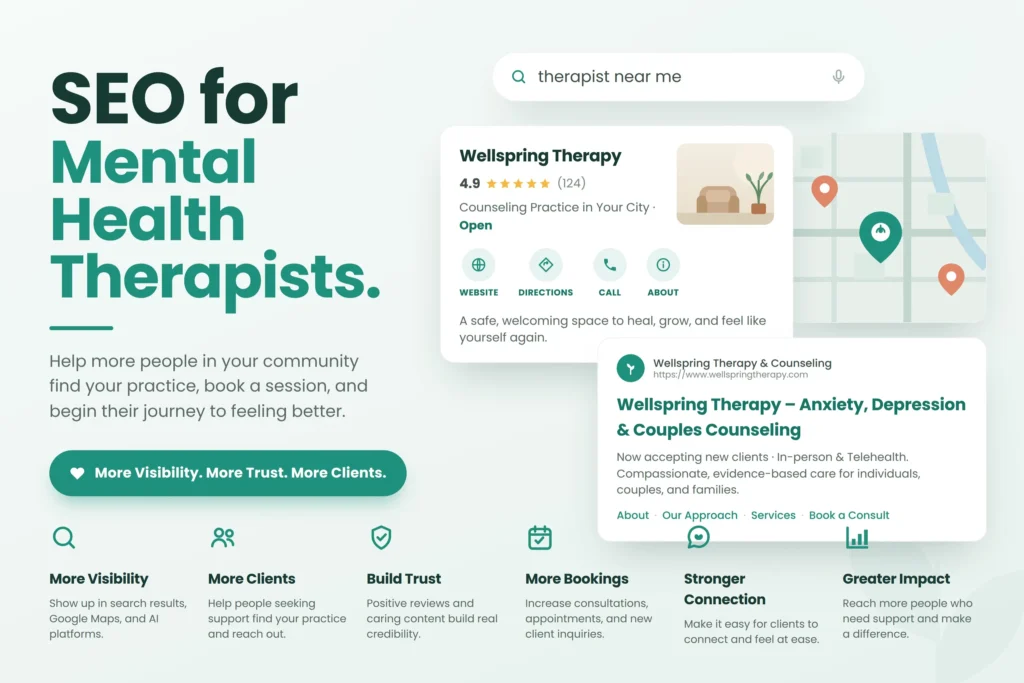
Most people begin searching for a therapist long before they make their first call. They compare providers, read reviews, visit multiple websites, and often return several times before booking an appointment. If your practice isn’t visible during this journey, potential clients may never discover you, regardless of your experience or qualifications.
Unlike many local businesses, mental health practices rely heavily on trust. Your online presence must demonstrate professionalism, expertise, and compassion while making it easy for prospective clients to understand your services and take the next step.
SEO for mental health therapists is about much more than improving rankings. It helps your practice appear when people actively search for therapy services, strengthens your credibility across Google Search and Google Maps, and increases the number of qualified inquiries from people who need your support.
This guide walks through the essential SEO strategies every mental health practice should implement, including Google Business Profile optimization, website structure, reputation management, local SEO, AI search optimization, technical SEO, and practical ways to turn online visibility into booked consultations.
How People Search for Mental Health Therapists
Understanding how prospective clients search is the foundation of a successful SEO strategy. Most people do not search using broad phrases like “therapist.” Instead, they combine symptoms, treatment methods, specialties, insurance preferences, and locations to find someone who meets their specific needs.
Common searches include:
- Anxiety therapist near me
- Trauma therapist in Dallas
- EMDR therapist accepting new patients
- Child psychologist nearby
- Couples counseling in my city
- PTSD therapist with evening appointments
- Online therapy in Texas
Because search intent varies significantly, your website should include dedicated pages for each primary service, specialty, and treatment area rather than combining everything on a single page. This makes it easier for Google and AI search systems to understand your expertise while helping potential clients quickly find the information they’re looking for. Conducting genuine keyword research on condition-specific and modality-specific terms reveals the exact phrases prospective clients use at each stage of their search, from early symptom research to active provider comparison.
Google Business Profile Workflow for Mental Health Therapists
For most local therapy practices, Google Business Profile generates some of the highest intent leads. People searching on Google Maps or local search results are often ready to schedule an appointment, making your profile one of the most valuable local SEO assets.
A fully optimized profile improves visibility, builds trust, and gives prospective clients confidence before they ever visit your website.
Choose the Most Relevant Categories
Your primary category should accurately reflect your core service, such as Mental Health Service, Psychotherapist, Psychologist, or Counselor, depending on your practice. Add secondary categories only when they genuinely represent additional services you provide. Choosing accurate categories helps Google understand your practice and match it with relevant local searches.
Upload Professional Photos and Videos
Many therapy practices overlook visuals, but they play an important role in building trust. Add high-quality photos of your office, waiting room, therapy spaces, team members, accessibility features, and exterior signage. Short introduction videos can also help prospective clients feel more comfortable before booking their first appointment.
Highlight Every Therapy Service
List each major therapy service individually rather than relying on a general description. Services such as anxiety therapy, depression counseling, trauma therapy, EMDR, couples counseling, family therapy, grief counseling, and virtual therapy should all be included where applicable.
Define Service Areas Carefully
If you operate as a service-area business or offer virtual therapy in licensed states or regions, configure your service areas accurately. For practices with a physical office, ensure your address and office hours remain up to date.
Publish Helpful Google Posts
Regular Google Posts keep your profile active while providing useful information to prospective clients. Share mental wellness tips, educational resources, practice updates, community events, seasonal topics, or new services. Posting consistently also demonstrates that your practice is active and engaged.
Maintain Consistent Business Information
Your practice name, address, phone number, website, office hours, appointment links, and business description should remain consistent across all online appearances. Consistency strengthens trust signals and reduces confusion for both search engines and potential clients.
Complete Every Available Profile Section
Many practices leave valuable profile fields unfinished. Complete business attributes, appointment URLs, insurance information where appropriate, accessibility details, social profiles, opening date, business highlights, amenities, and service options. A thorough review against the full Google Business Profile optimization best practices often surfaces fields that directly influence local rankings and that most therapy practices skip entirely.
Use Gemini to Improve Google Business Profile Management
Gemini can now assist eligible Google Business Profile users with everyday profile management tasks. It can help draft review responses, suggest profile improvements, generate Google Posts, refine service descriptions, summarize performance insights, and recommend updates that keep your profile accurate and engaging.
While Gemini does not directly improve rankings, it helps maintain a complete, active, and well-managed profile that supports your overall local SEO strategy and delivers a better experience for potential clients.
Website Structure for Mental Health Therapy Practices
A well-designed website supports both search visibility and conversions. Visitors should immediately understand who you help, what services you provide, and how to schedule an appointment without having to search through multiple pages.
Strong website architecture also helps Google understand your services while improving crawlability and internal linking.
Build a High-Converting Homepage
Your homepage should clearly explain your specialties, treatment approach, service areas, therapist credentials, insurance information where applicable, and primary calls to action. Include prominent appointment buttons and make contact information easy to find.
Create Dedicated Service Pages
Every core therapy service deserves its own optimized page. Individual pages for anxiety therapy, depression counseling, trauma therapy, family therapy, couples counseling, PTSD treatment, adolescent therapy, and online therapy allow you to target highly relevant searches while providing comprehensive information for prospective clients.
Develop Helpful Location Pages
If your practice serves multiple cities or neighborhoods, create unique location pages that include locally relevant information rather than copying the same content across every city. High-quality local pages improve visibility without creating duplicate content issues.
Scale Multi-Location Practices
Practices with multiple offices should create dedicated pages for each location, including office-specific information, therapist availability, driving directions, reviews, local contact details, and unique content for each clinic. The principles behind managing multiple practice locations apply directly here, since each office needs a consistent digital presence to rank effectively in its community.
Expand Multi-Service Visibility
As your practice grows, continue adding optimized pages for additional specialties, treatment methods, assessments, workshops, and counseling services. A well-organized service structure strengthens topical authority while helping search engines better understand your expertise.
Improve Website Conversions
SEO brings visitors to your website, but conversion optimization turns those visitors into clients. Make scheduling simple with clear calls to action, visible phone numbers, online booking, concise inquiry forms, therapist profiles, FAQs, insurance details, and trust signals that reduce uncertainty before someone reaches out. Small improvements to your intake flow often increase qualified inquiries from existing traffic without requiring any new rankings.
Therapist Credential, Licensure, and Fee Transparency Pages
People looking for a therapist want to know exactly who they will be working with before reaching out. Just putting the word “Credentials” on your homepage is not enough. If your practice clearly lists license type, supervision details, and real session costs, you are more likely to get calls than if you only provide a vague bio.
Publish Real Therapist Bio Pages
Every therapist should have a complete bio that includes their license type (like LCSW, LPC, LMFT, PsyD, or PhD), license number, state of licensure, years of experience, and any special training, such as EMDR or CBT certification. If a therapist is licensed for telehealth in more than one state, list each state clearly. This helps people searching for “online therapy in Texas” make sure the therapist can actually work with them before they book. Detailed clinician bios are among the most direct ways to demonstrate the experience and expertise signals that Google looks for when evaluating YMYL health content.
Publish a Clear Fees and Insurance Page
Be clear about which insurance plans you accept, your self-pay session fee, and whether you offer a sliding scale. Saying “insurance information where appropriate” does not give potential clients any useful details. Many people choose a therapist based on cost, so having a straightforward page about fees and insurance can help more people feel comfortable reaching out.
Reviews and Reputation for Mental Health Therapists
Reviews influence both local rankings and client decisions. While privacy and ethical guidelines require careful handling, a steady flow of authentic reviews helps establish trust and demonstrates the quality of care your practice provides.
An effective reputation strategy focuses on consistency, professionalism, and compliance rather than collecting as many reviews as possible.
Respond to Reviews Professionally
Respond thoughtfully while protecting client confidentiality. Thank reviewers for their feedback without discussing treatment details or confirming any therapeutic relationship. Professional responses show prospective clients that your practice values communication and respect.
Focus on Trusted Review Platforms
Google should remain your primary review platform because it directly supports local SEO and Google Maps visibility. Depending on your services, maintaining complete profiles on reputable healthcare directories can also strengthen credibility and improve discovery.
Build an Ethical Review Strategy
Develop a consistent process for requesting reviews from satisfied clients that adheres to professional guidelines and privacy requirements. Simple follow-up emails, post-appointment communication, or printed review instructions can help encourage genuine feedback without creating pressure.
Maintain Consistent Review Growth
A steady stream of authentic reviews sends stronger trust signals than receiving dozens of reviews in a short period. Regular feedback also keeps your profile current and reassures prospective clients that your practice remains active and trusted within the community. The way review velocity and platform diversity shape local prominence is especially relevant for mental health practices, where a strong, growing review profile often compensates for the ethical constraints that prevent aggressive review collection.
Crisis Safety Disclosures and Confidentiality Signals for Mental Health Practices
Sometimes, people in acute distress visit a mental health website, not just those looking to compare options. Having a visible crisis resource line is more than good practice. It shows that your practice cares about client wellbeing, even before someone books a session.
Add a Visible Crisis Resources Notice
Add a short, easy-to-see note on your homepage and contact page. Let anyone in crisis know they should call or text 988 (the Suicide and Crisis Lifeline) or go to the nearest emergency room, since your practice cannot handle emergencies. This quick update helps protect people in crisis and shows professionalism to all visitors.
Explain Confidentiality and HIPAA in Plain Language
Most people looking into therapy have never read a Notice of Privacy Practices and may not know what HIPAA covers. Creating a short, easy-to-understand page that explains what is confidential, when a therapist must break confidentiality (such as in cases of imminent harm to self or others), and how session records are kept secure can ease the worries of first-time clients concerned about privacy.
Comprehensive Local SEO Checklist for Mental Health Therapists
A successful mental health therapist’s local SEO strategy is built on multiple ranking signals working together. Optimizing only your website or only your Google Business Profile is rarely enough. The practices that consistently attract qualified clients invest in every part of their local search presence, creating a strong foundation that improves visibility, trust, and conversions.
Find the Right Local Keywords
Start by identifying how potential clients actually search for therapy services. Look beyond broad keywords and target searches based on conditions, treatment methods, specialties, and locations.
Examples include:
- Anxiety therapist near me
- Couples counselor in Dallas
- EMDR therapist accepting new patients
- Child therapist in Plano
These keywords should naturally appear throughout your service pages, location pages, FAQs, blog content, and Google Business Profile.
Optimize Every Important Page
Every page should target a clear search intent with unique title tags, meta descriptions, headings, internal links, optimized images, and helpful content. Focus on creating pages that answer questions while encouraging visitors to schedule an appointment.
Build Helpful Educational Content
Educational content helps establish expertise and supports prospective clients before they contact your practice. Cover topics that answer common questions about therapy, treatment options, mental health conditions, and what clients can expect during the counseling process.
Strengthen Google Maps Visibility
Google Maps continues to generate some of the highest intent local traffic. Earning a position in the local map pack is particularly valuable for therapy practices, where proximity and trust signals carry equal weight in determining which providers appear first. Maintain an accurate Google Business Profile, publish regular updates, collect authentic reviews, answer questions promptly, and keep every section of your profile complete.
Build Accurate Local Citations
Maintain consistent business information across reputable healthcare directories, local business listings, and trusted citation sources. Consistent NAP details across Psychology Today, TherapyDen, and general directories reduce the conflicting information that quietly weakens local rankings over time.
Earn Relevant Local Links
Quality local backlinks help reinforce your authority. Consider partnerships with physicians, healthcare organizations, universities, nonprofit organizations, wellness centers, community groups, and local events that naturally generate relevant mentions and links. These genuine community connections and professional partnerships carry more authority signal for a mental health practice than any directory submission campaign.
Increase Brand Mentions and Community Presence
Community involvement strengthens both your reputation and your local search presence. Hosting workshops, participating in wellness events, appearing on podcasts, publishing expert interviews, and collaborating with other healthcare providers all contribute to stronger brand authority.
Implement Structured Data
Use structured data to help search engines better understand your practice. Depending on your website, implement Organization, LocalBusiness, MedicalBusiness where appropriate, Service, FAQ, Breadcrumb, and Website schema.
Strengthen Entity Signals
Help search engines and AI systems clearly understand your practice by consistently connecting therapists, specialties, treatment methods, office locations, credentials, insurance information, and services throughout your website and online profiles.
AI Search Optimization for Mental Health Therapists
People are increasingly discovering healthcare providers through AI-powered search experiences. Google AI Overviews, ChatGPT, Gemini, Claude, and Perplexity often summarize trusted sources before users even click a website.
Practices with accurate information, well-structured content, strong entities, and consistent trust signals are more likely to appear in these AI-generated responses.
Improve Visibility Across AI Search
Create content that answers questions directly while clearly explaining your specialties, treatment approaches, therapist credentials, service areas, and frequently asked questions. Organize information logically so both people and AI systems can easily understand your expertise. The principles of generative engine optimization are particularly relevant for mental health, since AI systems are increasingly being asked to name trusted therapists by specialty and location, which rewards practices with the clearest, most structured expert content.
AI SEO Checklist for Mental Health Therapists
| AI SEO Element | Best Practice |
| Entity Optimization | Clearly define therapists, specialties, credentials, treatment methods, office locations, and service areas. |
| Structured Content | Use descriptive headings and answer common client questions directly. |
| Schema Markup | Implement MedicalBusiness, LocalBusiness, Service, FAQ, Review, Organization, Breadcrumb, and Website schema where appropriate. |
| Google Business Profile | Keep every profile section complete, accurate, and regularly updated. |
| Reviews | Build authentic client reviews in line with ethical guidelines and respond professionally. |
| Content Quality | Publish helpful educational content on mental health topics written by credentialed clinicians. |
| Internal Linking | Connect therapy service pages, clinician bios, location pages, and educational articles naturally. |
| Brand Consistency | Maintain identical business information across your website, GBP, healthcare directories, and Psychology Today. |
Measure AI Search Performance
Traditional rankings no longer tell the whole story. Monitor branded searches, impressions, qualified inquiries, Google Search Console data, referral traffic, and conversions to understand how your practice performs across both traditional and AI-powered search experiences. Understanding what Search Console reveals that Analytics does not helps practices identify which therapy service pages are earning search impressions but failing to convert, pointing directly to where content or conversion work is needed.
Technical SEO Checklist for Mental Health Therapists
Technical SEO ensures your website is easy for search engines to crawl, understand, and index. Even excellent content can struggle to perform if technical issues prevent Google from accessing or evaluating your pages correctly.
| Technical SEO Element | What to Check |
| Crawlability | Ensure Google can crawl your homepage, therapy service pages, therapist bios, location pages, blog posts, and contact page. |
| Indexing Status | Review indexed, excluded, duplicate, discovered, and crawled pages in Google Search Console. |
| XML Sitemap | Include all important service, location, therapist, and educational pages, and exclude unnecessary URLs. |
| Robots.txt | Confirm important pages and resources remain crawlable. |
| Index Bloat | Remove or noindex thin, duplicate, outdated, and low-value pages. |
| Orphan Pages | Ensure important service and therapist pages receive internal links. |
| Crawl Depth | Keep important pages within two or three clicks from the homepage. |
| URL Structure | Use clean, descriptive URLs for therapy services and locations. |
| Website Architecture | Organize services, therapists, locations, blog posts, and client resources logically. |
| Internal Linking | Connect related service pages, therapist bios, location pages, and educational content naturally. |
| Breadcrumbs | Improve navigation and crawl efficiency. |
| Title Tags | Create unique, keyword-focused titles for every important page. |
| Meta Descriptions | Write compelling descriptions that encourage appointment inquiries. |
| Heading Structure | Maintain one H1 with logical H2 and H3 hierarchy. |
| Duplicate Content | Avoid repeating content across service and location pages. |
| Canonical Tags | Point duplicate URLs to the preferred version. |
| Thin Pages | Expand weak pages with valuable client information. |
| Site Speed | Optimize loading speed across desktop and mobile devices. |
| Core Web Vitals | Monitor LCP, INP, and CLS performance. |
| Mobile Experience | Ensure clients can easily browse services and schedule appointments on mobile devices, since most people research therapy providers on their phones during quiet private moments. |
| Click to Call | Make phone numbers clickable across every page. |
| Accessibility | Improve readability, forms, navigation, image alt text, and button visibility. |
| Image Optimization | Compress images while using descriptive file names and alt text. |
| Practice Photos | Showcase real office spaces, therapists, and welcoming environments. |
| Schema Markup | Validate all structured data implementation. |
| NAP Consistency | Keep practice information consistent across all online platforms. |
| Service Coverage | Create dedicated pages for every major therapy service and specialty. |
| Location Pages | Build unique pages for every office location or licensed service area. |
| Broken Links | Repair broken internal and external links. |
| Redirects | Review redirect chains, outdated URLs, and unnecessary redirects. |
| HTTPS | Secure every page using HTTPS. |
| Security | Monitor for malware, spam, hacked pages, and indexing issues. |
| Appointment Forms | Test scheduling forms, intake forms, and contact forms regularly. |
| GA4 | Verify analytics tracking is working correctly. |
| Google Search Console | Monitor indexing, impressions, clicks, and search performance. |
| Conversion Tracking | Track consultation requests, phone calls, and intake form submissions. |
| GBP Tracking | Measure calls, website visits, direction requests, and profile interactions from Google Business Profile. |
Local SEO Mistakes Mental Health Therapists Should Avoid
Many therapy practices struggle with SEO because they overlook simple but important fundamentals. Avoiding these mistakes can improve both visibility and client inquiries.
- Relying on one generic page for every therapy service.
- Leaving Google Business Profile incomplete.
- Ignoring online reviews.
- Publishing thin or outdated content.
- Creating duplicate location pages.
- Neglecting technical SEO.
- Forgetting internal linking.
- Tracking rankings instead of qualified consultations.
- Providing inconsistent business information across directories.
- Failing to measure conversions.
Recover Rankings After a Google Update
Ranking fluctuations can be stressful, but reacting too quickly often creates additional problems. A systematic approach usually leads to better long-term results.
If your rankings decline:
- Review Google Search Console to identify affected pages.
- Compare traffic changes with recent Google updates.
- Check for technical SEO issues before rewriting content.
- Improve thin or outdated service pages.
- Refresh older educational content with current information.
- Strengthen internal linking across related pages.
- Continue earning authentic reviews and maintaining your Google Business Profile.
- Monitor performance over several weeks before making significant changes.
SEO improvements often take time to be reflected in search results. Focus on solving genuine quality issues instead of chasing quick fixes.
Helping Mental Health Therapists Build Long-Term Growth with LocalMighty
Mental health practices need more than higher rankings to grow. They need a trusted online presence that helps prospective clients feel confident enough to schedule their first appointment. As part of our healthcare SEO work, LocalMighty helps mental health therapists improve Google Business Profile performance, strengthen website structure, create service-focused content, optimize for Google Maps and AI search, and build trust signals that influence both search engines and potential clients. Every strategy is designed to generate more qualified consultations by combining local SEO, technical SEO, reputation management, conversion optimization, and AI search readiness into one sustainable growth strategy.
Final Notes
Successful mental health therapists’ SEO is built on trust, not just rankings. Your website, Google Business Profile, reviews, local authority, and technical foundation should work together to help potential clients feel confident about contacting your practice.
When you consistently publish helpful content, maintain an optimized local presence, and create a website that answers real questions, you improve more than search visibility. You build credibility with prospective clients and position your practice to earn more qualified inquiries from people actively seeking mental health support.
As search continues to evolve with AI-powered experiences, practices that prioritize accuracy, expertise, user experience, and trust will be best positioned to grow their visibility across Google Search, Google Maps, ChatGPT, Gemini, Claude, Perplexity, and future search platforms.