
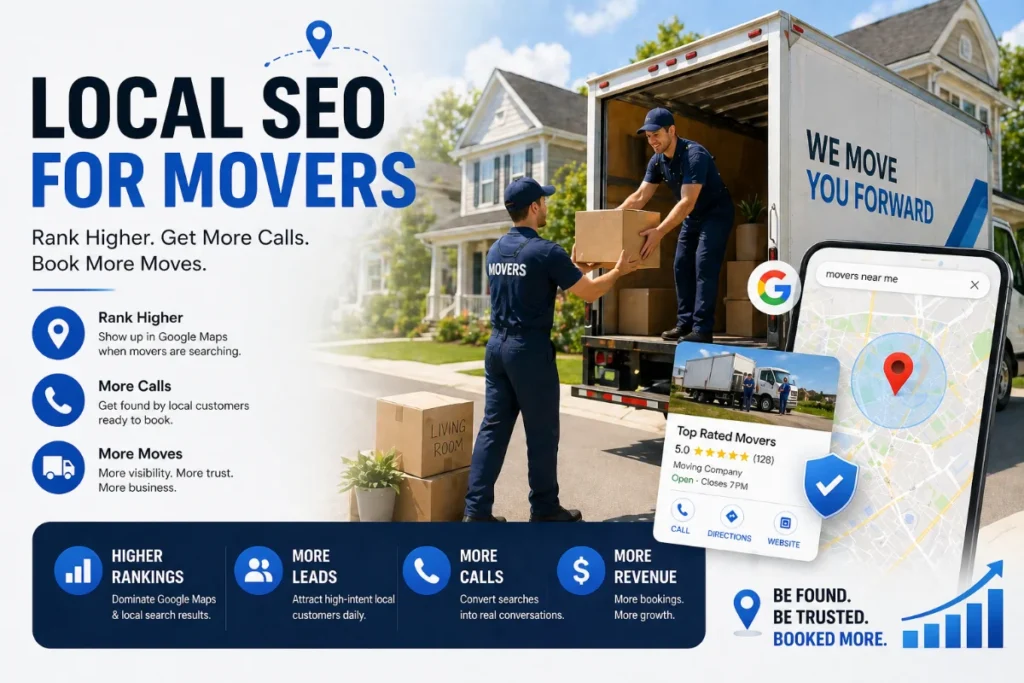
Moving is not a casual local purchase. Your prospect may be juggling a lease deadline, a home closing, an elevator reservation, and a family that expects every possession to arrive intact. They are stressed, comparing three or four companies quickly, and wary of brokers, rogue operators, hidden fees, and damaged furniture.
That is why local SEO for movers is not about a generic ranking report. It is about being the most credible, visible, and easy-to-contact moving company at the moment a high-intent customer needs help.
This playbook shows you how to:
- Win Google Maps for local phone-call volume
- Build an organic search engine for long-distance and specialty revenue
- Create the trust signals that let a legitimate carrier outrank lead brokers and low-price competitors
- Measure everything in booked moves, not vanity metrics
The Moving Search Landscape
Moving intent is urgent, anxious, and trust-sensitive
A person looking for a restaurant can browse. A person looking for movers often cannot. Their move date may be two weeks away, their building may require a certificate of insurance, and a buyer may be arriving for a walkthrough in an hour.
Mover searches fall into four intent groups:
| Intent | Example queries | Where it is won |
|---|---|---|
| Immediate and direct | “movers near me,” “moving companies in [City],” “same day movers” | Google Maps 3-Pack, Local Services Ads |
| Service-specific | “piano movers [City],” “office movers [City],” “white glove movers” | Maps + service pages |
| Route-based | “moving from [Origin] to [Destination],” “interstate movers [City].” | Organic route pages |
| Research and pricing | “cost to hire movers in [City],” “movers hourly rate [City].” | Cost guides, AI answers |
The customer is price-conscious, but price rarely wins on its own. In a category full of bad stories, customers pay for confidence. They want real trucks, real crews, clear policies, strong reviews, and proof that you will still answer the phone after the deposit clears.
The anatomy of a modern moving SERP
A typical moving search result now has five competitive layers:
- Local Services Ads (LSAs): Pay-per-lead placements with the Google Guaranteed badge. They produce leads fast, but cost per lead climbs when every operator in town bids on the same call.
- AI Overviews and AI answers: Pricing, planning, and “how do I choose a mover?” questions are often answered before any listing. Your goal is to be a company AI systems can confidently cite.
- The local 3-Pack: The core battlefield for local moves. Ranking in the 3-Pack puts you in front of the urgent phone-call audience.
- Aggregators: Yelp, Angi, Thumbtack, Move.org, and similar sites hold many top organic positions. Their model is selling attention, leads, or ad access.
- Real mover websites: A well-built site can win what aggregators handle poorly: specific services, local regulations, building logistics, cost guides, and genuine routes.
Pro tip: Treat Google Maps and organic search as separate acquisition channels. Maps is your local-volume engine. Organic content is your scalable margin engine, especially for long-distance and specialty work.
Local and long-distance searches do not behave the same way
Google ranks local results on three factors: relevance (how well your profile matches the search), distance (how close you are to the searcher or the location in the query), and prominence (reviews, links, citations, and overall reputation). For “movers near me,” distance carries heavy weight. A company three cities away will rarely outrank a legitimate nearby operator in Maps.
Long-distance searches work differently. A customer searching “moving from [Origin City] to [Destination City]” is researching a lane, not a storefront. Those results are more organic, more content-driven, and more crowded with aggregators.
One strategy cannot win both:
- Use your Google Business Profile to capture demand around your real dispatch location and service radius.
- Use service pages, route pages, proof pages, and original guidance to capture long-distance and high-consideration demand.
- Never create destination-city profiles unless you run a real, staffed location there. A suspended fake listing can put your main profile at risk.
Why paid-lead dependence erodes margins
Paid leads help fill trucks, test a market, or protect capacity in peak season. They become dangerous when they are your only pipeline.
If your cost per booked move keeps rising because you compete with brokers and lead platforms for the same inquiries, you are renting demand instead of building an asset. Map visibility, organic rankings, reviews, citations, and useful content keep producing leads after the work is done.
That is the moat: a legitimate local brand customers recognize before they hand their details to a broker.
Google Business Profile Mastery for Movers
Your Google Business Profile (GBP) is the single biggest lever for Maps visibility. Treat it as a live sales page, not a one-time listing.
Use your real business name
Your GBP name must match your real-world branding: signage, trucks, invoices, and legal or DBA filings. Adding keywords such as “Best Cheap Movers [City]” breaks Google’s guidelines and is one of the most common reasons mover profiles get suspended. If your legal name already includes “Moving” or a city, that is fine. Inventing it is not.
Set categories around the services you actually provide
Pick the primary category that best matches your core work, usually Moving company or Mover. Check the live category list in your GBP dashboard and compare it with the top-ranking legitimate movers in your market, since names and availability change.
Add secondary categories only when they describe a real, material part of the business:
- Moving and storage service
- Piano moving service
- Packaging supply store (only if you sell boxes and supplies to walk-in customers)
- Self-storage facility or storage facility (only if you operate one)
- Furniture moving or office/commercial moving categories, where they exist and are accurate
Do not copy a competitor’s categories. Category sprawl weakens relevance and makes you look like you are trying to be everything to everyone.
Choose the correct address model
A real warehouse, dispatch yard, or office with permanent signage is an advantage. It supports verification, shows a real operation, and gives Google a clear location signal.
- Show your address only if customers can visit during stated hours and the location has permanent signage.
- Hide your address and run as a service-area business (SAB) if you dispatch to customers and do not receive them at your location.
- Set service areas that reflect where you actually dispatch crews. Google allows up to 20 service areas; they do not directly expand your ranking radius, so keep them honest.
Google’s guidelines are explicit: virtual offices, P.O. boxes, mailboxes, and unstaffed rented addresses are not eligible. A co-working office must be signed, staffed by your team during business hours, and able to receive customers. Expect video verification that shows your signage, equipment, and business documents.
Complete every field customers use
Most movers stop at name, phone, and hours. A fully optimized profile covers every field below:
- Services: List each service (local moving, long-distance moving, packing, crating, piano moving, storage, commercial moving) with a short, factual description.
- Products: Use this section to showcase service packages, packing kits, or storage options with photos and starting prices you can honor.
- Business description: 750 characters on who you serve, where, what makes you different, and your licensing. Write for people, not keyword density.
- Attributes: Mark accurate attributes such as online estimates, veteran-owned or women-owned, and accepted payment types.
- Hours: Keep regular hours current and set special hours for holidays.
- Opening date: Add it. A long operating history is a trust signal.
- Appointment or quote link: Point it to your estimate form, not your homepage.
- Website link with UTM tracking: For example,?utm_source=google&utm_medium=organic&utm_campaign=gbp, so Maps traffic shows up separately in GA4.
- Posts: Publish updates on seasonal availability, completed specialty moves, community events, and offers. Posts rarely move rankings much, but they improve conversion and show the profile is active.
Build an anti-rogue-mover visual trust moat
A mover’s profile should not look like a stock-photo directory listing. It should make a worried customer think, “These people own trucks, have crews, and do this every day.”
Upload new photos and videos monthly or quarterly, not once at setup:
- Exterior of the signed warehouse, office, or dispatch yard
- Branded trucks from several angles, with USDOT number visible where applicable
- Uniformed crews using pads, dollies, ramps, and straps
- Packing, crating, appliance protection, and furniture wrapping
- Storage vaults or warehouse operations, if offered
- Team photos of estimators, dispatchers, and leadership
- Short videos of loading, securing furniture, or moving a piano
- Before-and-after photos of an organized move, with customer permission
Use real media and natural file names. The goal is not to manipulate location signals; it is to prove you are the legitimate operator.
Make competitor spam cleanup part of growth
During a move, fake map listings can push real carriers below the fold. Common offenders include lead-generation companies posing as movers, virtual-office locations, P.O. boxes, keyword-stuffed names, and duplicate listings.
Run a monthly audit on your main keywords and log violations in a simple sheet:
| Search term + city | Competitor + Maps URL | Suspected violation | Evidence (screenshot) | Date reported | Outcome |
|---|---|---|---|---|---|
| movers [City] | Example listing | Keyword-stuffed name | Signage photo, state filing |
Start with Suggest an edit in Google Maps. For fraudulent names, addresses, phone numbers, or websites, use Google’s Business Redressal Complaint Form with your evidence.
Report only documented policy violations, never competitors who simply outrank you. A clean map pack benefits every legitimate operator.
Local Keyword Research and Rank Tracking for Moving Websites
You cannot build the right pages or measure Maps progress without knowing which searches matter in your market.
Build a mover keyword map
Start from four sources:
- Your GBP Performance report: The “searches that showed your profile” list reveals the real terms customers use in your area.
- Google Search Console: Filter queries by city names, “near me,” service terms, and “to” (for route searches).
- Keyword tools (Google Keyword Planner, Semrush, Ahrefs): Pull volume for core terms and every suburb you serve.
- Your sales team: List the questions prospects ask on the phone. Those become FAQs, guides, and cost content.
Group terms by page so each keyword cluster has one clear home:
| Keyword cluster | Example terms | Target page |
|---|---|---|
| Core local | movers [City], moving company [City], movers near me | Homepage or metro hub + GBP |
| Suburb | movers [Suburb], [Suburb] moving company | Location page |
| Service | piano movers [City], office movers [City], packing services [City] | Service hub |
| Route | [Origin] to [Destination] movers, moving from [Origin] to [Destination] | Route page |
| Cost | how much do movers cost in [City], movers hourly rate [City] | Cost guide |
| Building/logistics | moving into [Building], [City] moving truck permit | Building or city guide |
Cover the variants customers really use: “movers,” “moving company,” “moving services,” and “relocation.” In bilingual markets, research Spanish (or other language) terms too and consider a translated page set if your crews and office can serve those customers.
Track Maps rankings with a geo-grid
A single “rank” for “movers [City]” is misleading, because Maps results change block by block with the searcher’s location. Use a geo-grid tool such as Local Falcon, BrightLocal, or a similar tracker to scan your rank across a grid of points around your dispatch location.
Track 5 to 10 core terms monthly. The grid shows:
- How far your 3-Pack visibility actually reaches
- Which suburbs need location pages, reviews, or links
- Which competitors dominate specific zones
- Whether a profile change helped or hurt
This is a diagnostic, not a business goal. Use it to decide where to invest, then judge success by booked moves (Section 9).
Website Architecture for Movers: The Hub-and-Spoke and Route-Pair Model
Your website should make it obvious what you do, where you operate, and why a customer should trust you with a high-stakes move.
Build service hubs first
Create a comprehensive, conversion-focused page for each core service:
- Local residential moving
- Long-distance and interstate moving
- Commercial and office relocation
- Packing and crating
- Storage, if offered
- Specialty moving: pianos, safes, fine art, antiques, senior moves, heavy items
Each service hub should answer what a real customer asks:
- Who is this service for?
- What is included?
- What affects the price?
- What equipment and expertise do you use?
- What should the customer prepare?
- What licenses, insurance, or valuation coverage apply?
- How does the estimate process work (in-home, virtual survey, or phone)?
- What is the next step: call, video survey, or quote request?
Skip thin 400-word pages with a city name swapped in. They do not persuade customers or earn durable rankings.
Use metro hubs and location spokes intelligently
A clean structure might look like this:
- Metro hub: /locations/[metro-city]-movers/
- Suburb spokes: /locations/[suburb-1]-movers/, /locations/[suburb-2]-movers/
Every location page needs unique, useful local substance:
- Real service coverage and dispatch context (for example, “crews dispatch daily from our [Suburb] warehouse”)
- Neighborhoods or ZIP codes you actively serve
- Local building, parking, access, or traffic considerations
- Relevant services and real project examples
- Local testimonials, with permission
- Links to city permits, utilities, or apartment resources
- A clear quote path tied to that market
Only build pages inside your real labor and dispatch radius. A page for a city you never serve is a trust problem before it is an SEO problem.
Pro tip: If a location page would read the same after swapping the city name, it is not ready. Add details your dispatch manager would recognize.
Get the on-page basics right
These local on-page SEO fundamentals apply to every service, location, and route page:
- Title tags: [Service] in [City] | [Brand] for service and location pages, for example, “Piano Movers in [City], [State] | [Brand].” Keep them under about 60 characters.
- H1: One clear H1 that matches the page’s main intent.
- NAP block: Show your exact business name, address (if not a hidden SAB), and phone on the contact page and in the footer, matching your GBP character for character.
- Embedded map: Add a Google Map of your real location to the contact or metro hub page.
- GBP landing page: Link your GBP to the page that best matches it, usually the homepage or metro hub, not a generic contact page.
- Internal links: Link hubs to spokes and back, link service pages to the location pages where those services are offered, and link route pages from the long-distance hub.
Build route-pair pages for lanes you actually run
Route pages are your strongest organic opportunity for interstate and long-distance revenue. Use a structure such as:
- /moving-routes/[origin-city]-to-[destination-city]/
- /interstate/[origin-state]-to-[destination-state]/
Do not generate every possible city combination. Start with three to five lanes supported by your booked-move history, sales data, truck availability, and margins.
A strong route page includes:
- Who the route is best for
- Approximate distance and typical transit and delivery windows
- Factors that affect price: volume or weight, access, timing, packing
- Pickup and delivery logistics
- Parking, permits, and building-access notes at both ends
- A route-specific checklist
- Testimonials or case studies from that lane
- An estimate form with move date and origin/destination fields
This content helps customers, filters out poor-fit inquiries, and shows Google first-hand experience with that route.
Own apartment, high-rise, and campus micro-intent
Some of the best mover keywords are hyperlocal, not “movers near me.” They are practical searches from someone who already knows their building or move date.
Create targeted guides for:
- Major apartment communities
- Downtown high-rises and condo towers
- Senior-living communities
- University housing and move-in periods
Cover certificate-of-insurance (COI) requirements, loading-dock and elevator reservations, parking restrictions, move-hour rules, and what residents should ask management. These pages convert because they solve a real anxiety before the prospect asks for a quote.
Technical SEO and Schema for Movers
Use structured data to clarify your business
Add valid local business schema markup in JSON-LD using the MovingCompany type. It is already a subtype of LocalBusiness, so you do not need both. Include only truthful information that also appears on the page:
- Business name, logo, and representative images
- Address (or service-area details for a hidden-address SAB)
- Telephone and website
- Opening hours
- Geo coordinates for a visible physical location
- Price range
- Services, via hasOfferCatalog
- Social profiles and official listings, via sameAs
- Official identifiers such as your USDOT number, where applicable
Use areaServed with real cities, counties, or regions. Never invent service polygons or licenses. Validate the markup with Google’s Rich Results Test and the Schema.org validator, then check the rendered page in Search Console.
Write FAQs for customers, not for rich results
Put clear FAQs on pricing, deposits, cancellation, valuation coverage, and claims. They reduce sales friction and give search engines and AI tools concise answers to understand and cite.
Do not expect FAQ markup to win extra space in search. Google stopped showing FAQ rich results for all sites on May 7, 2026, finishing a phase-out that began in 2023. You can keep FAQPage markup where the questions and answers are genuinely on the page, since Google still uses structured data to understand content. Just do not sell it internally as a visibility tactic.
Make mobile estimate requests effortless
Moving searches are overwhelmingly mobile. Your site must make it painless to call or request an estimate with one hand.
- Persistent click-to-call number on mobile
- Sticky “Get a Free Moving Quote” button
- Short, multi-step quote form: move date, origin, destination, home size, contact details
- Clear confirmation message with expected response time
- Compressed truck, crew, and gallery images (WebP, lazy-loaded)
- No intrusive pop-ups before visitors understand the service
- Separate tracking for call clicks, form submissions, and qualified estimates
Aim to pass Core Web Vitals on mobile. A beautiful gallery is worthless if it slows the page enough to lose a stressed customer on a weak connection.
Trust Signals and Conversion-Driven Content
Put licensing and regulatory proof where customers can find it
Create a dedicated Licensing and Insurance page and link to it from the footer, quote form, service pages, and GBP.
Depending on your services and state, include:
- USDOT number and a link to your FMCSA record for interstate work
- MC number, if you have one (FMCSA is considering phasing out MC numbers in favor of USDOT-number suffixes, so keep this page current)
- State licensing (PUC, DMV, or state DOT, depending on your state)
- Certificate-of-insurance request process for property managers
- Valuation coverage explained in plain language
- Claims process and contact
- Official business name, address, and phone number
For interstate customers, state clearly whether you are a carrier (you transport the goods) or a broker (you arrange transport and never take possession). Give customers a way to verify this independently on FMCSA’s site.
Publish the interstate consumer-protection pages competitors skip
These pages build trust, answer high-anxiety questions, and give AI tools clear facts to cite:
- FMCSA required documents: Interstate household-goods movers must give customers FMCSA’s “Your Rights and Responsibilities When You Move” booklet and the “Ready to Move” brochure. Link both prominently.
- Estimate types explained: Binding, non-binding, and binding-not-to-exceed estimates, with what each means for the final bill. Note that on a non-binding estimate, the customer cannot be required to pay more than 110% of the estimate at delivery.
- Valuation options: Released value protection (the minimum, at 60 cents per pound per article) versus full value protection, with examples of what each covers.
- How to spot a rogue mover: Large cash deposits, no in-home or video survey, no USDOT number, a company name that changes on the phone, and trucks without branding.
Protect your brand from brokers and impersonators
Once you build name recognition, expect brokers and competitors to target it.
Create an “Is this really us?” page that lists:
- Your official domain
- Official phone numbers
- USDOT and MC information, where applicable
- Your truck and crew branding
- Whether you are a carrier, broker, or both
- Warning signs of impersonation
Consider trademark registration, file ad trademark complaints when abuse occurs, and run a low-cost branded search campaign so you control the top result for your own name. Monitor Maps for duplicate or look-alike listings and report them with evidence.
Publish local cost guides that set expectations
A page titled “How Much Do Movers Cost in [City]? (Updated [Year])” captures early research traffic and pre-qualifies leads.
Explain the variables behind a quote:
- Hourly labor rates for local moves
- Crew size and truck size
- Packing materials and packing labor
- Long carries, stairs, elevators, and shuttle service
- Heavy-item handling
- Storage and delivery windows
- Peak-date demand
- Tipping etiquette, framed as optional
Publish ranges from your own booked jobs, explain your assumptions, and update the page at least yearly. Original pricing data is exactly what AI answers and journalists cite. Never advertise a starting price your operations team cannot honor.
Become the local moving resource
Create guides customers can share with family, real estate agents, and building managers:
- Utility transfer checklist for your city
- City moving-truck and parking permit guide
- Loading and parking rules by neighborhood
- Donation and disposal resources
- School-district or neighborhood move checklist
- First-week-after-moving checklist
These earn links because they are useful, not because they repeat “best movers in [City]” twenty times.
Show the people behind the trucks
Add an About page with the owner’s story, years in business, and photos and short bios of estimators and crew leads. Put author names and real experience on your guides. This is the experience and trust (E-E-A-T) evidence that separates an operator from a lead broker.
Short YouTube videos (how you wrap a sofa, what a video survey looks like, a crew lead introducing themselves) do the same work, and you can embed them on service pages and your GBP.
Industry Citations and Local Link Building
Secure the citations that validate a real mover
Audit your local citations, meaning your name, address, phone, website, hours, and licensing details everywhere they appear. Prioritize sources that customers, search engines, and AI tools trust:
| Type | Sources |
|---|---|
| Map platforms | Google Business Profile, Bing Places, Apple Business Connect |
| Regulatory | FMCSA SAFER and household-goods records (interstate carriers), state licensing listings |
| Industry | American Trucking Associations’ Moving & Storage Conference and ProMover (if eligible), state movers associations |
| Reputation | Better Business Bureau, Yelp, local Chamber of Commerce |
| Moving directories | MyMovingReviews, Moving.com, Sirelo, Move.org (where editorial inclusion is earned) |
| Data aggregators | Data Axle, Foursquare, Neustar Localeze (these feed many smaller directories and apps) |
Bing Places and Apple Business Connect matter more than many movers think: they feed Bing-powered AI tools, Apple Maps, and Siri.
Consistency matters. A mismatched phone number or old warehouse address creates ranking friction and customer doubt. Use a citation tool such as BrightLocal, Whitespark, or Yext to find and fix inconsistencies after a move or phone change.
Earn links through operational partnerships
The best local links come from real referral relationships, not outreach templates. Build co-marketing with:
- Real estate agents and mortgage brokers
- Self-storage facilities
- Property management companies and apartment communities
- Senior-living coordinators
- Interior designers and professional organizers
- Local employers with relocation needs
Offer something useful: a co-branded moving checklist, a tenant move-in packet, a storage guide, a moving-day discount, or a workshop. Ask for a genuine resource-page listing, not a keyword-stuffed link.
Use community PR to build reputation and authority
Support events where your logistics skill is meaningful:
- Charity moves
- Donation logistics for domestic-violence shelters
- College move-in days
- Furniture donation drives
- Community cleanouts
- Nonprofit relocations
Document the event, pitch it to local media, and publish a recap on your site. The payoff beats a single backlink: community recognition, more branded searches, referral relationships, and a more defensible local reputation.
The Review Velocity Engine
Reviews influence Maps rankings (through prominence), LSA placement, AI recommendations, and, most of all, whether a nervous customer calls you. Count matters, but so do recency, steady velocity, detail, and your responses. A profile with 300 reviews and nothing new in six months can lose to one earning ten fresh reviews a month.
Ask during the relief window
The best moment to ask for a Google review is usually one to two hours after final delivery sign-off, when the truck is empty, and the customer feels relief.
Automate the request by SMS and email, but keep it human:
“Hi [First Name], thank you for trusting [Company] with your move today. If the crew made your day easier, would you share a quick Google review? It helps local families choose a mover they can trust: [review link].”
Have crew leads mention it in person at sign-off, too. Customers are far more likely to follow through when the crew asks.
Stay compliant
- No review gating: Do not screen customers and send only happy ones to Google. Google prohibits it.
- No incentives for reviews: Google bans offering anything in exchange for reviews.
- FTC rule: The FTC’s rule on consumer reviews and testimonials (in effect since October 2024) bans fake reviews, buying reviews, and threatening or pressuring customers to suppress negative ones, with civil penalties per violation.
- Yelp is different: Yelp prohibits asking customers for reviews at all. Focus requests on Google and the moving directories that allow them.
Encourage useful detail without scripting
A follow-up prompt can help customers write a genuine, helpful review:
- Which neighborhood or city did you move from or to?
- Did the crew handle stairs, elevators, a piano, a safe, or other heavy items?
- What did the team do that made the move less stressful?
These details naturally reinforce service and location relevance. Invite real experiences; never dictate keywords.
Respond to every review
Reply to positive reviews within a few days, thanking the customer and mentioning the crew or service naturally. Reply to negative reviews calmly: acknowledge the concern, avoid private details, and invite an offline resolution with a named contact. Future customers read your replies as closely as the reviews.
Keep small claims from becoming public crises
A damage claim turns into a one-star review when the customer feels ignored. Give crews a clear on-site escalation process:
- Photograph and document the issue immediately.
- Give the customer a named claims contact and a simple way to file.
- Explain the next step and response timeline before the crew leaves.
- Follow up within one business day.
- Resolve fairly and document the outcome.
Flag only reviews that actually violate platform policy. Honest negative feedback is often your best operational intelligence.
Local Services Ads, Seasonality, Tracking, and AI Visibility
Run Local Services Ads alongside SEO, not instead of it
LSAs sit above the Maps pack and charge per lead, not per click. Movers who pass Google’s background, license, and insurance checks earn the Google Guaranteed badge.
The same signals that drive local SEO drive LSA placement:
- Reviews: Count and rating, including reviews from your GBP
- Responsiveness: How quickly you answer calls and messages
- Proximity: The customer’s distance from your business
- Hours: Being open when customers search
- Budget and bidding: How much you are willing to pay per lead
Answer every LSA call live, mark lead outcomes in the dashboard, and dispute leads that are clearly out of area or not moving jobs. A well-managed Local Services Ads campaign fills trucks quickly while your organic and Maps assets grow.
Match SEO priorities to your capacity
Peak season (May to September): focus on capacity control and margin.
- Promote booking on your best routes
- Prioritize high-margin specialty work
- Update availability expectations on the site and GBP
- Use pricing content to qualify serious leads
- Protect branded search demand
Off-peak (October to April): build demand that stabilizes schedules.
- Corporate and office relocations
- Apartment and senior moves
- Storage bundles and packing services
- Off-peak route promotions
Plan for local peaks too: end-of-month lease turnovers, university move-in and move-out dates, and military PCS season if you serve a base. Seasonality should shift the emphasis of your content and campaigns, not stop your SEO investment when demand dips.
Track booked moves, not vanity rankings
Rankings do not pay payroll. Track the full journey from source to booked move.
- Use dynamic number insertion through a call-tracking platform such as CallRail to separate calls from organic search, Google Maps, paid search, LSAs, and direct visits.
- Tag your GBP website link with UTM parameters so Maps visits show up correctly in GA4.
- Record form submissions, completed estimates, qualified leads, deposits, and booked moves in your CRM by source.
- Review GBP Performance (calls, direction requests, website clicks) and Search Console monthly.
Then calculate the return on each channel, starting with:
Cost per booked move = Total channel spend ÷ Number of booked moves from that channel
Compare local SEO, LSAs, Google Ads, referrals, and aggregators on booked revenue and gross margin, not raw lead count. A channel with fewer leads can be your best one if its customers book quickly, have larger move values, and cause fewer operational headaches.
Monitor AI visibility like a new local ranking surface
Once a month, run and log practical prompts in ChatGPT, Google AI Mode and AI Overviews, Gemini, Perplexity, and Copilot:
- “Best movers in [City]”
- “Affordable long-distance movers from [City]”
- “How much do movers cost in [City]?”
- “Who can move a piano in [City]?”
Record which companies are named, which sources are cited, and whether your company is described accurately. Watch GA4 for referral traffic from AI platforms.
AI tools tend to favor clear, corroborated facts: consistent listings on Google, Bing, and Apple; strong review sentiment; third-party mentions; original pricing data; explicit service areas; and clear policies. Vague “call for a quote” pages give them nothing to cite.
The Prioritization Rule for Small Movers
If you can only do three things, do these first:
- Build and maintain a legitimate, complete, evidence-rich Google Business Profile.
- Create a reliable post-move review process.
- Track calls and forms all the way to booked moves.
Everything else works better once those three foundations are in place.
How LocalMighty Helps Moving Companies Win Local Search
Every step in this playbook takes time that most moving companies would rather spend on dispatch, crews, and customers. LocalMighty runs it for you, combining hands-on local SEO experience with AI-driven strategy to put your company in front of customers on Google Search, Google Maps, and AI platforms such as ChatGPT, Gemini, and Perplexity.
Here is how that maps to the work in this guide:
- Google Business Profile optimization: We set up categories, services, service areas, photos, and posts the right way, then keep your profile clean of the violations that get mover listings suspended.
- Local SEO and site architecture: We build the service hubs, location pages, and route pages that match how your customers actually search, using only the markets and lanes you really serve.
- AI search optimization: We structure your facts, listings, and content so AI tools can confidently recommend and cite your company.
- Reputation and review management: We set up compliant post-move review requests and response workflows that build steady review velocity.
- Local Services Ads and PPC: We run high-intent paid campaigns to fill trucks while your organic visibility grows.
- Conversion rate optimization: We tighten your mobile quote flow and click-to-call setup so more visitors become booked moves.
Everything is measured in calls, leads, and conversions, not vanity rankings. And if we do not show meaningful improvement within 60 days, your next month is on us.
Ready to see where your moving company stands? Get a free SEO and AI visibility audit from LocalMighty.
Conclusion
Local SEO is not a shortcut around operations. It is the digital expression of a well-run moving company. When your website, Maps presence, reviews, licensing proof, and partnerships all show the same thing (that you are local, legitimate, capable, and easy to work with), you stop competing on price alone. You earn the moves competitors are not equipped to win.