
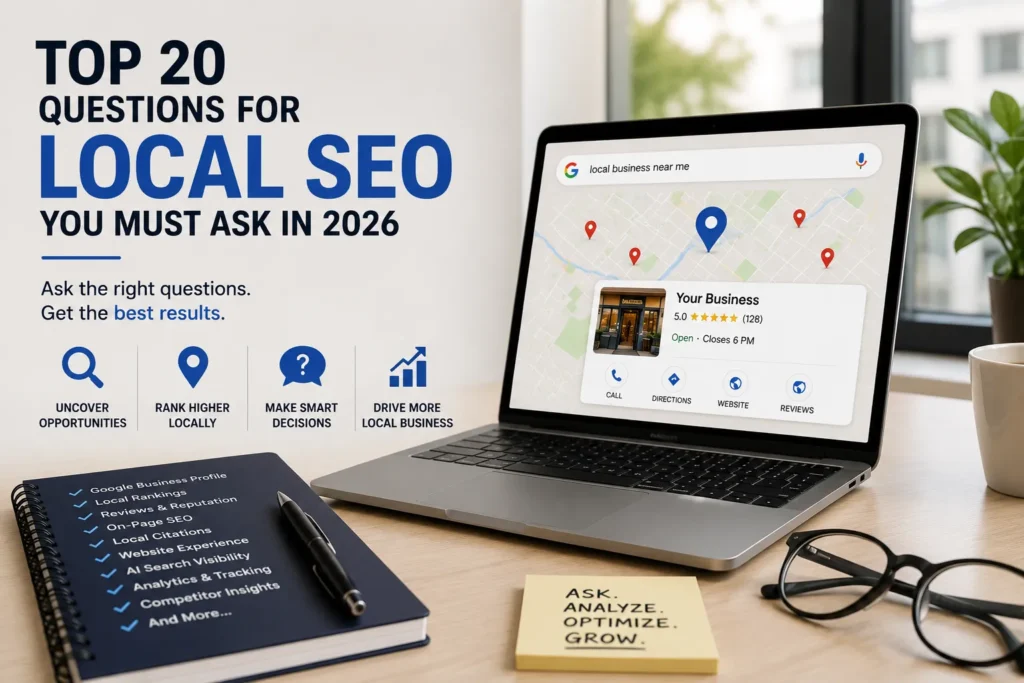
Local SEO is one of those disciplines that feels simple until you actually try to do it well. A business owner sits down to figure out why competitors are outranking them on Google Maps, and the questions start multiplying. Do you need a blog? How many reviews are enough? Is your Google Business Profile category right? Are you supposed to worry about ChatGPT now? Why is a nearby competitor with worse work still showing up first? Each answer opens two more questions, and it is easy to stall out before you have made a single meaningful change.
This guide cuts through that by answering the twenty questions that matter most, the ones every local business should ask before they spend another dollar on marketing. They are organized into eight categories: local SEO fundamentals; Google Business Profile; keywords and website; reviews, citations, and links; content and AI search; technical SEO and mobile; and finally, measurement and results. Read them in order for a full framework, or jump to the ones that reflect what you are stuck on right now. Either way, by the end you will have a real answer for each and a much clearer sense of what deserves your effort in 2026 and what does not.
Local SEO Fundamentals
Before touching any tool or profile, get the basics right.
1. What Is Local SEO and How Is It Different From Regular SEO?
Local SEO is the practice of optimizing your online presence so your business shows up when someone nearby searches for what you offer, especially on Google Maps, the Local 3-Pack, and location-based results like “chiropractor near me” or “coffee shop in Austin.” Regular SEO targets broader, geographically neutral searches and competes nationally or globally. Local SEO adds a location layer built on proximity, business information consistency, reviews, and citations, and it is the version that actually matters if your customers walk in, call, or book from a defined area. If this is still fuzzy, a clear explainer of what local SEO is covers the foundations in one place.
2. Why Does Local SEO Matter for Small Businesses in 2026?
Because the way people find local businesses has fundamentally shifted. A large majority of consumers now use Google to evaluate local businesses; most searches with local intent lead to a call, visit, or purchase within a day, and mobile drives the majority of it. That behavior compounds against you if you are invisible. A competitor with worse work and a stronger local presence will keep winning the customers you never even knew were looking. This is much of why local SEO is critical for small businesses trying to compete with larger or online rivals: the playing field is winnable, but only if you show up.
3. What Are the Main Local Ranking Factors Google Uses?
Google decides which local businesses to show using three broad factors. Relevance is how well your business matches the search, shaped by categories, services, and content. Distance is how close you are to the searcher; you cannot move it, but it favors well-optimized nearby businesses. Prominence is how established and trusted you appear, built from reviews, citations, links, and activity. For most local businesses in 2026, the levers that move you fastest are a complete Google Business Profile, a steady flow of recent reviews, consistent business details across the web, and pages that clearly match what customers search. A deeper look at local SEO ranking factors helps you decide where to spend your next hour of effort.
4. How Long Does Local SEO Take to Show Results?
Meaningful movement usually takes three to six months, and competitive markets can take longer. Google Business Profile improvements can deliver visibility gains within weeks, and simple wins like fixing NAP inconsistencies or adding fresh photos often produce a quick bump. The bigger changes, such as ranking for competitive service and city terms or climbing the map pack in a busy metro, need consistent work over months. Anyone promising number one rankings in thirty days is selling you something. Treat local SEO as a compounding asset rather than a quick campaign.
Google Business Profile Questions
Your profile is the single highest leverage asset in local search. These questions get the most out of it.
5. How Do I Optimize My Google Business Profile Properly?
Set the primary category to the most specific match for your work, then add accurate secondary categories. Fill every section, including services and products in the words customers search, hours (including any evening or weekend availability), a real local phone number, a natural business description, and complete attributes. Upload real, current photos and add short videos where you have them. Post updates a few times a month, respond to messages quickly, and answer questions in the Q and A section. Consistent NAP across every platform is non-negotiable. Full Google Business Profile optimization is ongoing work, not a one-time setup, because Google rewards active, well-maintained profiles over static ones.
6. How Do I Rank in the Google Local 3-Pack?
The three-business map block collects the majority of local clicks and calls, which is why it is the prize of local SEO. To earn a spot, you need strong relevance (right category, complete services, matching content on your site), prominence (steady recent reviews, consistent citations across the web, local links), and a healthy website tied to your profile. Proximity to the searcher is a natural advantage for a focused local business, so if you are set up correctly, a spot in the local pack is often more winnable than owners realize, especially against larger competitors in a metro who ignore local basics.
7. What Should I Do If My Google Business Profile Gets Suspended?
Do not panic or create a new profile, as that usually makes things worse. Read the notification for the stated reason, review Google’s guidelines to identify the likely trigger (keyword stuffing in the business name, address issues, category mismatch, duplicate listings, or policy violations), fix the underlying issue, then request reinstatement through the appeals process with clear evidence of legitimacy. A step-by-step walkthrough of how to fix a suspended business profile makes the process much less scary and covers the mistakes that keep businesses stuck in suspension limbo.
Local Keywords and Website Questions
Once the profile is solid, the site and its keywords come next.
8. How Do I Find the Right Local Keywords for My Business?
Start with what your business does and where you do it, then combine service and place: “residential electrician Austin,” “family dentist Brooklyn,” “commercial HVAC Denver.” Add condition, project type, and specialty variations that reflect real buyer language. Use a tool like Ahrefs, Semrush, or SE Ranking (some categories, especially healthcare, are limited in Google Keyword Planner) and check autocomplete to see what people actually type. Do not chase volume alone: 20 monthly searches from qualified nearby buyers will generate more revenue than 1,000 searches from people outside your service area. Proper local keyword research is what separates a site that pulls in customers from one that ranks for nothing.
9. What Should My Website Include for Strong Local SEO?
At minimum: dedicated pages for each main service, service and location pages if you cover multiple cities, a homepage that names what you do and where you do it, real photos of your work, credentials and trust signals, clear NAP details in the footer, a design built for mobile first, fast page load, and easy ways to contact you (tap to call, contact form, booking link, live chat where appropriate). Skip the generic “services” page listing everything at once, which rarely ranks. Strong on-page SEO for local pages turns individual pages into ranking assets that each capture their own qualified searches.
10. Do I Need Separate Pages for Each Location or Service?
Yes, if you want to rank for each. A single “services” page rarely wins competitive local terms, and one homepage cannot rank equally well for every city you serve. Give each service you want more of its own page, and give each meaningful city or neighborhood you serve its own genuine location page (with local content, not a copy-and-paste template). Avoid thin doorway pages that only swap the city name, as Google filters them. For businesses running multiple offices or storefronts, dedicated pages for each location are essential, and multi-location local SEO covers how to ensure each branch ranks in its own market rather than competing with itself.
Reviews and Reputation Questions
Reviews are the highest-leverage prominence signal and one of the most misunderstood.
11. How Do I Get More Google Reviews (the Right Way)?
Ask every satisfied customer at the moment they are happiest, not weeks later, and make it dead simple by sending a direct link. Build the request into your normal workflow, invoice, project close, or in-person handoff, so it happens consistently rather than during occasional bursts. Train your team to ask. Never buy reviews, use fake accounts, or offer discounts in exchange for a review, which violates Google’s policies and can get your profile suspended. A steady, honest system for asking customers for a Google review beats occasional campaigns every time and keeps recency, which matters as much to Google as volume.
12. How Do Reviews Actually Affect Local Rankings?
They affect them heavily. Volume matters, but recency, star rating, review content (customers who mention the service or city in their review reinforce those keywords), and how you respond all count. A steady flow of recent reviews outranks a stale block from three years ago. Negative reviews are not the end of the world if you respond promptly, professionally, and never share private customer details. In many categories, businesses with fewer than twenty or thirty reviews are consistently outranked by those with more, regardless of who does better work. The way reviews influence local rankings makes a real review system one of the strongest levers you actually control.
Citations and Links Questions
Consistent business information and relevant links are the quiet foundation under everything else.
13. What Are Local Citations and How Many Do I Need?
Citations are mentions of your business’s name, address, and phone number on third-party websites, most often directories like Yelp, Apple Maps, Bing Places, and industry-specific listings. They build trust with Google by confirming your business exists at the details you claim. There is no magic number, but quality and consistency beat volume. Start with the major directories and the ones specific to your industry, and be relentless about matching your business details across all of them. A guide to what local citations are and how they work covers which platforms matter most and how to prioritize them.
14. How Do I Build Local Backlinks Without Sounding Desperate?
Real relationships beat outreach templates every time. Sponsor a local sports team, get involved in the chamber of commerce, partner with complementary local businesses for referrals or joint events, contribute expert commentary to local news, and put yourself in front of local publications and industry directories relevant to your trade. Trade-specific sources (Houzz, Archinect, Healthgrades, industry associations) serve as both citations and authority signals. The best sources for local links and community mentions are almost always genuine involvement in your area, not a link-building campaign designed in a spreadsheet. Chase relevance over volume: a handful of quality local links outperforms dozens of random ones.
15. How Important Is NAP Consistency, and What Happens If It Is Wrong?
Very important. Google uses your name, address, and phone number to verify that your business is real, and inconsistencies (two phone numbers, an old address in one directory, a slightly different name in another) erode the trust your ranking depends on. Fixing inconsistencies is usually a quick win: audit your listings, correct any instances where your NAP does not exactly match your website and Google Business Profile, and establish a process to keep them consistent as details change. If two directories list different phone numbers, that alone can cost you rankings, and it is one of the easiest things to fix once you know to look for it.
Content and AI Search Questions
Content still matters, and in 2026 it does double duty by feeding AI answers.
16. Do I Really Need a Blog for Local SEO?
If your budget or time is limited, no. Focus first on the fundamentals: Google Business Profile, service and location pages, reviews, citations, and technical basics. A blog becomes valuable when you are in a competitive market, when your business has clear expertise worth publishing, or when you want to capture research intent searches (cost questions, comparison articles, “how to” content) that turn into customers later. When you do publish, write for the questions real customers ask, not thin posts stuffed with keywords. And follow experience and trust signals closely, since Google increasingly weighs who is behind content, especially in health, legal, and financial categories.
17. Should I Optimize My Business for ChatGPT, Perplexity, and AI Overviews?
Yes, but the good news is that most of the work that ranks you on Google also positions you in AI answers. When someone asks ChatGPT for a good plumber in their city or reads Google’s AI overview at the top of a search, the businesses named are the ones with clear structure, consistent information across the web, real credentials, and content that answers questions directly. Treating visibility in AI-generated answers as an extension of your local SEO strategy pays off across both channels. Write answers directly, keep your business details identical everywhere, publish under real people with credentials, and mark up your content with schema so machines can read it accurately. The techniques of generative engine optimization are steadily becoming as important as classic SEO for local businesses.
18. What Kind of Local Content Actually Works?
Content that answers real questions customers are already asking about your service, your city, or their problem. Cost guides, process explanations, comparison articles, service-specific FAQs, location-specific advice, and educational pieces about the work you do all convert better than generic industry posts. Write like a trusted local expert, not a generic industry blog: mention your city, your neighborhoods, local considerations (climate, permits, regulations where they apply), and real project examples. Content grouped into topic clusters around your core services signals real depth to Google and gives you internal linking opportunities that lift the whole cluster.
Technical SEO and Mobile Questions
The foundation everything else stands on.
19. Does My Website Need to Be Mobile Friendly and Fast?
Absolutely, and not just as a nice-to-have. Well over half of local searches happen on phones, and Google prioritizes mobile experience in rankings. A slow site sends a ready customer straight back to the results to pick someone else. Compress your images, use a design built for mobile first, keep page load times under a few seconds on mid-range phones, make phone numbers tap-to-call, and simplify forms. This is where mobile optimization for local SEO shifts from a technical concern to a direct revenue impact: a two-second delay measurably hurts conversion rates. Schema markup, using local business schema tailored to your business type, is worth the small effort because it helps Google and AI systems read your details correctly and can earn you rich snippets that boost click-through rates.
Measurement and Results Questions
You cannot improve what you cannot measure. The final question closes the loop.
20. How Do I Track Whether My Local SEO Is Actually Working?
Track the numbers tied to real business, not vanity metrics. Calls, form submissions, booking requests, direction requests, and new customers who mention they found you online matter more than raw ranking positions. Pair your Google Business Profile insights (calls, direction requests, profile views, and where customers found you) with website data. Use call tracking that does not compromise NAP consistency, set up conversion tracking in Google Analytics 4, and monitor Search Console for the queries that are actually driving impressions and clicks. Understanding what Search Console shows versus Analytics clarifies which tool answers which question. Review monthly, not daily, because local SEO moves in months, and look at trends across weeks and quarters rather than single-day fluctuations. If a page draws traffic but no conversions, that is your next fix.
Final Thoughts
You do not need to answer all twenty questions perfectly to see results. Most businesses can move up meaningfully by getting the fundamentals right: a complete Google Business Profile, steady reviews, consistent business information, service and location pages, and a fast mobile site, and adding the more advanced pieces (content, AI search, schema, deeper technical work) over time.
The businesses that win in 2026 are not the ones with the biggest budgets. They are the ones that ask the right questions honestly, fix what is actually broken, and stay consistent while competitors chase the next tactic. Start with question one, work through the list, and the ranking, calls, and customers usually follow within a few months. Local SEO rewards the boring, disciplined work far more than it rewards clever hacks, and that is exactly why it is one of the best investments a local business can make.